Photographs taken by Mark Jefferson, the former EMU Chair of Geography between 1900 and 1935.
Date Span
1900s-1930s
Object Type
Glass plate negatives
Publisher
Eastern Michigan University Archives
Subject
landscapes, nature photography, travel, portraits, 1900s-1930s, Michigan, New York, West Virginia, California, Eastern Michigan University, campus buildings, National Parks, architecture
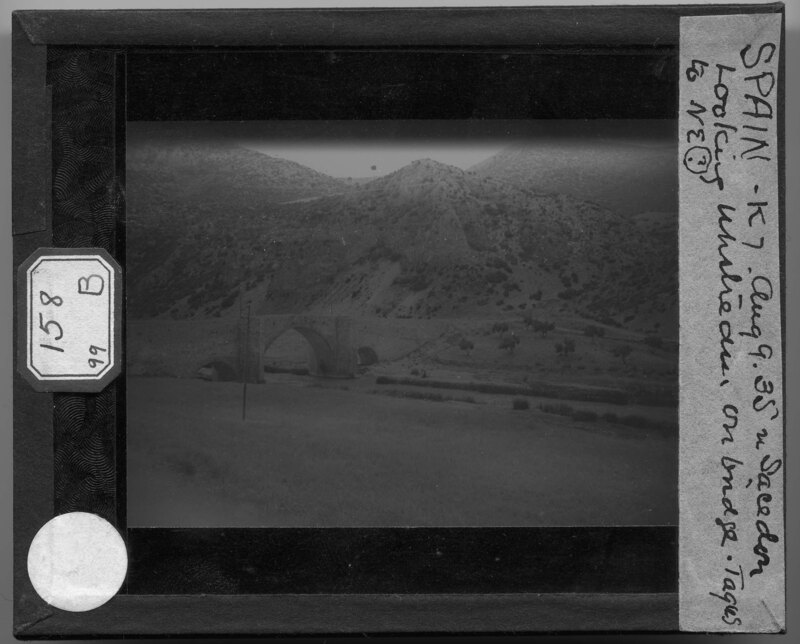
Mountainscape with the Tagus River and stone bridge in the foreground. Slide labeled with text, "Made by G.R. Swain, 713 E. University Ave., Ann Arbor, Michigan." Swain was staff photographer at U of M from 1913 to 1947.
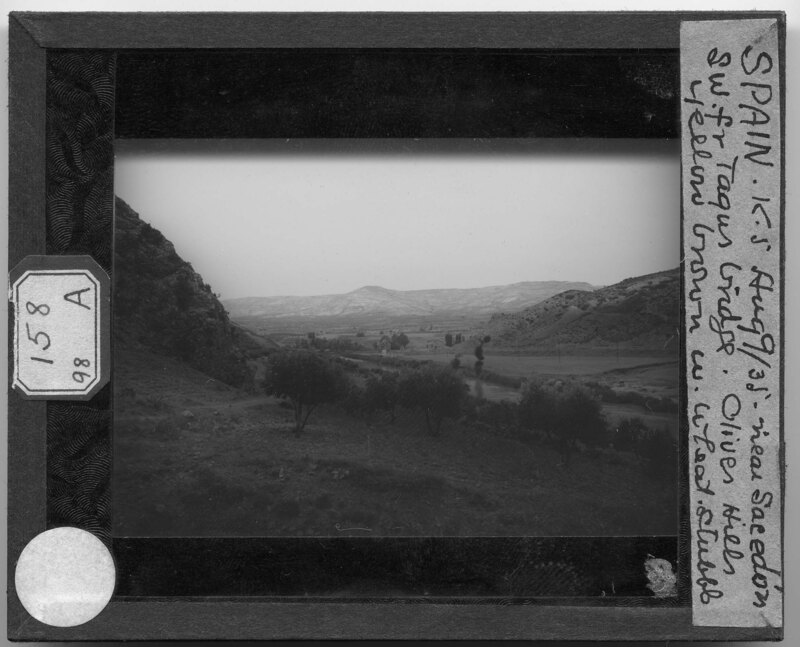
Mountainscape image with river valley. Olive trees can be seen in the foreground and houses can be seen across the river along with a wheat field that has been cut and harvested. Slide labeled with text, "Made by G.R. Swain, 713 E. University Ave., Ann Arbor, Michigan." Swain was staff photographer at U of M from 1913 to 1947.
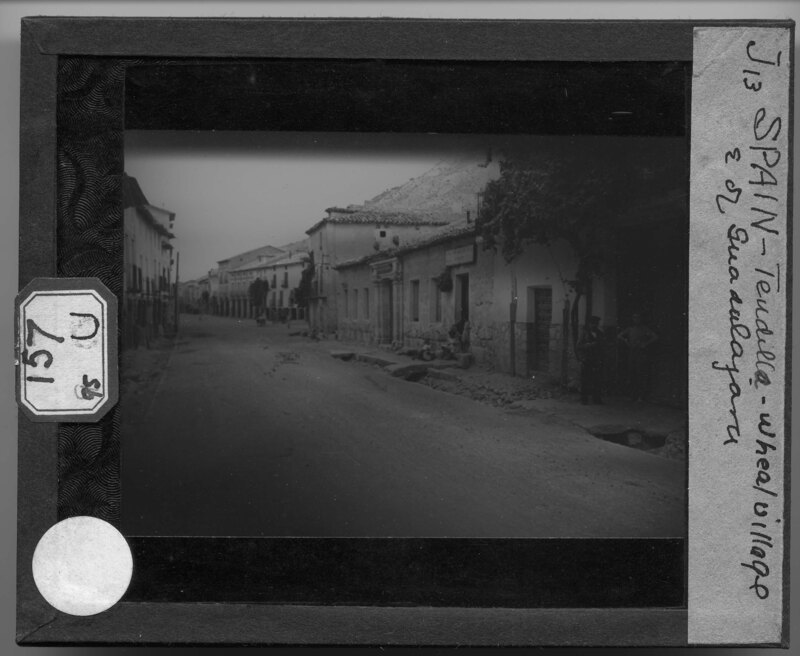
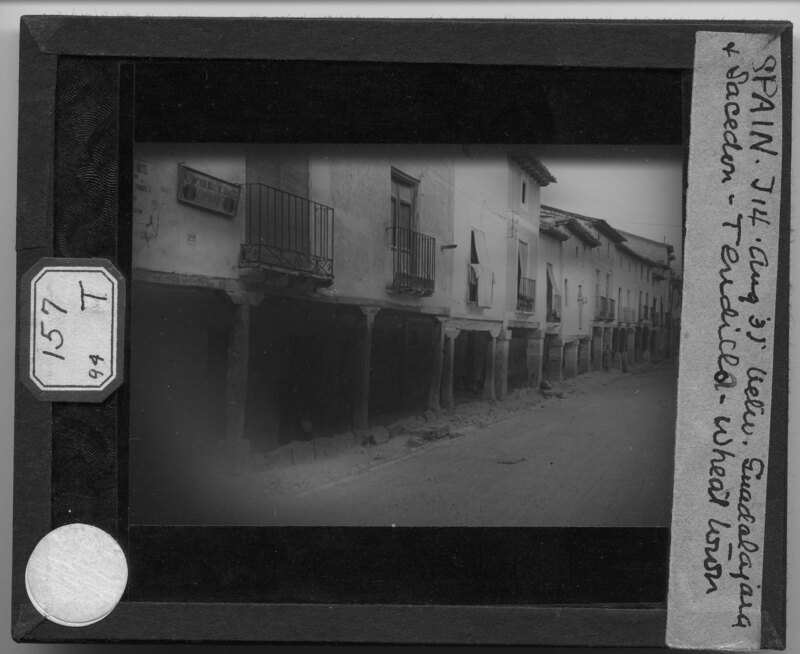
The wheat village of Tendilla, Spain. Streetscape of Spanish rowhouses. To men can be standing in the doorway of one of the houses. A mountain rises in the background behind the houses. The sidewalk outside of some of the homes is collapsed. Slide labeled with text, "Made by G.R. Swain, 713 E. University Ave., Ann Arbor, Michigan." Swain was staff photographer at U of M from 1913 to 1947.
Streetscape of Spanish row houses. A woman can be seen walking under the awnings of the houses carrying a pot. It is noted that this is a wheat town. Slide labeled with text, "Made by G.R. Swain, 713 E. University Ave., Ann Arbor, Michigan." Swain was staff photographer at U of M from 1913 to 1947.
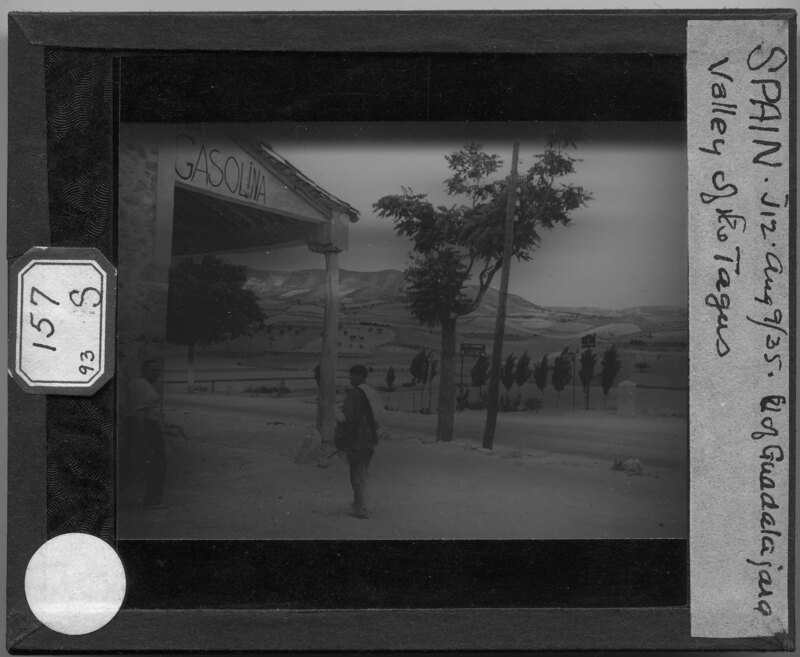
Valley of Tagus in the background. Two men can be seen outside of a stone building. A dirt road can be seen outside of the building. Slide labeled with text, "Made by G.R. Swain, 713 E. University Ave., Ann Arbor, Michigan." Swain was staff photographer at U of M from 1913 to 1947.
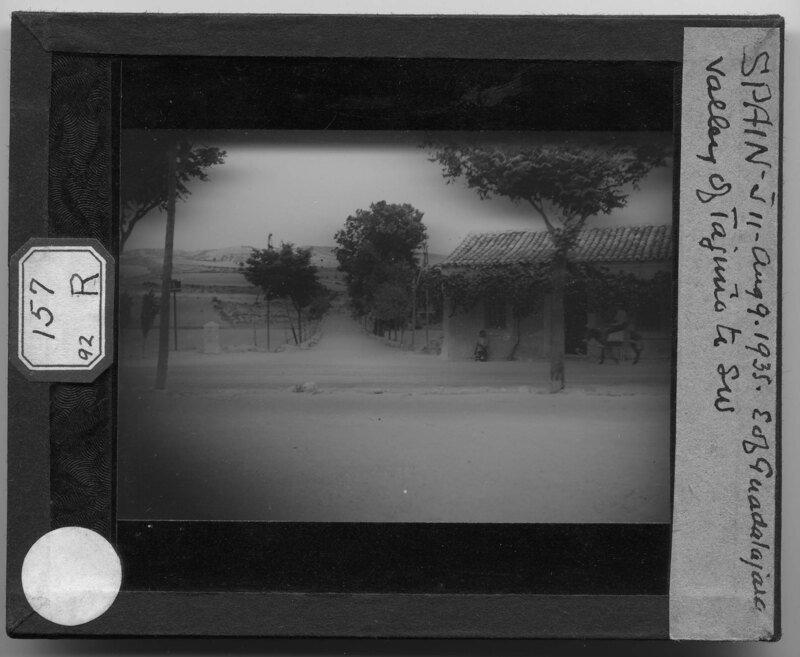
A man sits outside of an adobe house covered in vines. Another man rides a donkey past the house. A dirt road lined with trees goes off into the distance and the Valley of Tajuno can be seen in the background. Slide labeled with text, "Made by G.R. Swain, 713 E. University Ave., Ann Arbor, Michigan." Swain was staff photographer at U of M from 1913 to 1947.
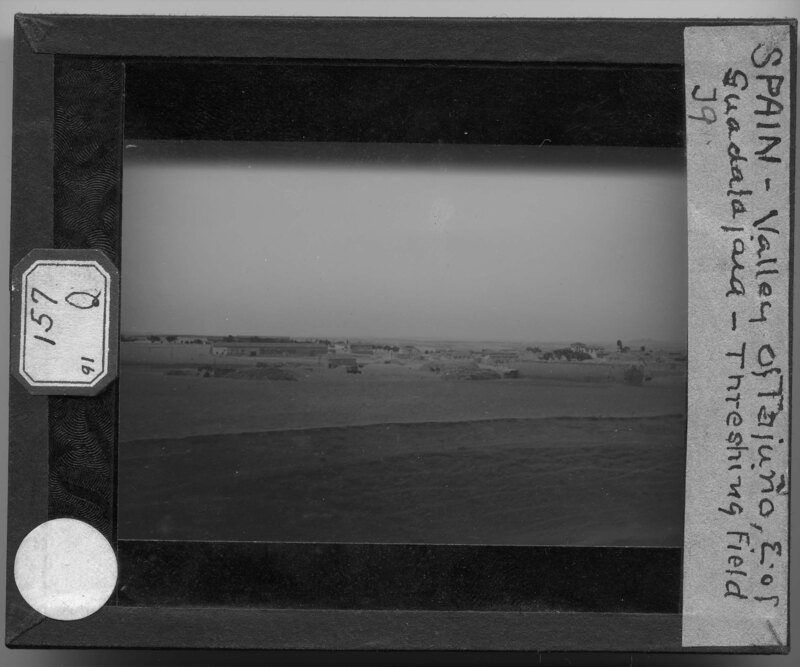
Landscape of the Valley of Tajuno. A threshing field can be seen beyond the cultivated field in the foreground and houses dot the landscape. Slide labeled with text, "Made by G.R. Swain, 713 E. University Ave., Ann Arbor, Michigan." Swain was staff photographer at U of M from 1913 to 1947.
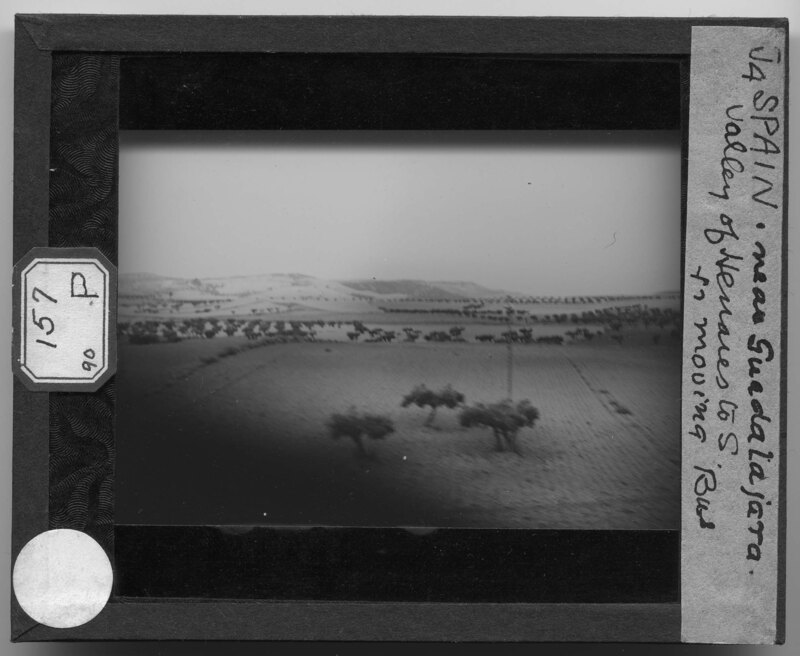
Landscape of the Valley of Henares from a moving bus. Cultivated fields can be seen extending to the mountain range in the background and trees are dispersed amongst the rows of plants. Slide labeled with text, "Made by G.R. Swain, 713 E. University Ave., Ann Arbor, Michigan." Swain was staff photographer at U of M from 1913 to 1947.
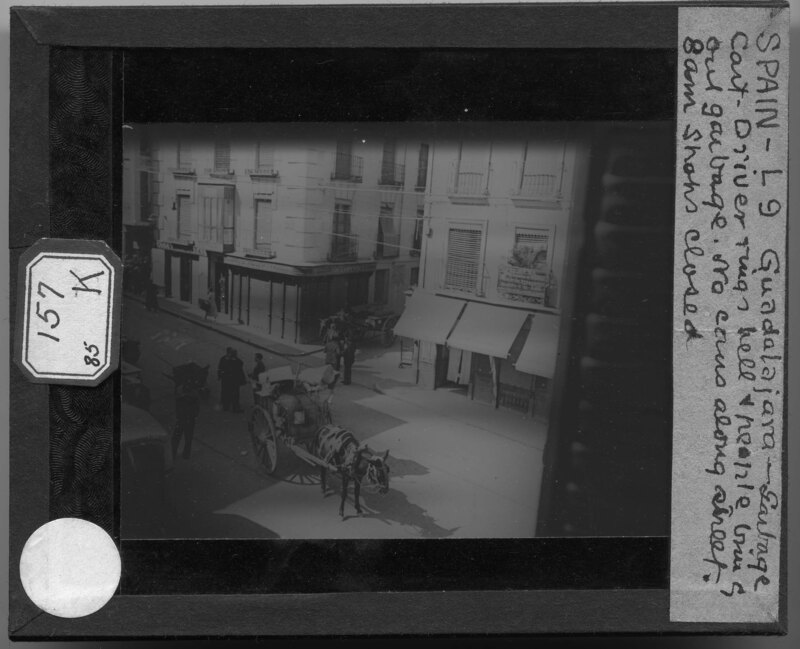
Street Scene with a donkey and a cart that is used for collecting garbage. A driver rings a bell and people bring out their garbage to be taken away on the cart. People can be seen walking along the sidewalks. Slide labeled with text, "Made by G.R. Swain, 713 E. University Ave., Ann Arbor, Michigan." Swain was staff photographer at U of M from 1913 to 1947.
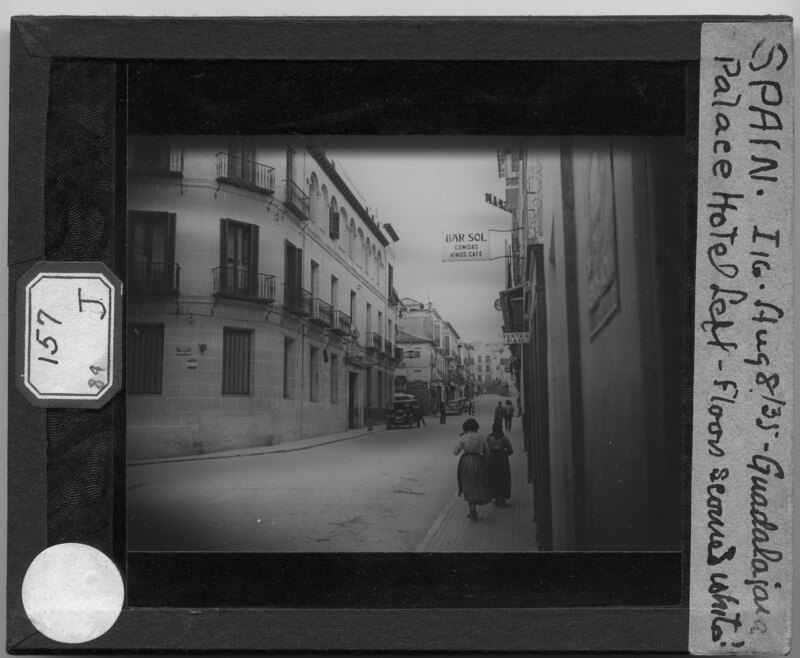
Streetscape in Guadalajara. Women can be seen walking along the sidewalk and a car is parked on the opposite side of the street outside of the Palace Hotel. The building is Classically inspired. It is noted the the floors of the Palace Hotel are scoured white. Slide labeled with text, "Made by G.R. Swain, 713 E. University Ave., Ann Arbor, Michigan." Swain was staff photographer at U of M from 1913 to 1947.
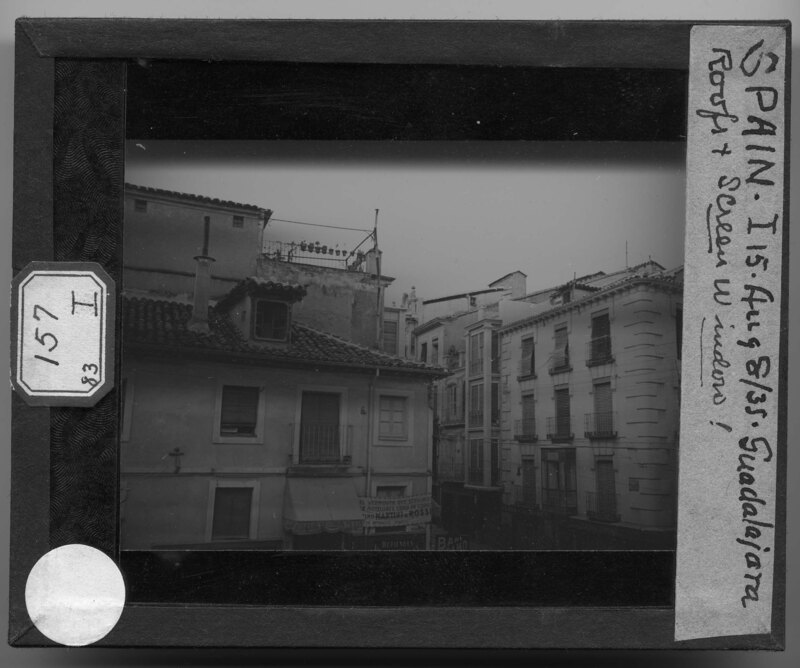
Rooftops and screened windows on 4 story buildings. The roofs are made of clay tile roofing and the windows are covered with wooden screens. A rooftop garden can be seen on the tallest building. Slide labeled with text, "Made by G.R. Swain, 713 E. University Ave., Ann Arbor, Michigan." Swain was staff photographer at U of M from 1913 to 1947.
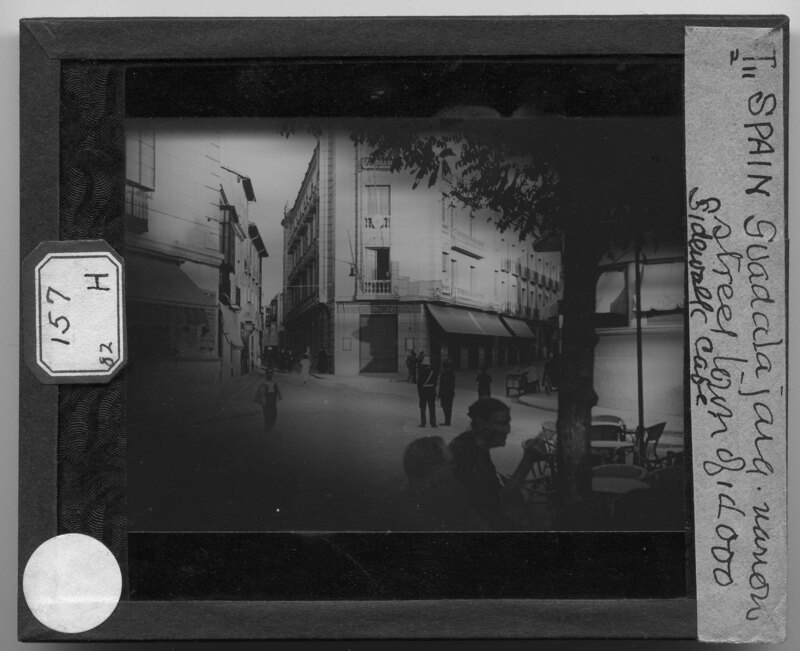
Streetscape where pedestrians are walking on the sidewalks and in the street. Men can be seen sitting around a table under a tree in the foreground. Two narrow streets diverge and create a V'd corner within the street. Slide labeled with text, "Made by G.R. Swain, 713 E. University Ave., Ann Arbor, Michigan." Swain was staff photographer at U of M from 1913 to 1947.
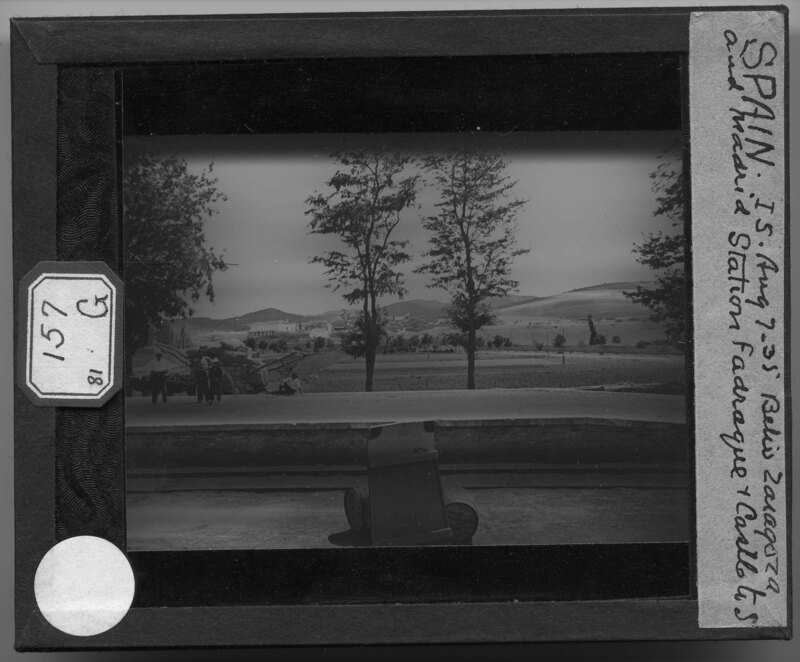
Taken from the vantage point of a train car. Three men and a boy can be seen next to a wagon piled with bundles and wares. Cultivated fields can be seen behind them and in the background houses dot the mountainscape. It is noted that the Fadrawue and Castle can be seen in the background. Slide labeled with text, "Made by G.R. Swain, 713 E. University Ave., Ann Arbor, Michigan." Swain was staff photographer at U of M from 1913 to 1947.
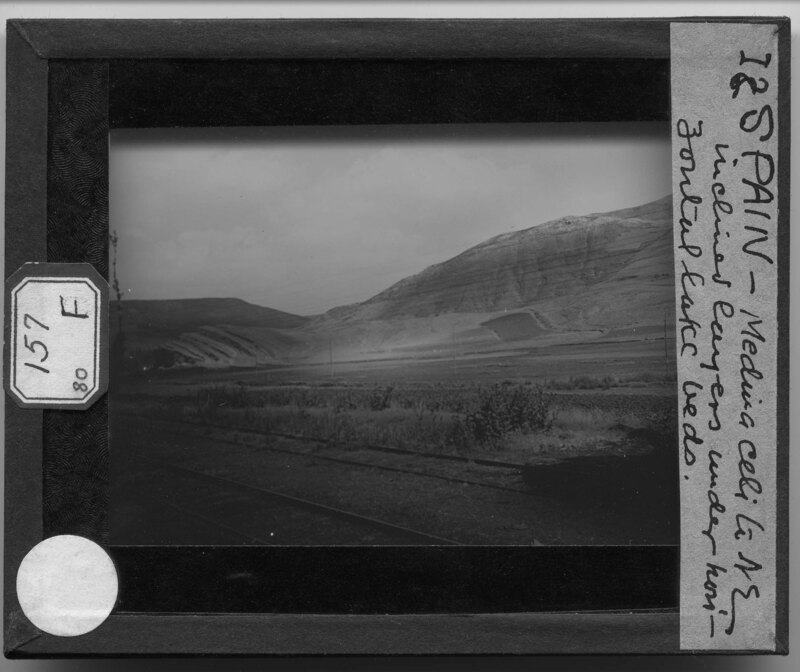
Meduia Celi to NE. Taken from the vantage point of a train car. Mountainscape with visible layers of rock and sediment. It is noted that there are layers under the lake bed. Slide labeled with text, "Made by G.R. Swain, 713 E. University Ave., Ann Arbor, Michigan." Swain was staff photographer at U of M from 1913 to 1947.
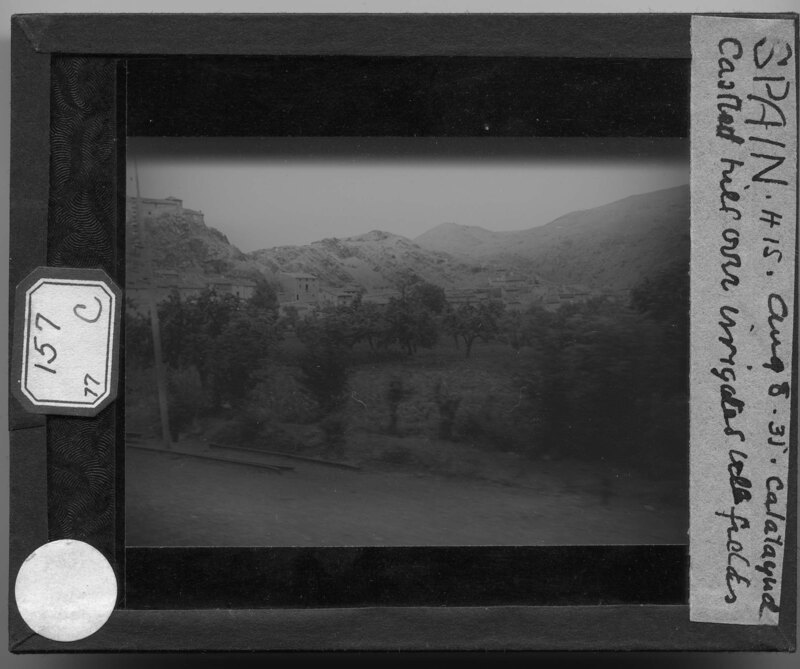
Taken from a moving train. A mountainscape with irrigated fields in the foreground and houses sitting on the side of a hill. Trees grow in between the cultivated rows. Slide labeled with text, "Made by G.R. Swain, 713 E. University Ave., Ann Arbor, Michigan." Swain was staff photographer at U of M from 1913 to 1947.
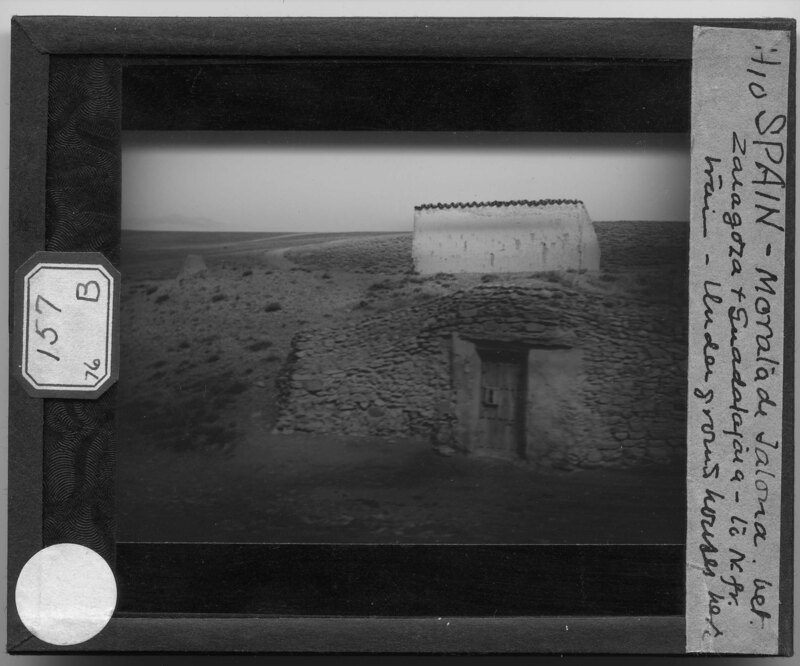
Morta de Talona. An underground house with a stone wall and entrance is built into the side of a hill. A stone building can be seen sitting on top of the hill. A road leads away from the house. Slide labeled with text, "Made by G.R. Swain, 713 E. University Ave., Ann Arbor, Michigan." Swain was staff photographer at U of M from 1913 to 1947.
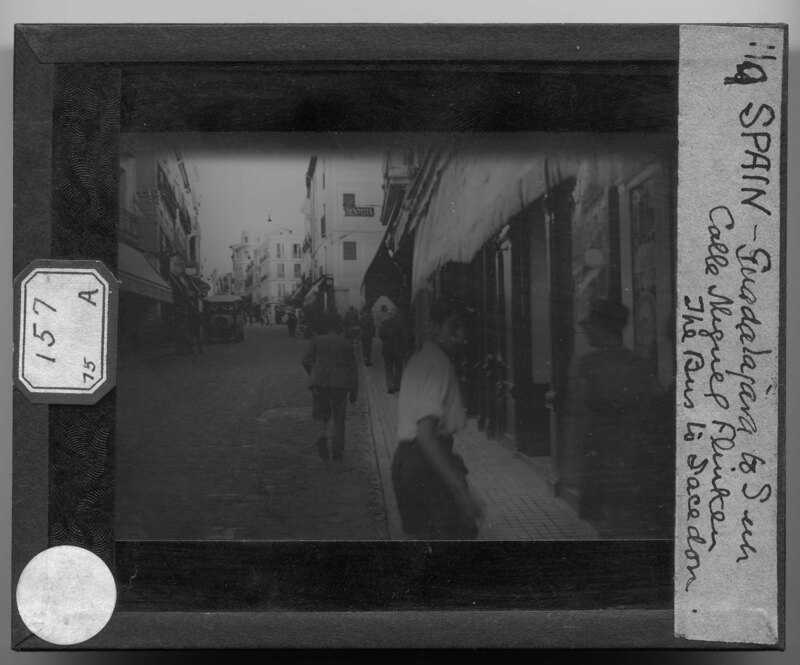
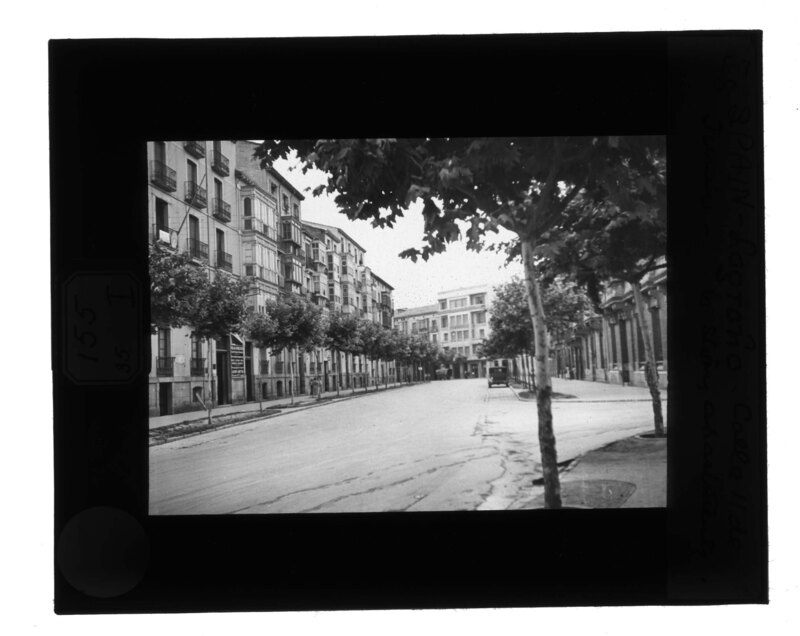
Streetscape of Calle Miguel Flinken in Guadalajara. Pedestrians can be seen walking on the sidewalks and in the street. A truck is parked along the sidewalk further down the street. Classical inspired architecture can be seen lining the street. Slide labeled with text, "Made by G.R. Swain, 713 E. University Ave., Ann Arbor, Michigan." Swain was staff photographer at U of M from 1913 to 1947.
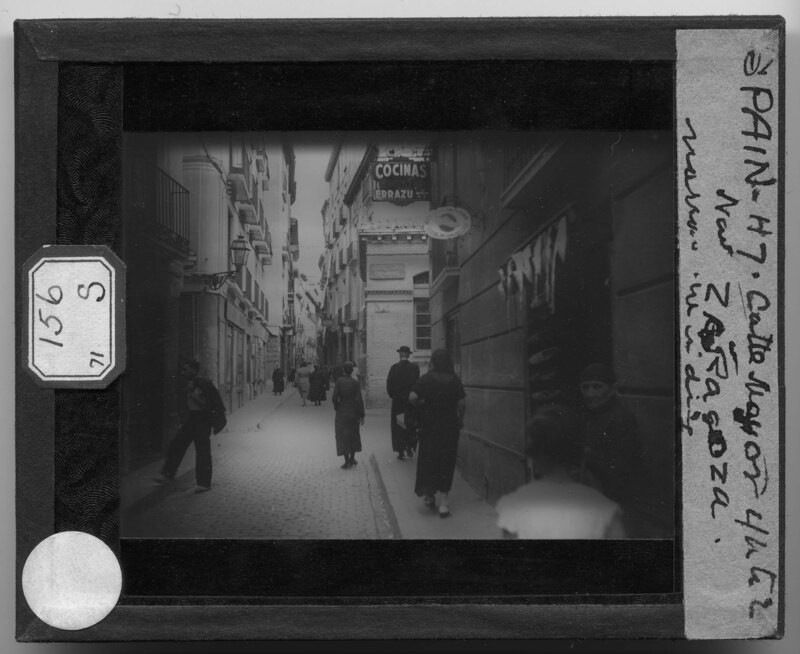
Streetscape of Calle Major in Zaragoza. Pedestrians can be seen walking on the sidewalks and in the streets as they pass shops. A woman selling shoes can be seen in the foreground. The street is narrow and winding. Slide labeled with text, "Made by G.R. Swain, 713 E. University Ave., Ann Arbor, Michigan." Swain was staff photographer at U of M from 1913 to 1947.
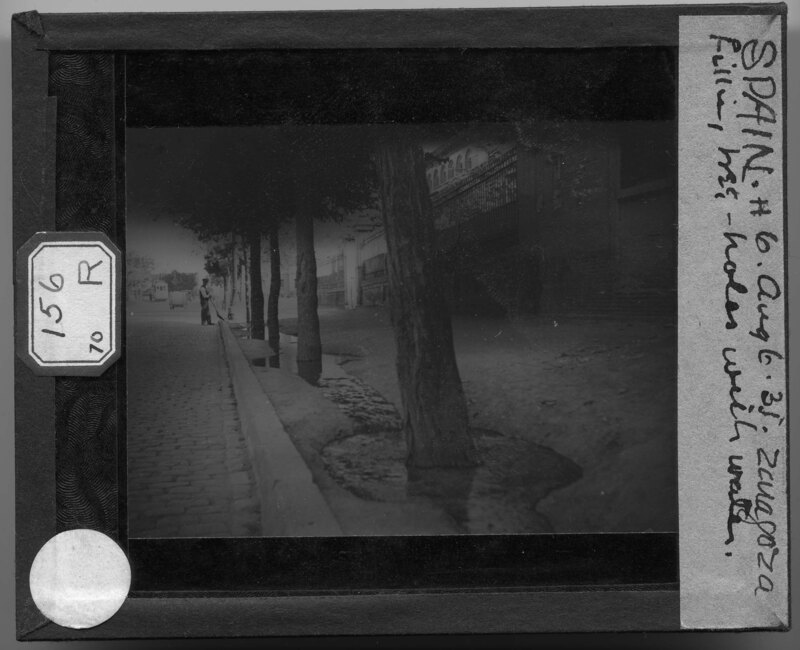
A man is filling holes around the bases of the trees with water, presumably irrigating them. A stone and iron fence wall runs along the sidewalk and blocks off houses front the street. Slide labeled with text, "Made by G.R. Swain, 713 E. University Ave., Ann Arbor, Michigan." Swain was staff photographer at U of M from 1913 to 1947.
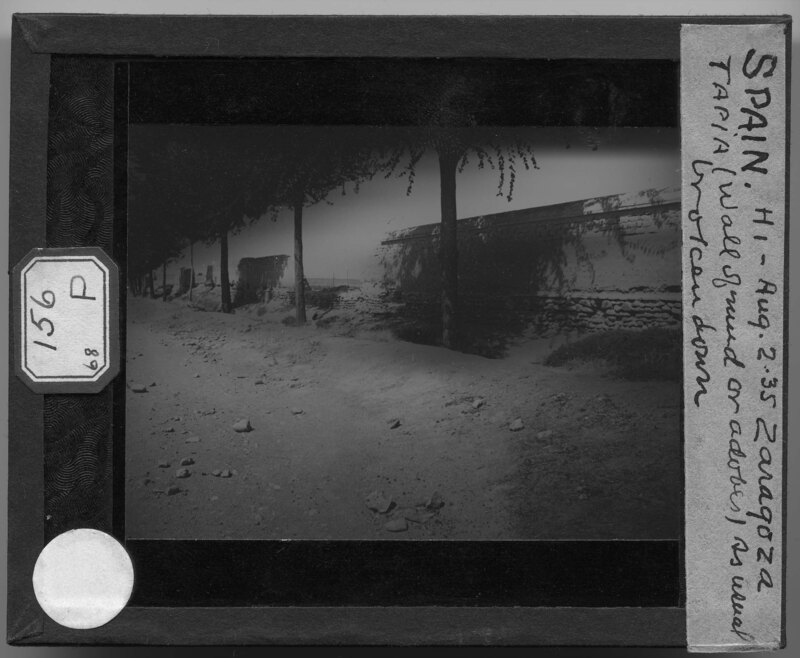
A tapia, or a mud or adobe wall. It is broken down in several places and it is noted that this is a typical occurrence.The road running alongside the wall appears to be built up with dirt on the side and trees grow in the ditch next to the road. Slide labeled with text, "Made by G.R. Swain, 713 E. University Ave., Ann Arbor, Michigan." Swain was staff photographer at U of M from 1913 to 1947.
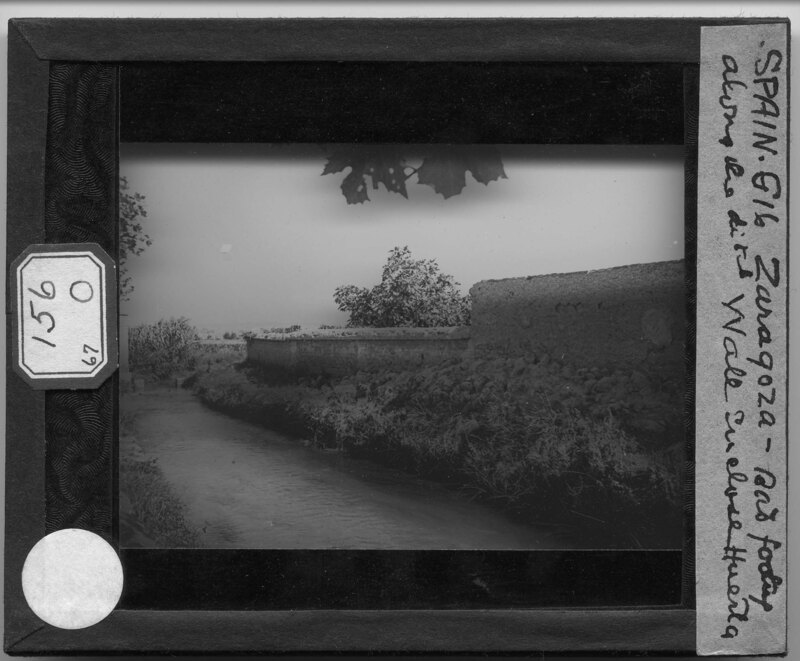
Canal or ditch that is running alongside a stone wall that is surrounding a Huerta. It is noted that the ground along the canal is uneven and has bad footing. Slide labeled with text, "Made by G.R. Swain, 713 E. University Ave., Ann Arbor, Michigan." Swain was staff photographer at U of M from 1913 to 1947.
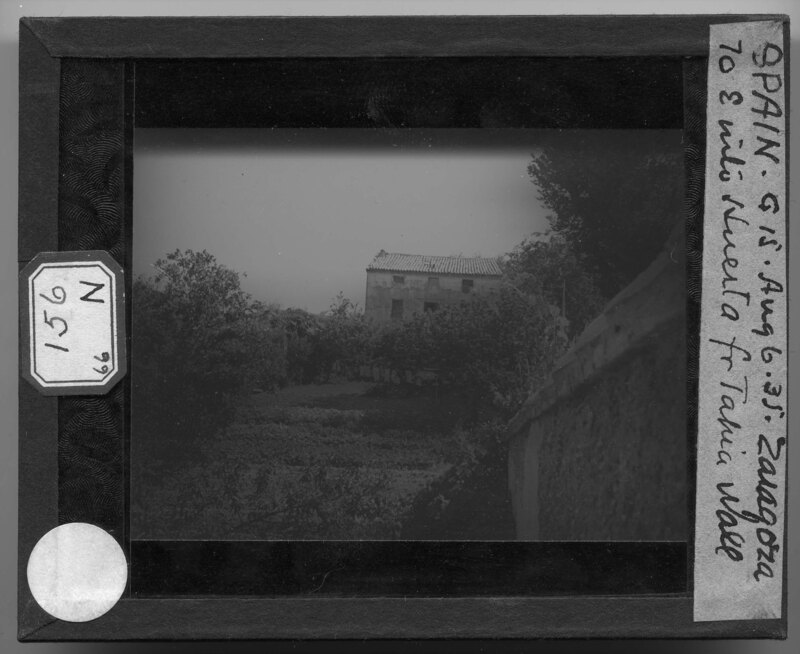
View of a house with tile roofing. A clothesline can be seen in the grove of trees outside of the house. A small field can be seen in the foreground with trees growing in between the plowed rows. It is noted the the wall in the right of the picture is the Tapia Wall. Slide labeled with text, "Made by G.R. Swain, 713 E. University Ave., Ann Arbor, Michigan." Swain was staff photographer at U of M from 1913 to 1947.
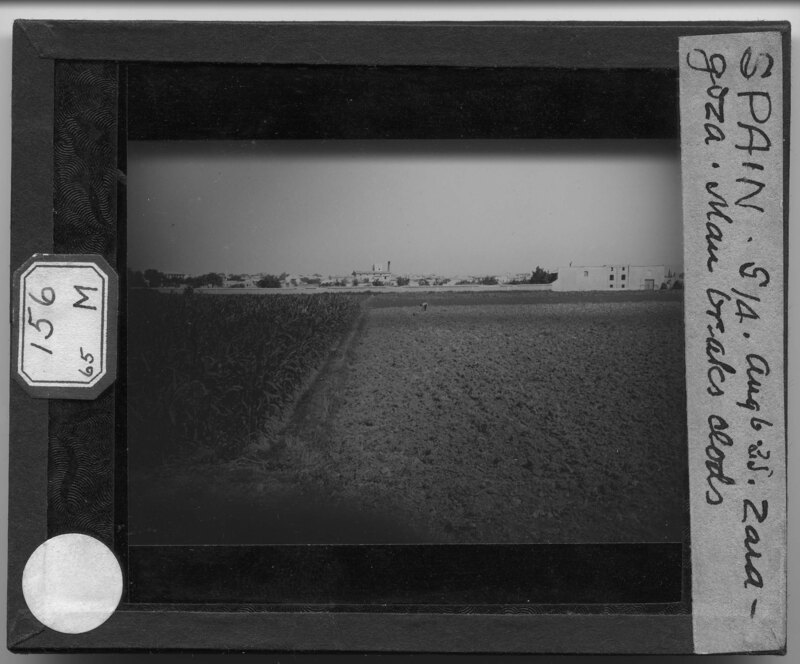
A field of corn can be seen to the left and a tilled field to the right. A man is breaking clods of dirt halfway down the field. An Italianate style building can be seen behind the field. Slide labeled with text, "Made by G.R. Swain, 713 E. University Ave., Ann Arbor, Michigan." Swain was staff photographer at U of M from 1913 to 1947.
Image of a boy in Zaragoza, Spain. It is noted that the picture was taken outside the huerta, opposite of the gate. Row houses can be seen behind the boy and a metal fence closes off the entrances from the sidewalk. Slide labeled with text, "Made by G.R. Swain, 713 E. University Ave., Ann Arbor, Michigan." Swain was staff photographer at U of M from 1913 to 1947.
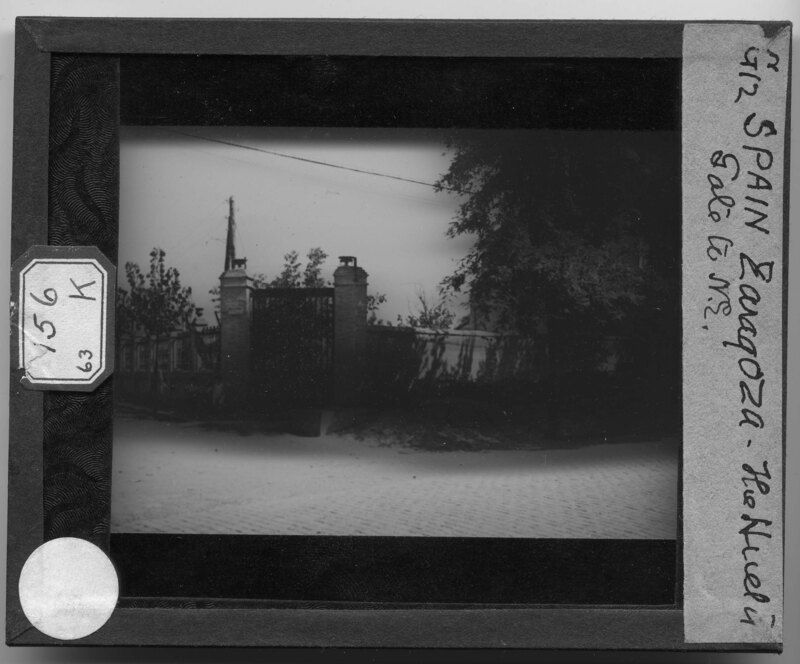
Gate and wall the encloses a huerta in Zaragoza, Spain. Three boys are standing on the sidewalk outside of the huerta and trees line the sidewalk. Slide labeled with text, "Made by G.R. Swain, 713 E. University Ave., Ann Arbor, Michigan." Swain was staff photographer at U of M from 1913 to 1947.
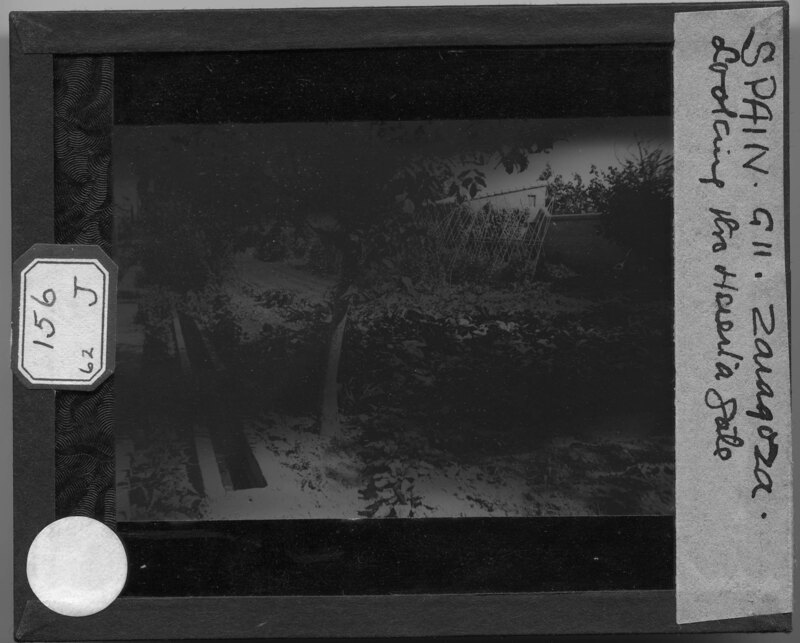
A huerta in Zaragoza, Spain. Irrigation trenches run along the rows of plants and trees are growing in between the rows. Slide labeled with text, "Made by G.R. Swain, 713 E. University Ave., Ann Arbor, Michigan." Swain was staff photographer at U of M from 1913 to 1947.
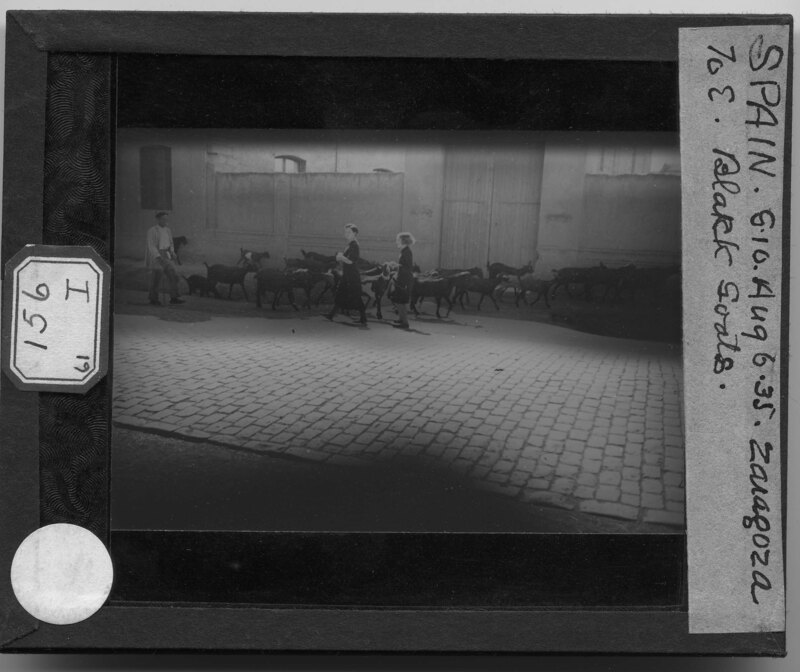
A farmer leads his goats through town and they are walking on the sidewalk and in the street as two women walk past the herd. Slide labeled with text, "Made by G.R. Swain, 713 E. University Ave., Ann Arbor, Michigan." Swain was staff photographer at U of M from 1913 to 1947.
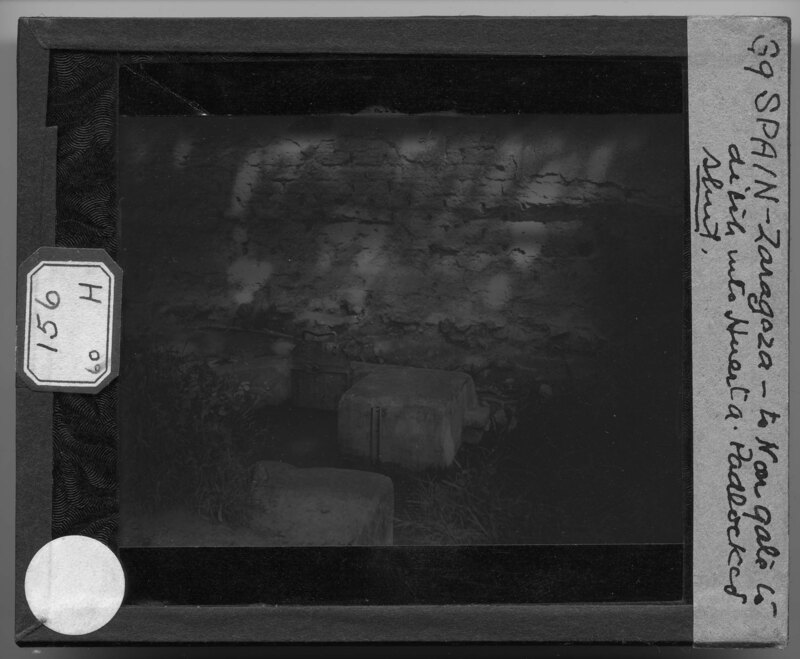
A gate blocking water from entering a Huerta behind the stone wall. The gate acts as a dam until the water is needed to irrigation. Slide labeled with text, "Made by G.R. Swain, 713 E. University Ave., Ann Arbor, Michigan." Swain was staff photographer at U of M from 1913 to 1947.
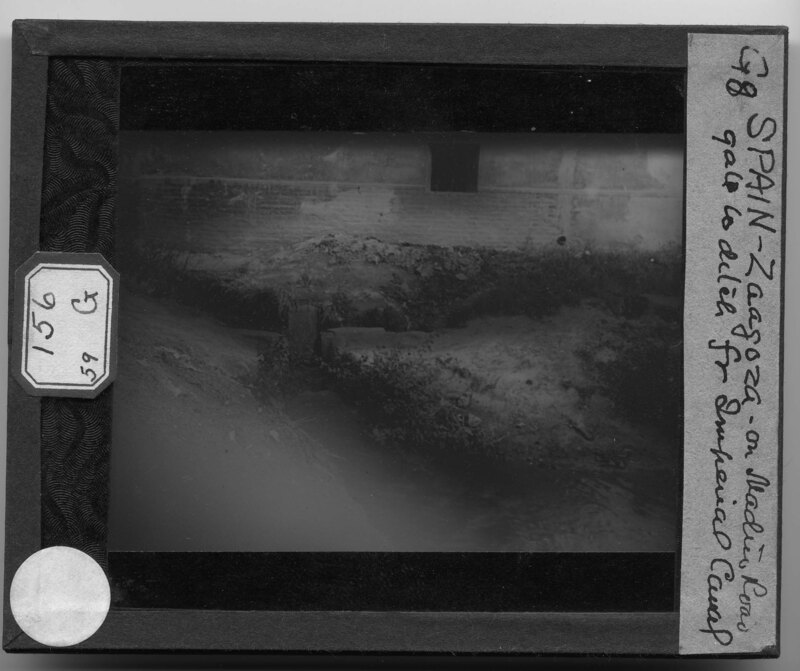
A gate is lifted to allow water to flow from one ditch to another for irrigation. The gate acts as a dam until the water is needed. It is noted that the gate is for the imperial canal. Slide labeled with text, "Made by G.R. Swain, 713 E. University Ave., Ann Arbor, Michigan." Swain was staff photographer at U of M from 1913 to 1947.
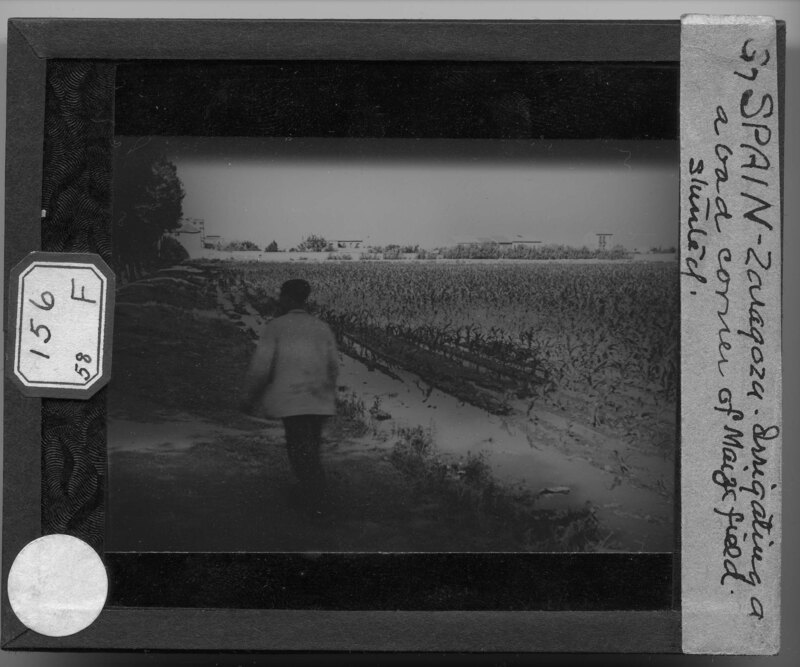
A man walks beside a corn (maize) field. The corner of the field is a low spot and the corn is stunted due to flooding. It is noted that the image depicts irrigation. Slide labeled with text, "Made by G.R. Swain, 713 E. University Ave., Ann Arbor, Michigan." Swain was staff photographer at U of M from 1913 to 1947.
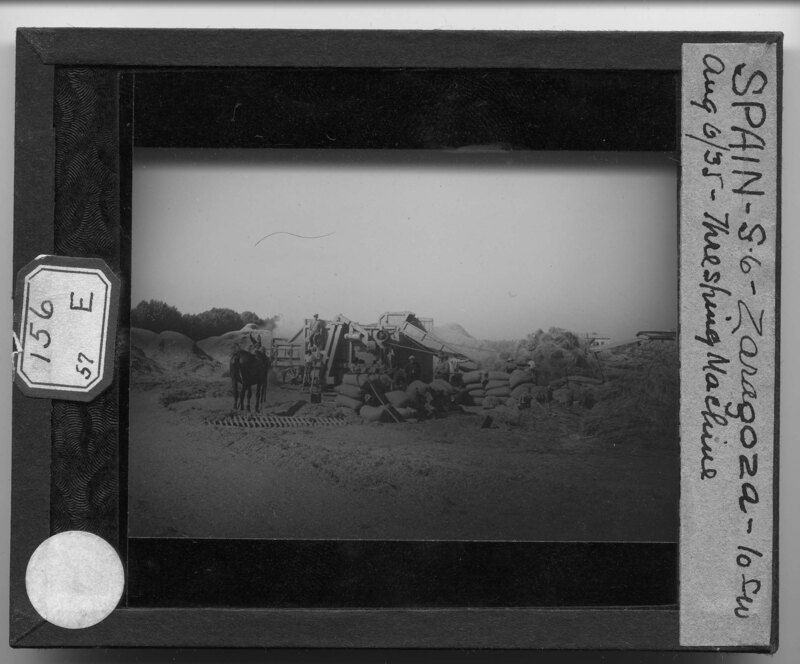
Threshing machine used to harvest wheat. Men can be seen sitting on and standing next to the machine. A raking pallet is attached to the donkey. Slide labeled with text, "Made by G.R. Swain, 713 E. University Ave., Ann Arbor, Michigan." Swain was staff photographer at U of M from 1913 to 1947.
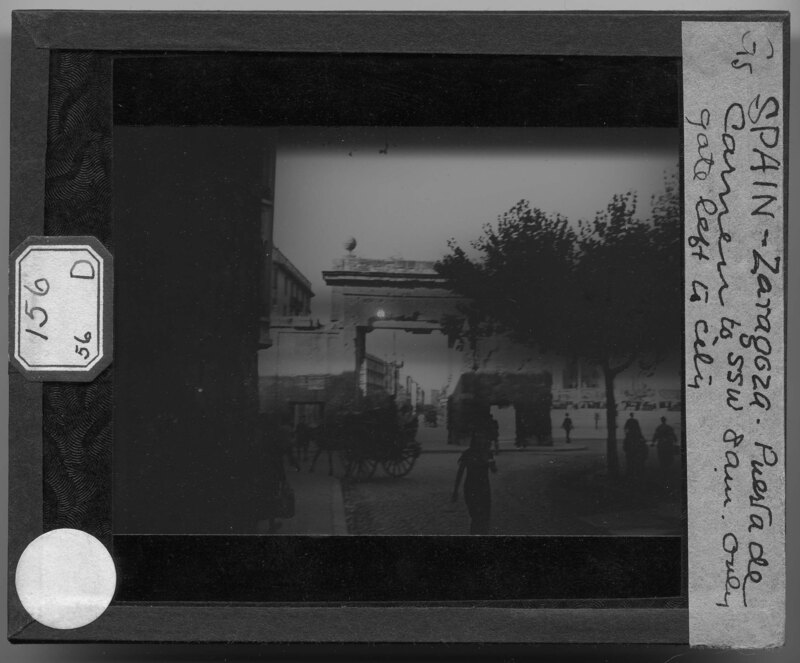
Image of a stone archway that is noted to be the only gate left into the city. The Puerta de Carmen can be seen behind the arch. Pedestrians can be seen walking on the sidewalk and in the street. A horse and buggy can be seen on the street. Slide labeled with text, "Made by G.R. Swain, 713 E. University Ave., Ann Arbor, Michigan." Swain was staff photographer at U of M from 1913 to 1947.
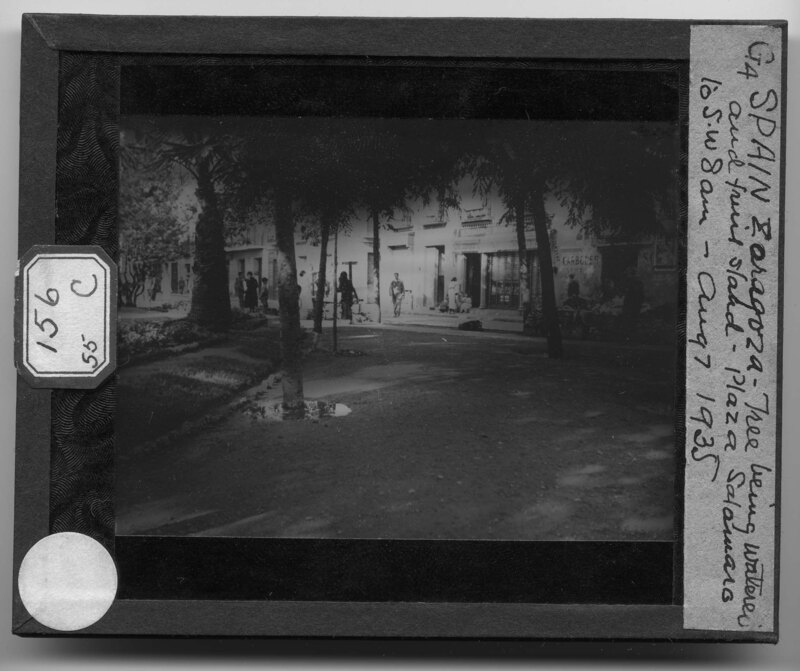
Streetscape with pedestrians walking past shops and stands. A fruit stand can be seen sitting on the sidewalk and a woman is buying produce. To the left a grassy park area can be seen and it is noted that the palm trees are being watered. Slide labeled with text, "Made by G.R. Swain, 713 E. University Ave., Ann Arbor, Michigan." Swain was staff photographer at U of M from 1913 to 1947.
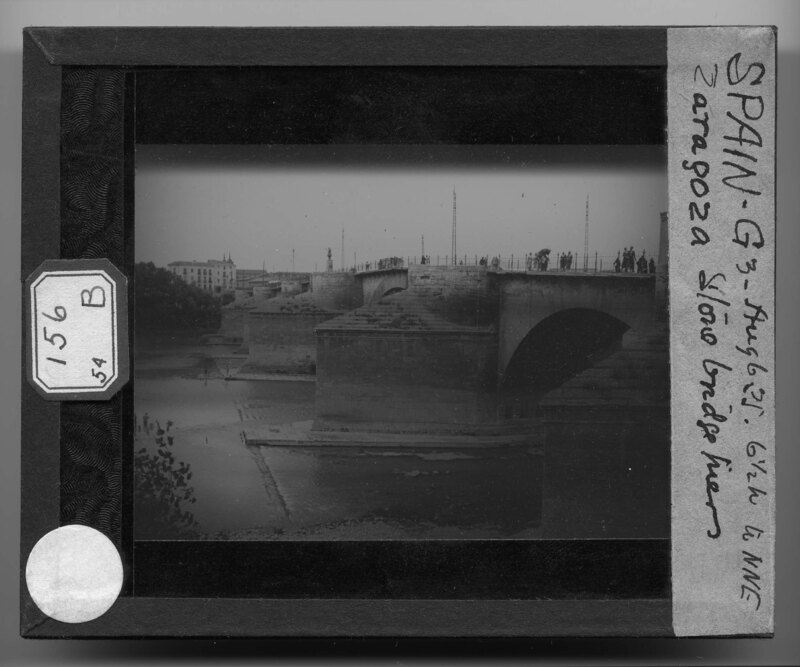
Image of a stone bridge crossing the river near Zaragoza. Pedestrians can be seen walking along the bridge. Boys are playing on the sand flats near a central pillar in the middle of the river. Slide labeled with text, "Made by G.R. Swain, 713 E. University Ave., Ann Arbor, Michigan." Swain was staff photographer at U of M from 1913 to 1947.
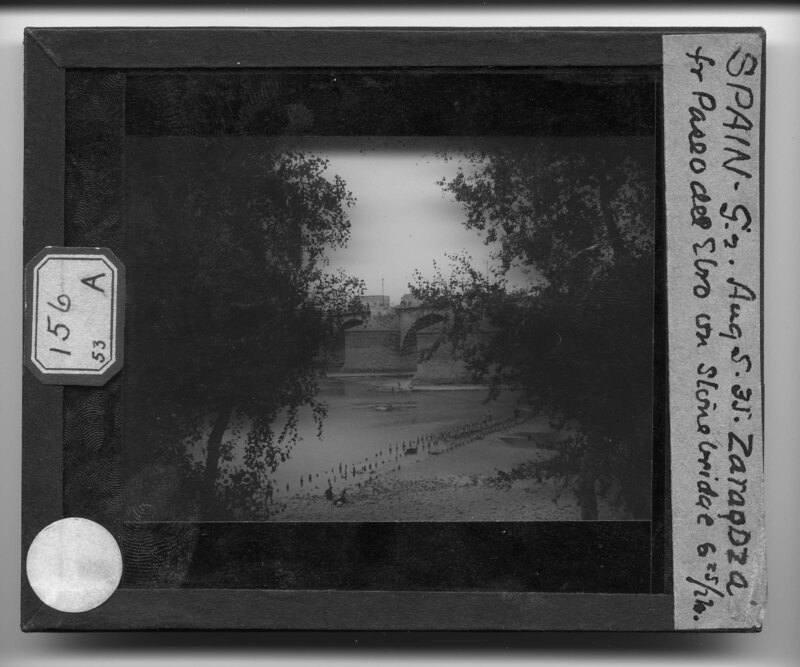
Looking through the trees at a stone bridge crossing the river. Boys can be seen sitting on the bank of the river and playing on a sand flat in the middle of the river. Men are fishing in the river. Italianate architecture can be seen in the background. Slide labeled with text, "Made by G.R. Swain, 713 E. University Ave., Ann Arbor, Michigan." Swain was staff photographer at U of M from 1913 to 1947.
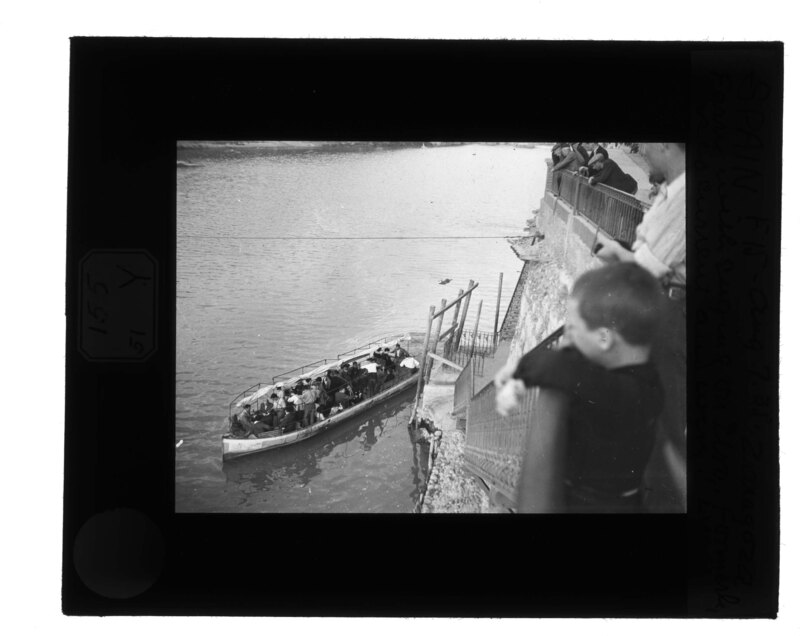
A ferry with an engine can be seen floating on the Ebro River in Zaragoza, Spain. It is noted the ferry previously was powered using the current of the river and wind. Men and boys are standing on a sidewalk looking over a railing at the ferry. Men can be seen sitting on the ferry presumably as the boat leaves the bank.
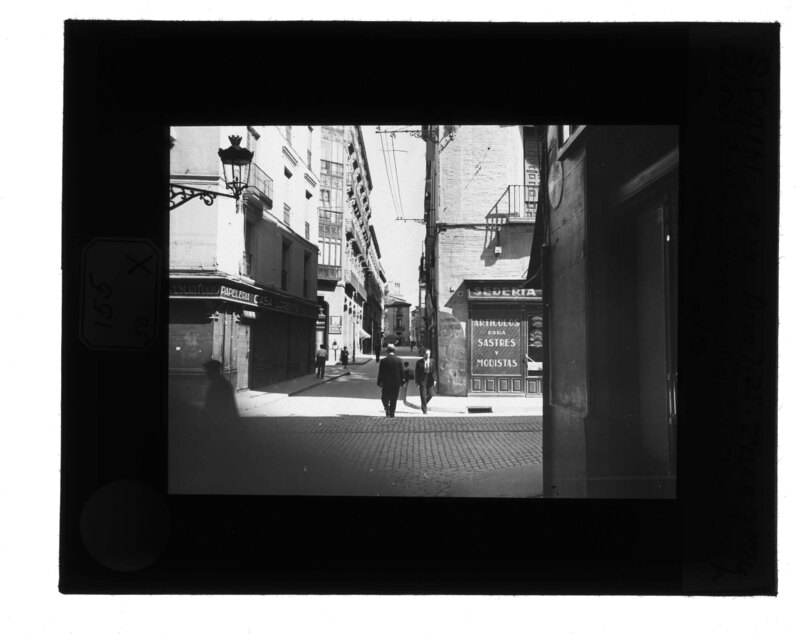
Street scene with Classically inspired architecture buildings lining the street on either side. Pedestrians can be seen walking along the sidewalks and shops selling various wares can also be seen along the street.
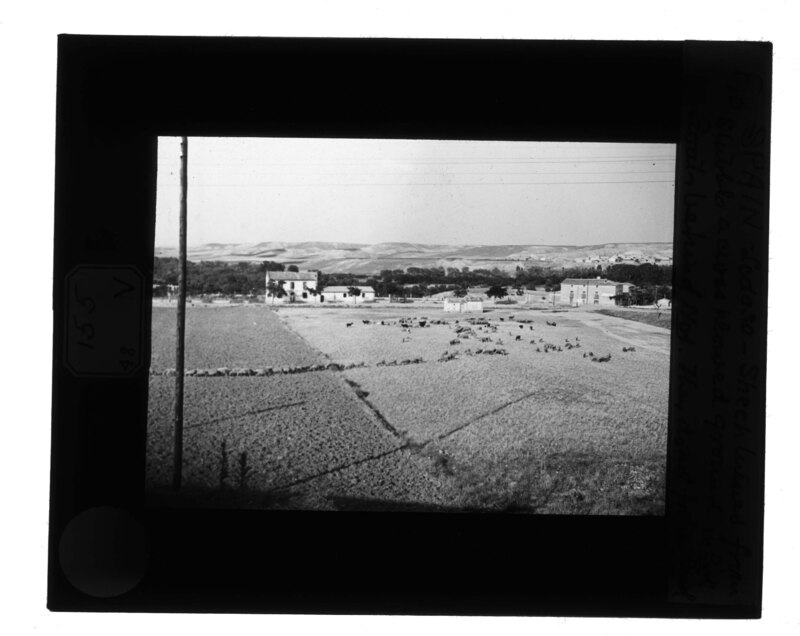
Overhead view of agricultural fields. Sheep and goats can be seen crossing into a new field to the left. An Italian style building can be seen behind the fields along with outbuildings. More houses can be seen sitting on a bluff in the mountains in the background.
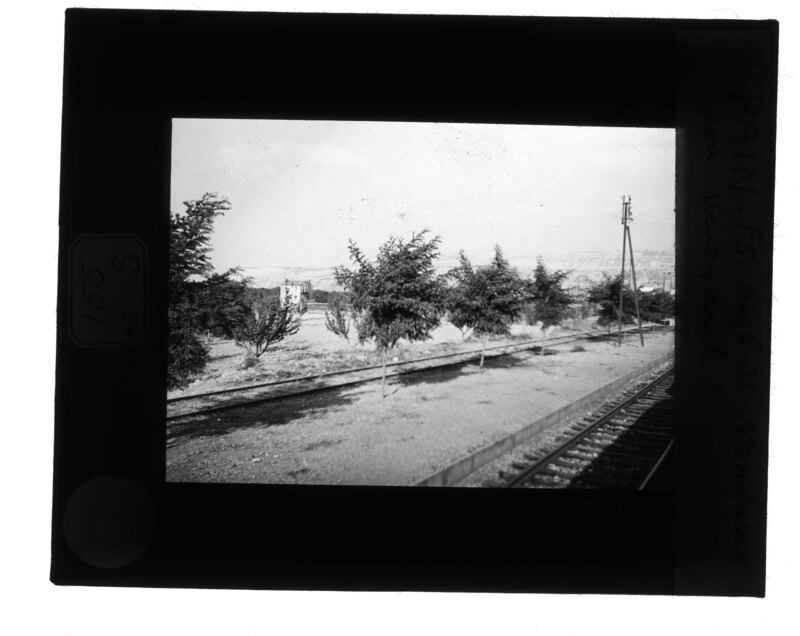
Image taken from the vantage point of a moving train. Railroad tracks can be seen in the foreground. A house sits behind trees and it is noted the image is depicting a vineyard. Mountain can be seen in the background
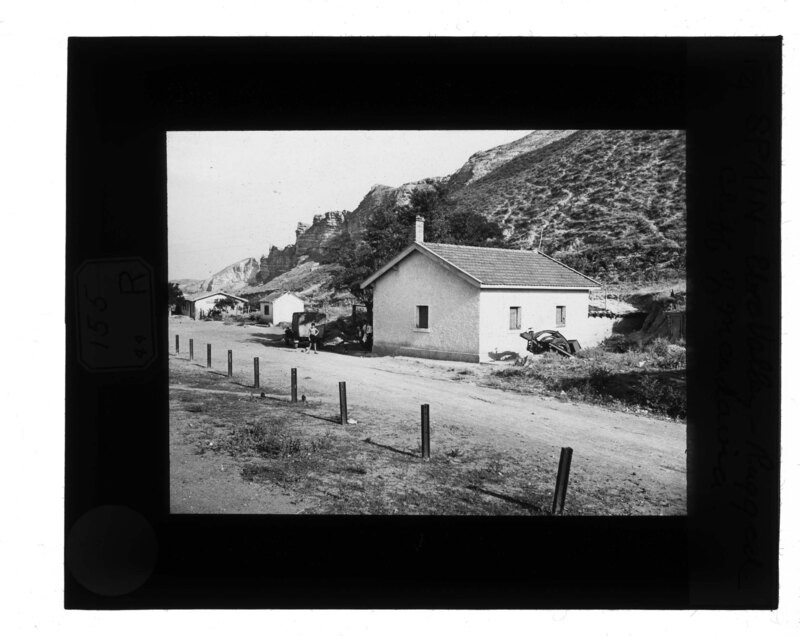
Image of a plaster house sitting next to a dirt road. A boy is standing outside next to a car. Several other houses can be seen in the background along the same road. Mountains rise behind the house and the landscape is rugged and mountainous.
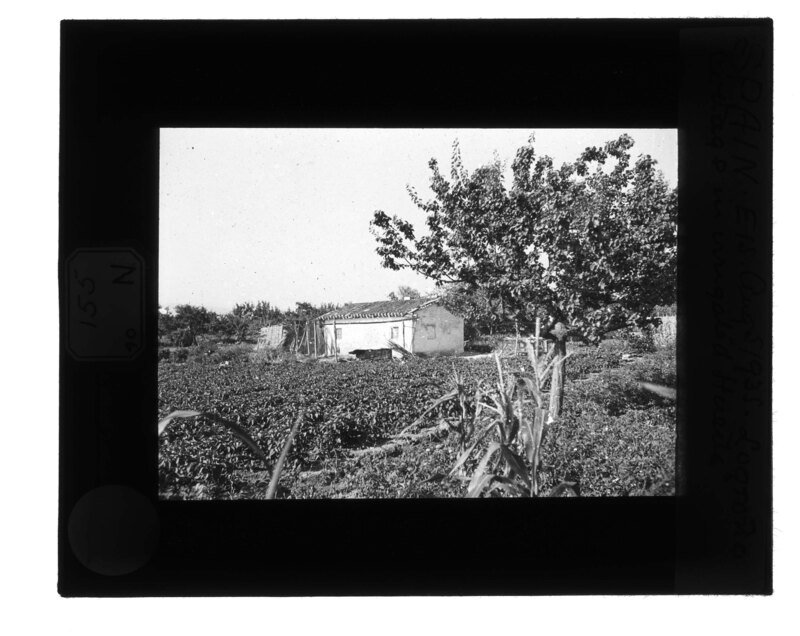
Image of a cottage behind an agricultural field. A tree can be seen growing amongst the planted crop. It is noted that the land is irrigated and huerta, or fertile
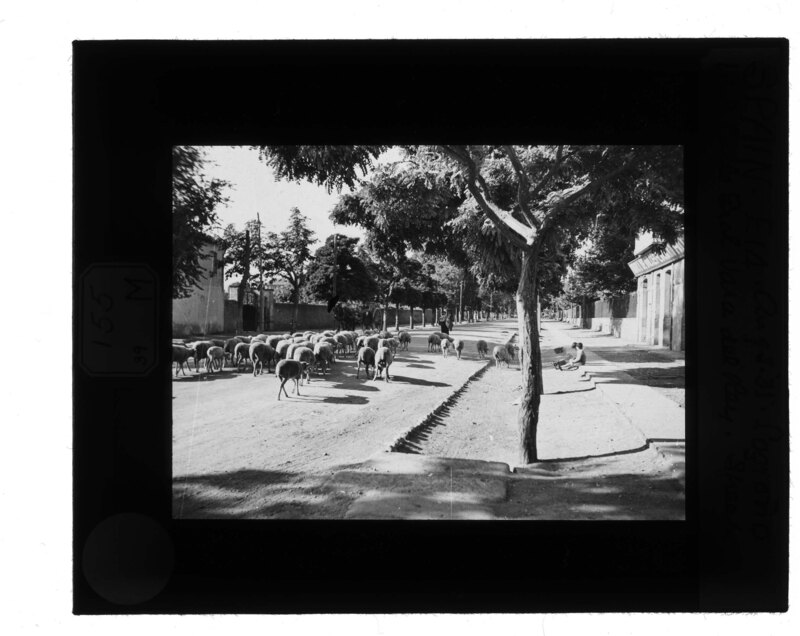
A street scene with sheep walking down the middle of the street along with a woman. A man with a donkey and a buggey can be seen in the shadows of the trees and children sit on the sidewalk watching the sheep.
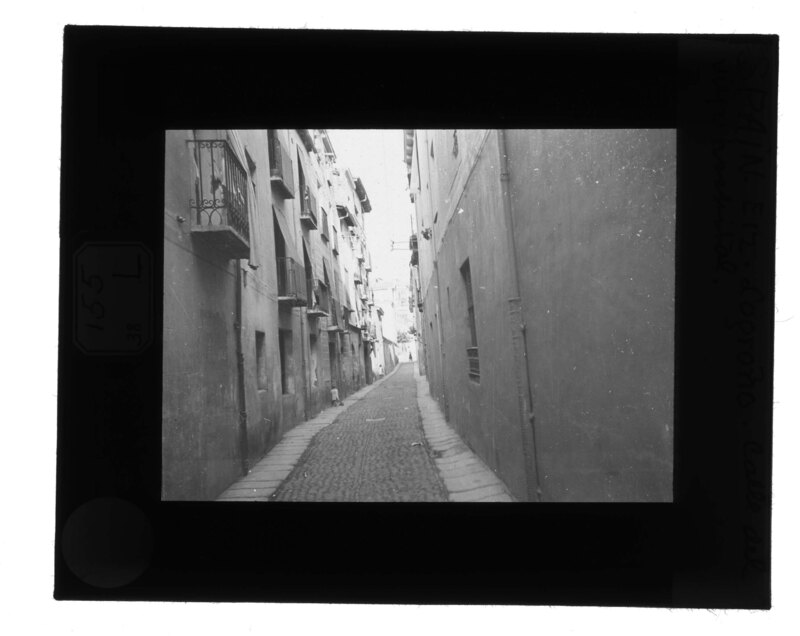
A narrow cobbled street with apartment style buildings on either side. A child can be seen standing in a doorway. It is noted the image is of the Calle del Viejo Hospital
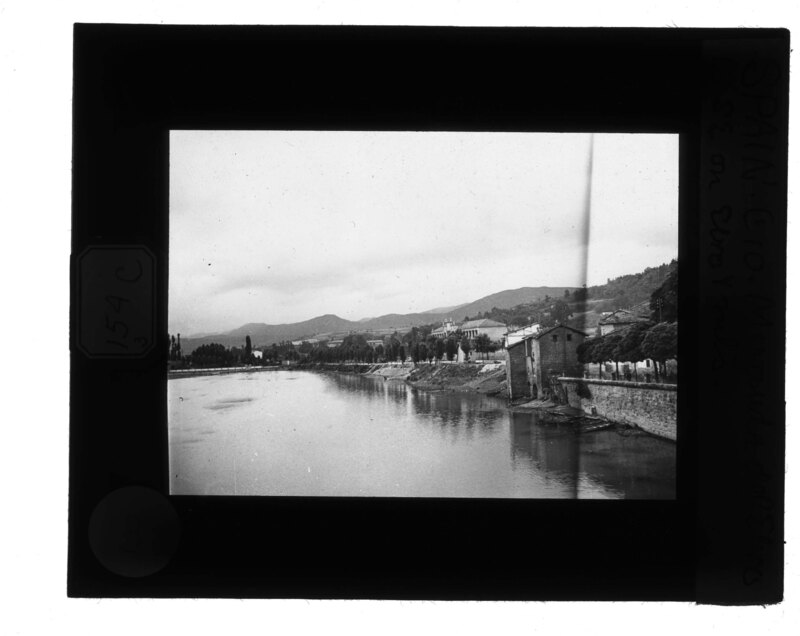
Women and children are washing in the Ebro River. A boat sits along the bank of the river. An Italianate style building can be seen across the river with other buildings surrounding it. Mountains can be seen in the background. The image is taken from the vantage point of a stone bridge. Men can be seen standing on the bridge.
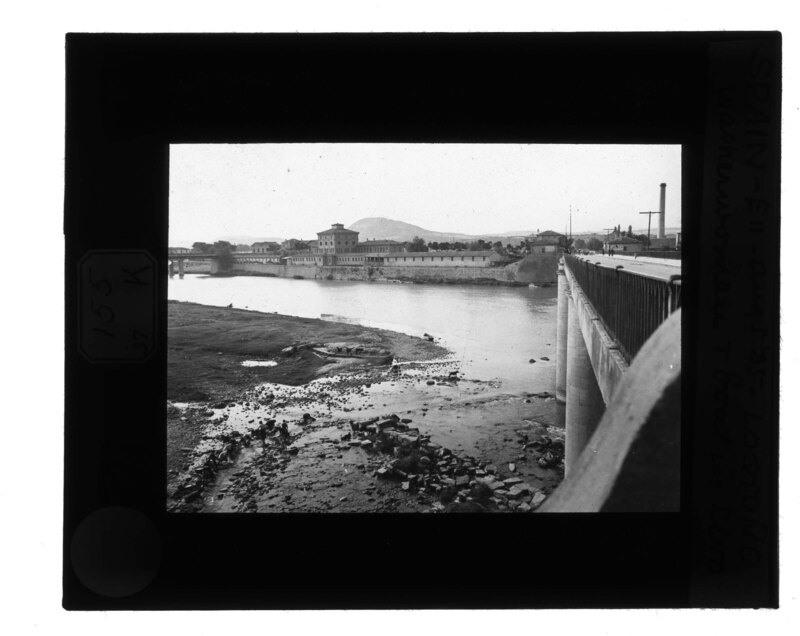
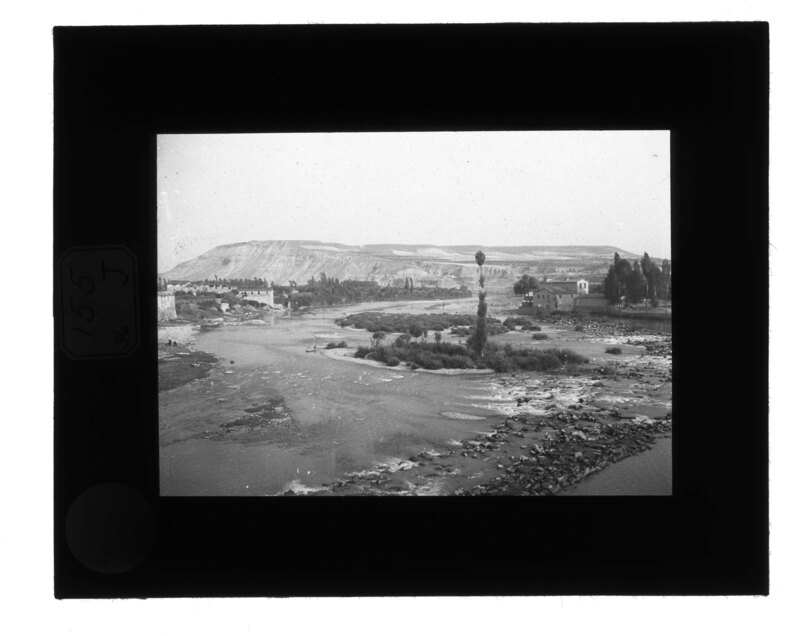
Image of the Ebro River, noted from a stone bridge vantage point. Mountains can be seen in the background and houses sit along the banks of the river. Exposed rocks and sand beds can be seen in the river
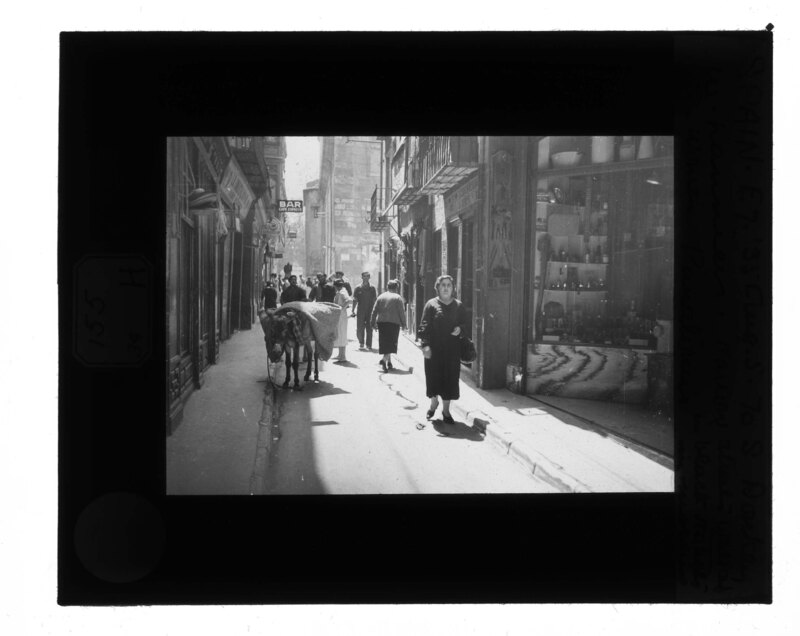
Image of a narrow streetscape in Ebro Valley, Spain. A woman in black is walking past as shop window that has cooking and storage containers in the window. A donkey is standing in the street with pieces of cloth and blankets on its back. Men and women can be seen talking further down the street. A sign reading, "Bar Cafe Express," can be seen near the group of people.
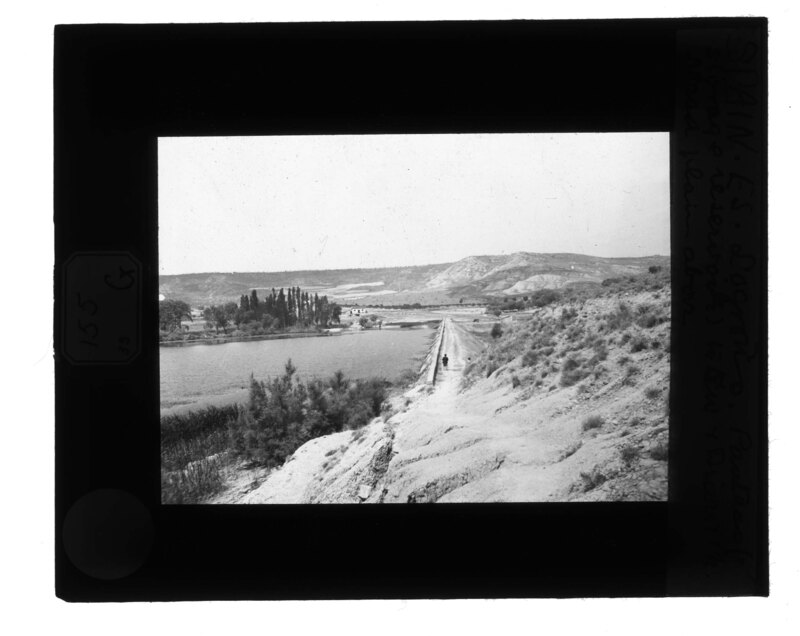
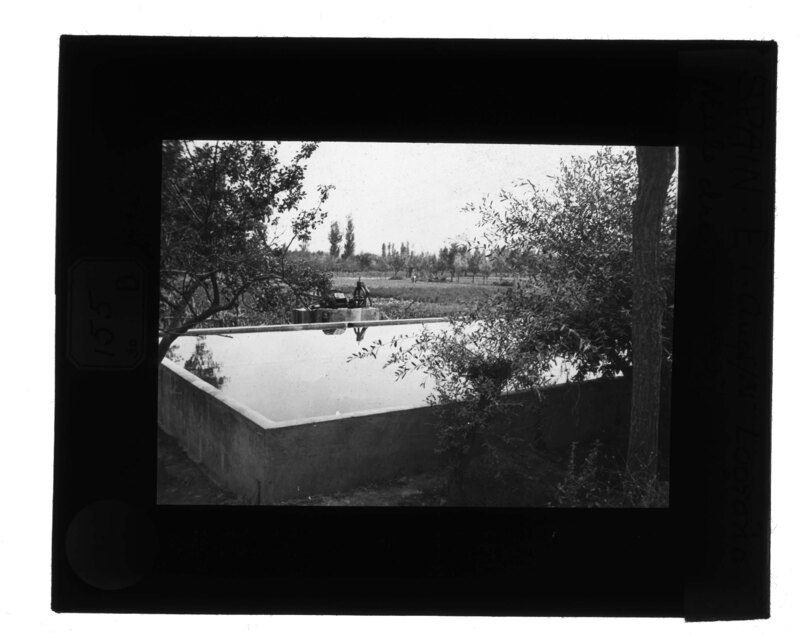
Two men can be seen walking along a dam that is part of the water storage reservoir in the left of the picture. It is noted that the mountainous landscape in the background is the Mesa Plain. The landscape is rocky and hilly with trees and foliage.
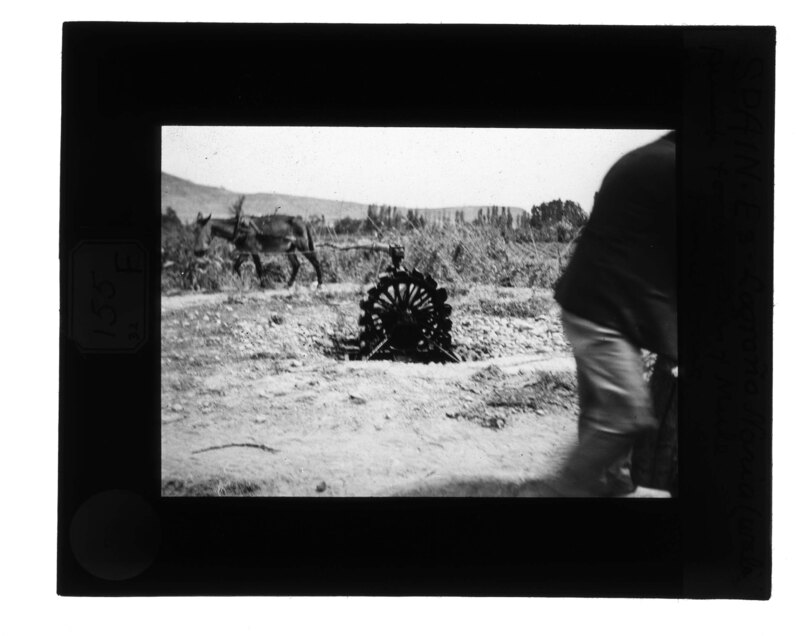
A mule is seen attached to a crankshaft in order to turn the crank to presumably draw water from the well. The large crank is attached to a wooden pole which is harnessed to the mule. As the mule walks in circles the crank turns and draws water from the well.
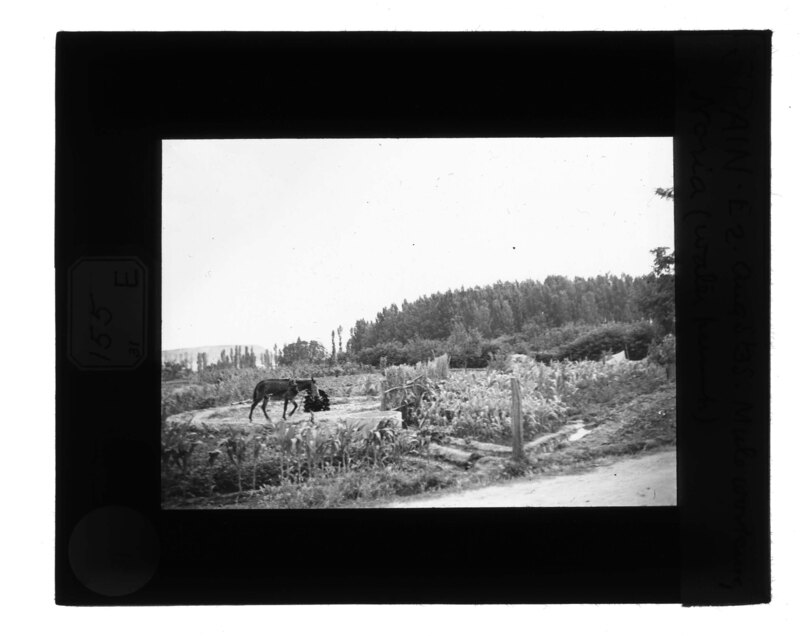
A mule is seen attached to a crankshaft in order to turn the crank to presumably draw water from the well. Corn can be seen growing next to the area where the donkey walks and there are trees that can be seen growing in the background.
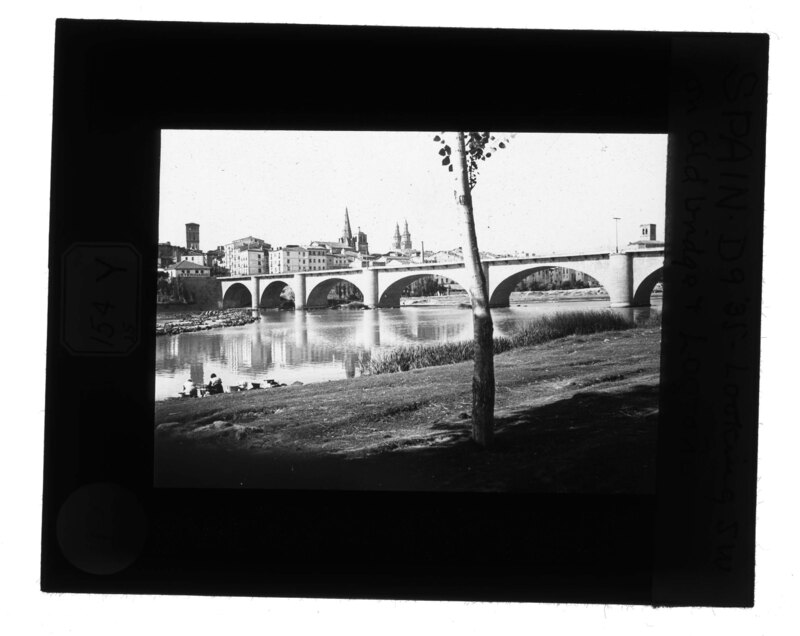
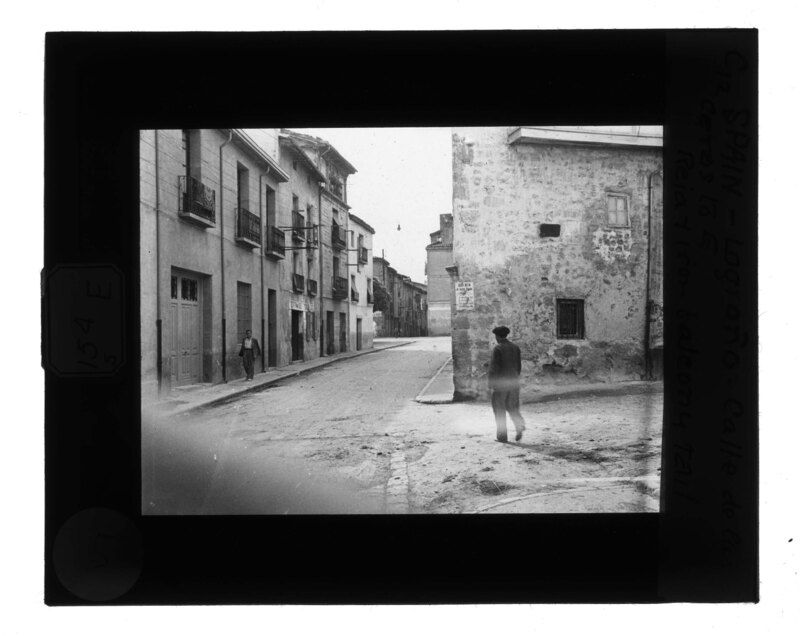
Image of an old bridge going into Logrono, Spain. Stately spires can be seen on top of buildings in the background along with three or four story buildings near the bridge. People can be seen sitting on the river bank in the foreground. A building with the name, "veterinario," can be seen next to the bridge. The river that runs under the bridge appears to be low because there are exposed rocks and grass grows on the sand beds.
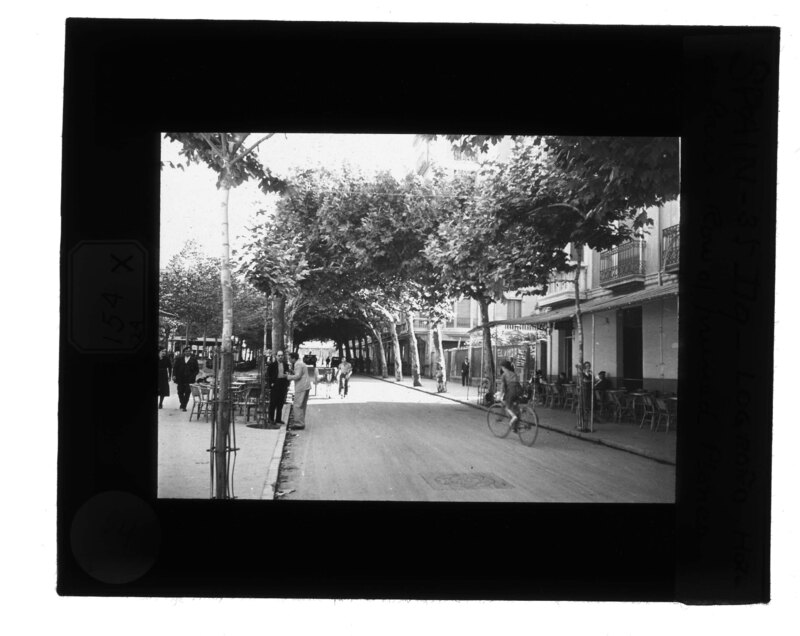
Streetscape scene with people riding bikes and walking along the sidewalks on either side of the street. The trees have been pruned to form a canopy over the road offering shade. Cars and a donkey with a cart are seen on the road. It is noted that the image also shows the Hotel de Paris. Seating areas can be seen on either side of the street.
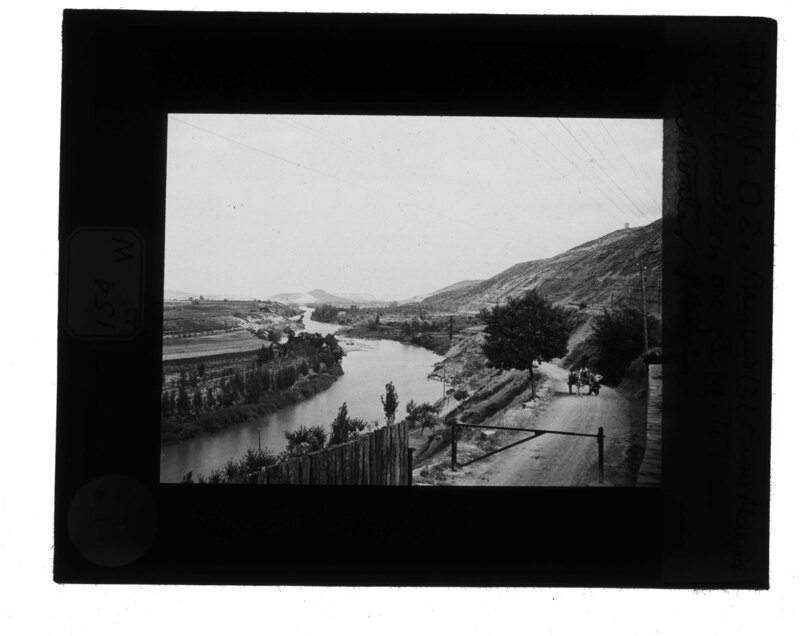
Image of the Ebro River. A dirt road with a gate can be seen to the right of the river. A donkey with a wagon is traveling along the road. The landscape is mountainous and rises up along the river banks.
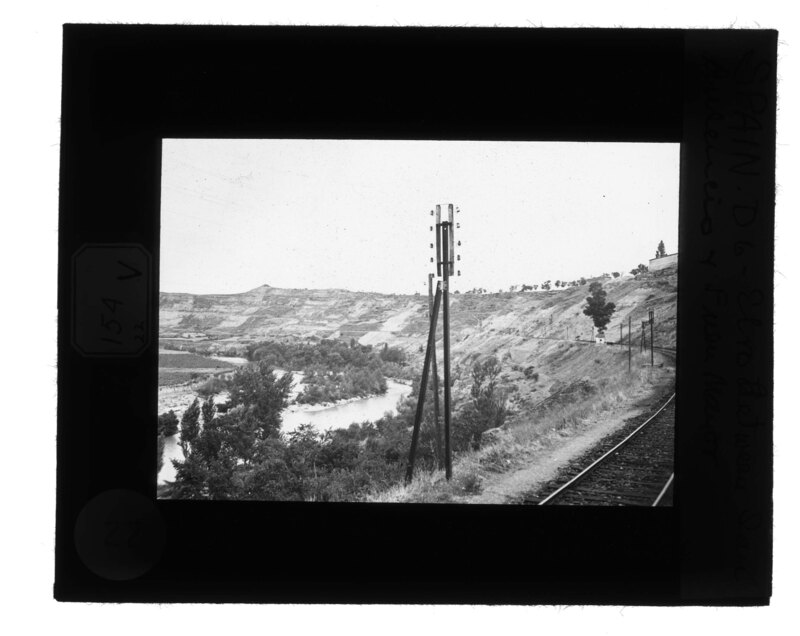
Image taken from the vantage point of a moving train. Railroad tracks and an electrical pole for the railroad can be seen in the foreground. The Ebro River runs below the railroad tracks and the landscape is hilly around the river.
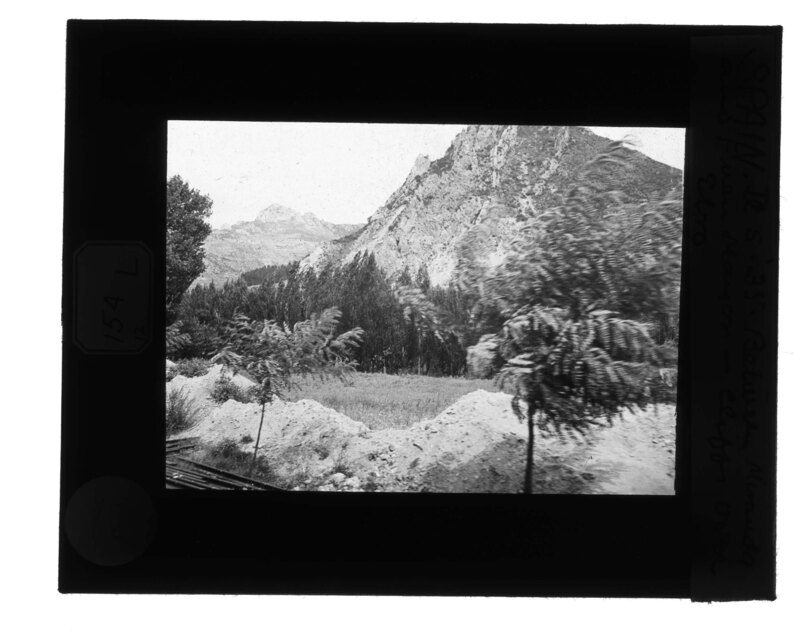
The cliffs that surround Ebro. The landscape is mountainous and covered in trees. Dirt piles can be seen in the foreground and two prominent mountains can be seen in the background.
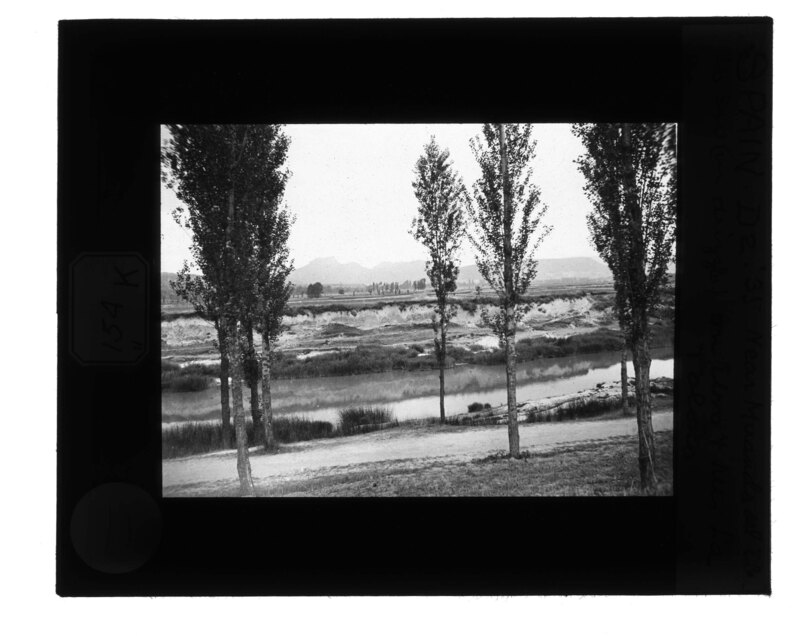
Image of the Ebro River showing its banks. A dirt road can be seen in the foreground and the opposite bank appears to be made of sand with little foliage. Mountains can be seen in the background.
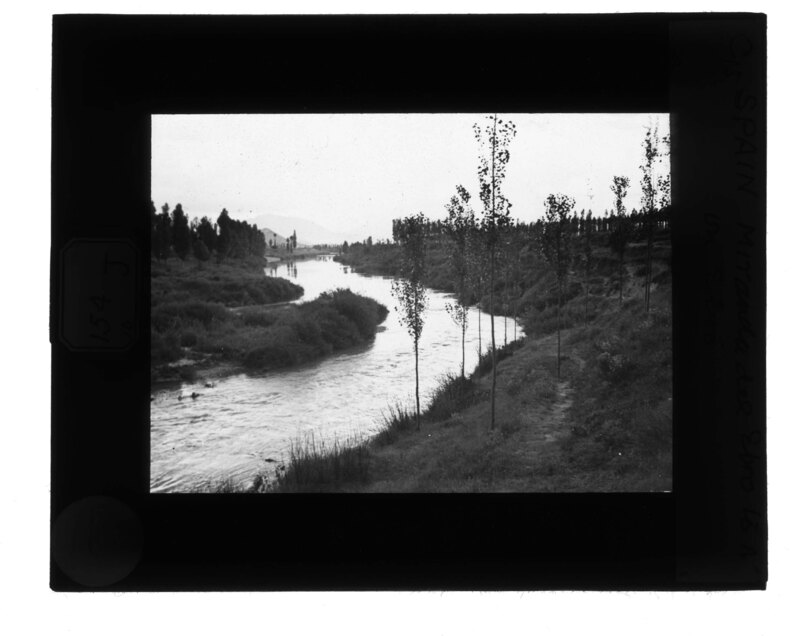
Image of the Ebro River showing its banks covered in grass and other foliage. A walking path can be seen on the bank in the right part of the image. Mountains can be seen in the background.
A man can be seen on the banks of the Ebro River picking up cerevisses. The banks of the river are covered in grass and other foliage and trees. Mountains can be seen in the background.
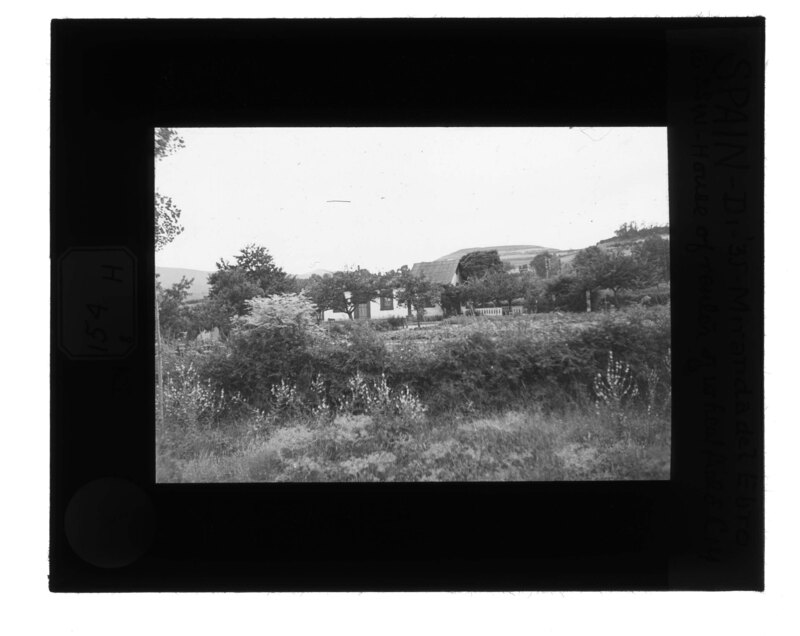
A lot of foliage obstructs the view of the camera, but the focal point is the worker's house in the background. The landscape is mountainous and dense with foliage.
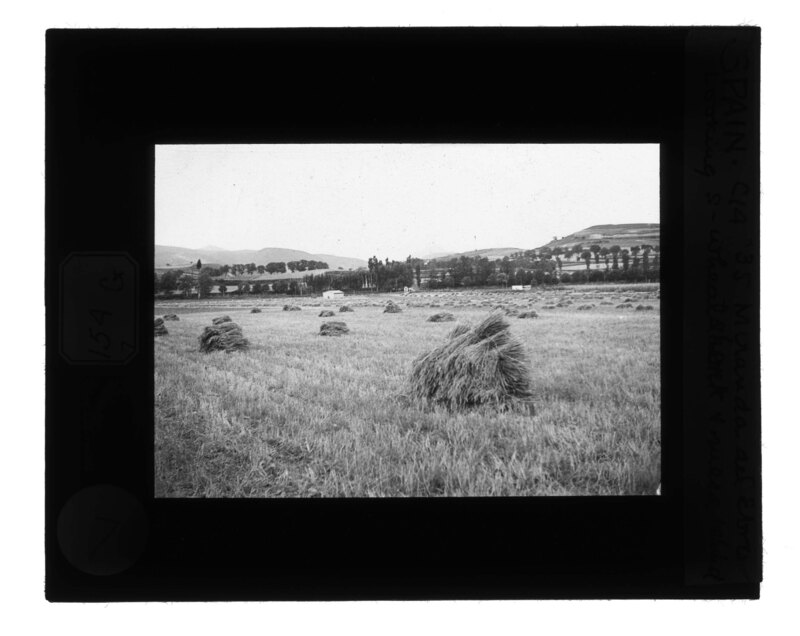
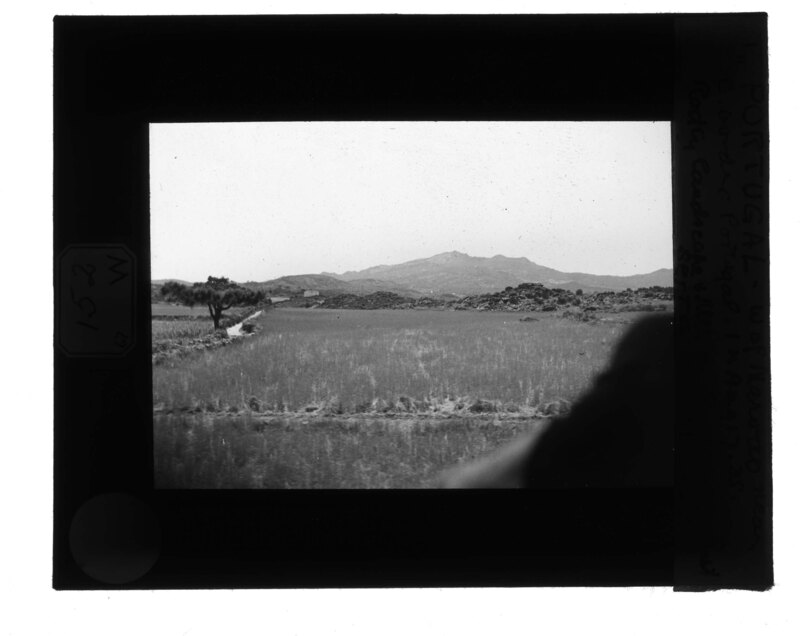
Image of wheat shocks sitting in a field with a mesa behind. The landscape in the background is mountainous and trees can be seen growing on the hills.
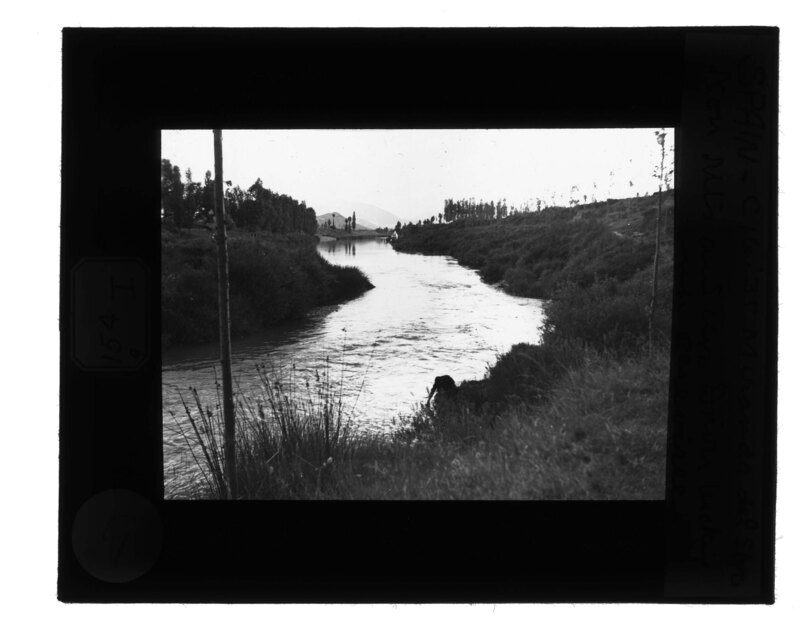
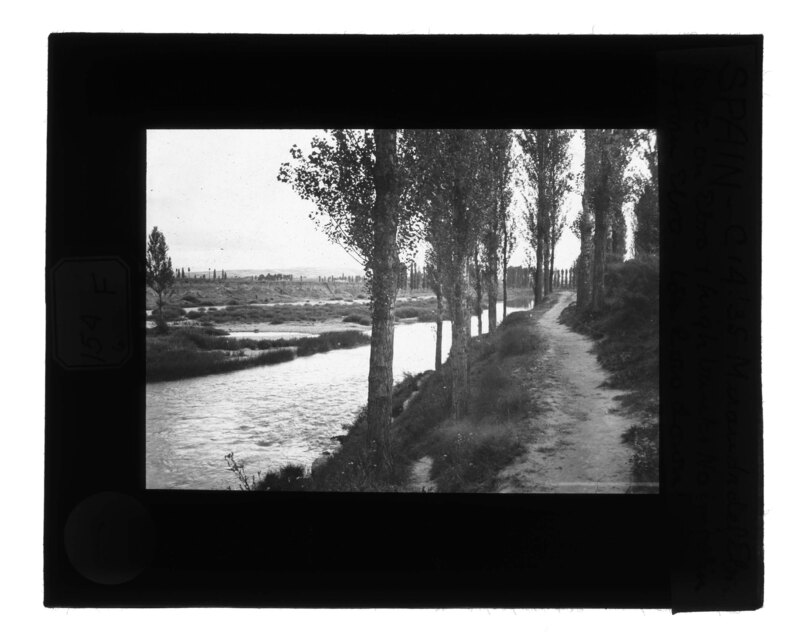
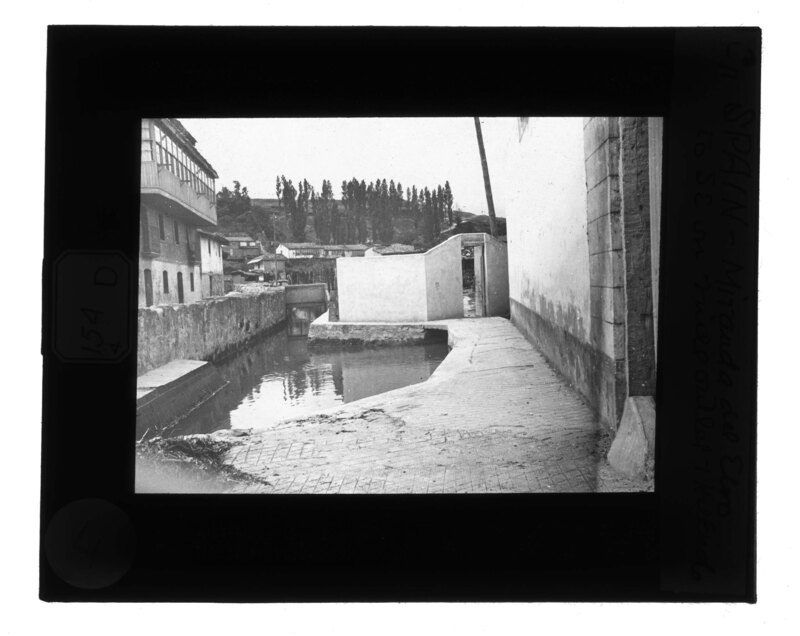
A dirt walkway can be seen going along the Ebro River. Trees and foliage can be seen growing on the banks of the river. It is noted that the image shows Miranda del Ebro to the NE.
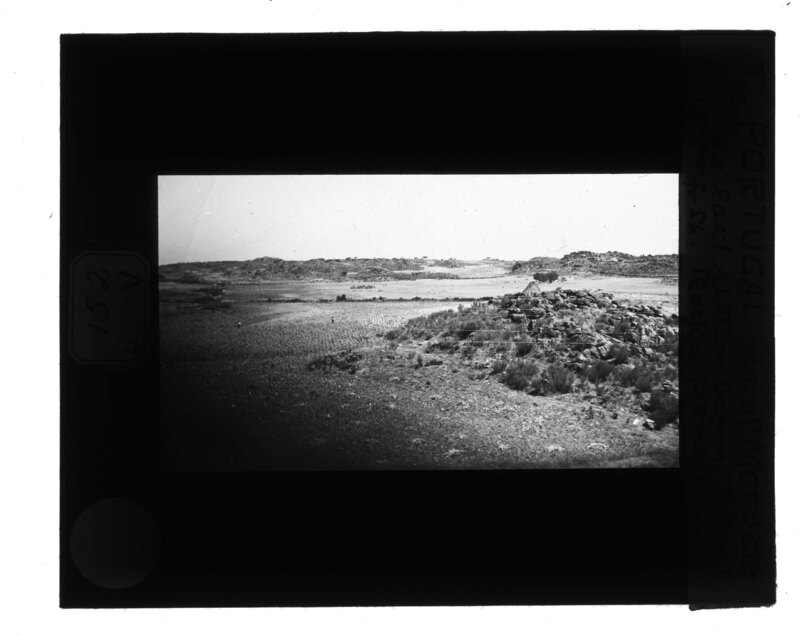
West of Morvao, Portugal. A rocky peneplain can be seen in the foreground as the landscape continues behind it. Two farmers can be seen in the the field next to a rock pile.
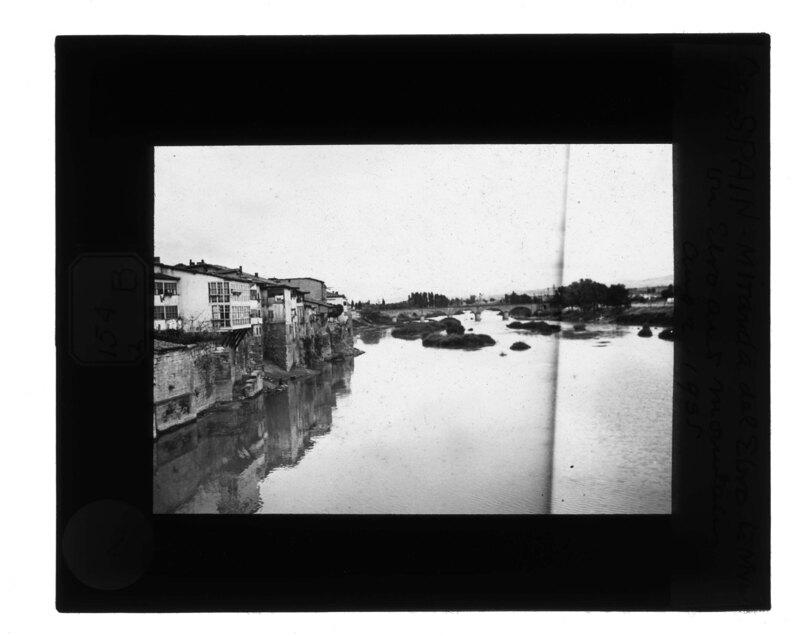
Miranda del Ebro can be seen in the left part of the picture while the Ebro River runs beside it. A bridge can be seen in the background crossing the river.
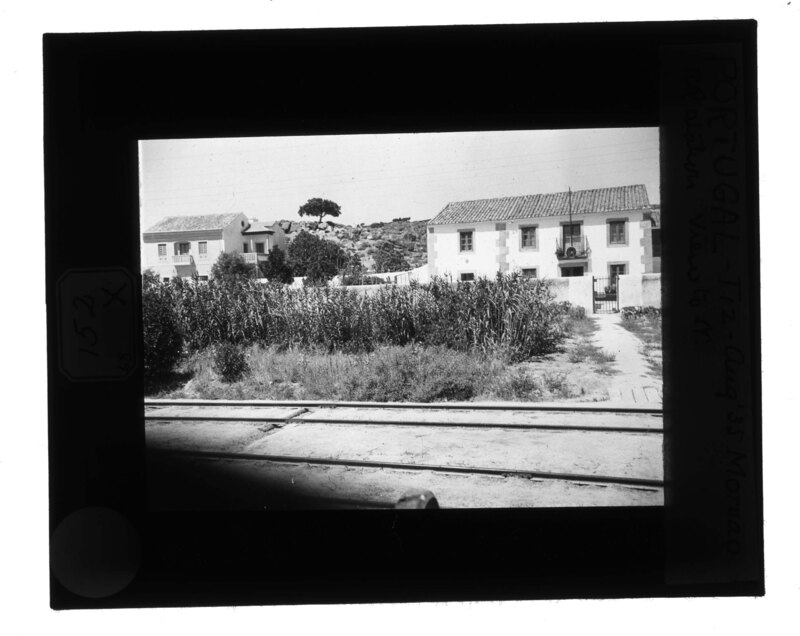
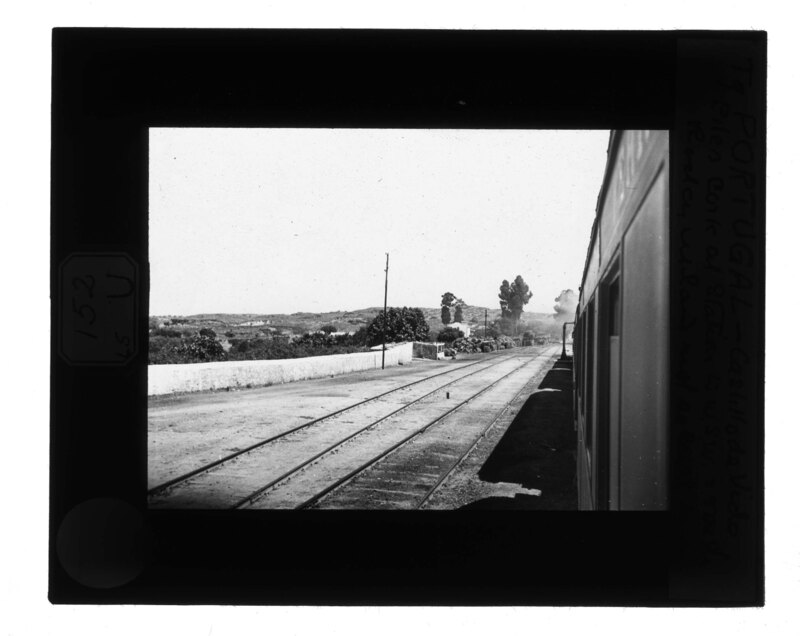
Morvao railroad station. Railroad tracks can be seen in the foreground and two houses sit next to each other in the background. The terrain is rocky and sporadic foliage dots the landscape.
Image of the landscape near the eastern Portugal border. Mountains can be seen in the background and a road goes up to a house and barn set off of the road.
West of Morvao, Portugal. A rocky peneplain can be seen in the foreground as the landscape continues behind it. Two farmers can be seen in the the field next to a rock pile
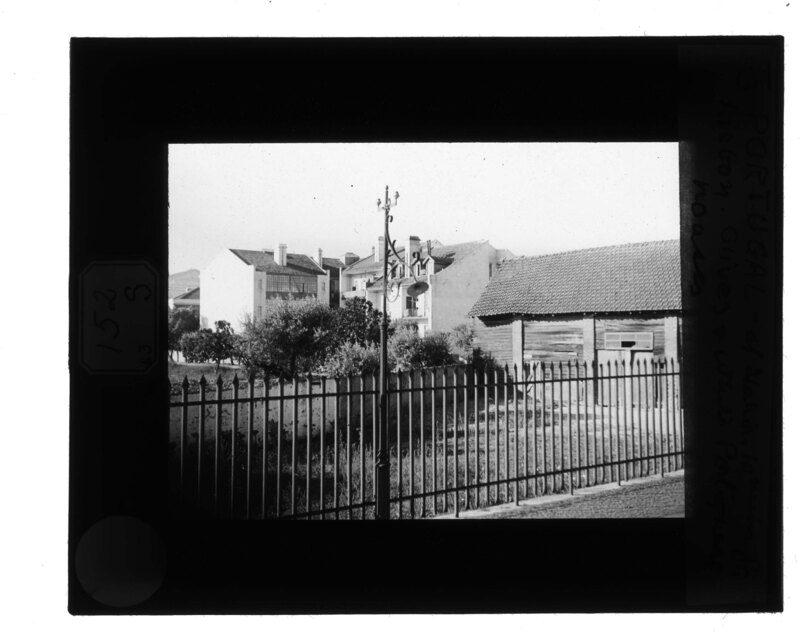
Olive trees can be seen growing behind a stone wall. An iron fence surrounds a shed or barn. Houses can be seen in the background. It is noted that they are white
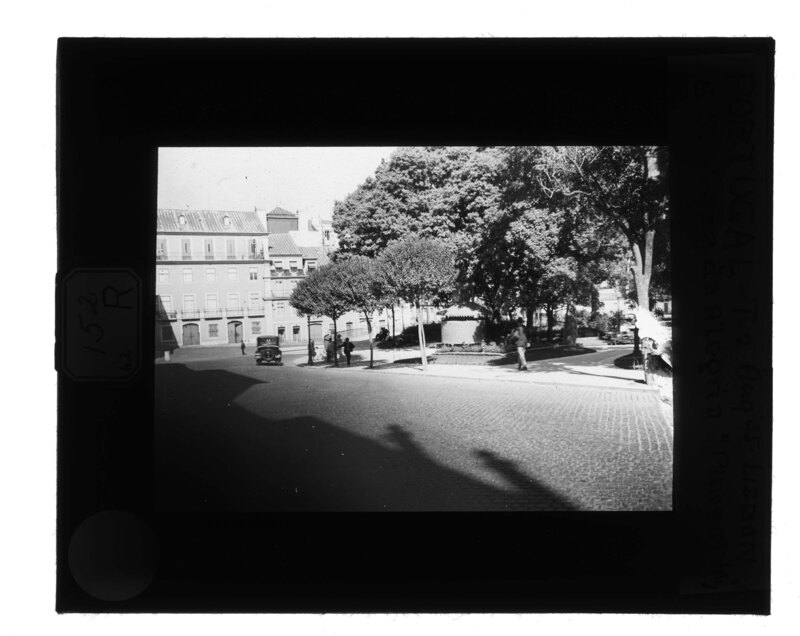
Plaza da Alegria in Lisbon. Translated to "Place of Joy," pedestrians can be seen walking along the sidewalk. A car can be seen driving on the road. Trees and plants can be seen in the Plaza to the right. Classical inspired architecture can be seen in the background along the street
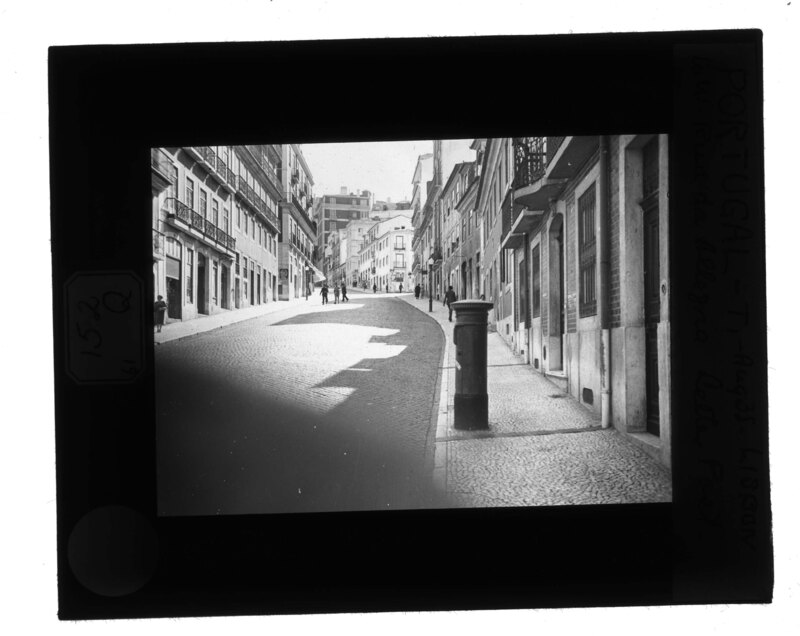
Looking west down Rua da Alegria in Lisbon. Pedestrians can be seen walking on the sidewalk and in the street. Classical inspired architecture lines the cobbled street on both sides.
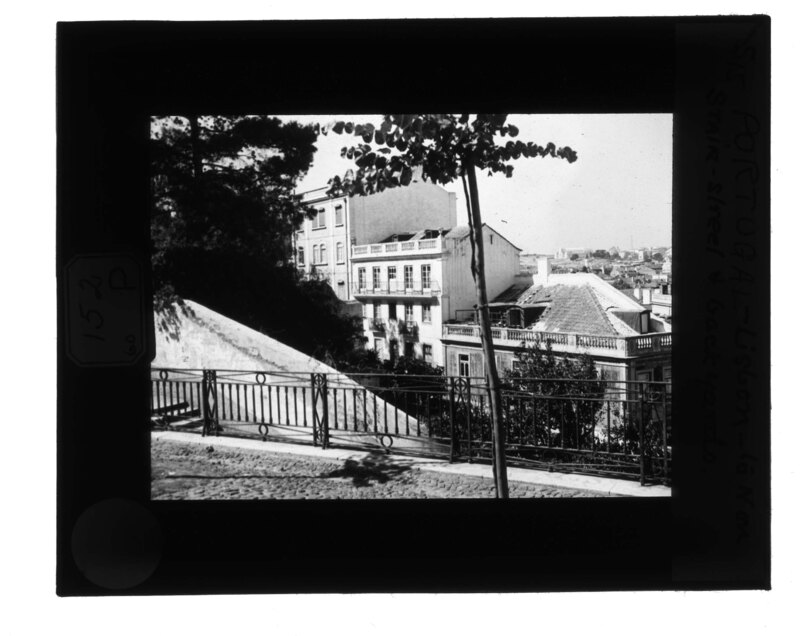
Three Classically inspired buildings can be seen from the vantage point of a walkway above the street below. Stairs can be seen leading down to the street below. In the background, Lisbon can be seen, presumably.