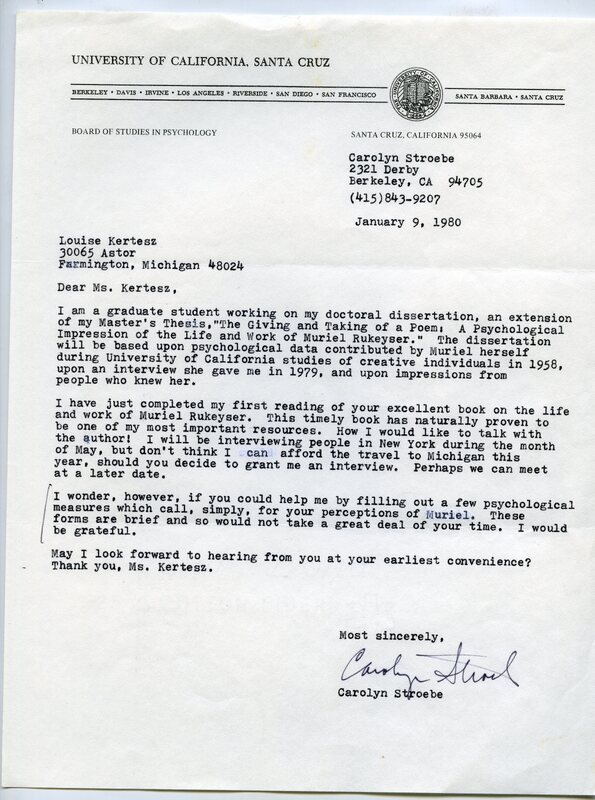
An original, typewritten letter from the University of California in Santa Cruz, dated January 9th, 1980. The letter is from Carolyn Stroebe to Louise Kertesz. Stroebe introduces herself by saying that she is a graduate student working on her doctoral dissertation, an extension of her Master’s Thesis, titled “The Giving and Taking of a Poem: A Psychological Impression of the Life and Work of Muriel Rukeyser.” The dissertation is based on psychological data provided by Rukeyser during a University of California study of creative individuals in 1958; on an interview that Rukeyser gave Stroebe in 1979; and on impressions from people who knew her. Stroebe had just finished reading Kertesz’s book on the life and work of Muriel Rukeyser for the first time, and the book had proven to be one of her most important resources. Stroebe would love to talk with the Kertesz. She will interview people in New York in May, but she doesn’t think she can afford to travel to Michigan this year. If Louise decides to grant Stroebe an interview, they could perhaps meet at a later date. Stroebe wonders if Kertesz can help her by filling out a few psychological measures which ask for her perceptions of Rukeyser. The forms will be brief and would not take a great deal of her time, Stroebe would be grateful. In closing, Stroebe says she is looking forward to hearing from Kertesz.
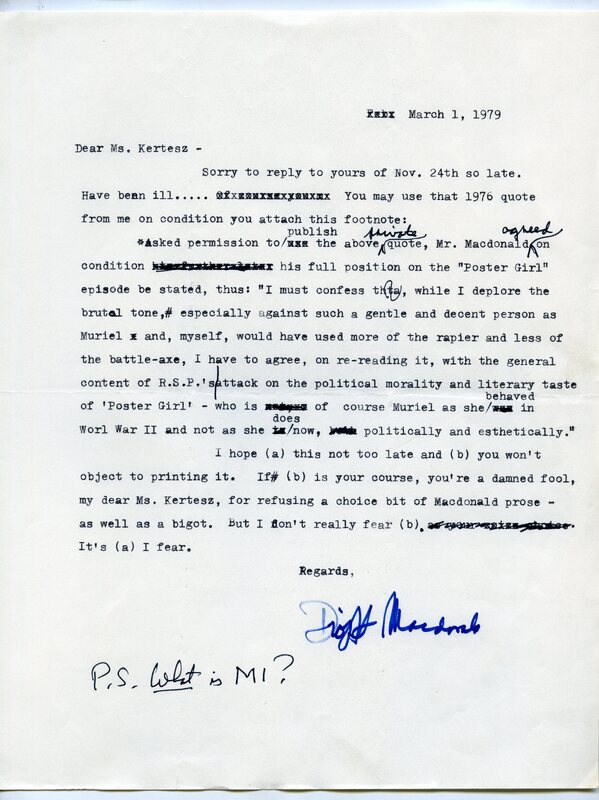
An original, typewritten letter, dated March 1st, 1979. The letter is from Dwight Macdonald to Louise Kertesz. Kertesz had sent Macdonald a letter on November 24th of the previous year, and he apologizes for replying to the letter so late. Macdonald will give her permission to use his quote in her book if she includes a disclaimer that says, “Asked permission to publish the above private quote, Mr. Macdonald agreed on condition his full position on the 'Poster Girl' episode be stated, thus, 'I just confess this, while I deplore the brutal tone, especially against such a gentle and decent person as Muriel and, myself, would have used more of the rapier and less of the battle-axe, I have to agree, on re-reading it, with the general content of R.S.P.'s attack on the political morality and literary taste of ‘Poster Girl’- who is of course Muriel as she behaved in Worl (sic) War II and not as she does now, politically and esthetically.” Macdonald says that he hopes it is not too late and that "you won't object to printing it." He adds that, should she refuse, she is “a damned fool ... for refusing a choice bit of Macdonald prose-as well as a bigot.” However, he really doesn’t fear this. Instead, he fears it is too late to submit it. There is a handwritten postscript on the letter that asks, “What is MI?”. The letter is also filled with typewriter errors, crossed out sections, and added. handwritten words by Macdonald himself.
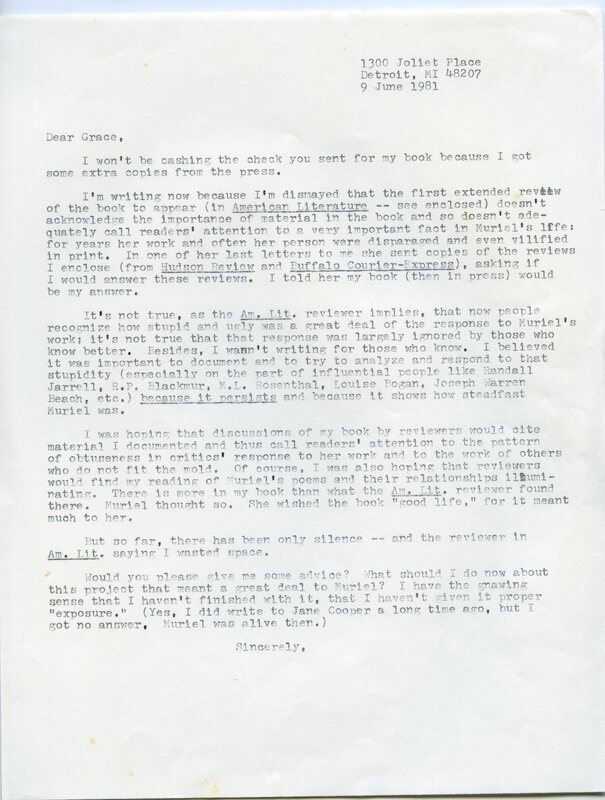
Dated June 9th, 1981, a typewritten letter from Louise Kertesz to Grace Paley. While there is no name after the valediction "sincerely" at the end of the letter, it can be assumed that this letter is from Louise Kertesz to Grace Paley. In the letter, Louise states that she won’t be cashing in the check that Grace sent for her book because she got some extra copies of the book from the press. Louise wrote to Grace because she is upset that the first review of her book, published in American Literature, “doesn’t acknowledge the importance of material in the book and so doesn’t adequately call readers’ attention to a very important fact in Muriel’s life: for years her work and often her person were disparaged and even vilified in print." In one of the last letters Muriel Rukeyser had sent Louise, she had enclosed two negative, even vicious reviews, one from Hudson Review, the other from Buffalo Courier-Express, and asked if Louise would answer those reviews. At the time, Louise reassured her that her book would be the answer. Louise then goes on to say that it is not true, as the American Literature reviewer states, “that now people recognize how stupid and ugly was a great deal of the response to Muriel’s work, it’s not true that that response was largely ignored by those who knew better.” Louise believes that “it was important to document and to try to analyze and respond to that stupidity (especially on the part of influential people like Randall Jarrell, R.P. Blackmur, M.L. Rosenthal, Louise Bogan, Joseph Warren Beach, etc.) because it persists and because it shows how steadfast Muriel was.”
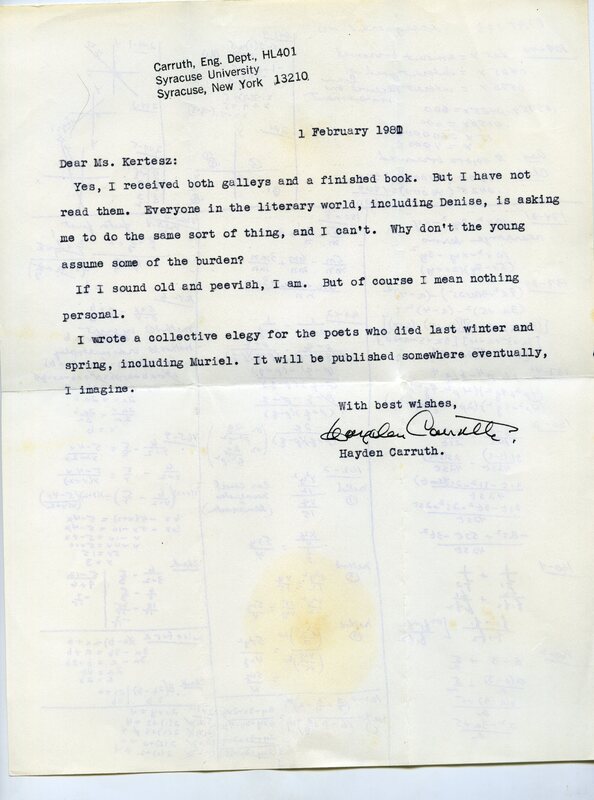
Envelope dated February 2nd, 1981, while the letter is dated February 1st, 1980, and then corrected to 1981. The typewritten letter is to Louise Kertesz from Hayden Carruth from the English Department of Syracuse University. Carruth acknowledges that he received both galleys and the finished book, and that everybody in the literary world, including Denise [Levertov] is pushing him to do the "same sort of thing," but he can’t. He also states that he wrote a collective elegy for the poets who died last winter and spring, including Muriel, and that it will be published somewhere soon. Noteworthy lines: “Why don’t the young assume some of the burden? If I sound old and peevish, I am. But of course I mean nothing personal.”
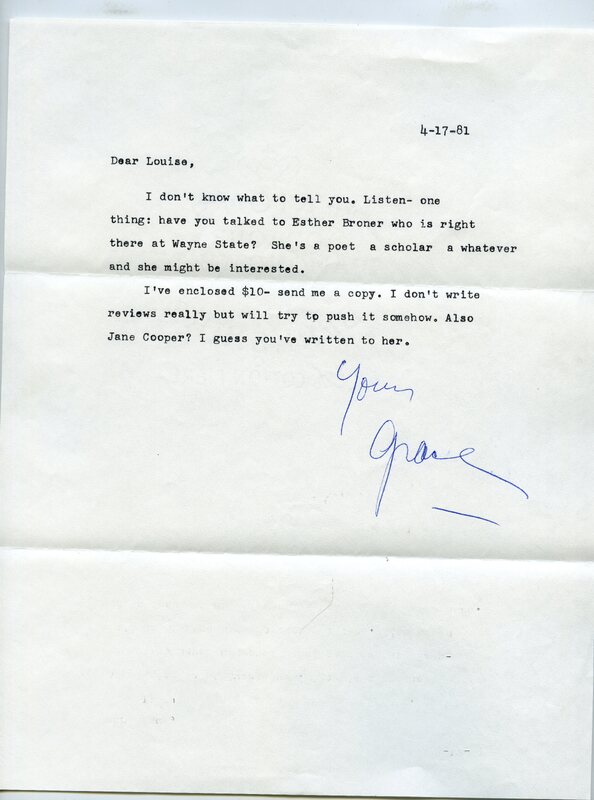
Dated April 17, 1981, from Grace Paley to Louise Kertesz. An original, typewritten letter. Envelope dated April 20th, 1981. Grace states that she doesn’t know what to tell Louise, and suggests she talk to Esther Broner at Wayne State, who is a poet and a scholar and may be interested. Grace enclosed a ten dollar check in the letter, saying she wants a copy of Louise’s book. She also suggests contacting Jane Cooper, but guesses that Louise has already written to her.
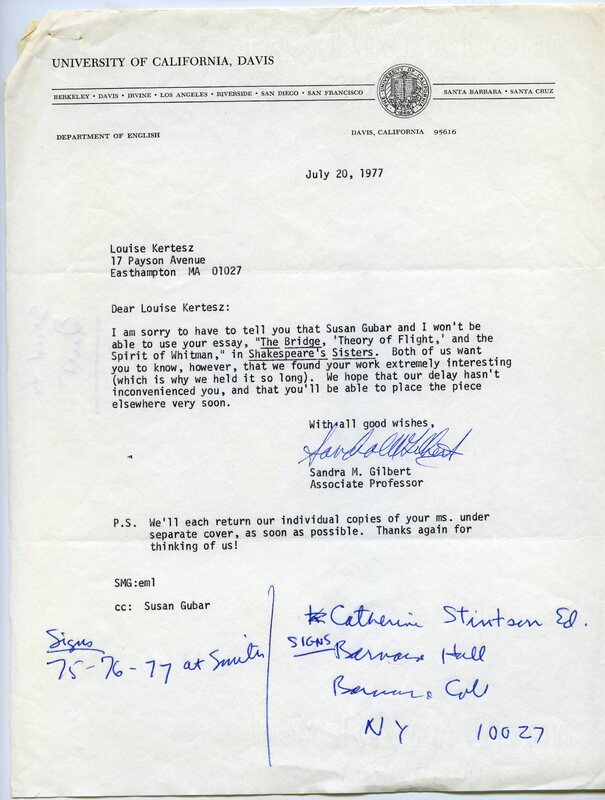
Dated July 20th, 1977. A typewritten letter from Sandra M. Gilbert, University of California, to Louise Kertesz. CC’D to Susan Gubar. They cannot use Louise Kertesz’s essays, “The Bridge, ‘Theory of Flight,’ and The Spirit of Whitman” for their collection Shakespeare’s Sisters. Gilbert adds: "Both of us want you to know, however, that we found your work extremely interesting (which is why we held it so long)."
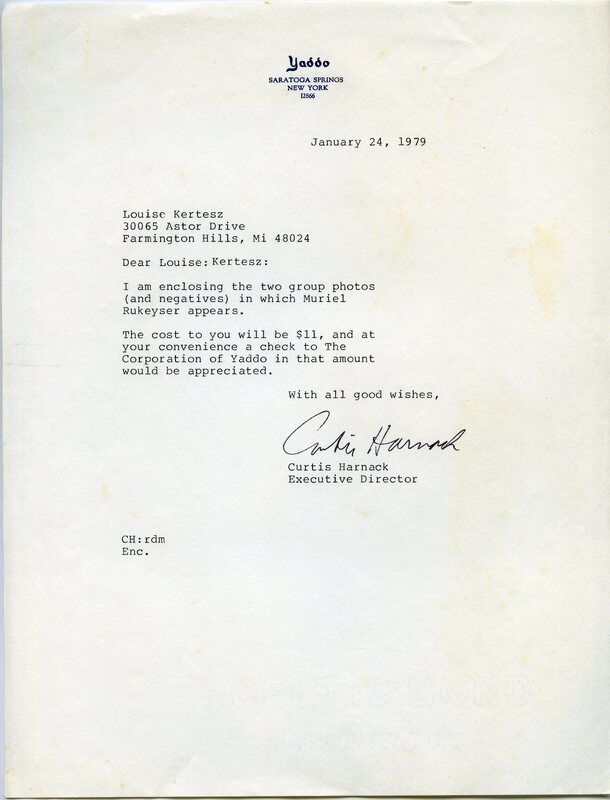
Dated January 24th, 1979. A typewritten letter from Curtis Harnack, Executive Director of Yaddo, to Louise Kertesz. The letter contains two photographs of Muriel Rukeyser. The cost of the photographs was eleven dollars.
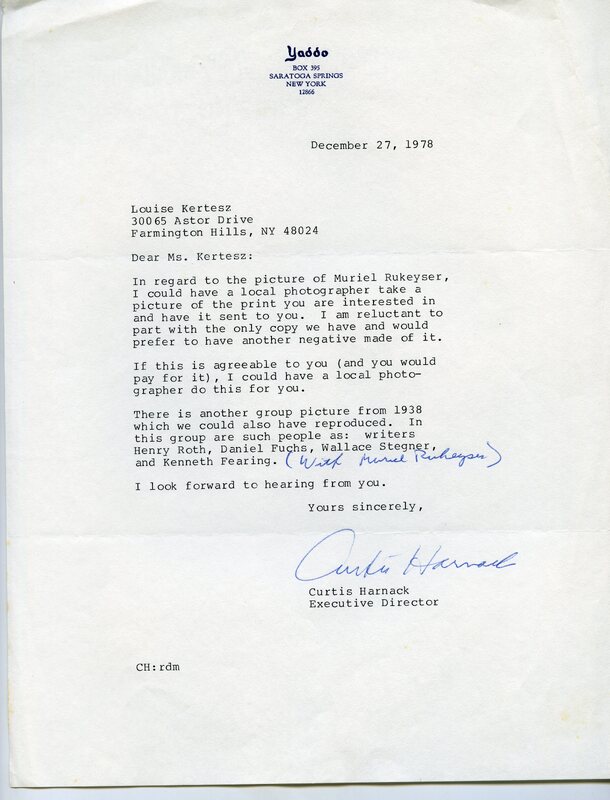
Dated December 27th, 1978. A typewritten letter from Curtis Harnack, Executive Director of Yaddo, to Louise Kertesz in regard to duplicating the two group photographs of Rukeyser at Yaddo.
Dated July 10th, 1978. A typed letter from Jane Cooper to Louise Kertesz. Cooper apologizes for replying to the letter so late, and expresses elation that Louise Kertesz is writing a book about Rukeyser. On page two of the letter, Cooper comments on Rukeyser as a teacher, in particular on her willingness "to let a class go through some stormy times in order to reach both a genuine group experience, communal growth, & to get each individual to reach deeply into herself or himself. I could be wrong, but I think she would say there can be no genuine growth without a certain amount of chaos, or grappling."
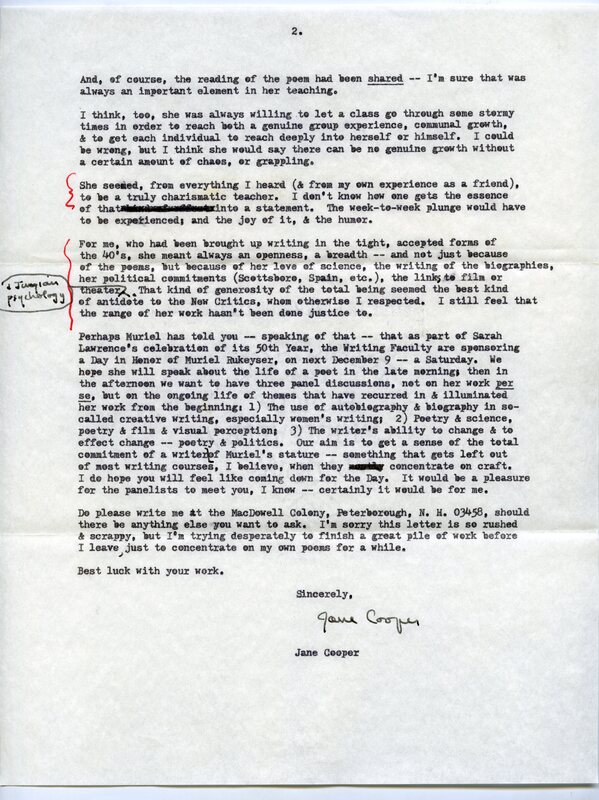
Cooper tells Kertesz "that as part of Sarah Lawrence's celebration of its 50th Year, the Writing Faculty are sponsoring a Day in Honor of Muriel Rukeyser." After describing the planned day-long event, she expresses her hope that Kertesz will be able to attend." Page 2 of 2.
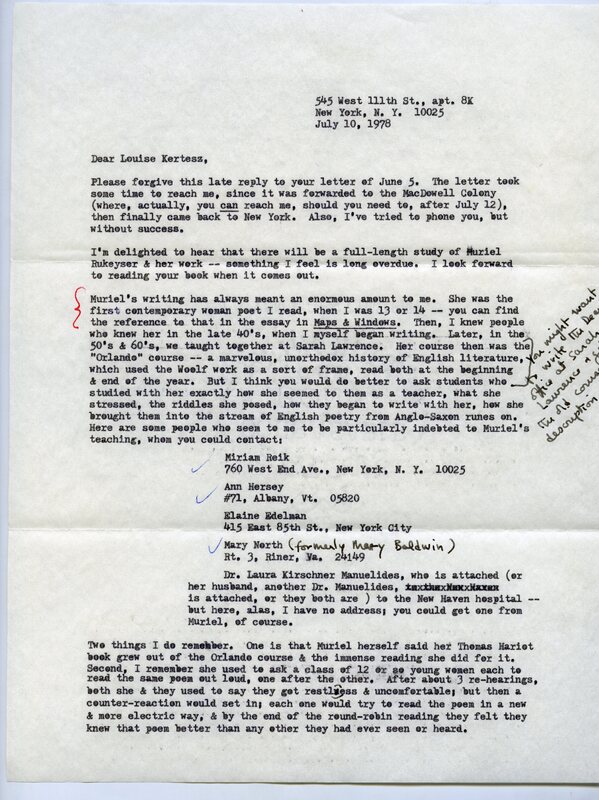
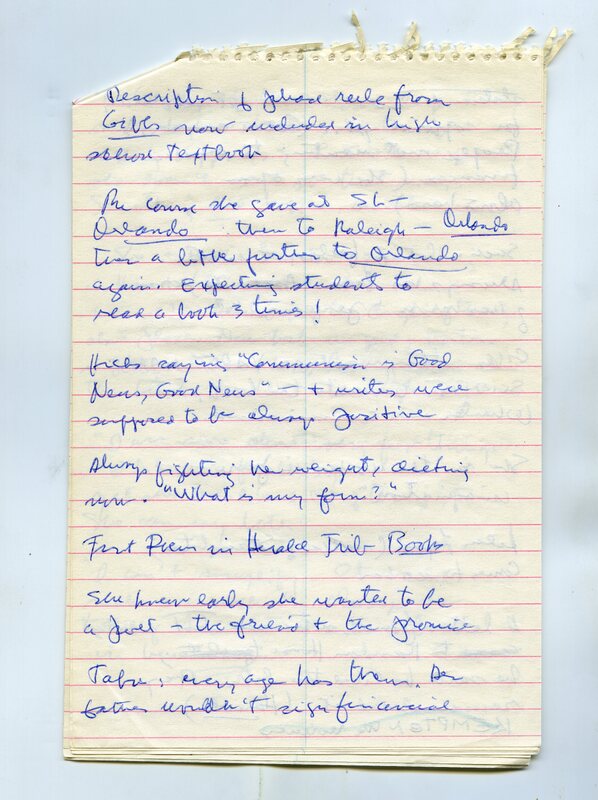
Dated July 10th, 1978. A typed letter from Jane Cooper to Louise Kertesz. Cooper apologizes for replying to the letter so late, and expresses elation that Louise Kertesz is writing a book about Rukeyser. In the letter, Cooper suggests names of former students of Rukeyser to contact. “Muriel’s writing has always meant an enormous amount to me. She was the first contemporary woman poet I read, when I was 13 or 14 … Later, in the 50s & 60s, we taught together at Sarah Lawrence. Her course then was the ”Orlando” course–a marvelous, unorthodox history of English literature, which used the Woolf work as a sort of frame, read both at the beginning & end of the year." Some check marks are next to the names of the students of Rukeyser. Some handwritten notes, apparently by Jane Cooper, are also on the letter. Page 1 of 2.
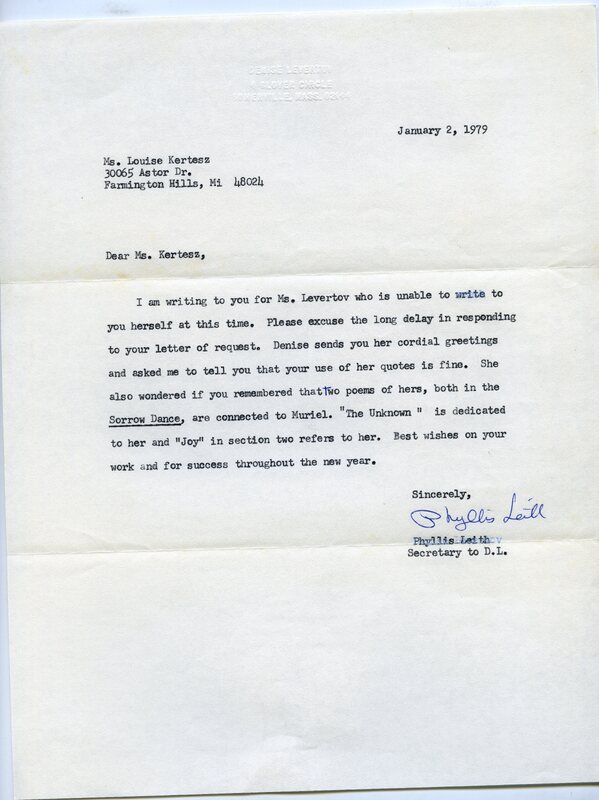
Dated January 2nd, 1979. A typed letter from Phyllis Leith to Louise Kertesz, writing on behalf of Denise Levertov. Levertov gives Louise Kertesz permission to use her quotes in her book, and notes that two of her poems in Sorrow Dance, “The Unknown” and “Joy,” are "connected to Muriel."
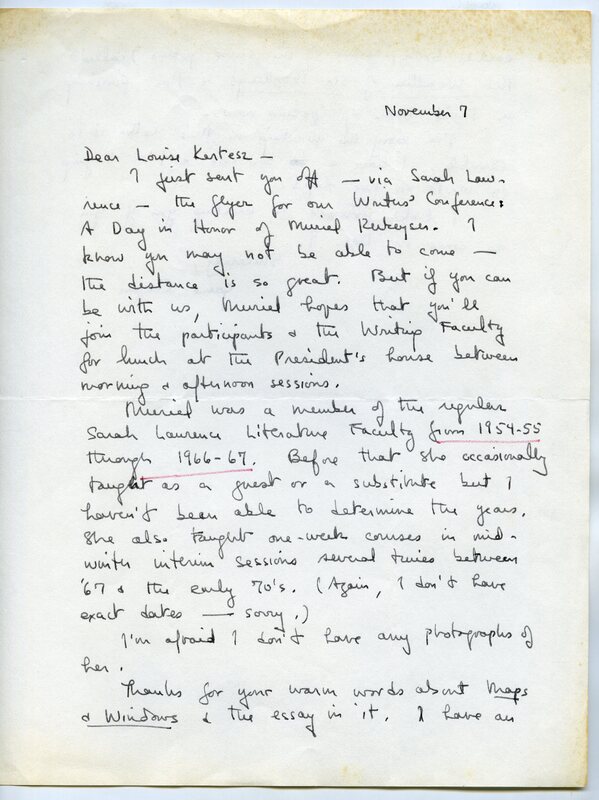
Dated November 7th. While no year is mentioned, the letter was obviously written in 1978. A handwritten letter from Jane Cooper to Louise Kertesz. Cooper talks about a Writer’s Conference: A Day in Honor of Muriel Rukeyser [December 9, 1978 at Sarah Lawrence University] that she hopes Kertesz will attend. Cooper regrets not having any photographs of Muriel. The letter is underlined in red (most likely by LK) in some places.
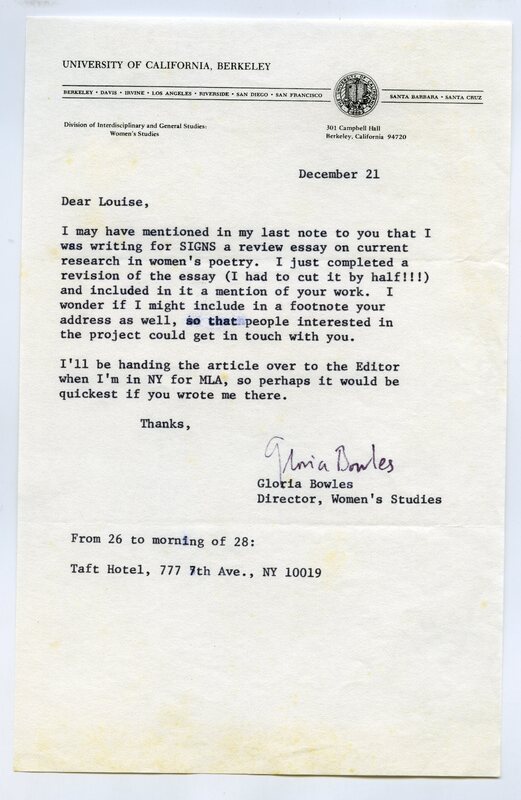
Dated December 21st, Unknown Year. A typed letter from Gloria Bowles, University of California, to Louise Kertesz. Bowles has included a mention of Kertesz’s book on Rukeyser in a review essay for Signs: Journal of Women in Culture and Society.
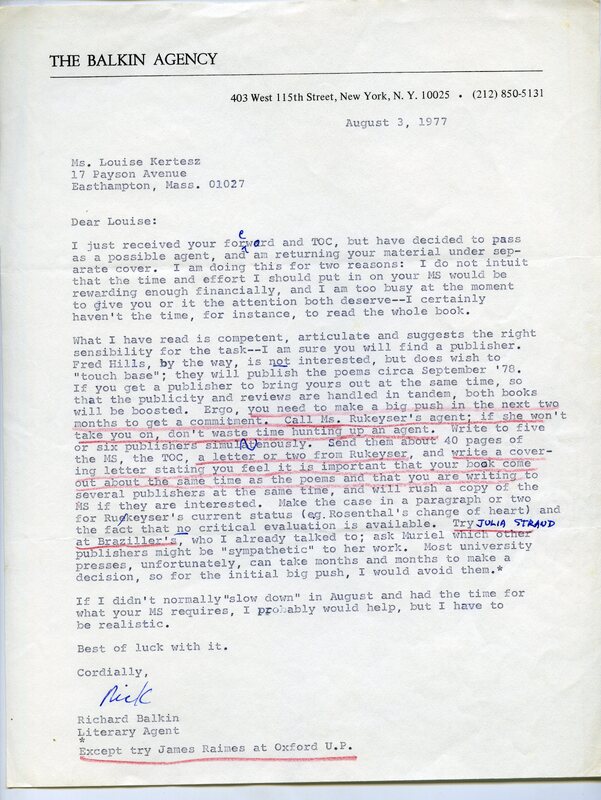
Dated August 3rd, 1977. A typed letter from the literary agent Richard Balkin. Balkin declines becoming the literary agent of Louise Kertesz, to help her publish her manuscript on Rukeyser. He does reassure her that the book will find a publisher, and suggests possible publishers and literary agents. Some handwritten notes, including the name of another agent, are added. Parts of the letter are underlined red, most likely by Kertesz.
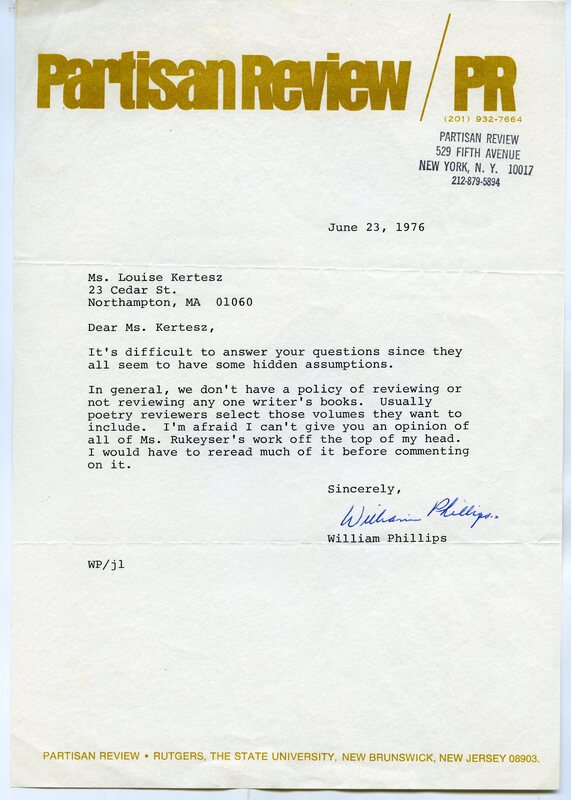
Dated June 23rd, 1976. A typed letter from William Phillips of Partisan Review to Louise Kertesz: “It’s difficult to answer your questions since they all seem to have some hidden assumptions.”
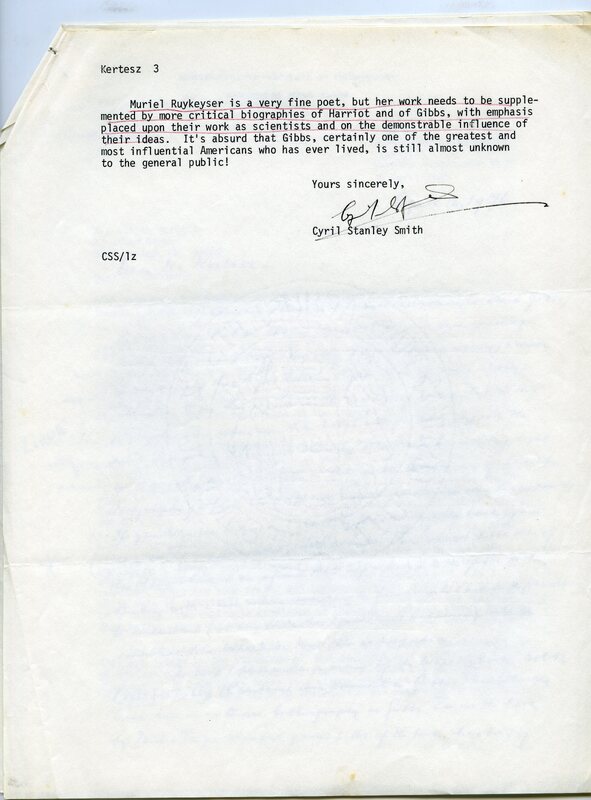
Dated April 12th, 1976, a typed letter from MIT (Massachusetts Institute of Technology) Professor Cyril Stanley Smith to Louise Kertesz, in response to her inquiries about Muriel Rukeyser’s Willard Gibbs and The Traces of Thomas Hariot. On page three, he concludes his letter by calling Rukeyser "a very fine poet." And he adds that "her work needs to be supplemented by more critical biographies of Harriot and of Gibbs, with emphasis placed upon their work as scientists and on the demonstrable influence of their ideas. It's absurd that Gibbs, certainly one of the greatest and most influential Americans who has ever lived, is still almost unknown to the general public."
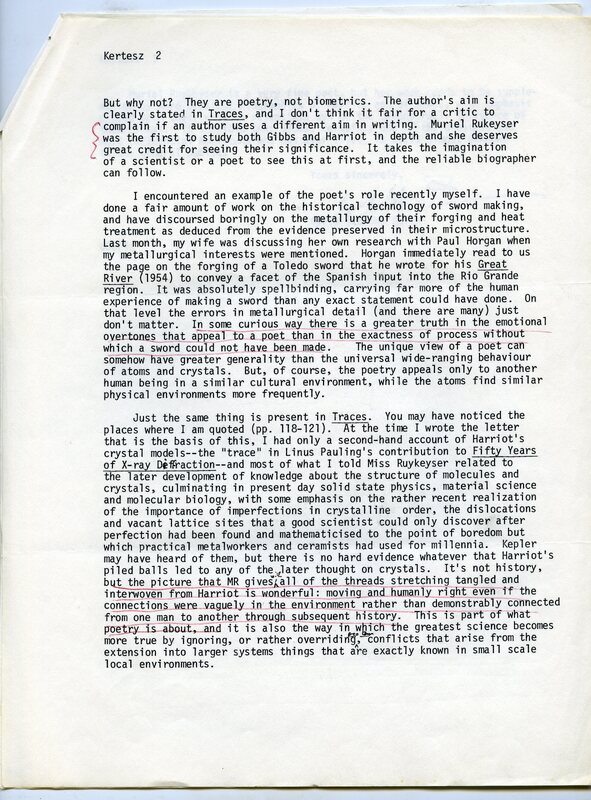
Dated April 12th, 1976, a typed letter from MIT (Massachusetts Institute of Technology) professor Cyril Stanley Smith to Louise Kertesz, in response to her inquiries about Muriel Rukeyser’s Willard Gibbs and The Traces of Thomas Hariot. On page two of the letter, he defends Rukeyser's imaginative extension of facts, writing: "In some curious way there is greater truth in the emotional overtones that appeal to a poet than in the exactness of process..." Page 2 of 3.
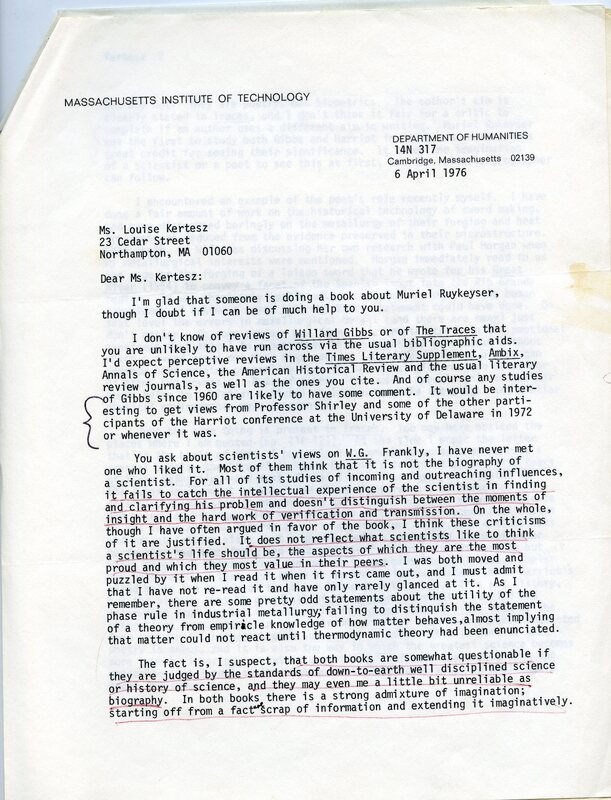
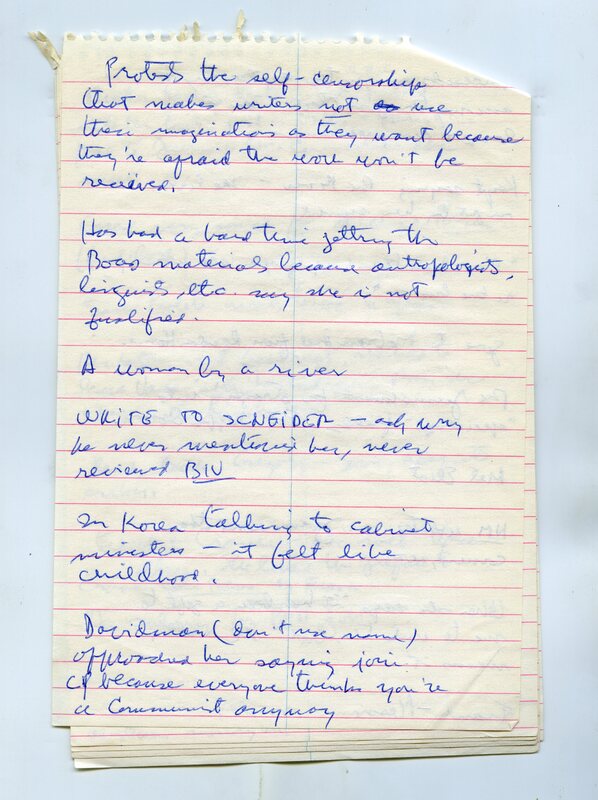
Dated April 6th, 1976, a typed three-page letter from MIT (Massachusetts Institute of Technology) Professor Cyril Stanley Smith to Louise Kertesz, in response to her inquiries about Muriel Rukeyser’s Willard Gibbs and The Traces of Thomas Hariot: “You ask about scientists' views on W.G. Frankly, I have never met one who liked it. Most of them think that it is not the biography of a scientist. For all of its studies of incoming and outreaching influences, it fails to catch the intellectual experience of the scientist in finding and clarifying his problem and doesn't distinguish between the moments of insight and the hard work of verification and transmission." Stanley himself, though he often argued in favor of the book, thinks these criticisms are justified. Nevertheless, he "was both moved and puzzled by it" when it first came out. He points out that in both books is a "strong admixture of imagination; starting off from a factual script of information and extending it imaginatively." Page 1 of 3.
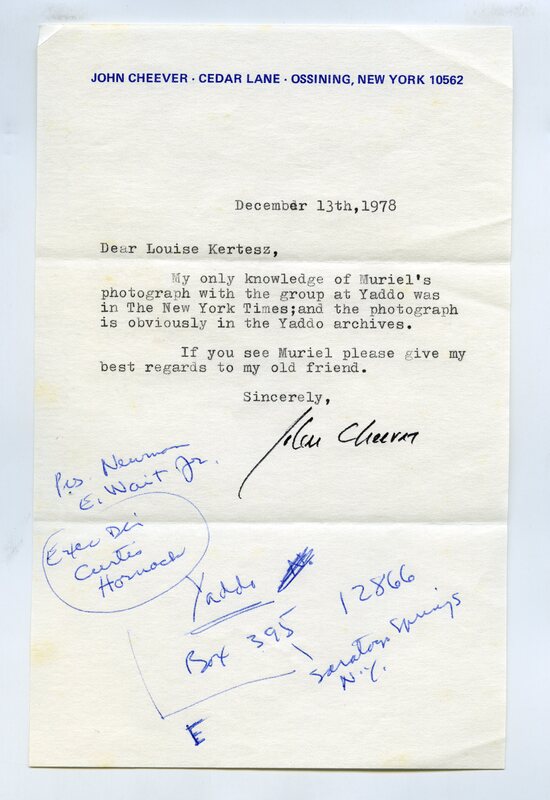
Dated December 13th, 1978. A typed letter from John Cheever to Louise Kertesz, talking about a photograph from Yaddo with Muriel in it. Also contains some handwritten notes by Louise Kertesz.
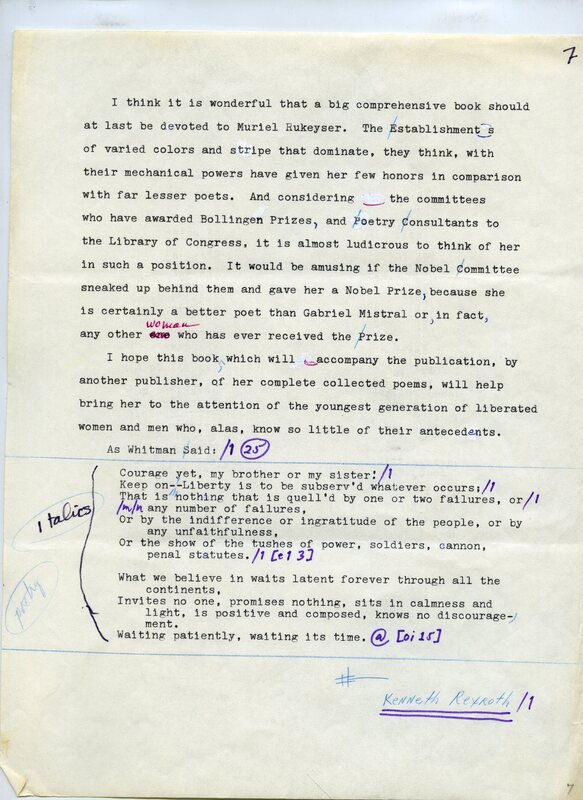
Original copy of Kenneth Rexroth’s introduction to Louise Kertesz’s book on Muriel Rukeyser, dated December 5th, 1978. There are underlines, marks, and additional notes on the introduction papers. Page 7 of 7.
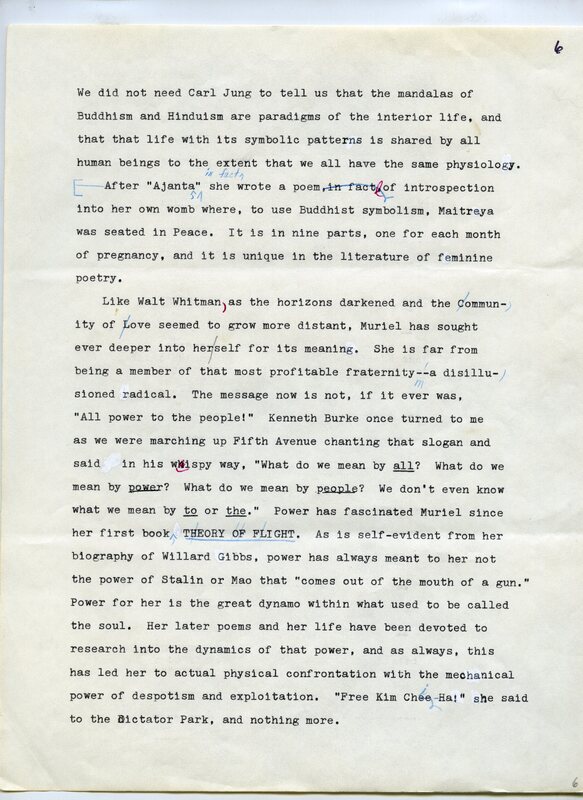
Original copy of Kenneth Rexroth’s introduction to Louise Kertesz’s book on Muriel Rukeyser, dated December 5th, 1978. There are underlines, marks, and additional notes on the introduction papers. Page 6 of 7.
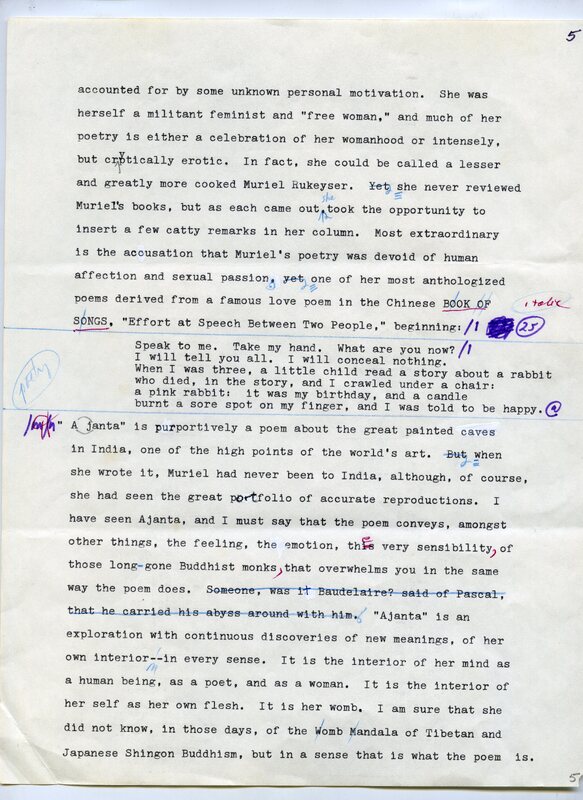
Original copy of Kenneth Rexroth’s introduction to Louise Kertesz’s book on Muriel Rukeyser, dated December 5th, 1978. There are underlines, marks, and additional notes on the introduction papers. Page 5 of 7.
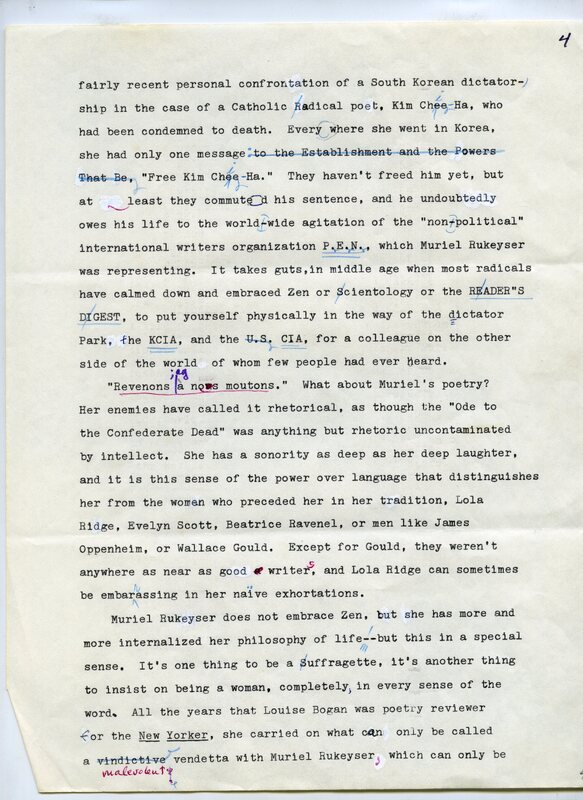
Original copy of Kenneth Rexroth’s introduction to Louise Kertesz’s book on Muriel Rukeyser, dated December 5th, 1978. There are underlines, marks, and additional notes on the introduction papers. Page 4 of 7.
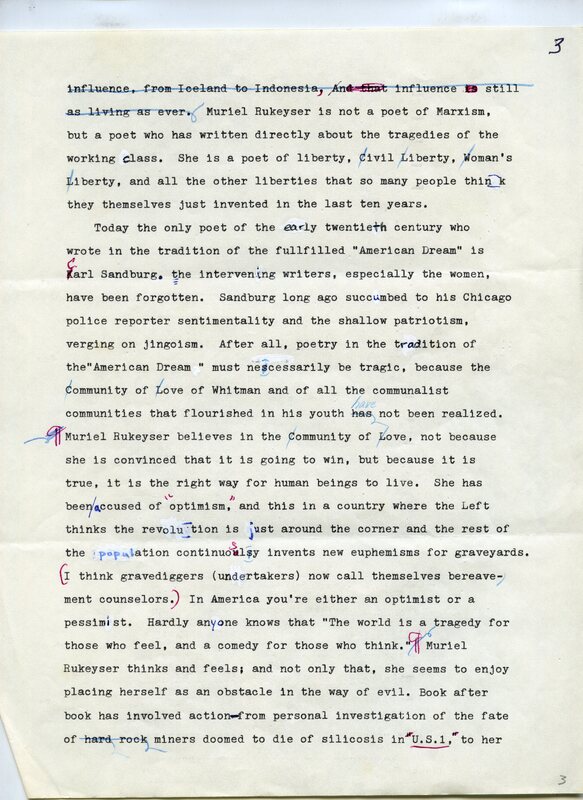
Original copy of Kenneth Rexroth’s introduction to Louise Kertesz’s book on Muriel Rukeyser, dated December 5th, 1978. There are underlines, marks, and additional notes on the introduction papers. Page 3 of 7.
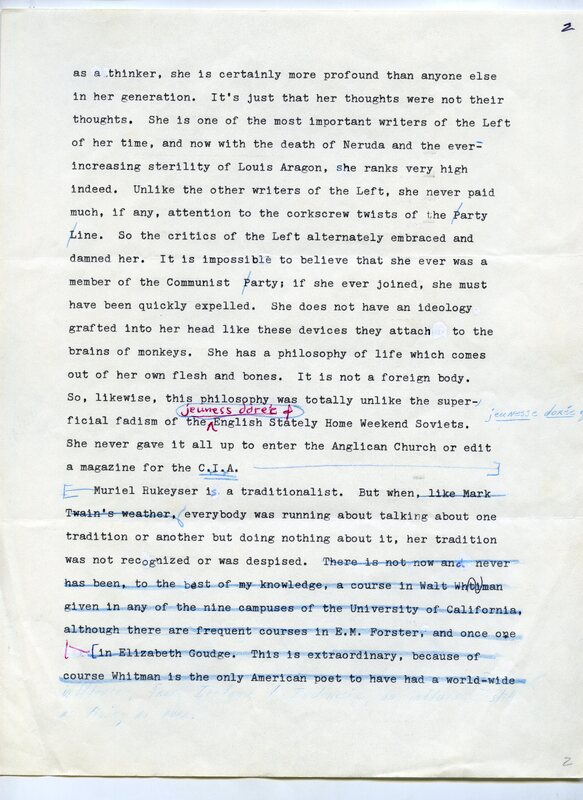
Original copy of Kenneth Rexroth’s introduction to Louise Kertesz’s book on Muriel Rukeyser, dated December 5th, 1978. There are underlines, marks, and additional notes on the introduction papers. Page 2 of 7.
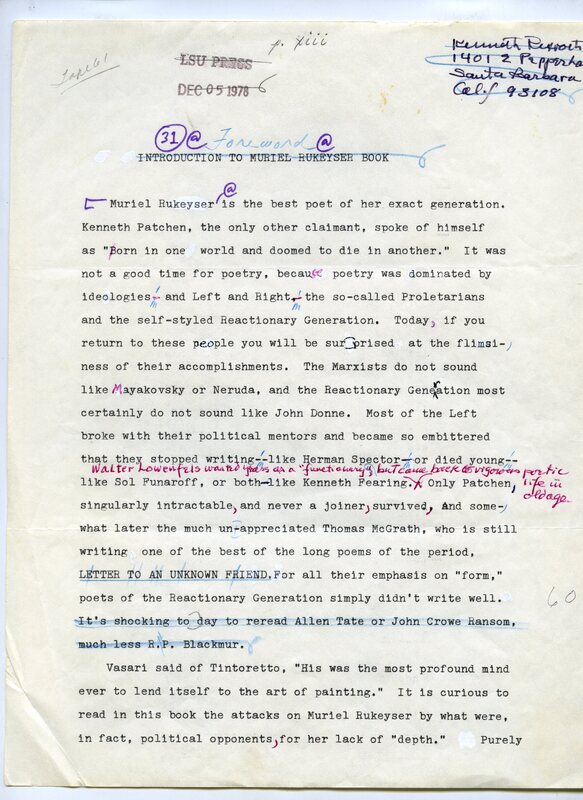
Original copy of Kenneth Rexroth’s introduction to Louise Kertesz’s book on Muriel Rukeyser, dated December 5th, 1978. There are underlines, marks, and additional notes on the introduction papers. Page 1 of 7.
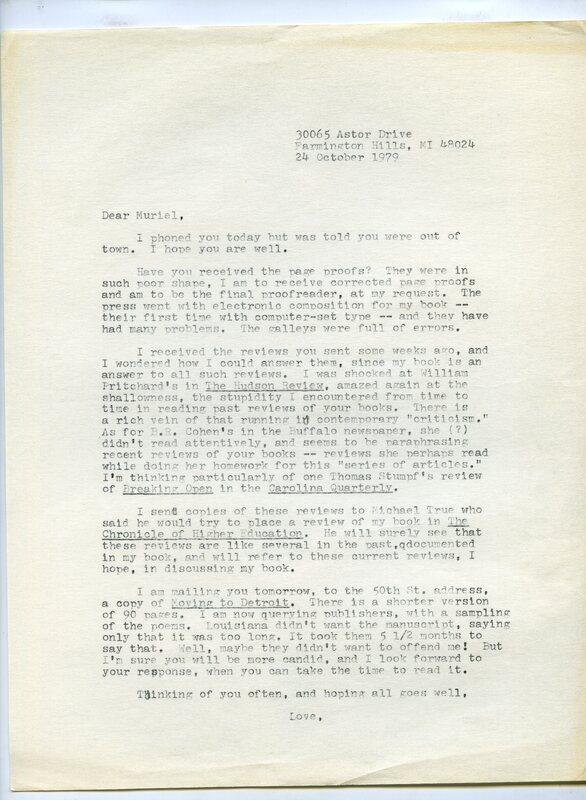
An original, typewritten letter dated October 24th, 1979. The letter is from Louise Kertesz to Muriel Rukeyser. Louise begins the letter by saying that she had phoned Rukeyser earlier today, but she was told that Rukeyser was out of town. Louise hopes that Rukeyser is doing well. Louise asks Rukeyser if she has received the page proofs. The proofs were in such poor shape that Louise requested that she will be the final proofreader for the corrected page proofs. The press went with electronic composition for her book, which is their first experience with computer set type, and they have had many problems. The galleys were full of errors. Louise received the reviews that Rukeyser had sent her a few weeks ago, and she wonders how she could answer them, since her book is an answer to all of these reviews. Louise was particularly shocked at William Prichard’s review in The Hudson Review, and amazed at the “...shallowness, the stupidity I encountered from time to time in reading past reviews of your books.” "There is a rich vein of that running in contemporary 'criticism.'” Louise then states that B.R. Cohen, in [her?] review in the Buffalo Newspaper "didn’t read attentively, and seems to be paraphrasing recent reviews of your books." Louise sent copies of these reviews to Michael True who said he would try to place a review of her book in The Chronicle of Higher Education. True will see that the reviews that Rukeyser sent Louise are like several others documented in Louise’s book. Louise hopes that True will reference these reviews in his review of Louise’s book. She is also mailing to Rukeyser at her 50th St. address a copy of Moving to Detroit. There is a shorter version at 90 pages. Louise is now querying publishers, with a sampling of the poems. Louisiana didn’t want the manuscript, saying only that it was too long. It took five and a half months for them to say that. Perhaps they didn’t want to offend Louise, but Louise is sure that Rukeyser will be more candid. She is looking forward to Rukeyser’s response, when she gets time to read it. Louise ends the letter by saying that she is thinking of Rukeyser, and she hopes that all is well.
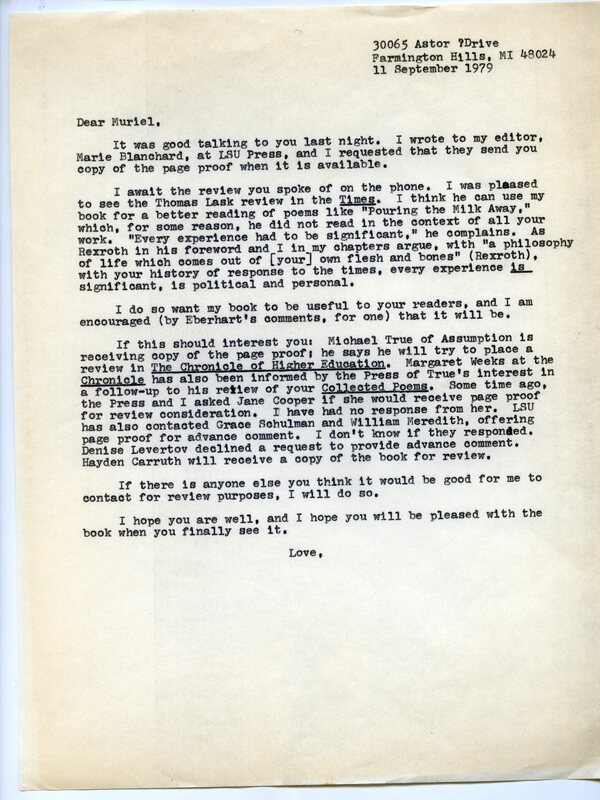
An original typewritten letter dated September 11th, 1979. The letter is from Louise Kertesz to Muriel Rukeyser. Louise begins the letter by saying that it was good to talk with Rukeyser last night. Louise had written to her editor at LSU Press, Marie Blanchard, and requested that they send Rukeyser a copy of the page proof when it is available. Louise is waiting for the review that Rukeyser spoke of on the phone. Louise was pleased to see the Thomas Lask review in the Times. She thinks that Lask will be able to use her book for better readings of some of the poems, such as “Pouring the Milk Away,” which he did not read in the context of all of Rukeyser’s work. Lask stated that “Every experience had to be significant." Kenneth Rexroth argues that the poems show “... a philosophy of life which comes out of [your] own flesh and bones.” Louise states that “...with your history and response to the times, every experience is significant, is political and personal." Louise does want her book to be useful to Rukeyser’s readers, and has been encouraged by Eberhart’s comments that it will be. Louise informs Rukeyser that Michael True of Assumption is receiving a copy of the page proof, and he says he will try to place a review in The Chronicle of Higher Education. Margaret Weeks at The Chronicle had also been informed by the Press of True’s interest in a follow-up of his review of Rukeyser’s Collected Poems. Some time ago, Louise and the Press had asked Jane Cooper if she would read the page proofs in order to review the book. Louise received no response from her. Louise had also contacted Grace Schulman and William Meredith, offering page proofs for advance comment. Louise does not know if they responded. Denise Levertov declined a request for advanced comment. Hayden Carrruth will get a copy of the book for a review. If there is anyone else that Rukeyser would recommend for a review, Louise will contact them. Louise ends the letter by saying that she hopes that Rukeyser is well, and that she will be pleased with the book when she sees it.
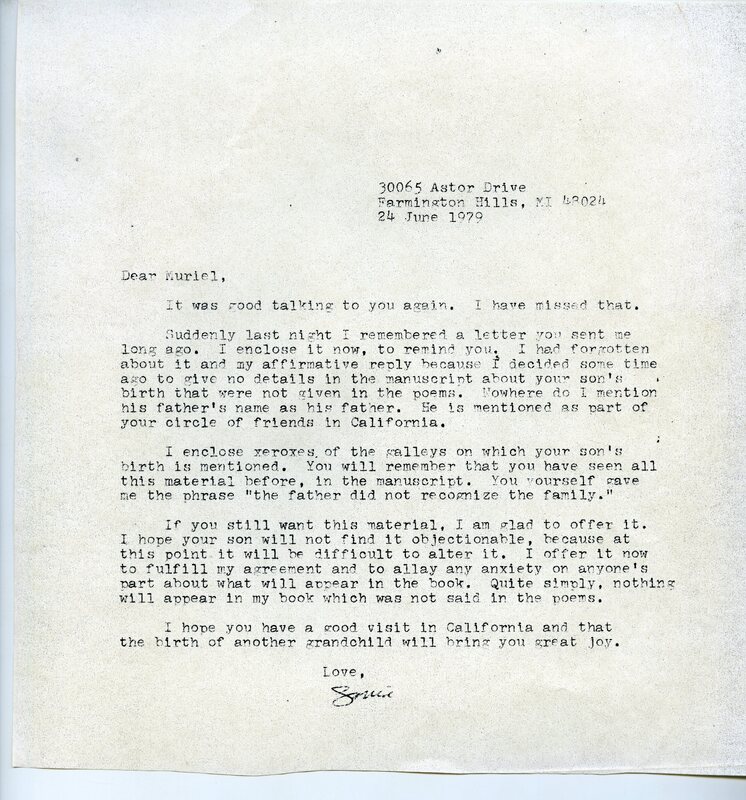
Photocopy of a typewritten letter, dated June 24th, 1979. The letter is from Louise Kertesz to Muriel Rukeyser. Louise begins the letter by saying that she enjoyed talking to Rukeyser again, and that she had missed that. Last night, Louise had remembered a letter that Rukeyser sent her long ago. Louise is enclosing it in the envelope to remind Rukeyser about it. Louise had forgotten about it and her reply because Louise had decided some time ago to give no details in the manuscript about the birth of Rukeyser’s son that were not given in the poems. Louise did not mention his father’s name as his father. His name was only mentioned in the list of people in California that Rukeyser knew. Louise encloses xeroxes of the galleys on which Muriel’s son’s birth is mentioned. Rukeyser should remember that she had seen the material before in the manuscript. Rukeyser had given the statement that the father “did not recognize the family.” If Rukeyser still wants that material, Louise would be glad to offer it. Louise hopes that Rukeyser’s son will not find it objectionable because it would be hard to alter at this point. Louise sends the information to Rukeyser now to honor her agreement and to allay any anxiety on anyone’s part about what will appear in Louise’s book. "Simply put, nothing will appear in my book which was not said in the poems." Louise ends the letter by saying that she hopes that Muriel has a good visit in California and that the birth of another grandchild will bring her great joy.
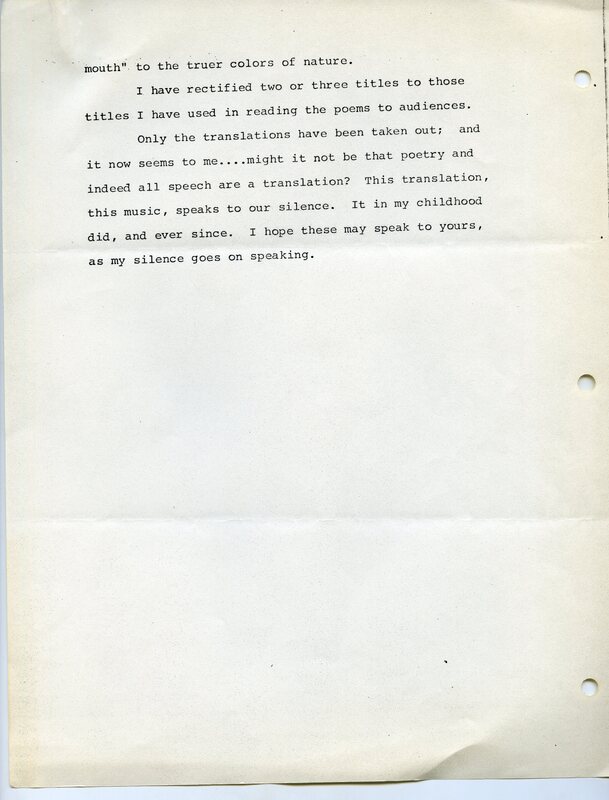
Type-written three-page Preface to The Collected Poems of Muriel Rukeyser. The preface was written by Rukeyser, and dedicated, in a hand-written note on the upper right of page one, "for Louise with Love, Muriel." Page 3 of 3.
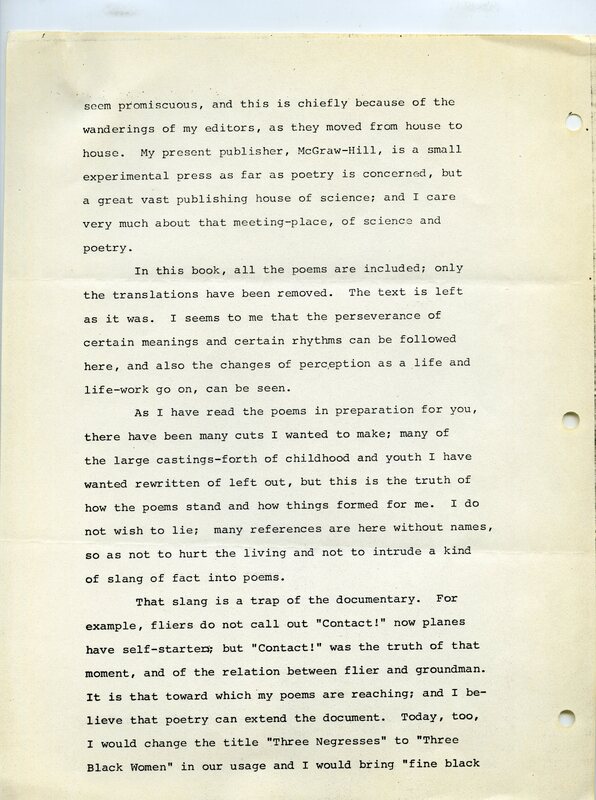
Type-written three-page Preface to The Collected Poems of Muriel Rukeyser. The preface was written by Rukeyser, and dedicated, in a hand-written note on the upper right of page one, "for Louise with Love, Muriel." Page 2 of 3.
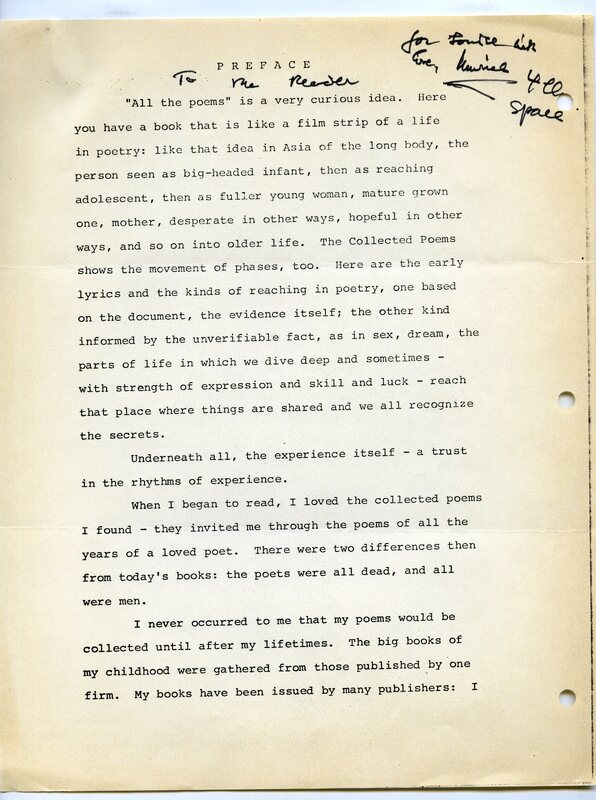
Type-written three-page Preface to The Collected Poems of Muriel Rukeyser. The preface was written by Rukeyser, and dedicated, in a hand-written note on the upper right of page one, "for Louise with Love, Muriel."
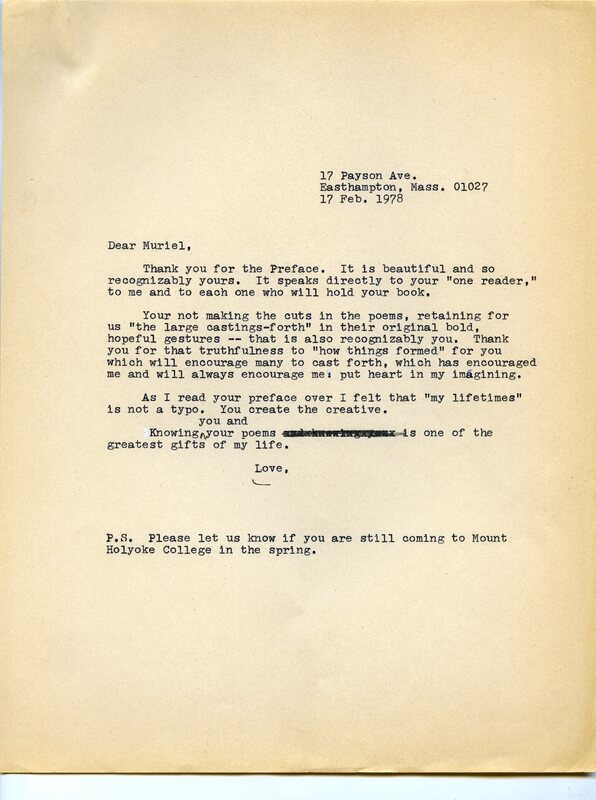
Original letter, dated February 17th, 1978 , written by Louise Kertesz to Muriel Rukeyser and attached to a typed copy of Rukeyser's preface to her forthcoming Collected Poems. Louise begins the letter by thanking Muriel for the Preface to the book. The Preface is “...beautiful and so recognizably yours.” It speaks directly to Rukeyser’s “one reader,” to Louise and to each person who will hold Rukeyser’s book. Louise then states that the fact that Muriel did not cut the poems, and that “...retaining for us the large castings forth in their original bold, hopeful gestures—that is also recognizably you.” She thanks Rukeyser for her truthfulness in “'how things formed' for you which will encourage many to cast forth, which has encouraged me and will always encourage me: put heart into my imagining." As Louise read the Preface over and over, she felt like “my lifetimes” was not a typo, and that Rukeyser creates the creative. Louise ends the letter by saying that knowing Rukeyser’s poems is one of the greatest gifts of her life. There is a postscript to the letter that asks whether or not Rukeyser is still coming to Mount Holyoke College in the Spring.
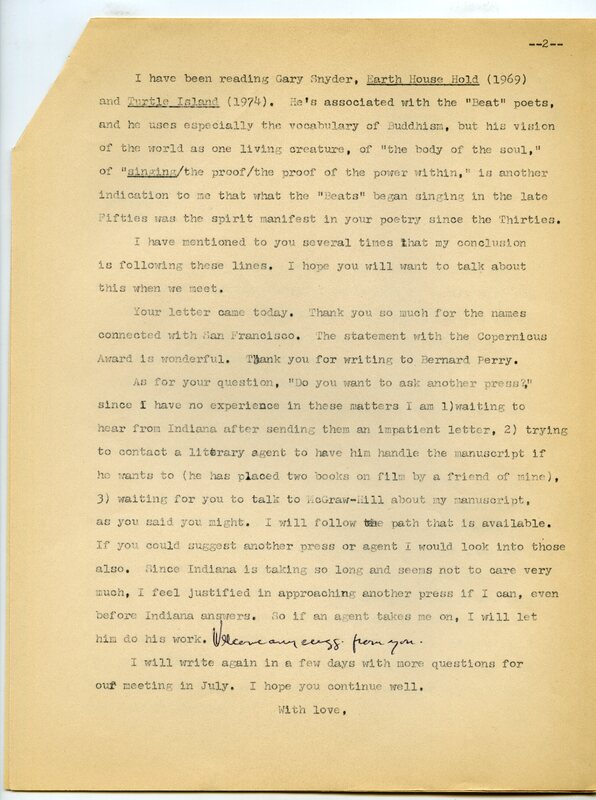
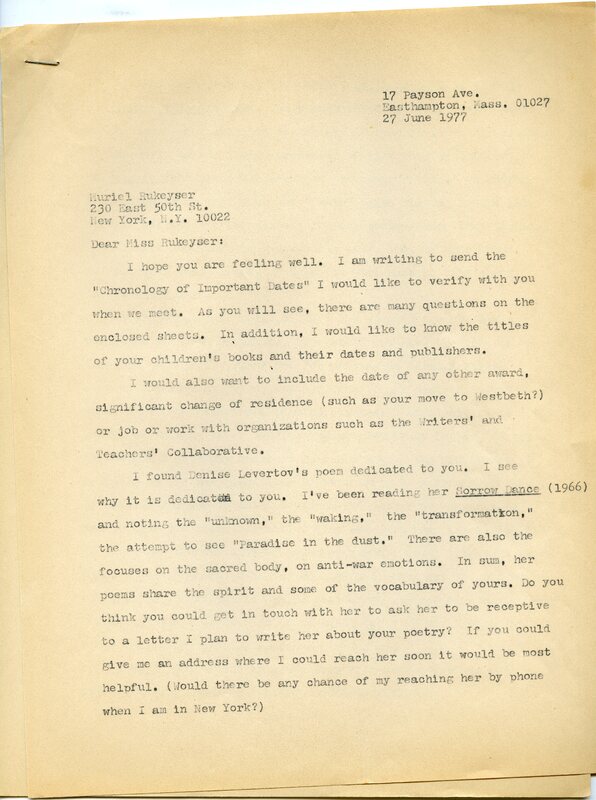
An original, two-page letter, dated June 27th, 1977. Presumably from Louise Kertesz to Muriel Rukeyser. Louise is sending Rukeyser “The Chronology of Important Dates” that she would like to verify with her when they meet. Louise is also enclosing many questions in an envelope. In the “Chronology of Important Dates" Louise wants to include the date of any of Rukeyser’s awards, significant changes in residence, or Rukeyser’s work with organizations such as the Writers’ and Teachers’ Collaborative. Louise found Denise Levertov’s poem dedicated to Rukeyser. She had been reading Levertov’s Sorrow Dance, and noted the “unknown”, the “waking,” and the “transformation,” and also the attempt to see “Paradise in the dust.” Levertov's poems, she notes, "share the spirit and some of the vocabulary of yours." Louise asks Muriel to find out if Levertov would be receptive to inquiries about her poetry. Louise has also read Gary Snyder's Earth House Hold and Turtle Island. Snyder is associated with the Beat poets and uses Buddhist terms, but his vision of the world as one living creature, or “the body of the soul,” and of “singing/the proof/the proof of the power within” is another indication that "what the Beats' began singing in the late Fifties was the spirit manifest in your poetry since the Thirties." Louise hopes Muriel will talk with her about this when they meet. Rukeyser’s letter listing the names of people whom she knew in San Francisco had arrived that day. Louise thanks her for her letter, and for writing to Bernard Perry. Louise also says that Rukeyser’s statement for the Copernicus award was wonderful. As for Rukeyser’s question, “Do you want to ask another press?” Louise replies that she has no experience in these matters, and is trying to hear from Indiana after sending them an impatient letter, trying to contact a literary agent and have him handle the manuscript, and finally, waiting for Rukeyser to talk to McGraw-Hill about her manuscript, as Rukeyser said she might do. Louise will follow the path that is available. If Rukeyser could suggest another press or agent, Louise would look into those as well. Since Indiana is taking so long and does not seem to care very much, Louise feels justified in choosing another press if she can, even before Indiana answers. So if an agent takes Louise on, she will let him do the work. Louise ends the letter by saying that she will write again in a few days with more questions for her and their meeting in July. Louise hopes Muriel continues to do well. There is a sentence of handwriting on page two of the letter.
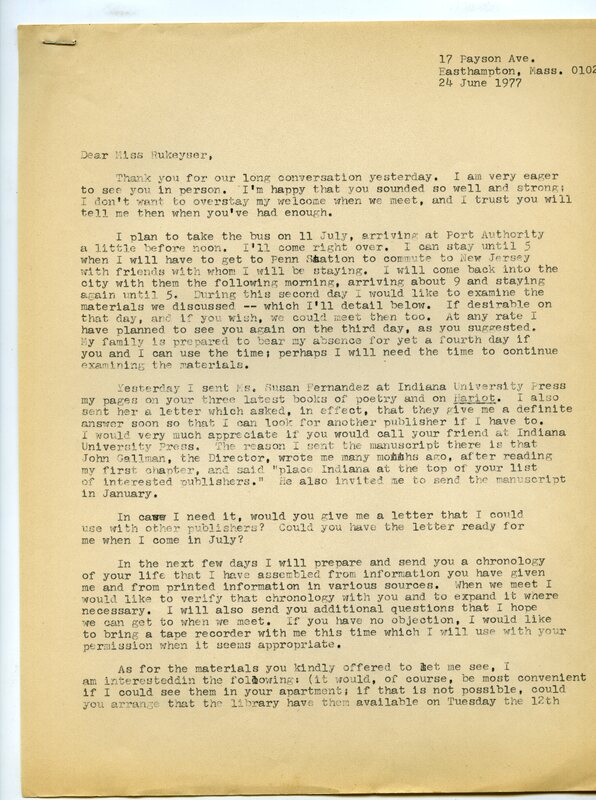
Original typewritten letter, dated June 24th, 1977. The letter is from Louise Kertesz to Muriel Rukeyser. Louise thanks Rukeyser for their long (phone) conversation the day before. She is very eager to see her in person. Louise is happy that Muriel sounded so well and strong, and expresses concern about not overstaying her welcome when they meet. Louise plans to take the bus on July 11th, arriving at Fort Authority a little before noon. Louise will come right over. She can stay until 5, which is when she will have to go to Penn Station to commute to New Jersey, where she will be staying with friends until the following morning, arriving at Rukeyser’s at about 9 and staying again until 5. During the second day, Louise would like to examine the materials that they have discussed which she will detail later in the letter. If desirable, Louise will see her again on the third day, as Rukeyser suggested. Louise’s family is prepared to bear her absence for a fourth day if she and Muriel could use the time. Yesterday, Louise sent Susan Hernandez at Indiana University Press her pages on Rukeyser’s three latest books of poetry and on Hariot. Louise also sent the press a letter which asked if they would give her a definite answer soon so she can look for another publisher if she has to. Louise would appreciate it if Rukeyser could call her friend at Indiana University Press. The reason that Indiana University Press was on the top of the list of publishers is that John Gallman, the director, wrote Louise many months ago after reading the first chapter of her book, saying, “Place Indiana at the top of your list of interested publishers.” He also invited Louise to send the manuscript in January. In case she needs it, Louise asks if Rukeyser can give her a letter that she can use with other publishers, and if Rukeyser can have the letter ready by the time Louise meets with her in July. In the next few days, Louise will prepare and send Rukeyser a chronology of her life that she assembled from information that Rukeyser had given her and from printed information from various sources. When Louise and Rukeyser meet, Louise would like to verify that chronology and expand it if necessary. Louise will also send her additional questions that she hopes Rukeyser can answer when they next meet. If Rukeyser has no objections, Louise would like to bring a tape recorder with her which she will use with Rukeyser’s permission when it seems appropriate. As for the material that Rukeyser offered to let Louise see, Louise says it would be best to look at it in her apartment, but Rukeyser can also arrange for the library to have it available on Tuesday the 12th. The letter cuts off here, and no information about what Louise wanted to see is given. It is highly probable that the letter went on for another page.
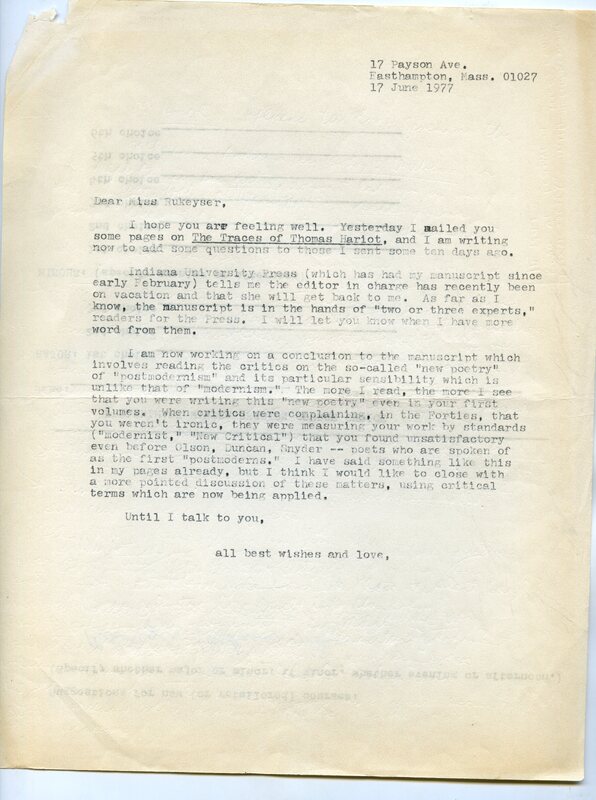
Original typewritten letter, dated June 17th, 1977. The letter is from Louise Kertesz to Muriel Rukeyser. Louise hopes Rukeyser is feeling well, and tells her that she mailed her a few pages on The Traces of Thomas Hariot, and that she is writing now to ask a few questions about those pages. Indiana University Press, who had Louise’s manuscript since early February, told Louise that the editor in charge went on vacation, and that the manuscript is in the hands of two or more experts. Louise will let Rukeyser know if she hears anything from them. Louise is now working on a conclusion to the manuscript which involves reading a critic on the so-called “new poetry” of "postmodernism,” the particular sensibility which is unlike that of “modernism.” The more Louise reads, the more she sees that Rukeyser was writing this ”new poetry” even in her first volumes. When critics were complaining in the Forties that Rukeyser wasn’t ironic, they were measuring her works by standards that Rukeyser had found unsatisfactory even before Olson, Duncan, and Snynder, who are poets now spoken of as the first “postmoderns.” Louise had said something like that already, but she thinks she would like to close with a more pointed discussion of these matters, using critical terms which are now being applied. The back page of the letter is a course selection sheet.
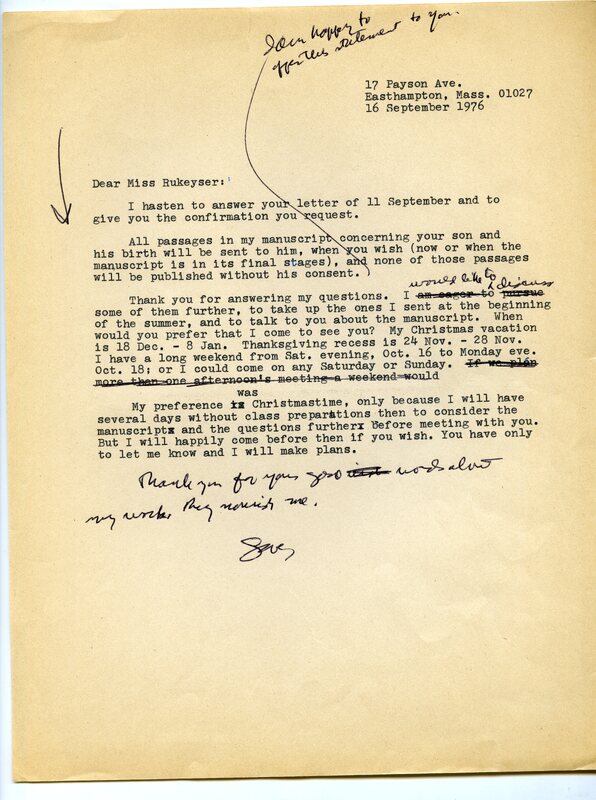
An original typewritten letter [perhaps a draft], dated September 16th, 1976. The letter is from Louise Kertesz to Muriel Rukeyser. Louise begins the letter by saying that she hurried to answer Rukeyser’s letter sent on September 11th. Louise confirms that all passages in her manuscript about Rukeyser’s son and his birth will be sent to him, whenever Rukeyser wished, and that none of the passages will be published without his consent. Louise thanks Rukeyser for answering her questions. Louise would like to discuss some of them further, to take up the ones that she sent Rukeyser at the beginning of the summer, and to talk with her about the manuscript. Louise asks when Rukeyser would prefer for Louise to come and see her. Her Christmas vacation is December 18th to January 6th. Her Thanksgiving recess is November 24th to November 28th. Louise has a long weekend from Saturday evening, October 16th to Monday evening on October 18th, or she could come to see Muriel on any Saturday or Sunday. Her preference is Christmastime, because she will have several days without class preparations then. However, Louise could come before Christmas if Rukeyser wishes. Rukeyser only has to let Louise know and she will make plans. Some sections of the letter are crossed out, with additional writing included.
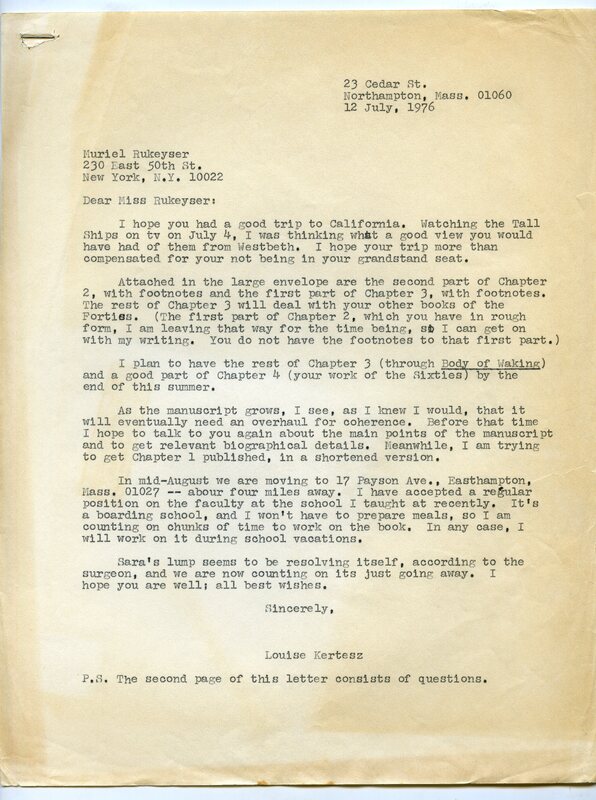
An original, typewritten copy of a letter, dated July 12th, 1976. The letter is from Louise Kertesz to Muriel Rukeyser. Louise begins the letter by saying that she hopes that Rukeyser had a good trip to California. Louise watched the Tall Ships on July 4th and was thinking about what a good view Rukeyser would have had of them from Westbeth. Louise attached the second part of Chapter 2 of her book in the envelope, with footnotes, and the first part of Chapter 3. Chapter 3 will deal with Rukeyser’s books from the 40s. Louise had given Rukeyser the first part of Chapter 2 in rough copy, and she is leaving it that way for the time being. Louise plans to get Chapter 3 and a good part of Chapter 4 done that summer. As Louise’s manuscript grows, she sees that it needs an overhaul for coherence. Before that time, Louise hopes to talk to Rukeyser again and to get relevant biographical details. She is also trying to get Chapter 1 published in a shortened version. In mid august, Louise and her family are moving to 17 Payson Avenue in Easthampton, Massachusetts. Louise accepted a position on the faculty at the school that she taught at recently. It is a boarding school, and she won’t have to prepare meals, so she is counting on a lot of extra time to work on her book. In any case, she will also work on the book on school vacation. Sara’s lump seems to be resolving itself according to the surgeons, and now they are expecting it to just go away. Louise ends the letter by sending Rukeyser her best wishes. A postscript says that the second part of the letter consists of questions.
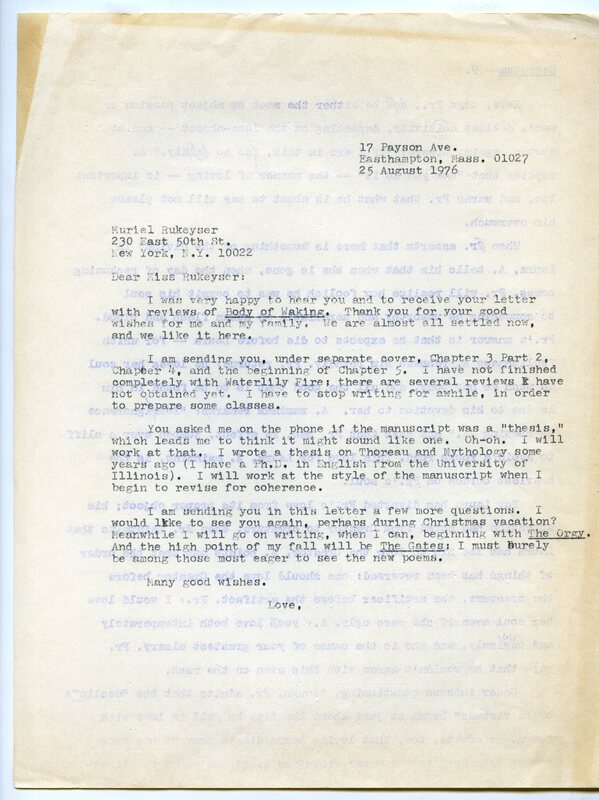
Original handwritten letter, dated August 25th, 1976. The letter is from Louise Kertesz to Muriel Rukeyser. Louise begins the letter by saying that she was happy to hear from Rukeyser and receive her letter with reviews for Body of Waking. Louise also thanks Rukeyser for her fond wishes for her and her family; they are almost settled in their new home, which they like. Louise is sending Rukeyser, under separate cover, Chapter 3 Part 2, Chapter 4, and the beginning of Chapter 5 of her book. Louise has not finished totally with Waterlily Fire, since there are several reviews she has not obtained. Louise will also have to stop working for a while, in order to prepare for her classes. Muriel had asked Louise on the phone if the manuscript was a thesis, which leads Louise to think that it might sound like one. Louise assures Rukeyser that she will make sure it won’t sound like a thesis. Louise had written a thesis on Thoreau and Mythology some years ago, since she has a Ph.D. in English from the University of Illinois, and she will work on the style of the manuscript when she begins to revise for coherence. Louise is sending Rukeyser a few more questions. She would like to see Rukeyser again, perhaps during Christmas vacation. Louise will continue writing while she can, beginning with The Orgy. The high point of her fall will be writing about The Gates. Louise states that she is surely among "those most eager to see the new poems." On the back of the letter is what looks like the fragment of an essay Louise may possibly have written during Graduate School.
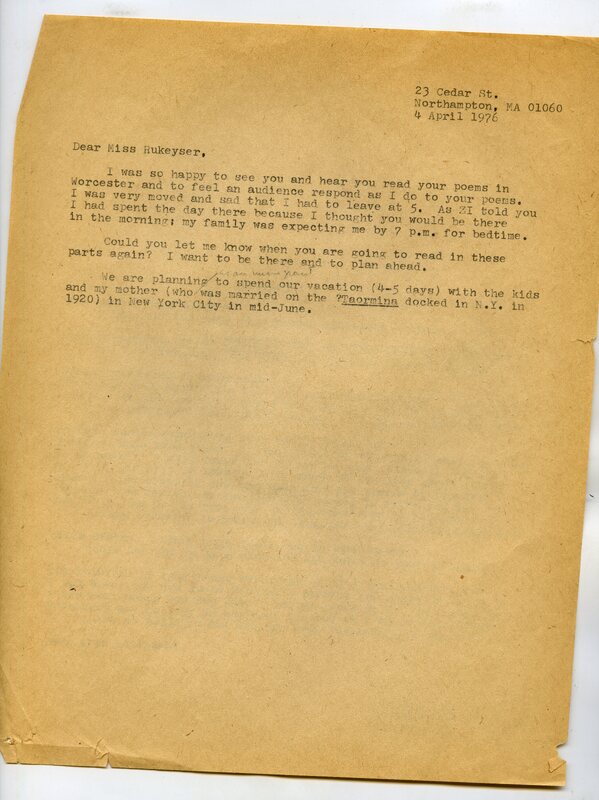
An original, typewritten letter, dated April 4th, 1976. The letter is from Louise Kertesz to Muriel Rukeyser. Louise begins the letter by saying that she was happy to hear Rukeyser read her poems in Worcester, and to see an audience respond to the poems the way she herself did. She was moved by her poems, and was sad that she had to leave at 5 o’ clock. Louise had spent the day there, expecting Rukeyser would be there in the morning, but had to leave early since her family expected her home at 7 pm for bedtime. Louise asks Rukeyser to tell her when she will read the poems again, so she can plan ahead. Louise then says that her family is planning to spend her vacation, which will last 4 to 5 days, with the kids and her mother in New York City in June. Louise tells Rukeyser about her mother, an immigrant from Italy, who in 1920 "was married on the Taormina docked in N.Y., and she has always loved visiting the standards: the Statue of LIberty, etc." Should Rukeyser read her poems in New York, Louise wants to be there. Louise will phone Rukeyser before they come to see whether or not Rukeyser can spare them some time. It would give Louise and Chris, her husband, great pleasure if they could take her to dinner. Louise is enclosing questions with this letter. Louise states that Muriel was very kind to suggest taped replies. If Rukeyser would prefer, they can wait until a meeting in mid-June. Louise then thanks Rukeyser for her warm encouragement, and tells her she is deeply committed to her work. Louise will be teaching Moby Dick for the next few weeks, but she is teaching Rukeyser’s works Breaking Open and The Speed of Darkness in another class. Louise ends the letter hoping that Rukeyser is doing well. Incomplete copy of letter on the back of the sheet.
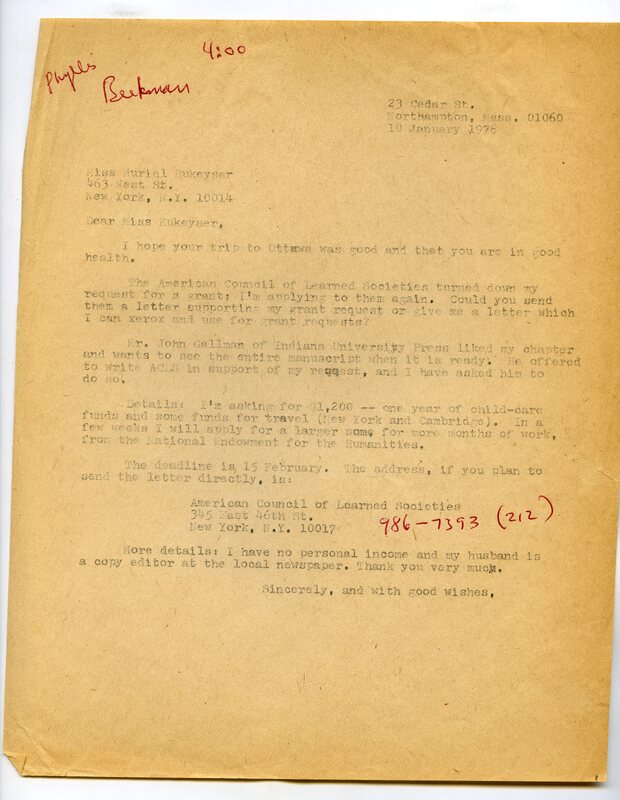
Dated January 10th, 1976. A worn, typewritten letter from Louise Kertesz to Muriel Rukeyser. Kertesz hopes that Muriel’s trip to Ottawa was good and that she is in good health. The American Council of Learned Societies turned down her request for a grant, and she is applying to them again. Louise asks for Rukeyser to send her a letter supporting her petition for a grant. She is asking for $1,200 dollars, for one year of child-care and some funds for travel to New York and Cambridge. (Today, that amount would be approximately $6,028).
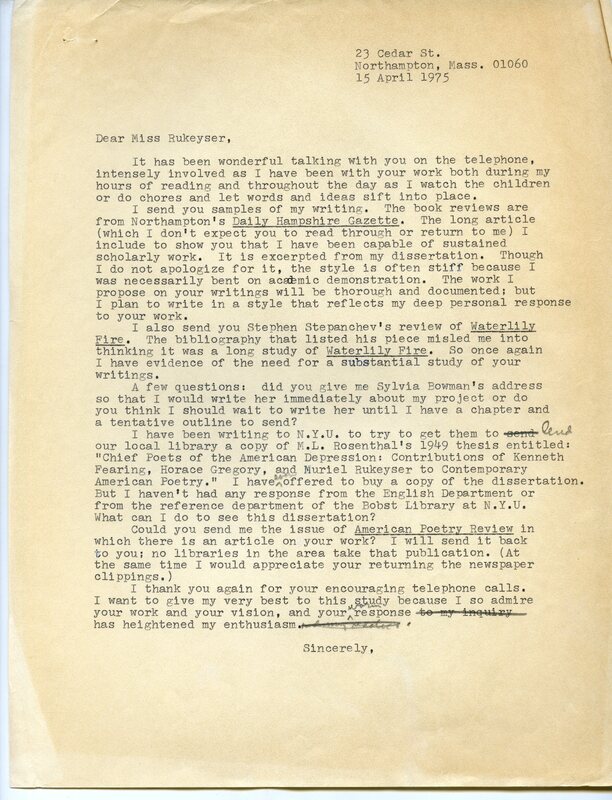
An original, typewritten letter, dated April 15th, 1975. The letter is from Louise Kertesz to Muriel Rukeyser. Louise states that it has been wonderful talking with Rukeyser on the telephone. Louise has been intensely involved with Rukeyser’s work, during her hours of reading and even throughout the day when she watches her children do chores. Louise sent Rukeyser samples of her writing. The book reviews are from Northampton’s Daily Hampshire Gazette. The long article, which Louise doesn’t expect Rukeyser to read fully or even send back to her, is intended to show that she can do scholarly work. It is an excerpt from her dissertation. Louise does not apologize for it, but explains that the style is often stiff because she was bent on academic approbation. The work that Louise proposes to do on Rukeyser’s writings will be thorough and documented, but in a style that reflects her deep personal response to her work. Louise also sent Rukeyser Stephen Stepanchev’s review of Waterlily Fire. The bibliography had misled Louise into thinking it was a long study of Waterlily Fire. Once again, this gives Louise evidence of the need for a substantial study of Rukeyser's writings. Louise wrote to New York University trying to get hold of M.L. Rosenthal’s 1949 thesis entitled “Chief Poets of the American Depression: Contributions of Kenneth Fearing, Horace Gregory, and Muriel Rukeyser to Contemporary American Poetry.” Louise also asks Muriel Rukeyser to send her a copy of American Poetry Review in which her work is featured in an article. Louise will send it back to Rukeyser. Louise ends the letter by thanking Rukeyser for her encouraging telephone calls. Louise wants to give her very best to the proposed study because she admires Rukeyser’s work and her vision, and also due to the fact that Rukeyser’s response has heightened her enthusiasm.
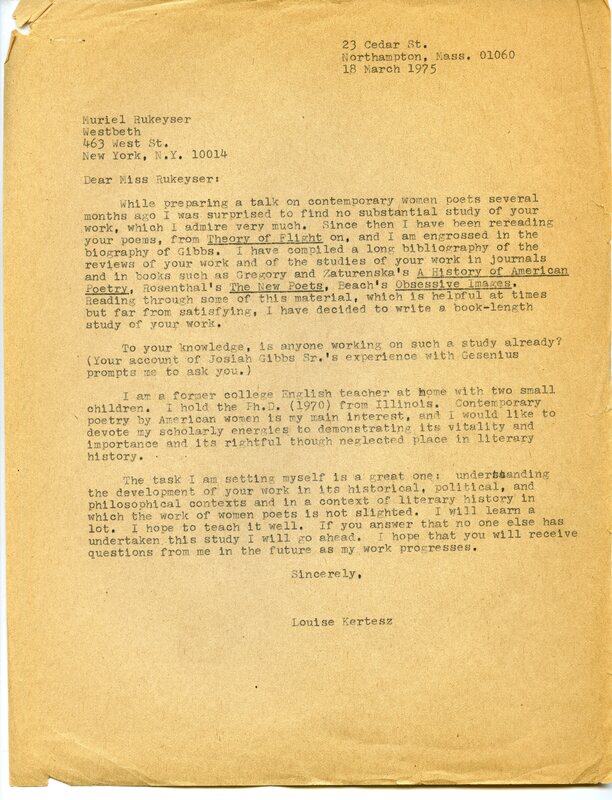
Original, fragile, typewritten letter, dated March 18th, 1975. The letter is from Louise Kertesz to Muriel Rukeyser. This is the first letter Louise wrote to Rukeyser. While Louise was preparing a talk on contemporary women poets several months ago, she was surprised to find that no substantial study had been done on Muriel Rukeyser’s work. Since then, Louise had been reading her poems, from Theory of Flight on, and is currently engrossed in her biography of Gibbs. Louise has compiled a long bibliography of the reviews of Rukeyser's work and of the studies of Rukeyser’s work in journals and in books such as Gregory and Zaturenska’s A History of American Poetry, Rosenthal’s The New Poets, Beach’s Obsessive Images. Reading through this material, which was helpful at times but far from satisfying, compelled her to write a book-length study of Muriel Rukeyser’s work. Louise asks Muriel if she knows whether or not anyone has been working on a study already, Rukeyser’s account of Josiah Gibbs Sr. 's experience with Gesenius prompted her to ask Rukeyser. Louise describes herself as a former college English teacher with a PhD from Illinois, presently at home with two small children. Contemporary poetry by American Women is Louise’s main interest. Louise would like to devote her scholarly energies to demonstrating the vitality of Rukeyser’s work and give it its proper place in literary history. The task that Louise is setting for herself is a great one, which is to understand the development of Rukeyser’s work in its historical, political, and philosophical contexts and in a context in which the work of women poets is not slighted. Lousie will learn a lot, and hopes to teach it well. If Rukeyser says that no one else has undertaken a study of her work, Louise will begin her own. She ends the letter by saying that she hopes that Rukeyser is willing to respond to questions from Louise as the work progresses.
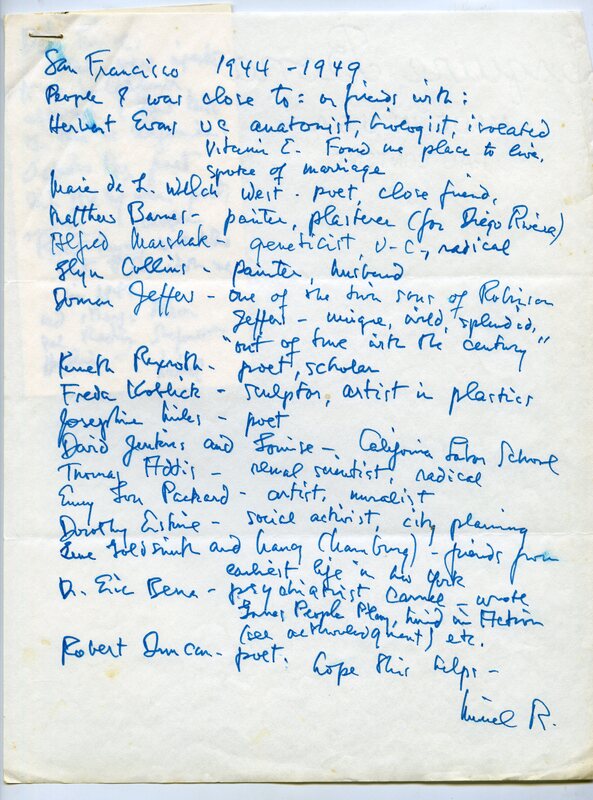
Undated, labeled "San Francisco 1944-1949." Handwritten by Muriel Rukeyser, it contains a list of people whom Muriel was close to and their occupations while she lived in S.F.: Herbert Evans, US anatomist, biologist; Marie de L. Welch, writer, poet, “close friend”; Matthew Barnes, painter, plasterer for Diego Rivera; Alfred Marshak, geneticist, U-C, radical; Glyn Collins, “painter, husband”; Donan Jeffers, “one of the twin sons of Robinson Jeffers–unique, wild, splendid, ‘out of time with the century’”; Kenneth Rexroth, “poet, scholar”; Freda Koblick, “sculptor, artist in plastics; Josephine Miles, poet; David Jenkins and Louise, California Labor School; Thomas Addis, renal scientist, radical; Emmy Lou Packard, artist, muralist; Dorothy Erskine, social activist, city planning; Lena [?] Goldsmith and Nancy Naumburg, “friends from earliest life in New York”; Dr. Eric Berne, psychiatrist Carmel–wrote Games People Play; Robert Duncan, poet. The list is stapled to a postcard from Muriel Rukeyer to Louise Kertesz in which she mentions additional people who “were important to me in California.”
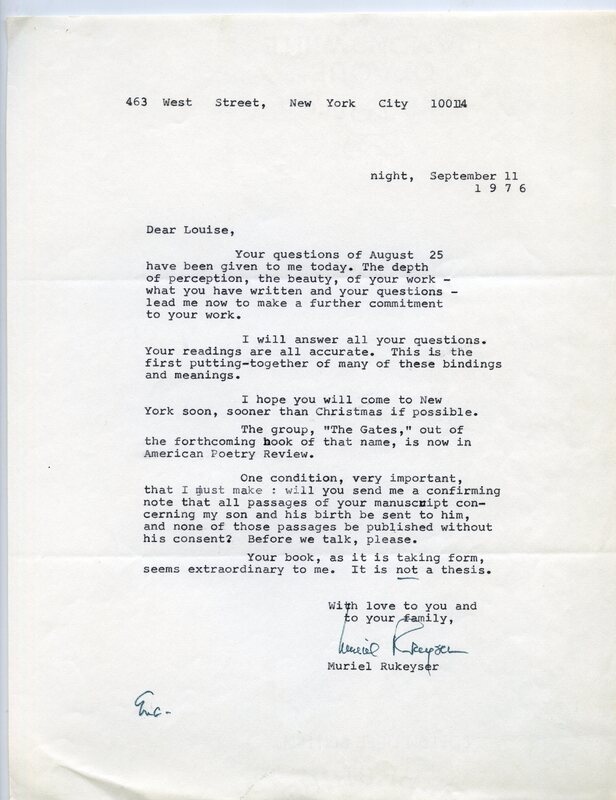
Dated September 11th, 1976. A typewritten note From Muriel Rukeyser to Louise Kertesz. Muriel received Louise’s questions of August 25th, and she praises “The depth of perception, the beauty, of your work - what you have written and your questions lead me now to make a further commitment to your work.” "I will answer all your questions. Your readings are all accurate. This is the first putting-together of many of these bindings and meanings." There is “one condition, very important, that I must make: will you send me a confirming note that all passages in your manuscript concerning my son and his birth be sent to him, and none of those passage be published without his consent?” Muriel ends by saying, “Your book, as it is taking form, seems extraordinary to me. It is not a thesis.”
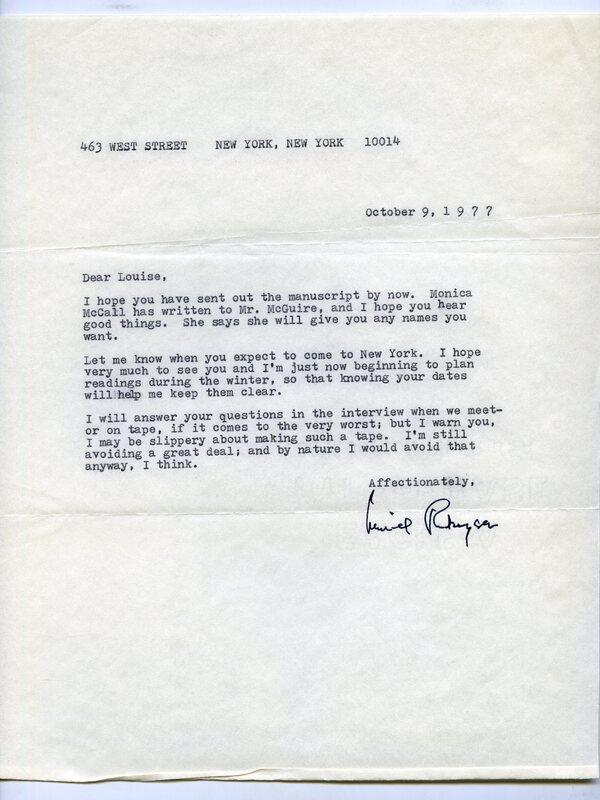
Original, typewritten letter, from October 9th, 1977. The letter is from Muriel Rukeyser to Louise Kertesz. Muriel states that she hopes that Louise has sent out the manuscript by now. Monica McCall has written to Mr. McGuire, and Rukeyser hopes that Louise hears good things. Monica says that she will give Louise any names she wants. Muriel asks Louise to let her know when she intends to come to New York. She is now planning poetry readings that will take place over the winter, so knowing the dates of Louise's visit will help her plan out her final schedule. Rukeyser will answer Louise’s questions in the interview when they meet, or on tape, "if it comes to the very worst." She warns Louise that she may be "slippery" when it comes to making such a tape: "I'm still avoiding a great deal; and by nature I would avoid that anyway...."
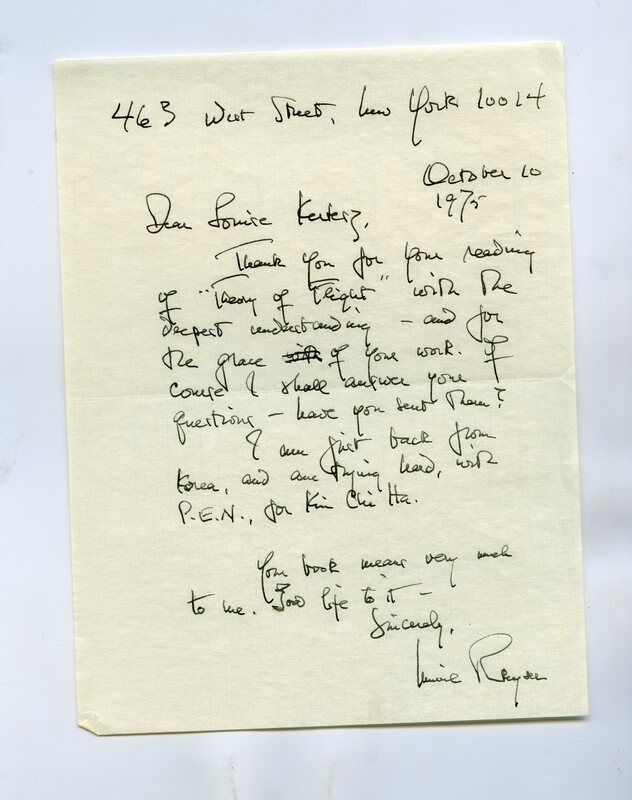
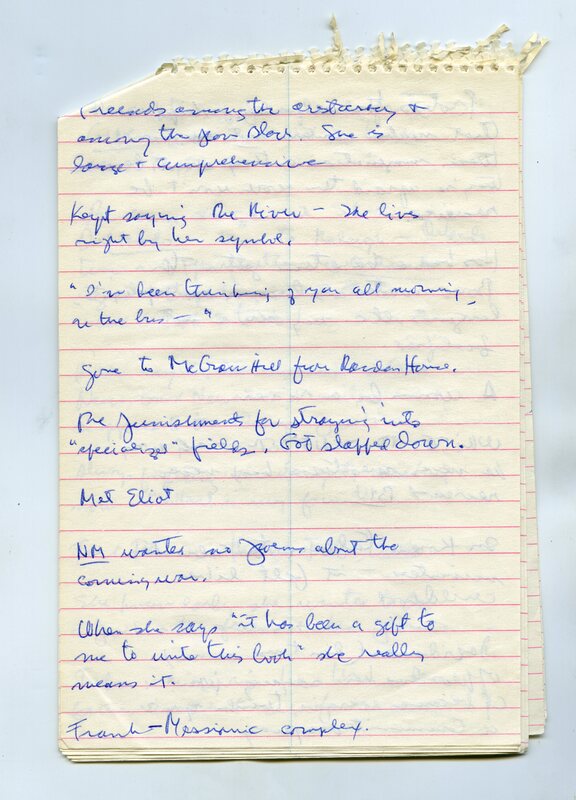
Original handwritten letter, dated October 10th, 1975. The letter is from Muriel Rukeyser to Louise Kertesz. Rukeyser thanks Louise for reading her work, Theory of Flight, "with the deepest understanding - and for the grace of your work." Rukeyser states that she will answer Louise’s questions, and asks if she has sent them. Rukeyser just came back from Korea and is "trying hard, with P.E.N., for Kim Chi Ha." Muriel ends the letter by saying that Louise’s book means a lot to her.
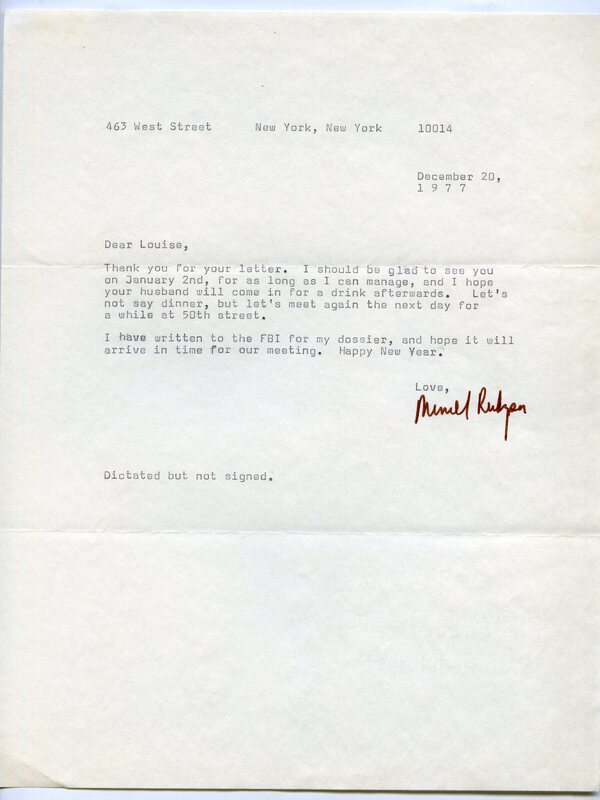
Original, typewritten letter, dated December 20th, 1977. The letter is from Muriel Rukeyser to Louise Kertesz. Rukeyser thanks Louise for her letter. She will be glad to see Louise on January 2nd for as long as she can manage. Muriel hopes that Louise’s husband will come in for a drink afterwards, Muriel doesn’t want to make dinner plans, but wants to meet Louise a little bit the next day at 50th Street. Rukeyser had written to the FBI for her dossier, and she hopes it will arrive in time for their meeting. Rukeyser ends the letter by wishing Louise a Happy New Year.
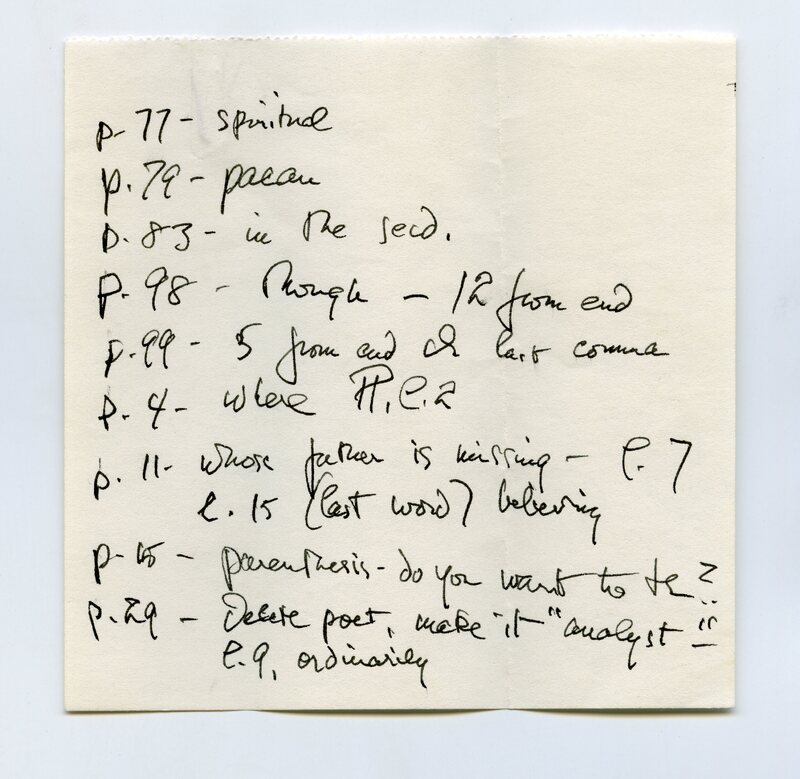
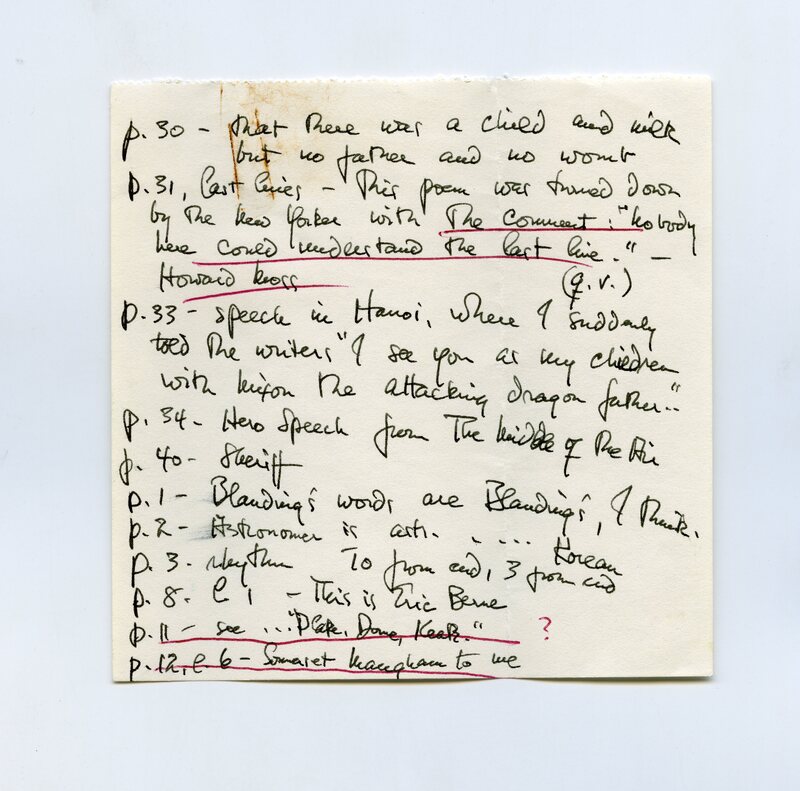
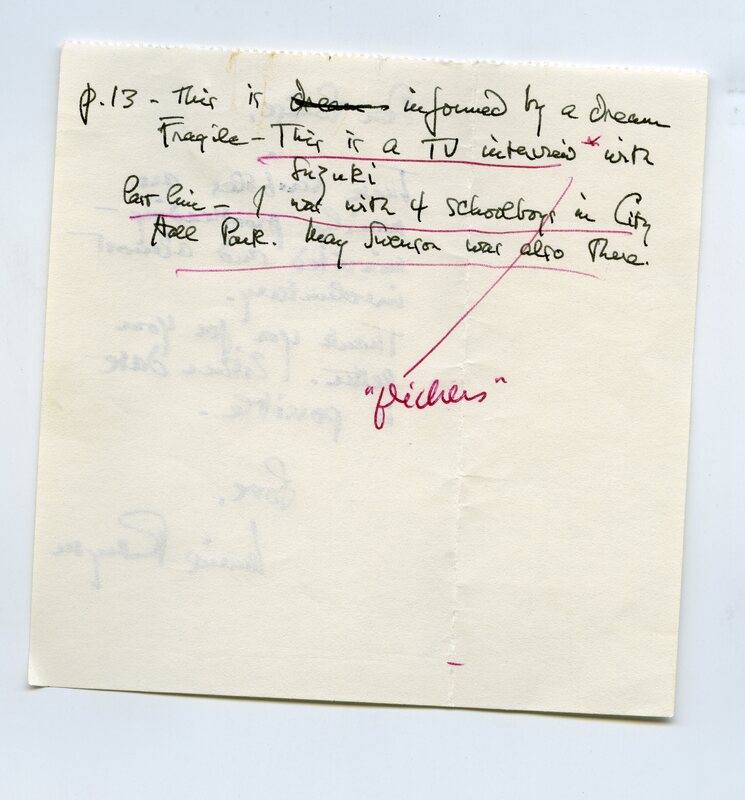
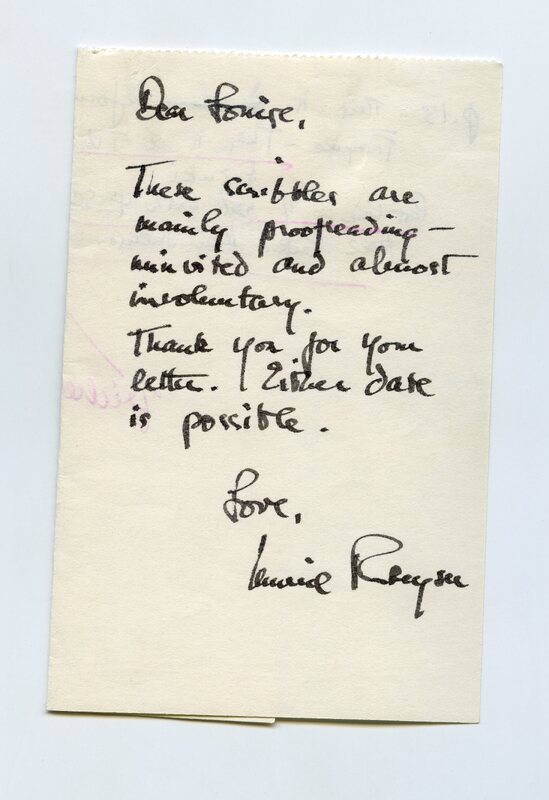
Dated September 8th, 1978, from Muriel Rukeyser to Louise Kertesz. Envelope with three sheets of handwritten editorial notes inside. On the back of one sheet, Muriel writes a short explanatory comment: “These scribbles are mainly proofreading, uninvited and almost involuntary. Thank you for your letter. Either date is possible. Love, Muriel Rukeyser.” The three pieces of paper have page numbers referring to the manuscript of The Poetic Vision of Muriel Rukeyser, with Muriel’s comments next to them. There is a message on the back of the envelope in Muriel’s handwriting: “jotting–a pen just given me by Bill Meredith."
Dated September 8th, 1978, from Muriel Rukeyser to Louise Kertesz. Envelope with three sheets of paper inside. On the back of one sheet, Muriel writes a short note that says, “These scribbles are mainly proofreading, uninvited and almost involuntary. Thank you for your letter. Either date is possible. Love, Muriel Rukeyser.” The three pieces of paper have page numbers with Muriel’s comments next to them. There is a message on the back of the envelope in Muriel’s handwriting: “jotting–a pen just given me by Bill Meredith.
Dated September 8th, 1978, from Muriel Rukeyser to Louise Kertesz. Envelope with three sheets of handwritten editorial notes inside. On the back of one sheet, Muriel writes a short explanatory comment: “These scribbles are mainly proofreading, uninvited and almost involuntary. Thank you for your letter. Either date is possible. Love, Muriel Rukeyser.” The three pieces of paper have page numbers referring to the manuscript of The Poetic Vision of Muriel Rukeyser, with Muriel’s comments next to them. There is a message on the back of the envelope in Muriel’s handwriting: “jotting–a pen just given me by Bill Meredith."
Dated September 8th, 1978, from Muriel Rukeyser to Louise Kertesz. Envelope with three sheets of handwritten editorial notes inside. On the back of one sheet, Muriel writes a short explanatory comment: “These scribbles are mainly proofreading, uninvited and almost involuntary. Thank you for your letter. Either date is possible. Love, Muriel Rukeyser.” The three pieces of paper have page numbers referring to the manuscript of The Poetic Vision of Muriel Rukeyser, with Muriel’s comments next to them. There is a message on the back of the envelope in Muriel’s handwriting: “jotting–a pen just given me by Bill Meredith."
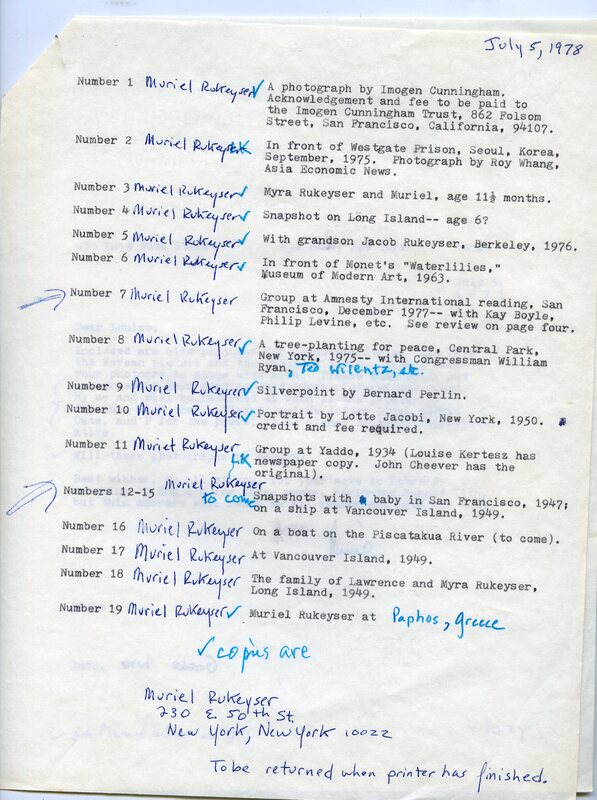
List of typewritten descriptions for photographs that Muriel Rukeyser had prepared for Louise's The Poetic Vision of Muriel Rukeyser, forthcoming from Louisiana University Press. "July 5, 1978," handwritten by Rukeyser at top of page.
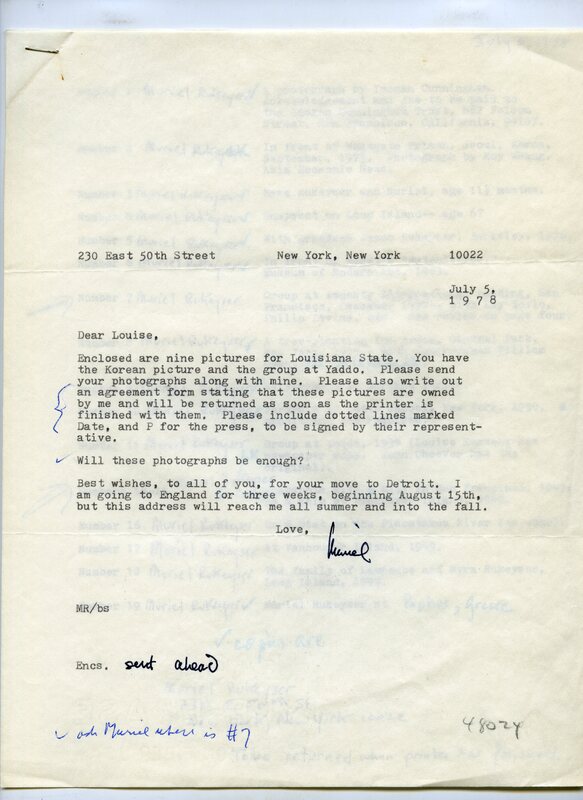
Original typewritten letter, dated July 5th, 1978. The letter is from Muriel Rukeyser to Louise Kertesz. In the letter Rukeyser had enclosed nine pictures for Louisiana State University Press. The letter says that Louise has the Korean picture and the group at Yaddo. Rukeyser asks whether or not these photographs will be enough, and she wishes Louise’s family the best on their move to Detroit. Rukeyser is going to England for three weeks, beginning August 15th, but her address at 230 East 50th Street in New York City "will reach me all summer and into the fall." Stapled to this letter is a page that describes all of the pictures Rukeyser sent to Louise.
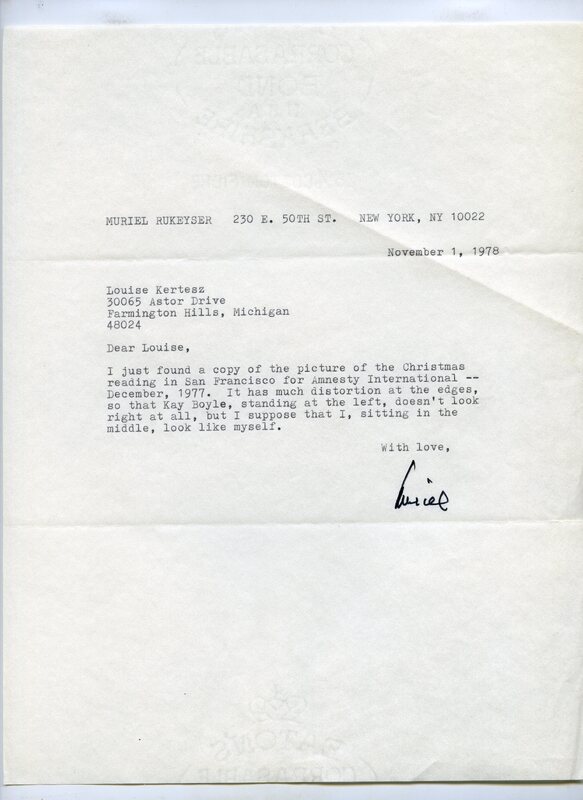
Original, typewritten letter, dated November 1, 1978. The letter is from Muriel Rukeyser to Louise Kertesz. In the letter, Rukeyser tells Louise that she found a copy of the picture of the Christmas reading in San Francisco for Amnesty International in December of 1977. The picture is distorted at the edges, so that Kay Boyle, who was standing on the left of Rukeyser, "doesn't look right at all," but Rukeyser supposes "that I, sitting in the middle, look like myself."
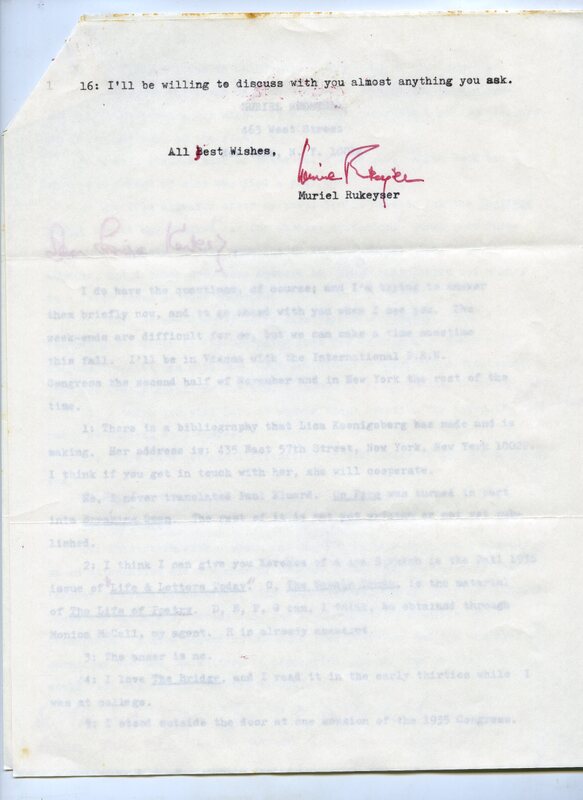
Original typewritten three-page letter, undated, of Muriel Rukeyser to Louise Kertesz, answering sixteen questions. Rukeyser ends her letter by responding to question 16 with the following words: "I'll be willing to discuss with you almost anything you ask." Page 3 of 3.
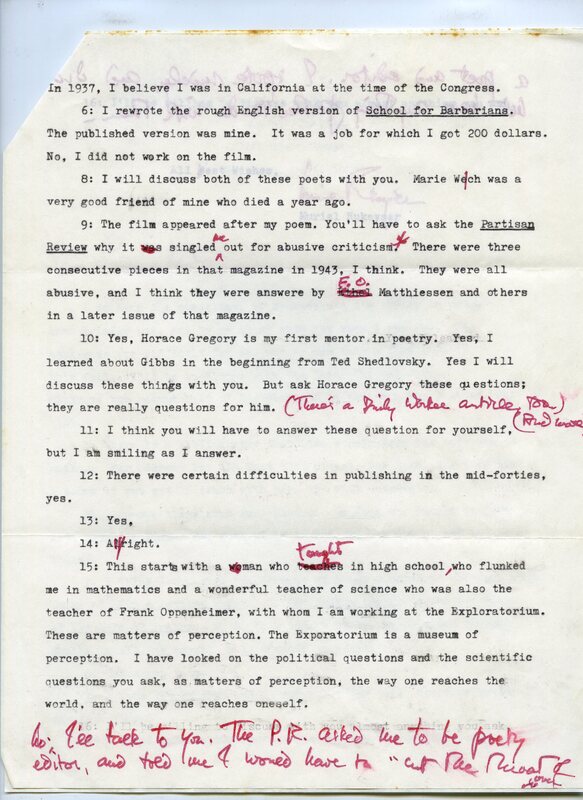
Original typewritten three-page letter, undated, of Muriel Rukeyser to Louise Kertesz, answering sixteen questions. Rukeyser's answers are wide-ranging. In answer to a question about her involvement in the publication of Erika Mann's book School for Barbarians: Education Under The Nazis, she clarifies that "I rewrote the rough English version ... The published version was mine. It was a job for which I got 200 dollars." She also addresses the Partisan Review debacle and suggests that Kertesz ask the editors directly "why it [her poem "Wake Island"] was singled out for abusive criticism." In another answer, she mentions a "wonderful teacher of science who was also the teacher of Frank Oppenheimer, with whom I am working at the Exploratorium ...The Exploratorium is a museum of perception. I have looked on the political questions and the scientific questions you ask, as matters of perception, the way one reaches the world, and the way one reaches onself." Page 2 of 3.
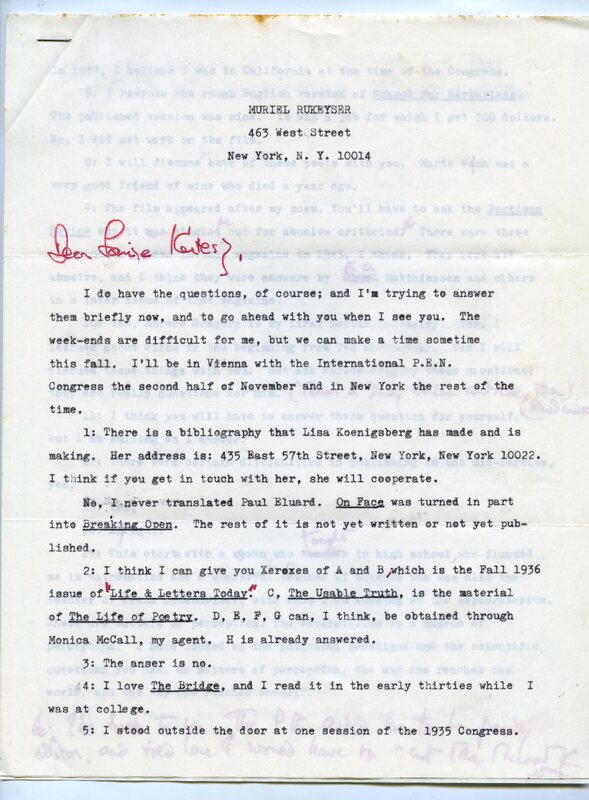
Original typewritten three-page letter, undated, of Muriel Rukeyser to Louise Kertesz, answering sixteen questions. Rukeyser's answers are wide-ranging. She mentions a poem "On Face," which may have been inspired by a Paul Eluard poem: "On Face was turned in part into Breaking Open. The rest of it is not yet written or not yet published." Page 1 of 3.
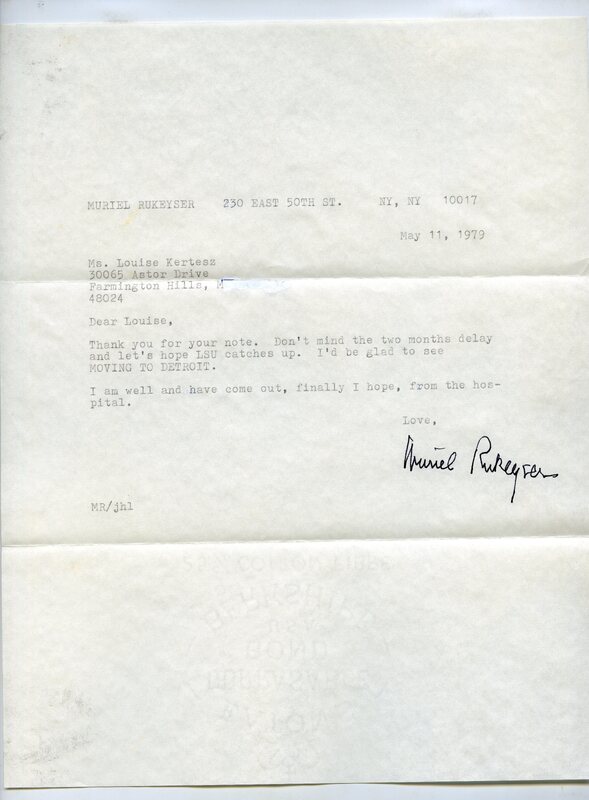
An envelope dated May 21st, 1979, with a letter dated May 11th, 1979. The letter is from Muriel Rukeyser to Louise Kertesz. Rukeyser begins the letter by thanking Louise for her note. Rukeyser also tells Louise to not mind the two-month delay and to hope that LSU catches up. Furthermore, Rukeyser says that she will be glad to see MOVING TO DETROIT [Kertesz''s manuscript of poems which she submitted to Louisiana State University]. Rukeyser ends the letter by saying that she is doing well and that she may be ready to leave the hospital.
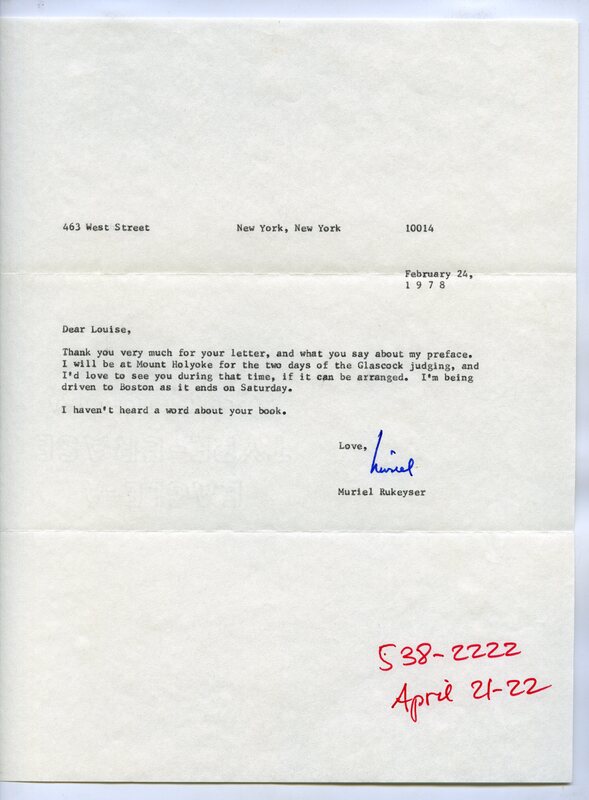
Original typewritten letter, dated February 24th. 1978. From Muriel Rukeyser to Louise Kertesz. Muriel thanks Louise for her letter and what she says about her preface [Rukeyser's preface to The Collected Poems of Muriel Rukeyser, published in 1978]. The letter says that Muriel will be at Mount Holyoke for the two days of the Glascock Poetry Contest, and that she would love to see Louise during that time. Muriel is being driven to Boston as the event ends on a Saturday. The letter ends with Muriel saying that she hasn’t heard a word about Louise’s book.