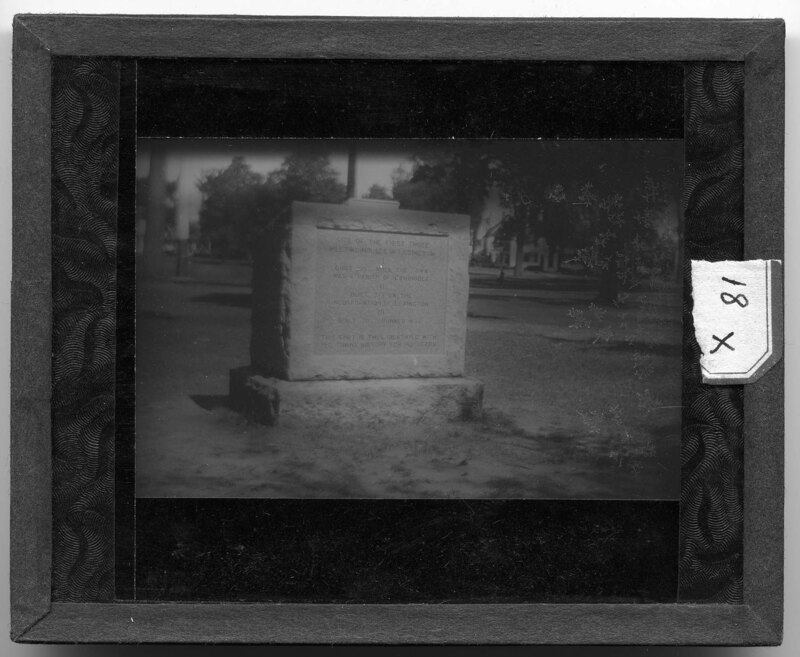
Monument in the Lexington Common in Lexington, Massachusetts. The monument was erected to mark the site of the first three meeting houses in the town. The monument reads, "Site of the first three meeting houses in Lexington. I. Built 1692 when the town was a parish of Cambridge II. Built 1713 on the incorporation of Lexington III. Built 1784, burned 1846. This spot is thus identified with the town's history for 150 years." Slide labeled with text, "Made by G.R. Swain, 713 E. University Ave., Ann Arbor, Michigan." Swain was staff photographer at U of M from 1913 to 1947.
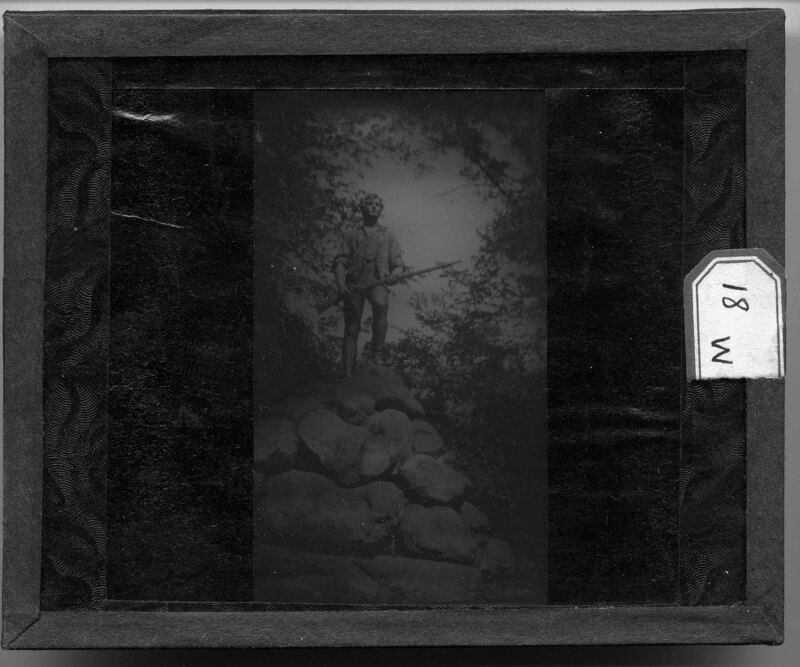
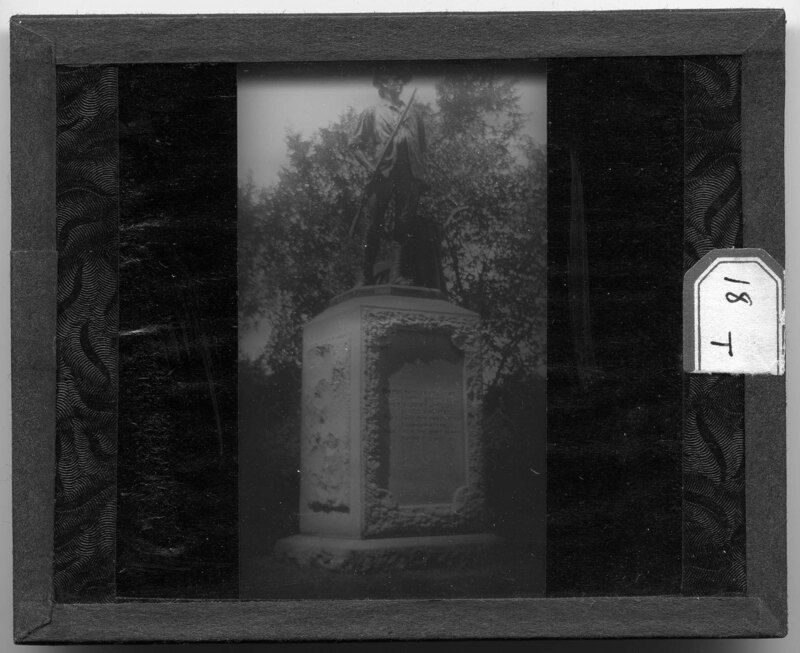
Statue of Captain John Parker in Lexington, Massachusetts. Captain John Parker led the American militia army against the British army in the Battle of Concord on April 19, 1775. He was a farmer and mechanic before he was the leader of the militia group. The statue depicts him standing on a boulder with a musket gun across his legs. The statue was constructed in 1900 by Henry Hudson Kitson and is part of the town common known as the Lexington Battle Green. Slide labeled with text, "Made by G.R. Swain, 713 E. University Ave., Ann Arbor, Michigan." Swain was staff photographer at U of M from 1913 to 1947.
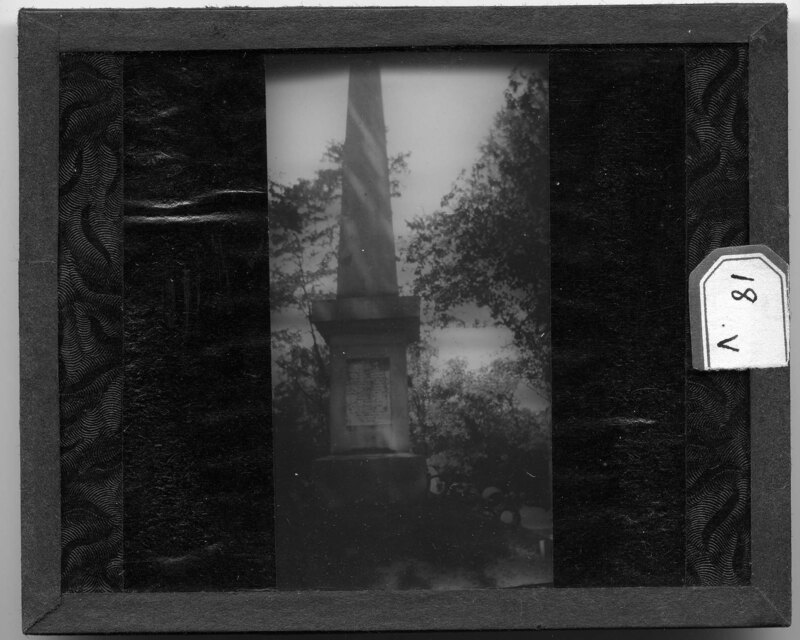
Memorial at the end of the Old North Bridge in Concord, Massachusetts. Located on the eastern banks of the river, the obelisk reads, "Here on the 12 of April 1775 was made the first forcible resistance to British aggression. On the opposite stood the American militia. Here stood the invading army and on this spot the first of the enemy fell in the War of the Revolution which gave independence to the United States. In gratitude in God and in the love of Freedom this monument was erected. D. 1836." Slide labeled with text, "Made by G.R. Swain, 713 E. University Ave., Ann Arbor, Michigan." Swain was staff photographer at U of M from 1913 to 1947.
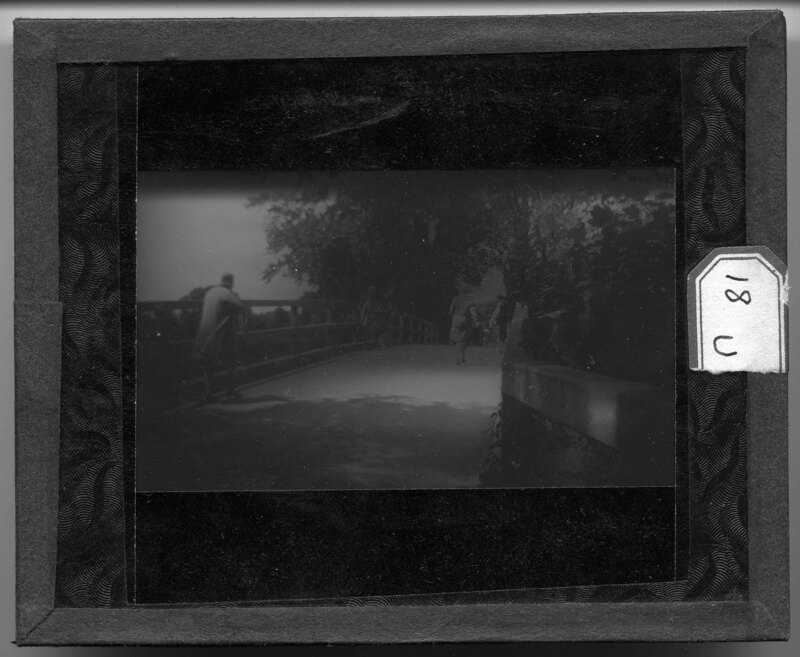
Old North Bridge in Concord, Massachusetts. Part of the Minute Man National Historical Park, the Old North Bridge is the location of the Battle of Concord, the first battle of the American Revolution, started on April 19, 1775. Women can be seen walking across the bridge which appears to be poured cement and wooden side railing. Trees and other bushes cover the banks of the river. Slide labeled with text, "Made by G.R. Swain, 713 E. University Ave., Ann Arbor, Michigan." Swain was staff photographer at U of M from 1913 to 1947.
Statue of a Minute Man in Concord, Massachusetts. Originally designed and constructed by Daniel Chester French in 1875 to honor the Minute Men who helped win the Revolutionary War, the statue is now part of the Minute Man National Historical Park where the Revolutionary War began on April 19, 1775 between the American colonists and the British military. The memorial depicts a Minute Man next to a plow signifying the colonists dual roles at the country was founded. Slide labeled with text, "Made by G.R. Swain, 713 E. University Ave., Ann Arbor, Michigan." Swain was staff photographer at U of M from 1913 to 1947.
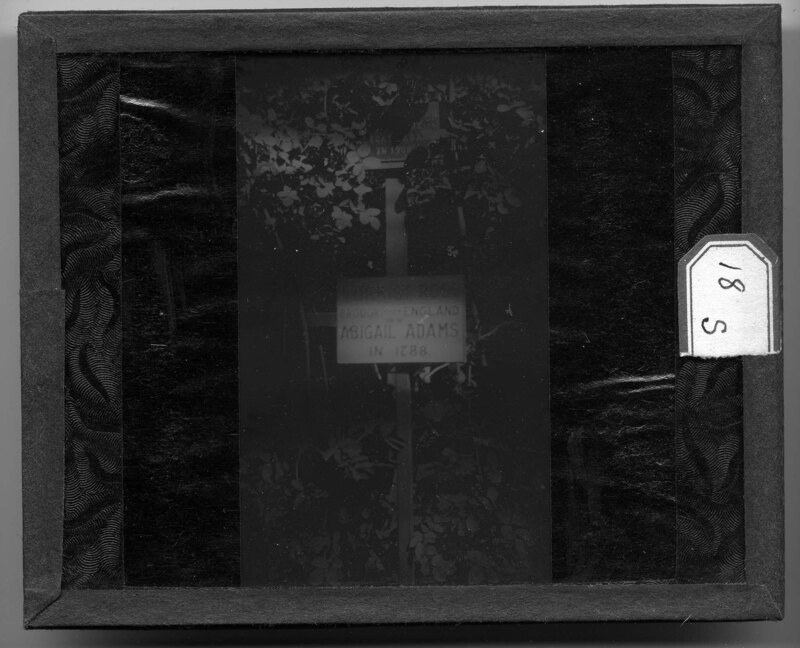
A sign in the Adams' garden at the house in Quincy, Massachusetts. The sign reads, "Yorkist Rose brought from England by Abigail Adams in 1788." Abigail Adams was the second First Lady and wife of John Adams, second president of the United States. Slide labeled with text, "Made by G.R. Swain, 713 E. University Ave., Ann Arbor, Michigan." Swain was staff photographer at U of M from 1913 to 1947.
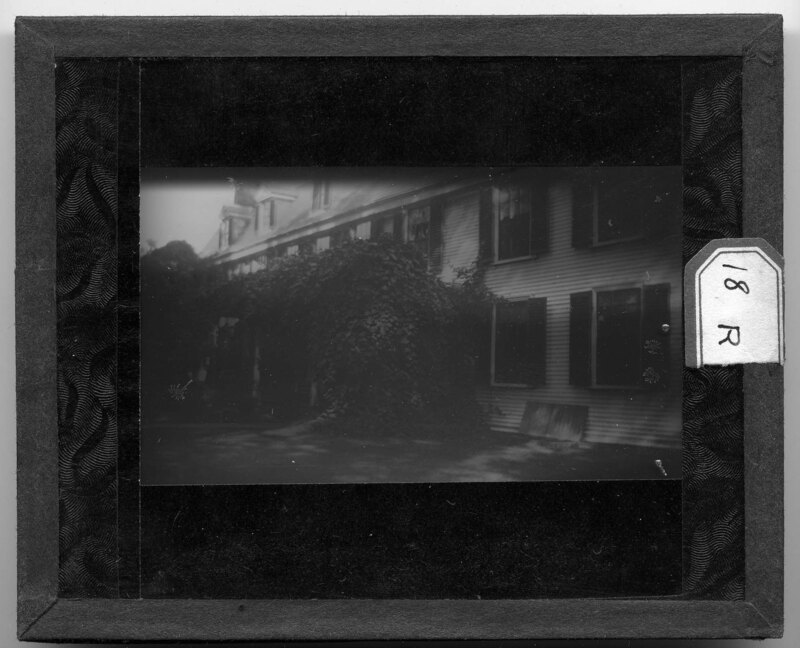
The Adams mansion in Quincy, Massachusetts. The house is two stories with at least four roof dormers and nine bays. Ivy covers most of the front facade and the main entrance portico. Shutters are attached to all of the windows. The house was the residence of two American presidents and their descendents from 1720 to 1927. The house is now a protected historical park and a park of the National Park Service. Slide labeled with text, "Made by G.R. Swain, 713 E. University Ave., Ann Arbor, Michigan." Swain was staff photographer at U of M from 1913 to 1947.
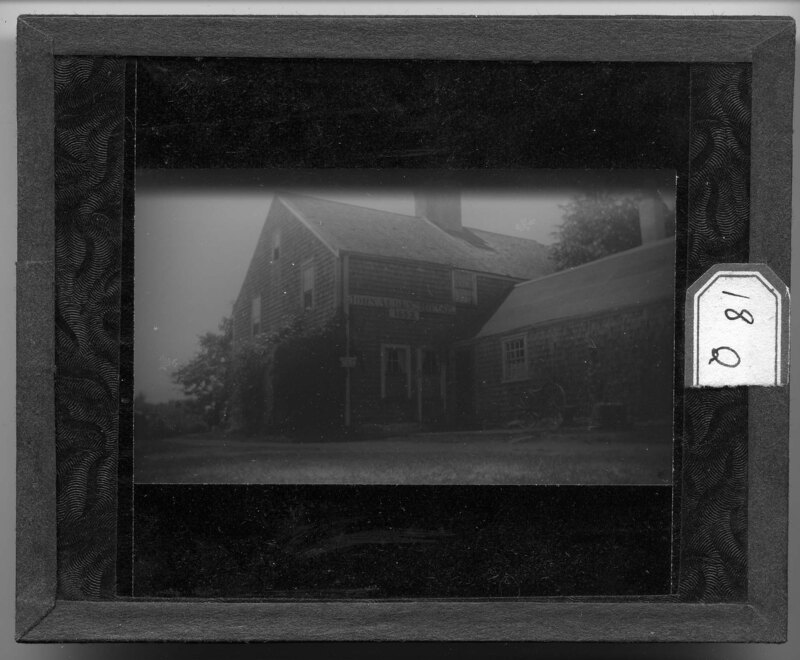
The John Alden house in Duxbury, Massachusetts. It is noted that the house was originally constructed in 1653 and is appears to be a Four over Four style house with a rear ell addition. A large central chimney can be seen on the ridge line of the main house and a secondary chimney can be seen on the addition, which was most likely a kitchen area. Ivy covers the corner and side of the building and dirt paths can be seen surrounding the structure. Slide labeled with text, "Made by G.R. Swain, 713 E. University Ave., Ann Arbor, Michigan." Swain was staff photographer at U of M from 1913 to 1947.
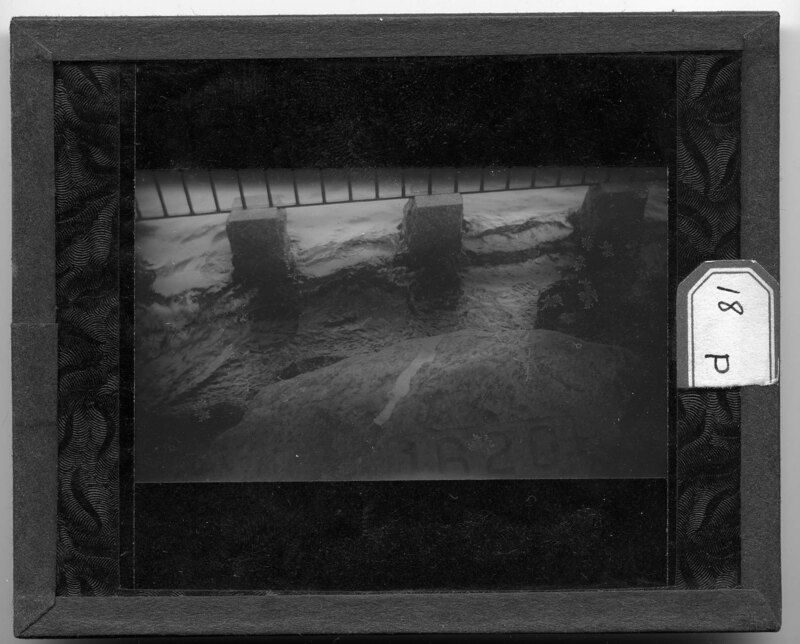
Plymouth Rock in Plymouth, Massachusetts. The Plymouth Rock, inscribed with the year 1620, is said to mark the landing of the Mayflower Pilgrims in Plymouth when they traveled from England to the American colonies. The rock marks the entrance to Plymouth Harbor and it appears to have been restored by patching a crack in the rock near the year inscription. Water laps the shore where the rock is located and a fence has been installed to keep the rock safe from vandalism. Slide labeled with text, "Made by G.R. Swain, 713 E. University Ave., Ann Arbor, Michigan." Swain was staff photographer at U of M from 1913 to 1947.
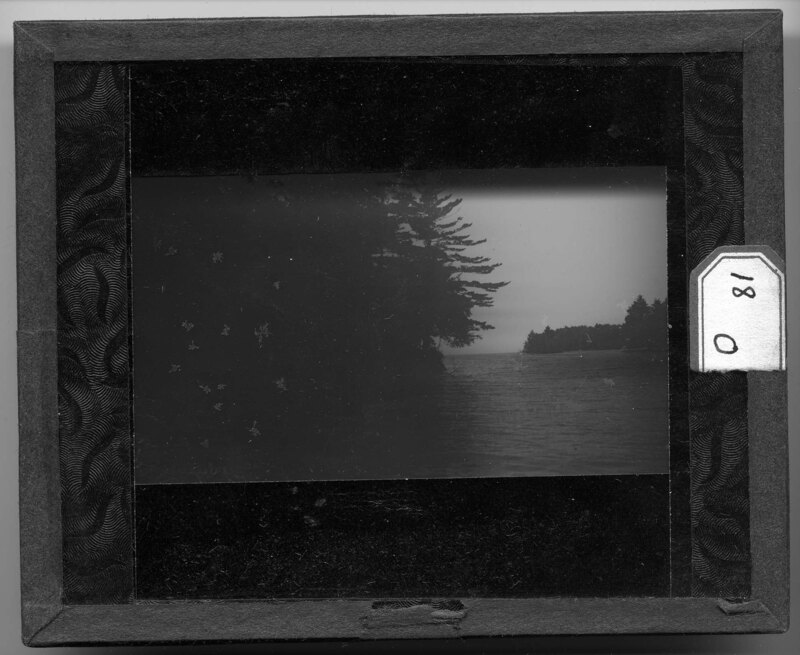
The meeting of Lake Winnipesaukee and Alton Bay in Alton, New Hampshire. Dense foliage covers the rocky shoreline of the lake and grass can be see sticking out of the water in the shallows to the left. Lake Winnipesaukee and Alton Bay are both inland water basins in New Hampshire. Slide labeled with text, "Made by G.R. Swain, 713 E. University Ave., Ann Arbor, Michigan." Swain was staff photographer at U of M from 1913 to 1947.
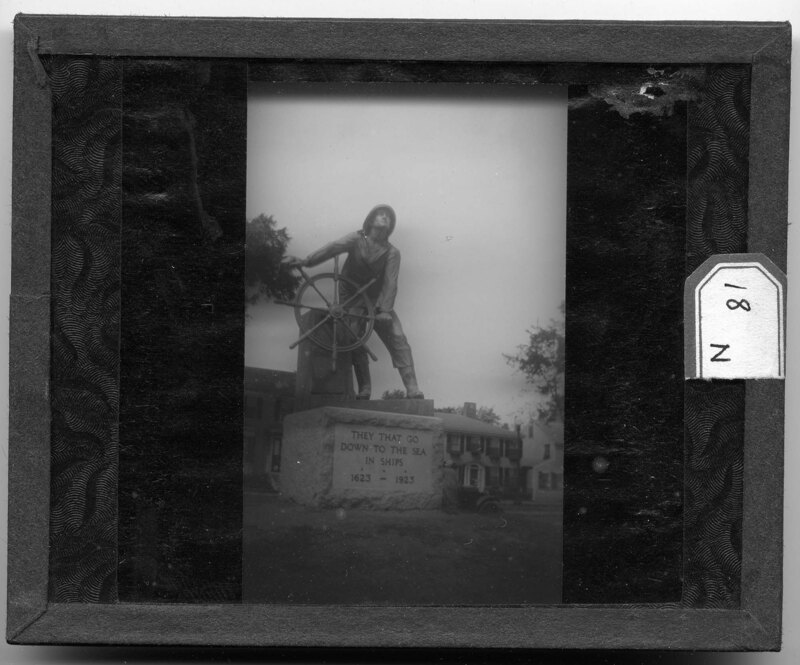
A bronze and stone monument to fishermen in Gloucester, Massachusetts. The monument reads, "They that go down to the sea in ships. 1623-1923," and depicts a fisherman at the wheel of a ship. Several Four over Four style houses can be seen in the background. Slide labeled with text, "Made by G.R. Swain, 713 E. University Ave., Ann Arbor, Michigan." Swain was staff photographer at U of M from 1913 to 1947.
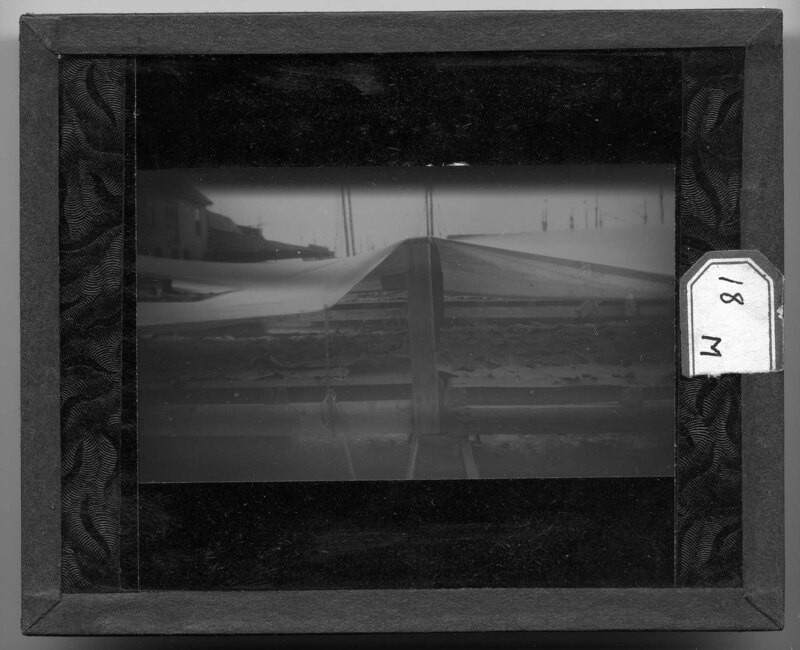
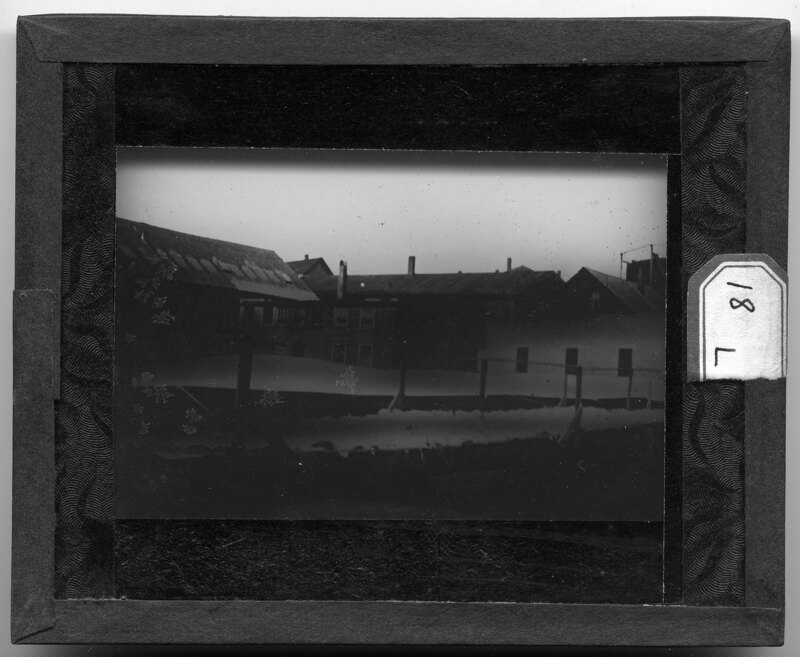
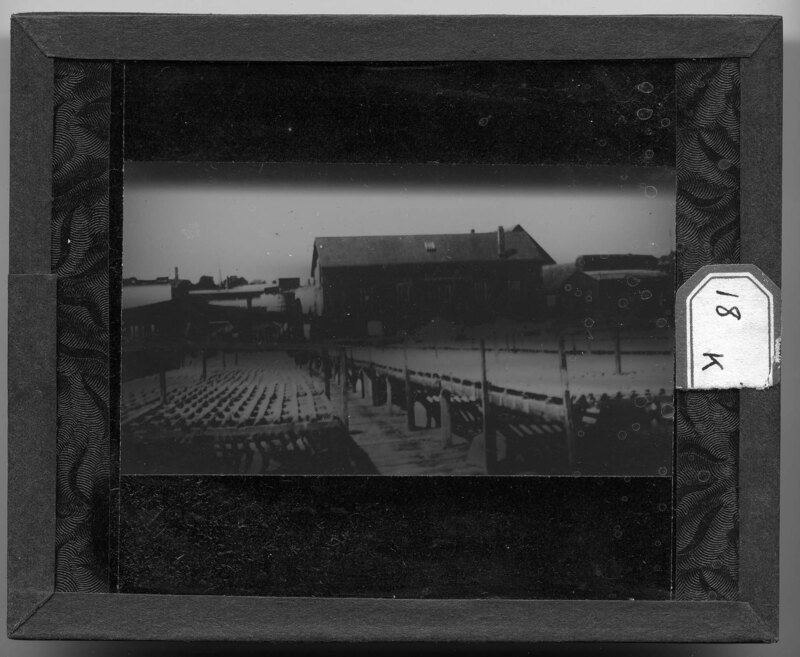
Sheets covering the drying racks in Gloucester Harbor, Massachusetts. The cod fillets can be seen drying on the wooden racks that are covered by canvas tarps to keep the fish out of the elements as it dries. The tarps are secured with ropes attached to the racks. Ship masts can be seen in the background along with several timber framed structures. Slide labeled with text, "Made by G.R. Swain, 713 E. University Ave., Ann Arbor, Michigan." Swain was staff photographer at U of M from 1913 to 1947.
Cod drying on wooden racks at the Gloucester Harbor in Massachusetts. The cod fillets are draped over the wooden cross sections on the racks to dry and cure. Several timber framed structures can be seen in the background, and are most likely businesses associated with the harbor. Slide labeled with text, "Made by G.R. Swain, 713 E. University Ave., Ann Arbor, Michigan." Swain was staff photographer at U of M from 1913 to 1947.
Cod drying on wooden racks at the Gloucester Harbor in Massachusetts. The cod fillets are draped over the wooden cross sections on the racks to dry and cure. Several timber framed structures can be seen in the background, and are most likely businesses associated with the harbor. Slide labeled with text, "Made by G.R. Swain, 713 E. University Ave., Ann Arbor, Michigan." Swain was staff photographer at U of M from 1913 to 1947.
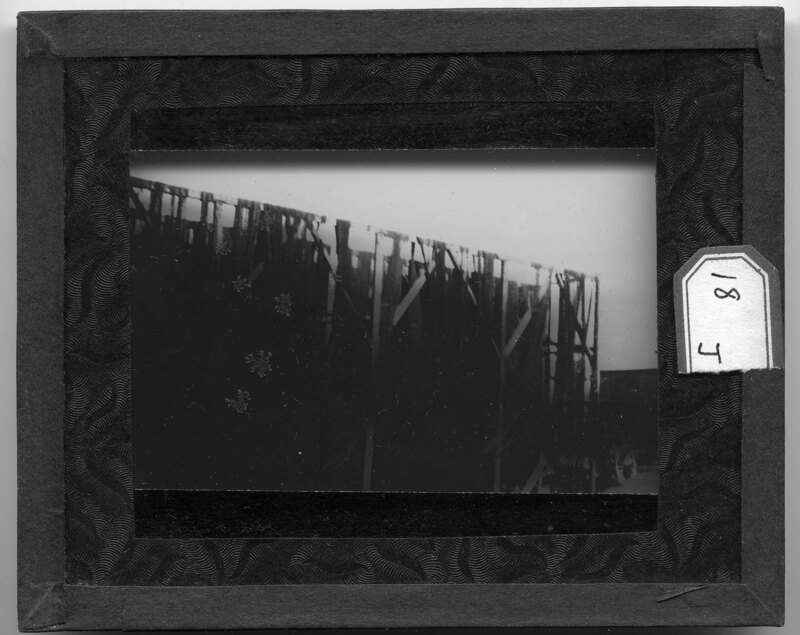
Drying fishing nets in the Gloucester Harbor in Massachusetts. The large nets are draped over a wooden frame to dry. A car can be seen next to the nets and a building can be seen in the background. Slide labeled with text, "Made by G.R. Swain, 713 E. University Ave., Ann Arbor, Michigan." Swain was staff photographer at U of M from 1913 to 1947.
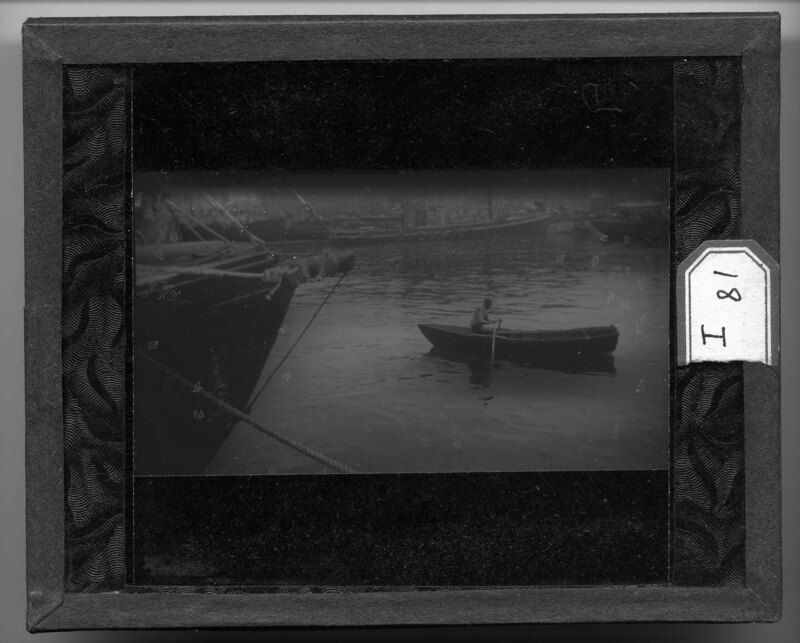
A man rows a small boat in the Gloucester Harbor in Massachusetts. It is noted he is a millionaire fish dealer. Several large fishing schooners can be seen moored to the docks around him. The schooner in the foreground is decorated with ornate detailing on the bow of the ship. Slide labeled with text, "Made by G.R. Swain, 713 E. University Ave., Ann Arbor, Michigan." Swain was staff photographer at U of M from 1913 to 1947.
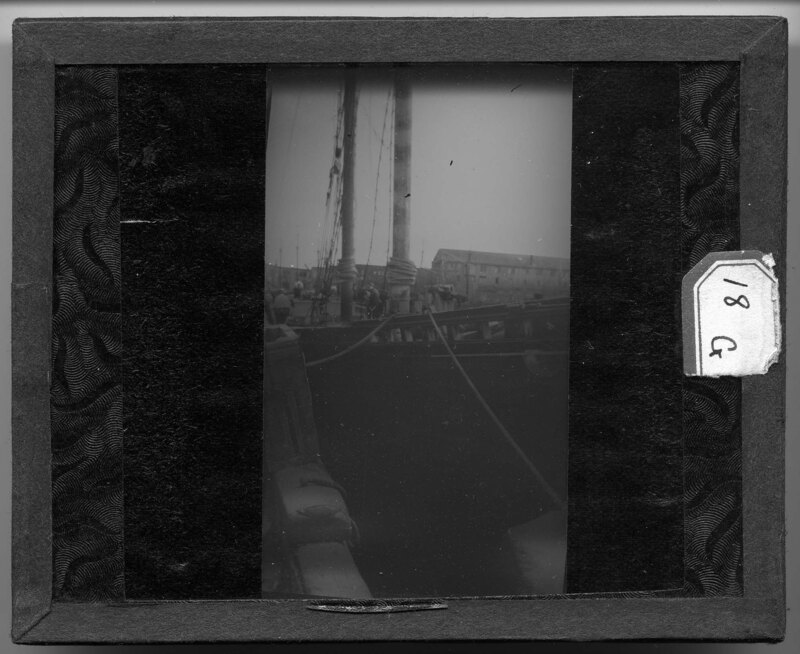
A fishing schooner moored to a dock in Gloucester, Massachusetts. It is noted that this vessel is part of an Italian fleet. The ship is a relatively narrow wooden structure with two central masts. Large ropes secure the ship to the dock and men can be seen walking along the deck in the background. Slide labeled with text, "Made by G.R. Swain, 713 E. University Ave., Ann Arbor, Michigan." Swain was staff photographer at U of M from 1913 to 1947.
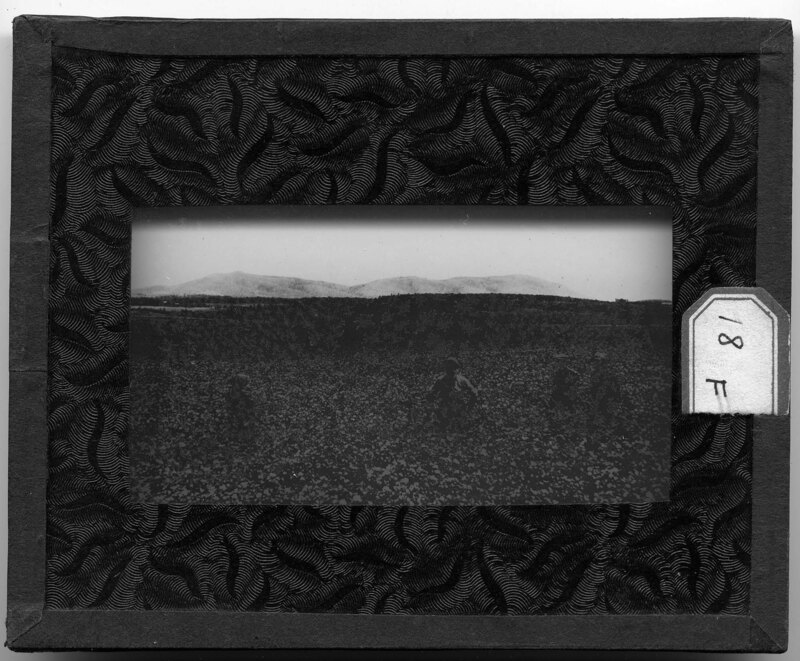
A potato field in Presque Isle, Maine. Four people can be seen standing between the rows of potato plants. It is noted that the plants are in bloom. The entire field covers several acres and the landscape is hill with mountains in the background. Slide labeled with text, "Made by G.R. Swain, 713 E. University Ave., Ann Arbor, Michigan." Swain was staff photographer at U of M from 1913 to 1947.
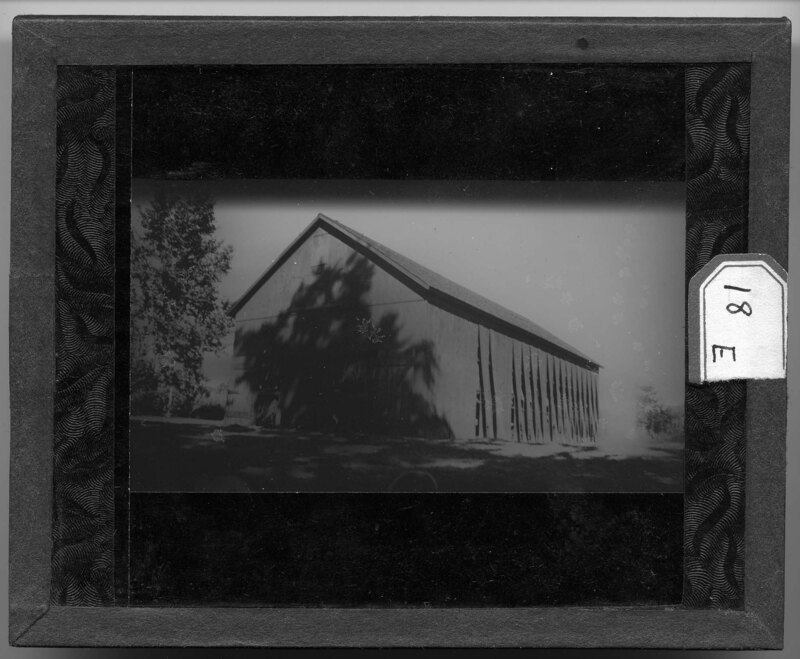
A tobacco barn in Broad Brook, Connecticut. After harvesting the tobacco leaves, they are hung over the rafters of the barn to cure and dry. The barn is an open-concept style to allow for airflow through the drying tobacco. The floorplan is most likely made of long walkways with no crib divisions to allow for better air flow. Vents can be seen on the side of the barn. Slide labeled with text, "Made by G.R. Swain, 713 E. University Ave., Ann Arbor, Michigan." Swain was staff photographer at U of M from 1913 to 1947.
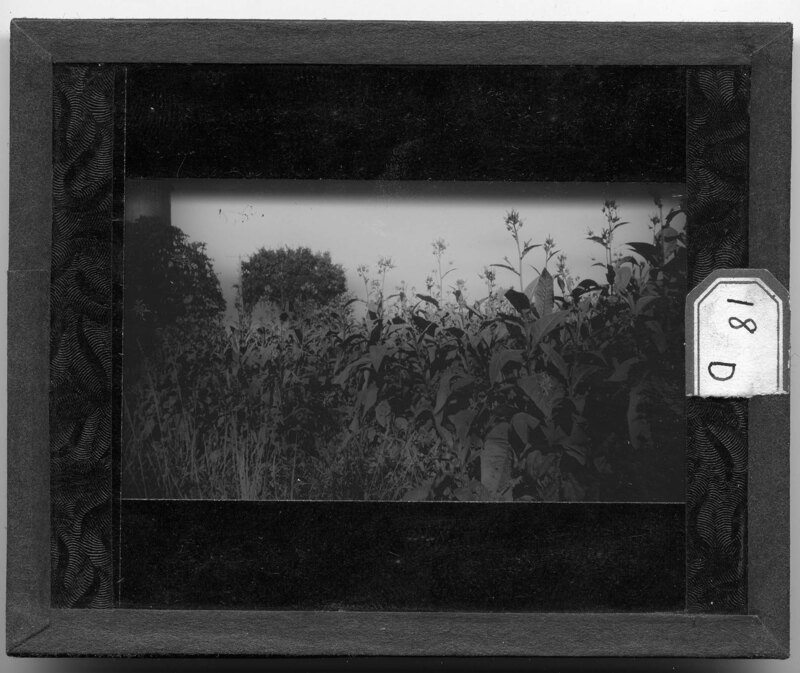
Tobacco plants near House Point, Connecticut. Tobacco has been a staple crop in the United States since the 17th century, however, it was introduced to English settlers and travelers by the Native American's previous to this era. The plants appears to be flowering and grow in dense rows. Grasses obscure some of the plants. A water tower, trees, and power lines can be seen in the background. Slide labeled with text, "Made by G.R. Swain, 713 E. University Ave., Ann Arbor, Michigan." Swain was staff photographer at U of M from 1913 to 1947.
A young boy picks blueberries near Gilamanton, New Hampshire. Dense foliage covers the hillside and several types of trees and bushes can be identified. The blueberry bush that the boy is picking blueberries from is taller than him and is growing on the side of the hill by itself with not other bushes around it. Slide labeled with text, "Made by G.R. Swain, 713 E. University Ave., Ann Arbor, Michigan." Swain was staff photographer at U of M from 1913 to 1947.
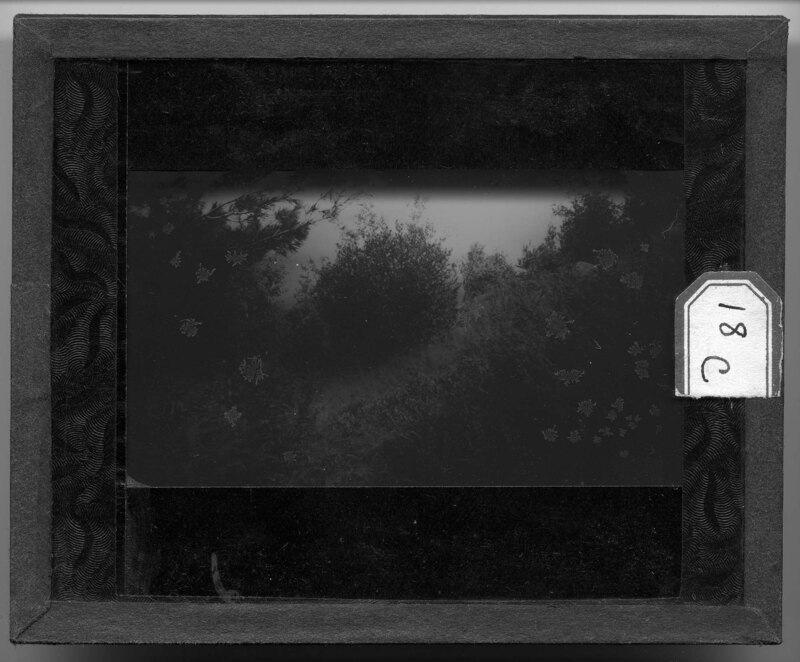
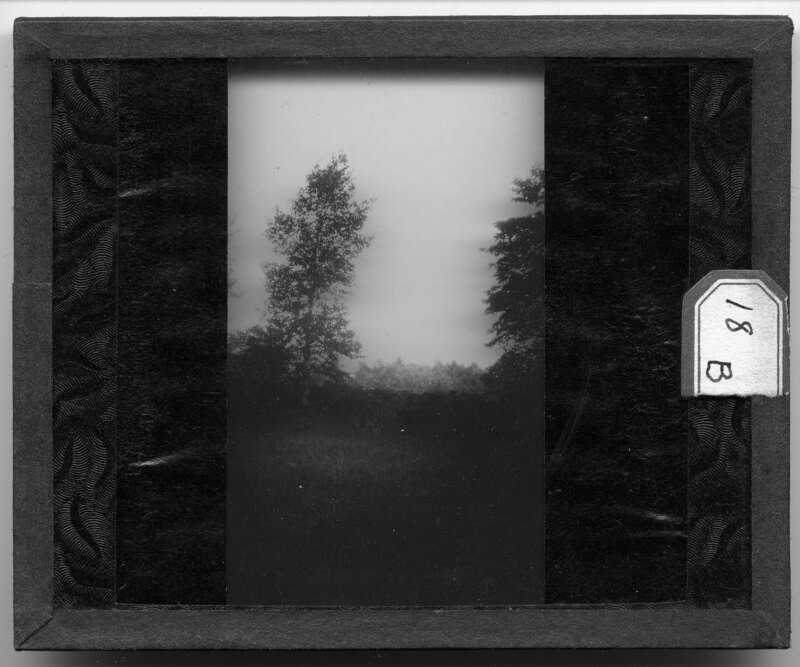
Stone fence dividing a property east of Gilmanton, New Hampshire. A White Birch tree and Rowan trees grow next to the stone wall that is approximately three feet tall. The stones that make up the wall appear to be uncoursed fieldstone. A grassy field leads up to the wall. Slide labeled with text, "Made by G.R. Swain, 713 E. University Ave., Ann Arbor, Michigan." Swain was staff photographer at U of M from 1913 to 1947.
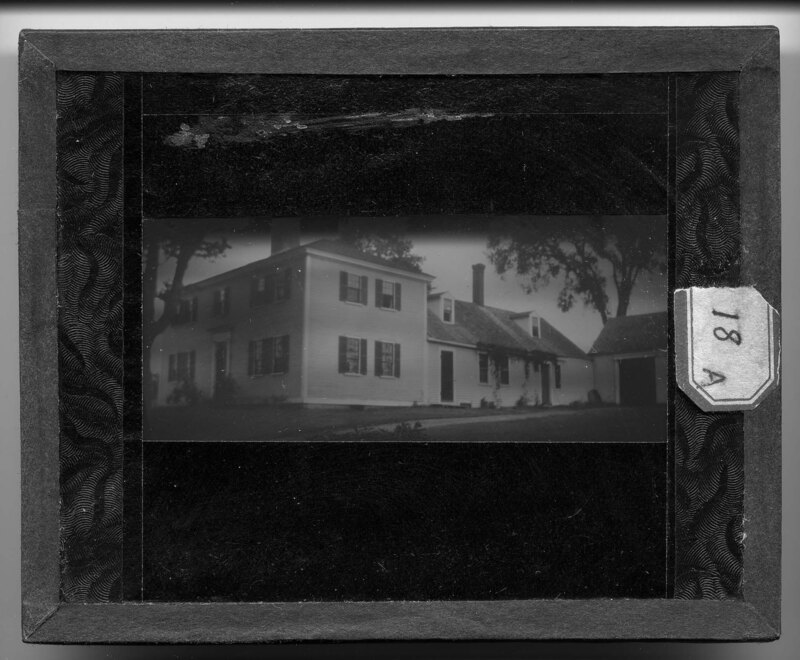
A Four over Four farm house between Laconia and Portsmouth in New Hampshire. The house is a typical Four over Four style with a rear ell addition that appears to be two or three rooms with five bays. A central chimney can be seen on the hipped roof of the main house and an unattached garage can be seen in the background. It is noted that this is a typical style of farmhouse for this region. Slide labeled with text, "Made by G.R. Swain, 713 E. University Ave., Ann Arbor, Michigan." Swain was staff photographer at U of M from 1913 to 1947.
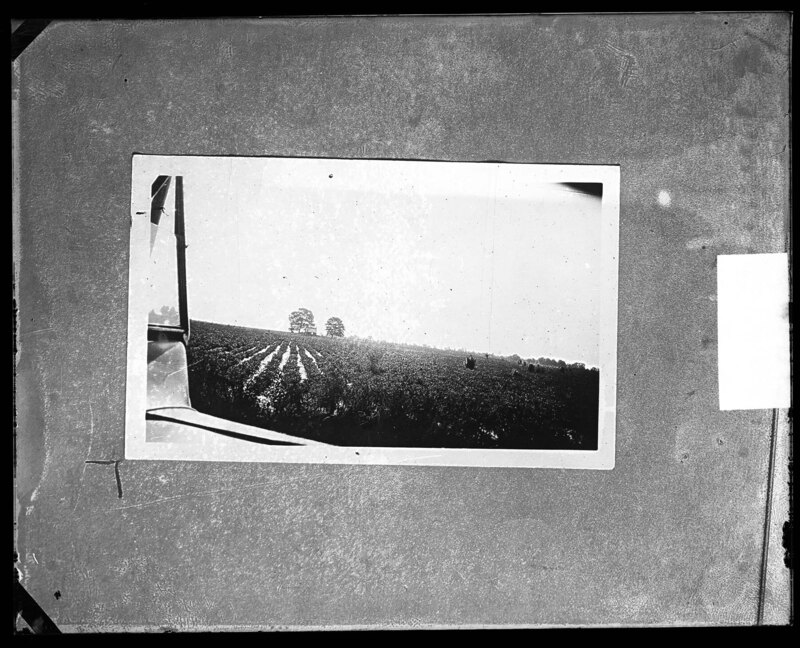
A peanut field in Georgia. Rows of peanut plants can be seen extending down the several acre field. A grove of trees and a house sit in the middle of the field in the background.
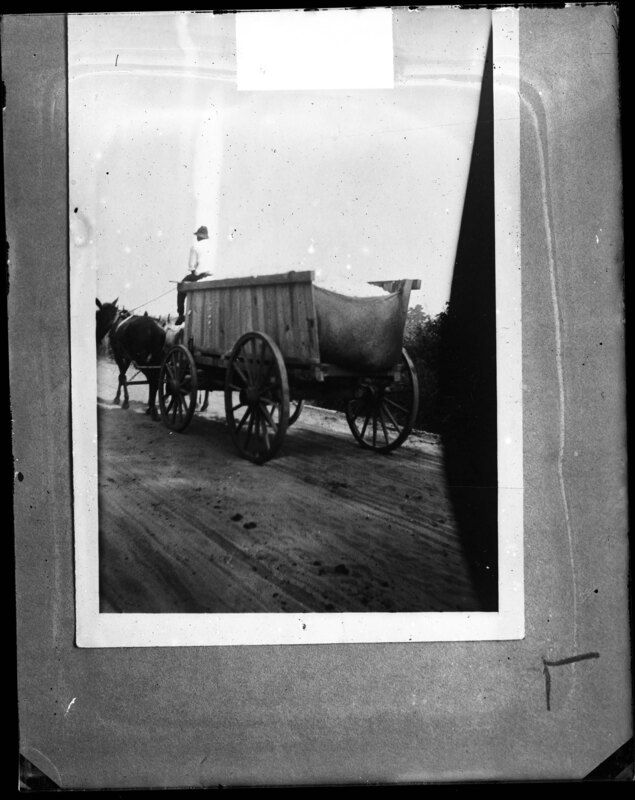
A farmer drives a two house wagon team to sell a load of cotton in Georgia. The wagon is made of vertical boards and a net helps catch cotton falling off of the wagon on the back. The road is very rutted and sandy.
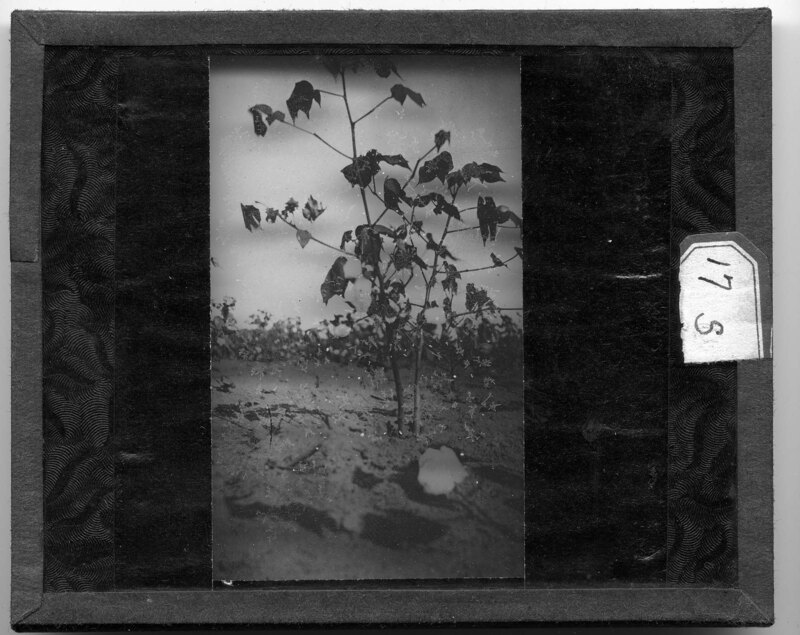
Cotton plant in Georgia. Cotton plants are a woody type of shrub bush that produces cotton fiber in bolls, or protective casing around the fiber. Cotton has been a prominent crop in the United States for approximately 200 years. The image shows several cotton plants with cotton still in the bolls of the plant and a piece of cotton on the ground near the plant. The soil is very dry and the plants have minimal leaves. Slide labeled with text, "Made by G.R. Swain, 713 E. University Ave., Ann Arbor, Michigan." Swain was staff photographer at U of M from 1913 to 1947.
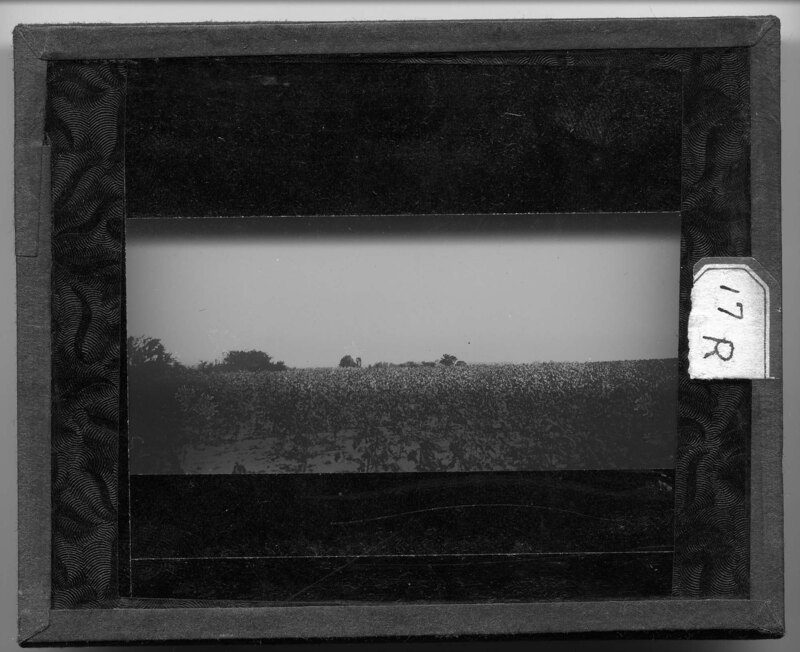
A cotton field in Georgia. The ground appears to be very dry and the plants are shriveled. Trees define the property in the background and the field appears to be a couple of acres. Slide labeled with text, "Made by G.R. Swain, 713 E. University Ave., Ann Arbor, Michigan." Swain was staff photographer at U of M from 1913 to 1947.
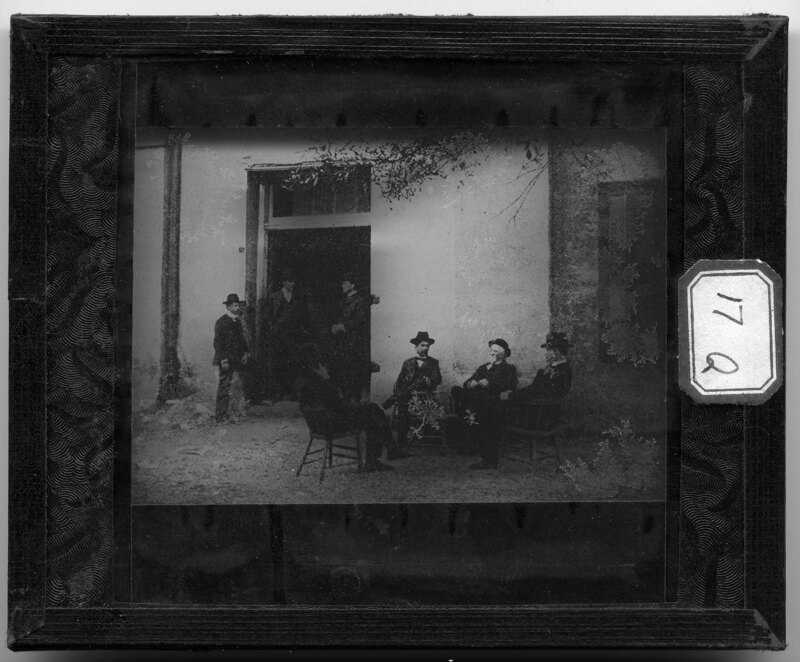
Men standing around the entrance to the courthouse in Tuskegee, Alabama. Referred to as "loafers," the men are sitting in wooden spindle backed chairs and standing in the main entrance way of the courthouse. They are all wearing suit jacket and bowler hats. The building appears to be in some disrepair due to window panes missing above the doorway and piles of stone around the foundation of the structure. Slide labeled with text, "Made by G.R. Swain, 713 E. University Ave., Ann Arbor, Michigan." Swain was staff photographer at U of M from 1913 to 1947.
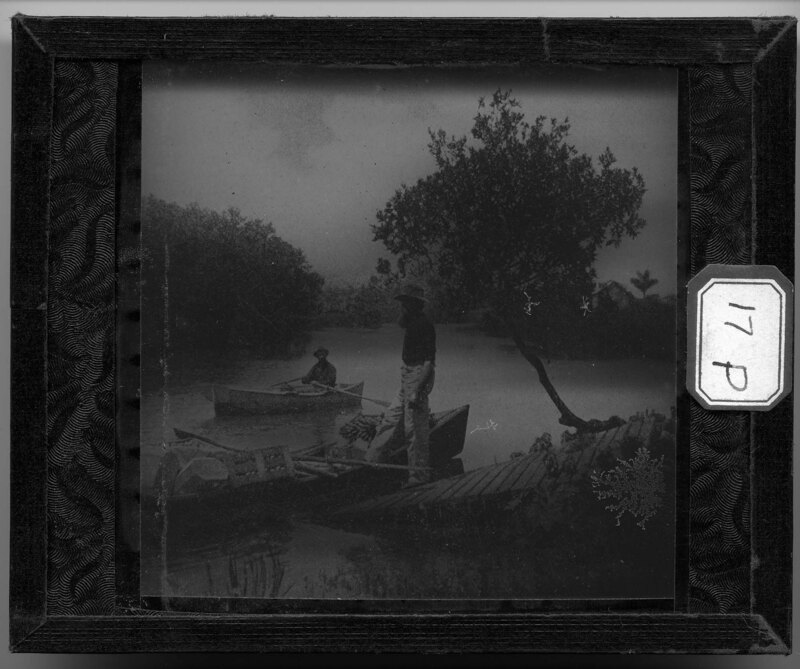
Two men in rowboats on the Miami River in the Everglades of Florida. A man with a large beard can be seen standing on a wooden ramp that reaches into the river and his boat is loaded with crates and other cargo waiting to be taken to the market. The second man is sitting in a rowboat in the middle of the river. Trees cover the banks of the river and dense foliage covers the ground. Slide labeled with text, "Made by G.R. Swain, 713 E. University Ave., Ann Arbor, Michigan." Swain was staff photographer at U of M from 1913 to 1947.
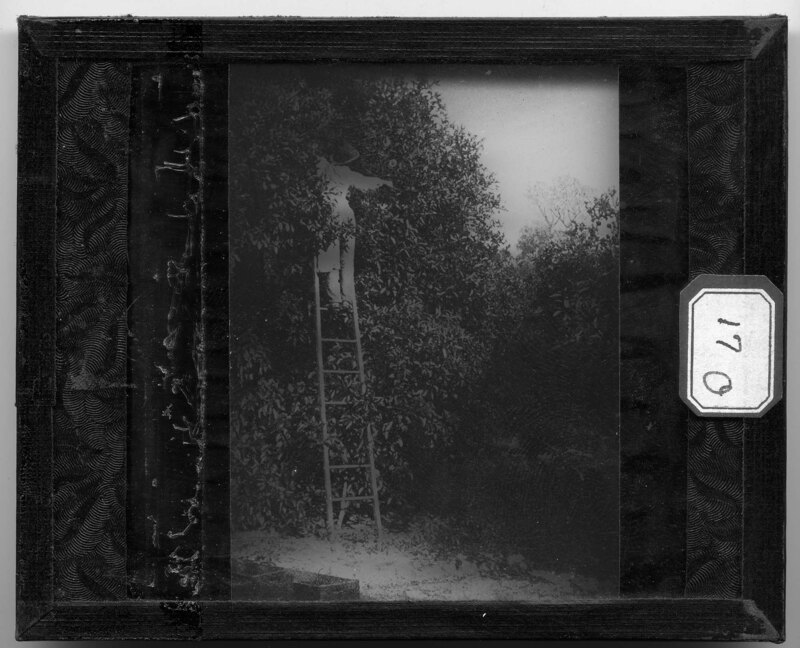
A man can be seen on a wooden ladder picking oranges near the St. John's River in Florida. The orange tree branches reach down to the ground and the trees are approximately 15' tall. Three wooden crates can be seen in the bottom left corner of the picture. Slide labeled with text, "Made by G.R. Swain, 713 E. University Ave., Ann Arbor, Michigan." Swain was staff photographer at U of M from 1913 to 1947.
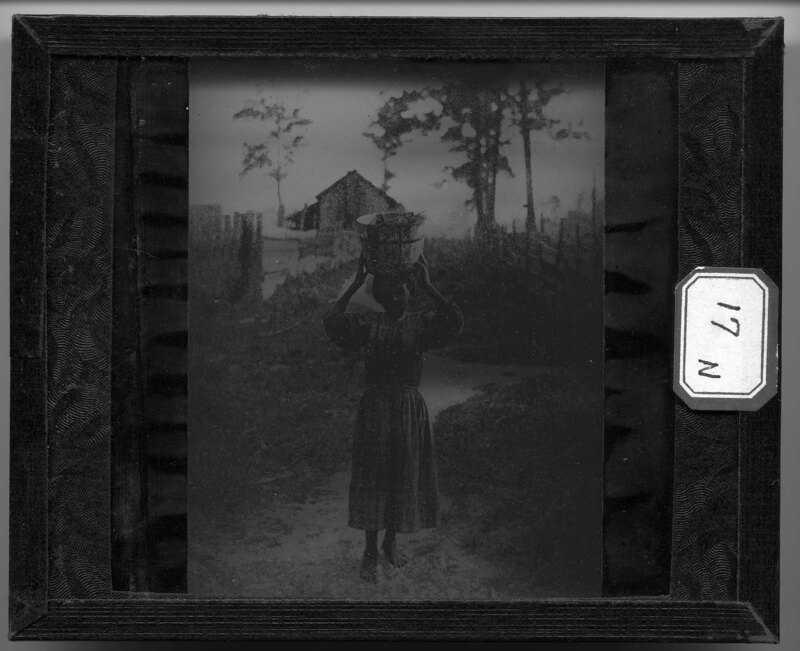
A girl carries a wooden barrel of water from the village pump near the Suwanee River in Florida. She is wearing a plaid dress and a head wrap that helps support the water bucket she balances on her head. Wooden fences can be seen in the background along with a Porched Tidewater house with a chimney on the gabled end of the house. The path's near the fences and the house appear to be sandy. Slide labeled with text, "Made by G.R. Swain, 713 E. University Ave., Ann Arbor, Michigan." Swain was staff photographer at U of M from 1913 to 1947.
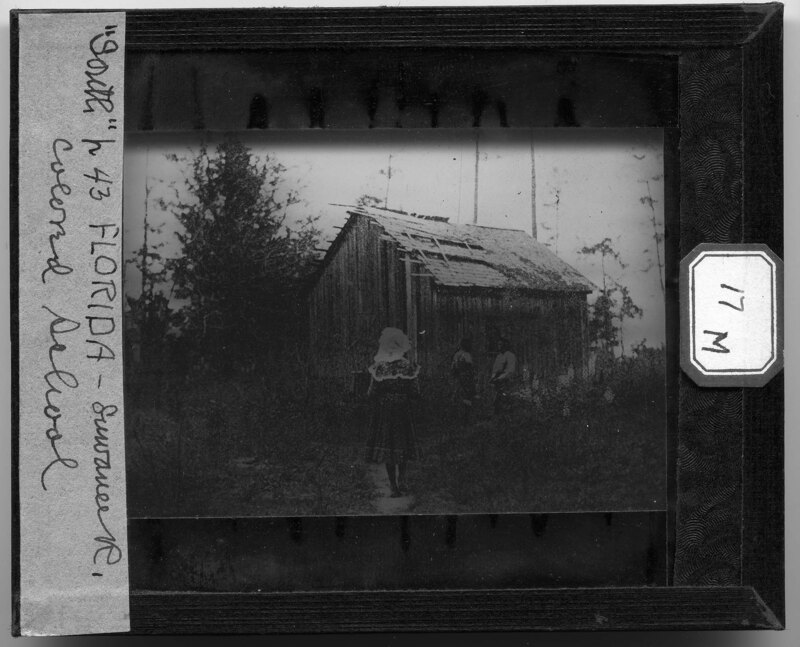
An African American schoolhouse near the Suwanee River in Florida. A girl can be seen walking toward the schoolhouse, which appears to be a one or two room timber framed structure. The roof is falling in and the vertical beams that make up the walls are deteriorating. Two men can be seen outside of the school house and the foliage is overgrown surrounding the structure. Slide labeled with text, "Made by G.R. Swain, 713 E. University Ave., Ann Arbor, Michigan." Swain was staff photographer at U of M from 1913 to 1947.
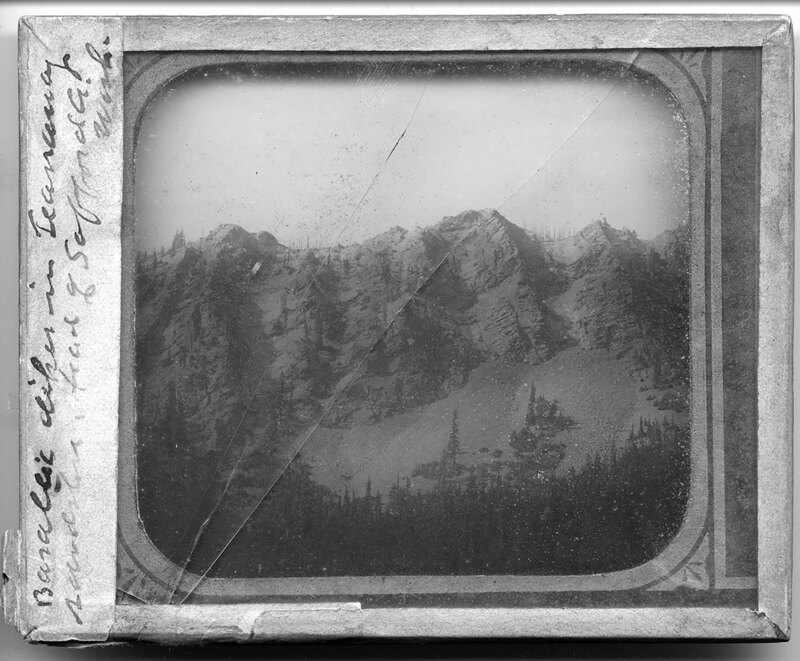
Mountain landscape with rocky peaks and eroded piles of rock at the base of the range. Pine trees grow at the base of the mountains and are partially covered by falling rocks and boulders. Deposit lines can be seen in the exposed portion of the peaks.
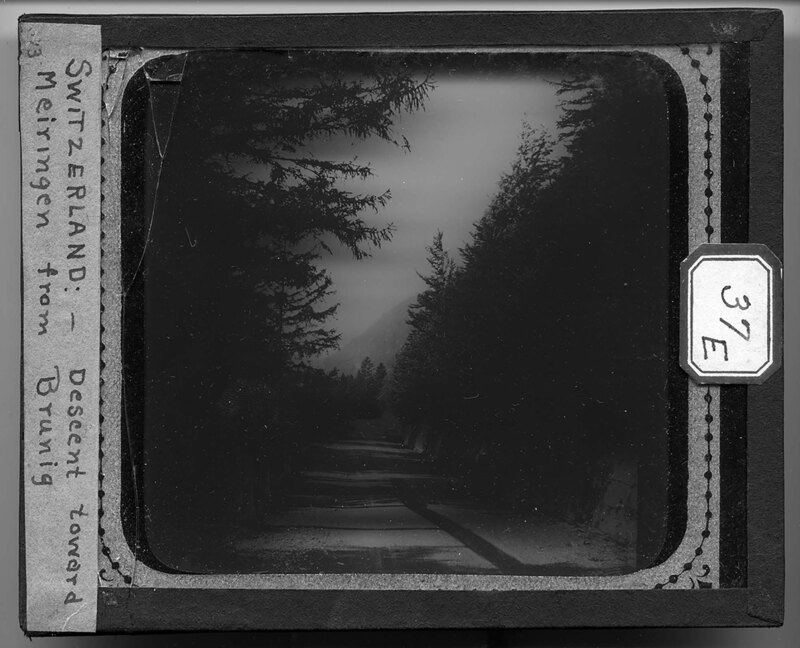
Streetscape of a mountain pass descending from Brunig to Meiringen in Switzerland. Pine trees offer shade on the roadway and a large rock retention wall can be seen to the right. Mountains can be seen in the background.
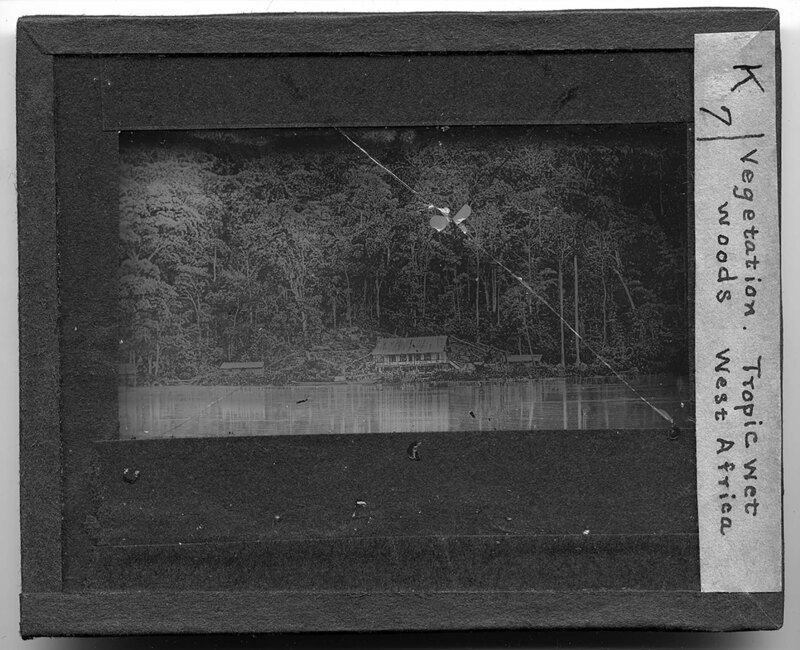
Photostat sketch of a house built on the banks of a river in the tropic woods of west Africa. The house has a thatch roof and is built on piers in case the river rises. Dense vegetation covers the bank of the river.
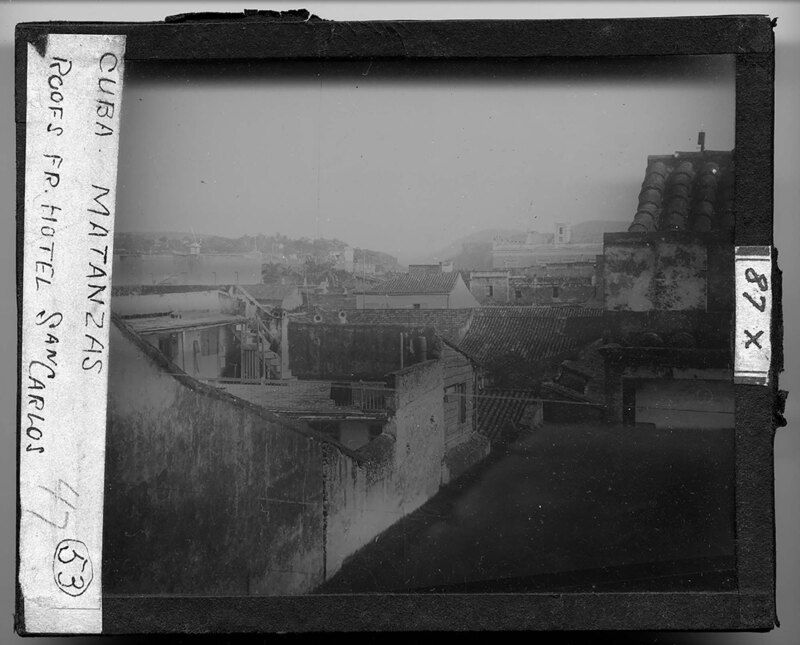
Overlooking the roofs of houses in Matanzas, Cuba. It is noted the picture was taken from the San Carlos hotel. Most of the roofs are clay tiled and have rooftop patios. Mountains can be seen in the background.
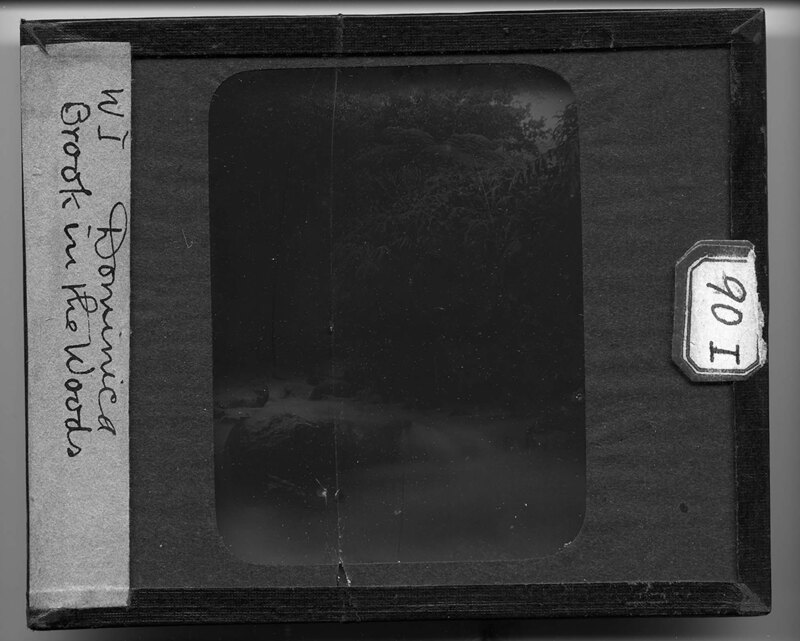
River landscape in Wisconsin. It is noted this is the Dominica Brook. Water cascades over exposed boulders in the riverbed and dense vegetation covers the banks.
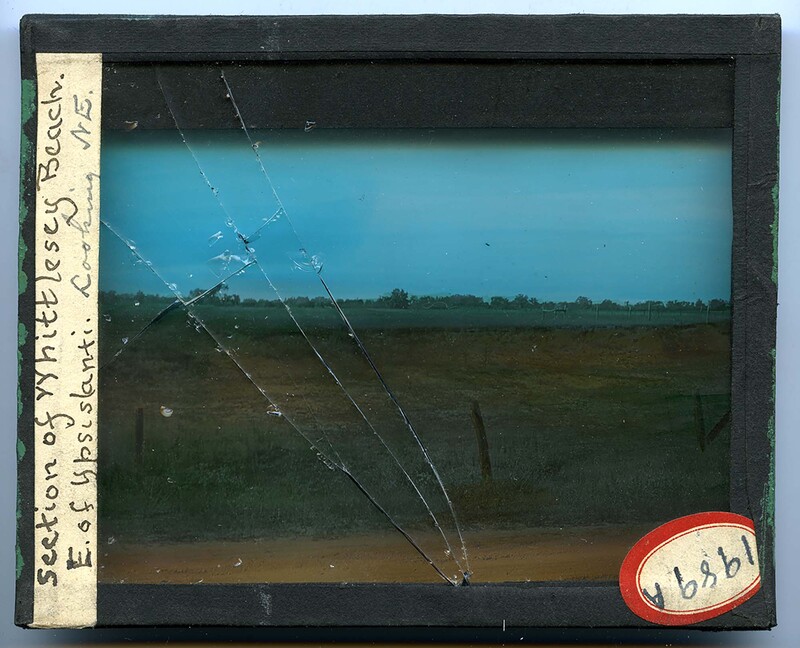
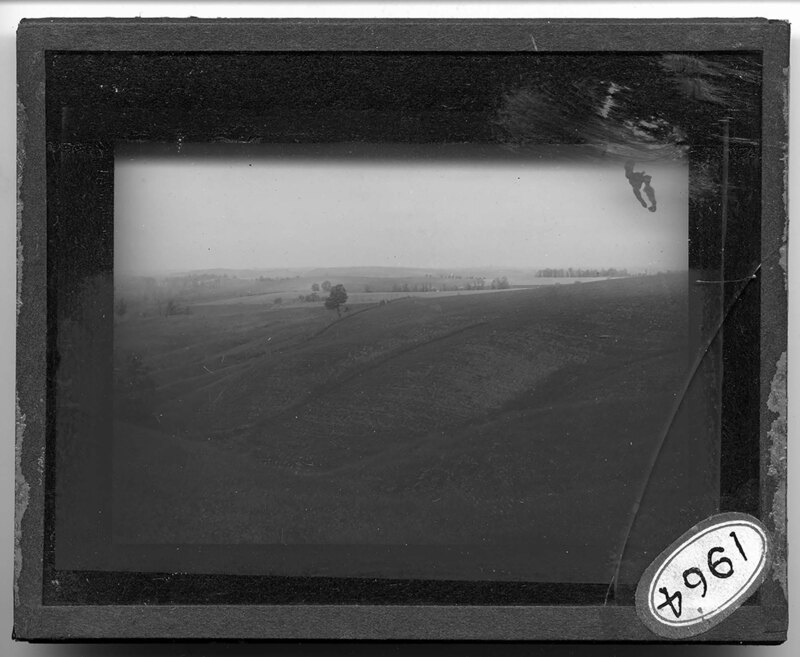
Grassy landscape to the east of Ypsilanti, Michigan. A portion of the field has eroded so the exposed soil of the hill no longer has grass growing on it. Fences divide the different agricultural fields and separate the dirt roadway from the fields.
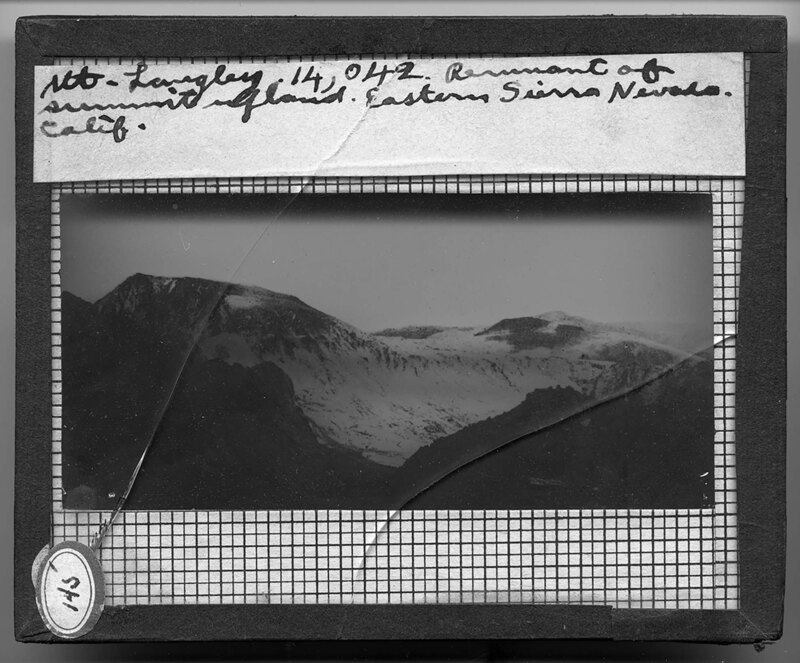
Mountainscape of Mt. Langley in the Eastern Sierra Nevada Mountain range. It is noted that the peak is at 14,042' and the picture shows most of the peaks around the mountain are snowcapped. There is no vegetation.
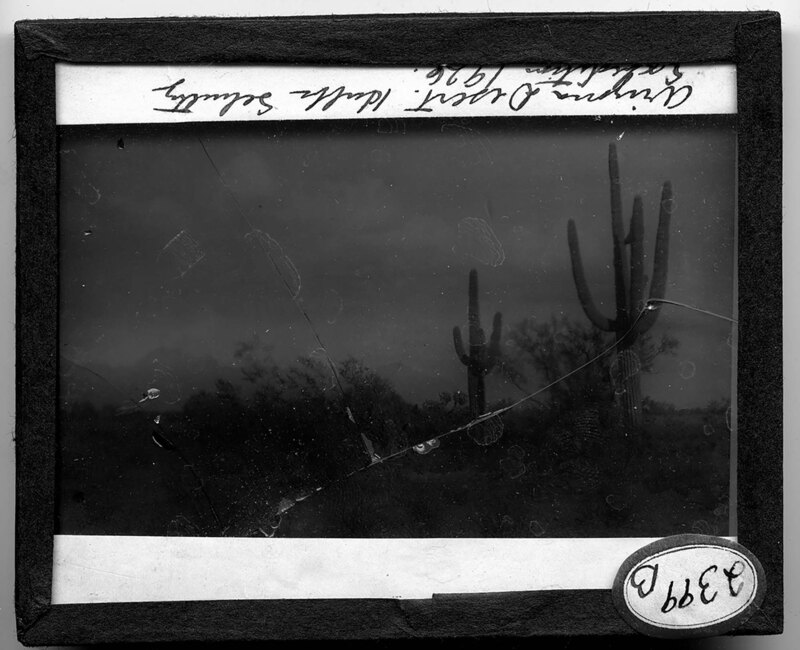
Landscape of a desert in Arizona. Two large Saguaro cacti and several large bushes dominate over the other vegetation in the area. Mountains rise in the background.
Two men paddle a canoe on the Jericho Ditch. Dense vegetation surrounds the narrow ditch and the water is slow-moving. The men are both wearing formal suits and hats.
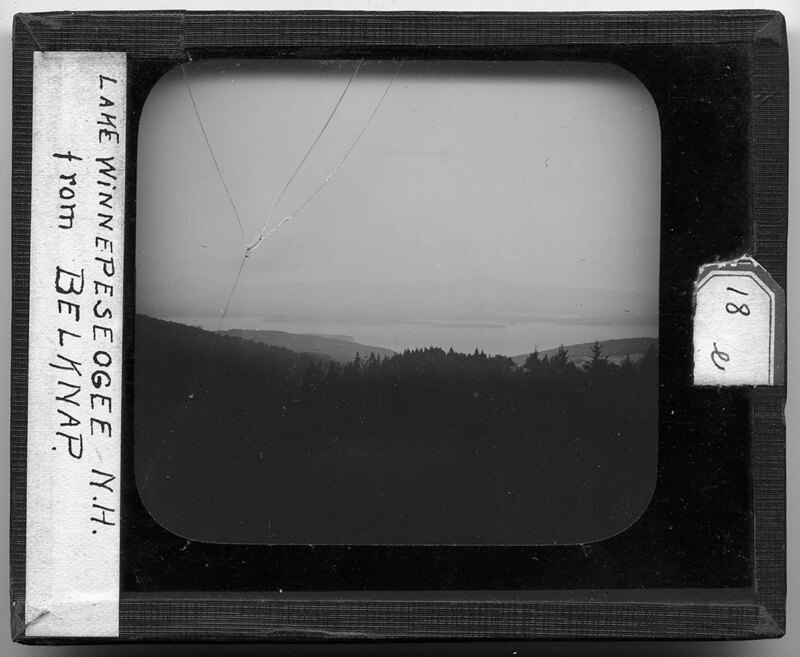
Overlooking Lake Winnipiseogee in New Hampshire. Several islands can be seen in the middle of the lake and the steep banks of the hills around the lake can be seen in the background. Trees and other vegetation cover the hill in the foreground and the terrain is mostly rolling hills.
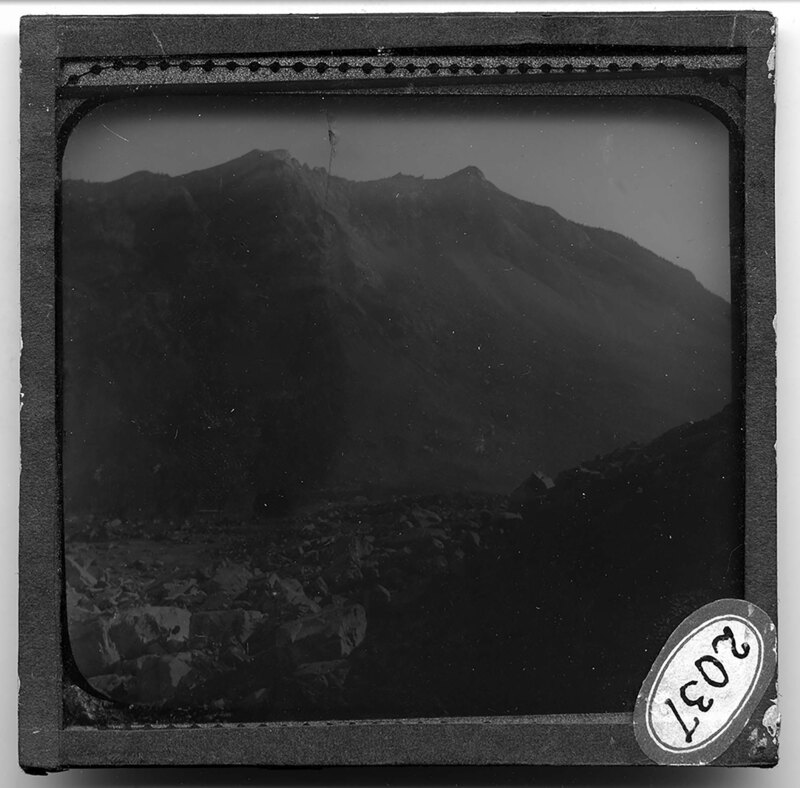
The remnants of a landslide in the Canadian Rockies. A large mountain rises in the background and it is noted this is the source of the landslide. Large boulders have been deposited in the valley in the foreground. Trees can be seen at the base of the mountain.
Landscape of an ancient beach line. Men walk the perimeter of the forest where presumably the water reached. The flat landscape in the foreground is covered with grass and other vegetation and the forested portions of the hills rise around the ancient water line.
Hilly landscape of agricultural fields. The hills are covered with grass and are likely used for grazing. Wooden fences divide the fields and several trees offer shade along the fences rows, but the land has mostly been clear cut.
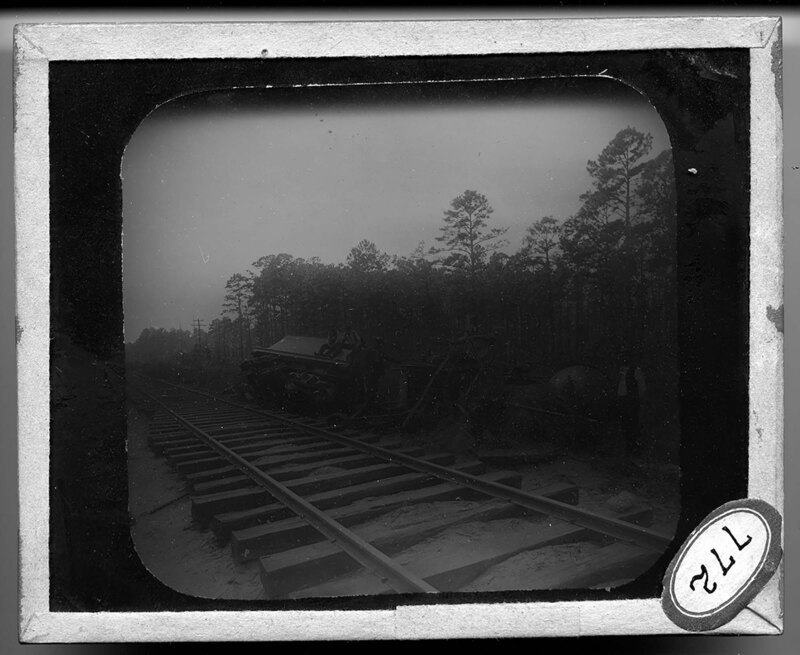
A derailed train in Charleston, South Carolina. It is noted the train was derailed after an earthquake. Three men stand next to the train engine and two are sitting on the car behind the engine. A dense forest can be seen in the background and powerline run beside the rail line in the foreground.
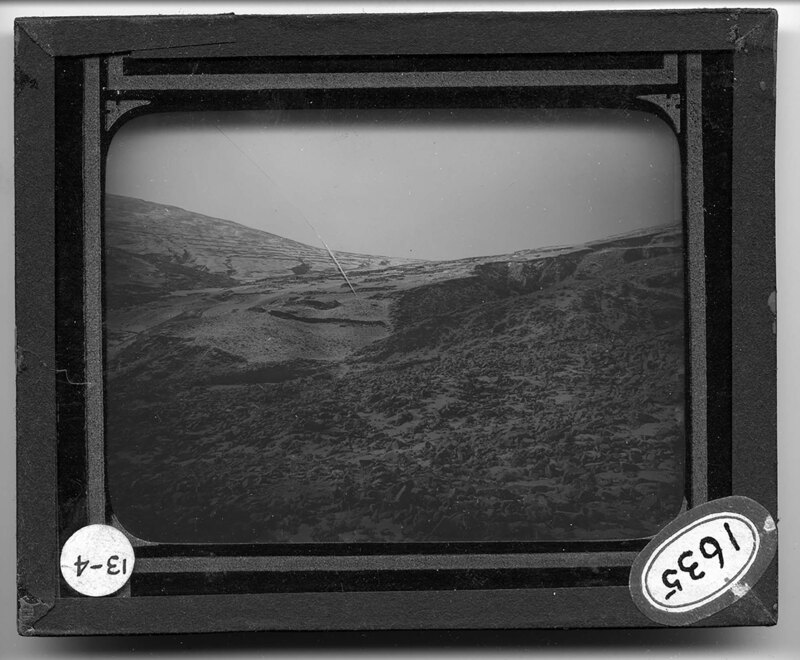
A rocky deforested mountain landscape in the Shan-si province in China. It is noted that because of deforestation the lower landscape in the foreground is covered in boulders that have fallen from the fields above. Stepped agriculture fields can be seen to the left.
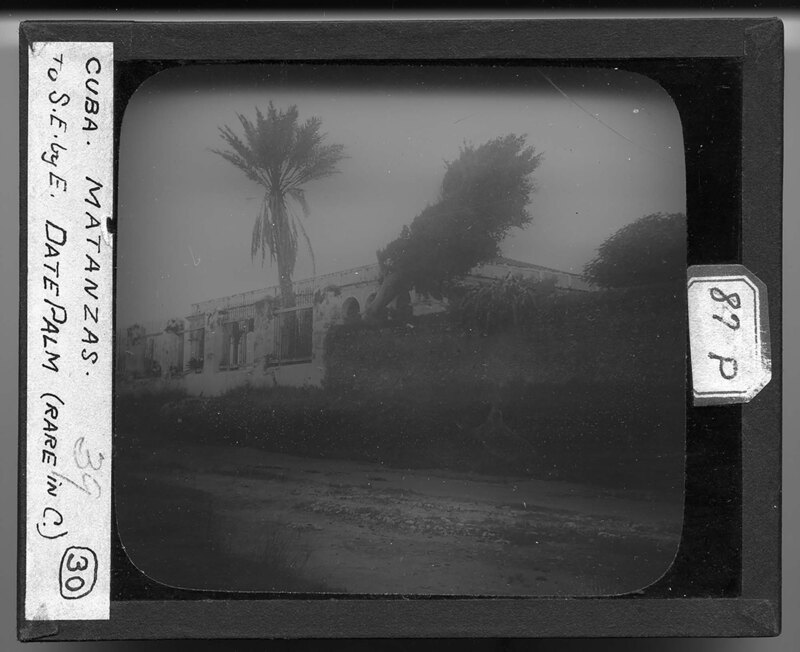
Streetscape in Cuba. Large date palm trees grow behind the block wall surrounding a house in the background. It is noted that this type of plant is rare in Cuba. The street is covered with rocks and grass and is flooded. Vegetation grows on the stone wall to the right.
Streetscape with outdoor eating areas and patios for the storefronts. A woman walks in the street in the foreground and people sit at tables, enjoying sitting under canvas overhangs. A restaurant or hotel called, "Alachope," sits on the corner of the building and it appears to be spring or summer because the trees have their leaves.
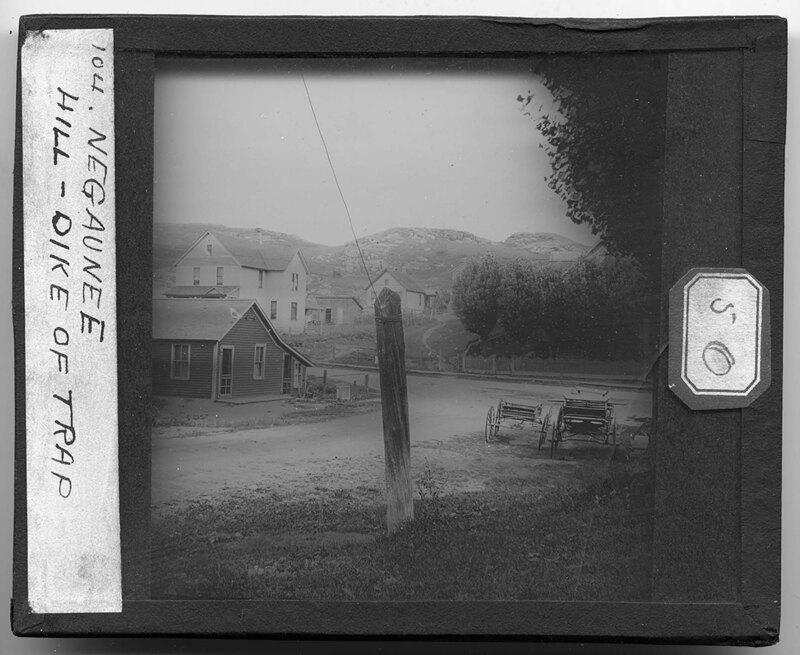
Streetscape overlooking Negaunee Hill. Several houses have been constructed along the dirt roadway and are all varying sizes. Two wooden wagons are parked under a tree to the right and a wooden post holds a taut cable in the foreground. Rocky hills can be seen behind the houses and the landscape is covered with grass.
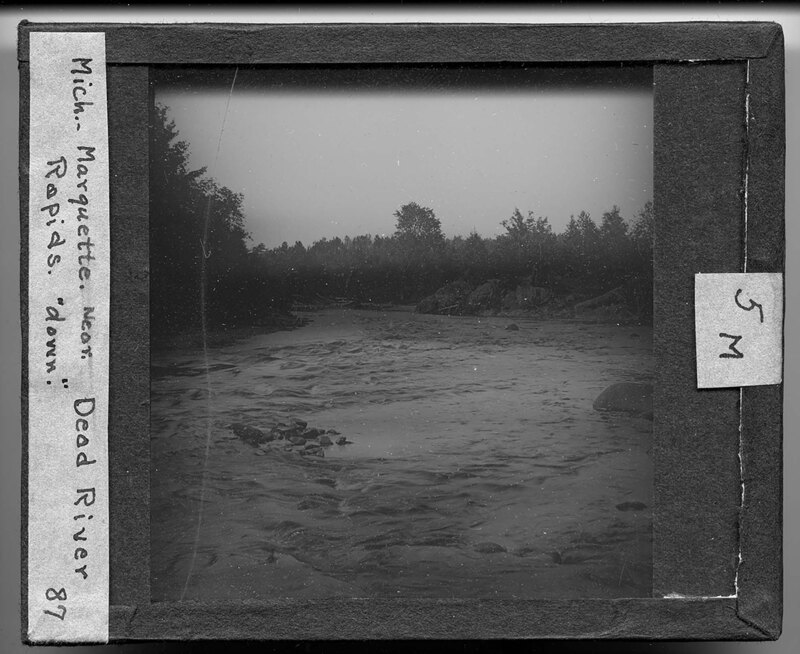
Overlooking the river in Marquette, Michigan. It is noted the picture was taken down river from the Dead River Rapids. Rocks and boulders stick up out of the water, which rushes around them creating a strong current. A large rock formation can be seen on the bank to the right, and trees grow out of the top. Dense vegetation covers both banks and large tree trunks can be seen stacked on the bank further down the river.
Mountainscape with a large glacier in the foreground. Rocky peaks rise up around the glacier and are mostly snow capped. Fissures are being created as the glacier moves down the mountain, picking up rocks and sediment as it erodes the peaks below. Fog obscures a portion of the mountain to the left.
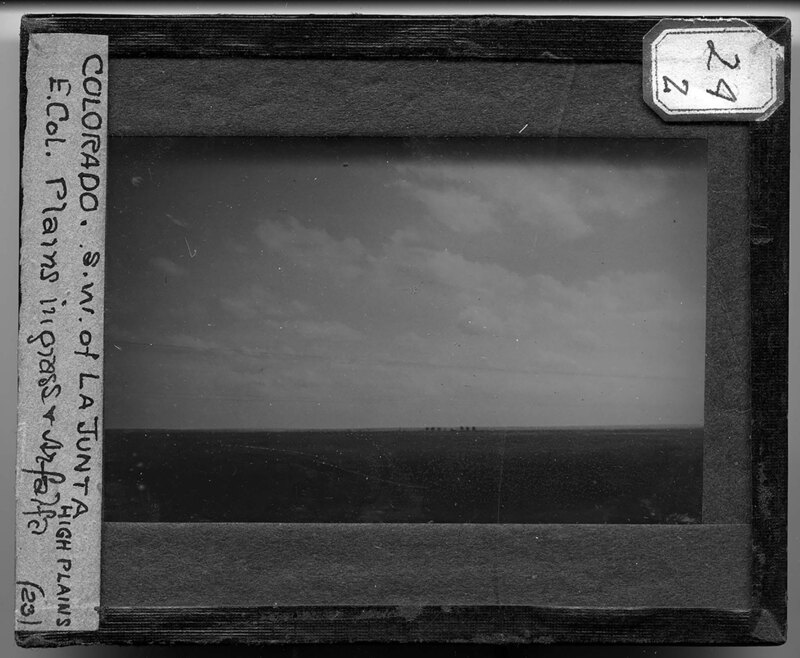
Flat landscape of a grassy plain in Colorado. It is noted this location is S.W. of La Junta in eastern Colorado. Grass and alfalfa covers the ground which is so flat that the view is unimpeded for miles. A single farm can be seen in the center of the picture, surrounded by several trees. Otherwise, the land is clear cut and likely used for grazing.
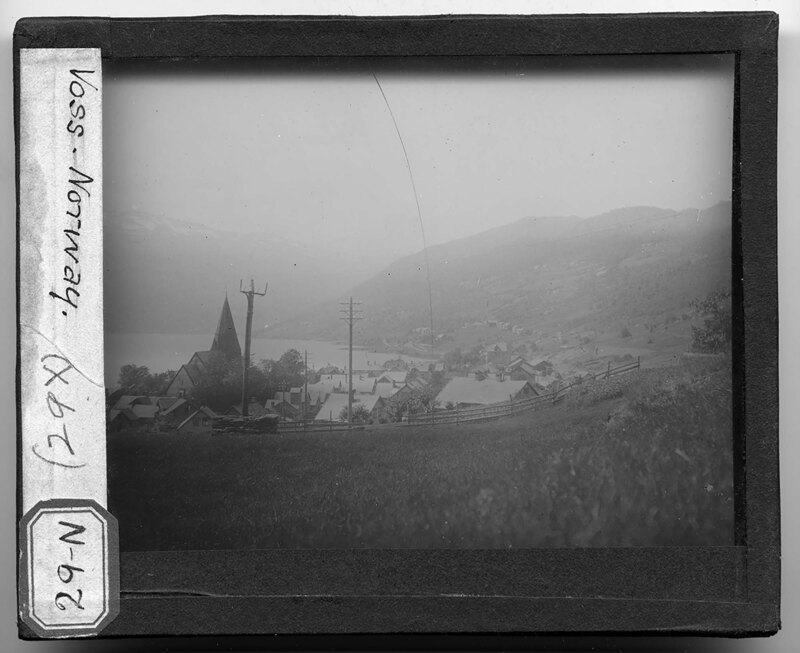
Overlooking the town of Voss, Norway. Steep hills surround a lake at the center of the town, and houses and a church can be seen in the foreground, built on the banks of the lake. A wooden fence divides the town from the grassy field in the foreground and snowcapped peaks can be seen to the left.
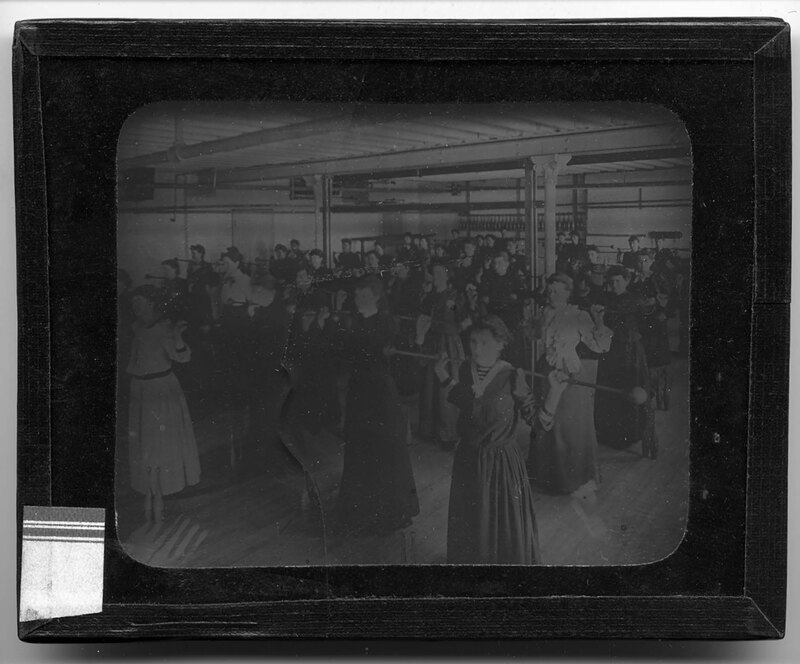
Women exercising during a gym class, likely at the Michigan State Normal College, now Eastern Michigan University. The women are all wearing long dresses and are holding small barbells. Weights sit on the floor in front of the women and can be seen handing on the back wall.
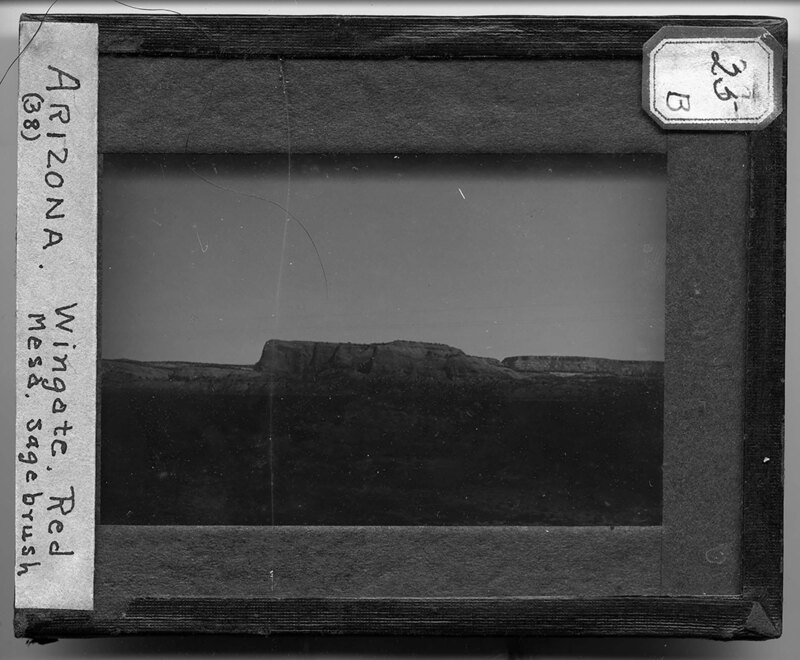
Desert landscape in Arizona. Sagebrush covers the flat plateau in the foreground and a large rocky mesa rises in the background. Settlement deposit lines can be seen in the rock wall of the formation and desert vegetation covers the top. Power Lines can be seen in the foreground.
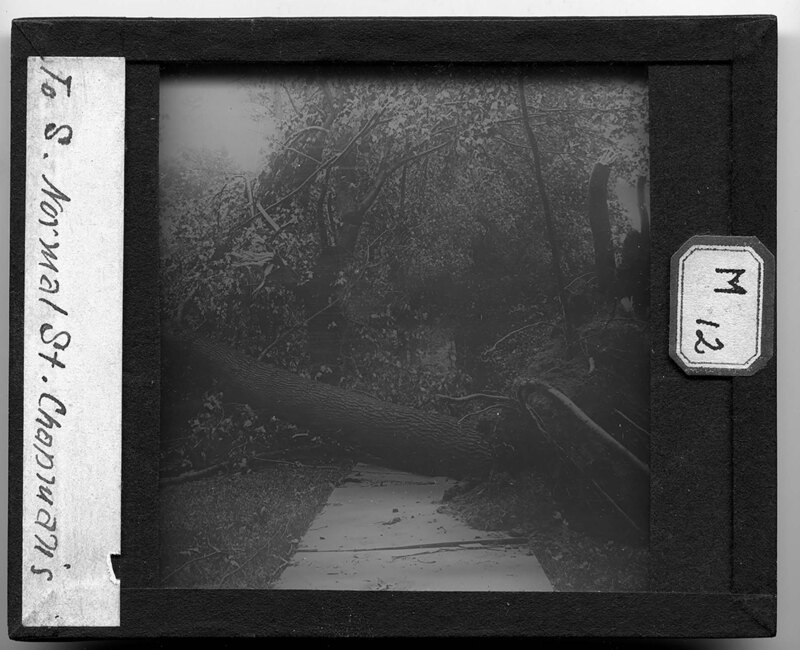
A fallen tree between Normal and Chaplin Streets in Ypsilanti, Michigan. The tree feel presumably following a storm and now lays across the sidewalk, which has cracked under the impact of the tree. Roots protrude out of the ground and branches obscure the sidewalk behind the tree.
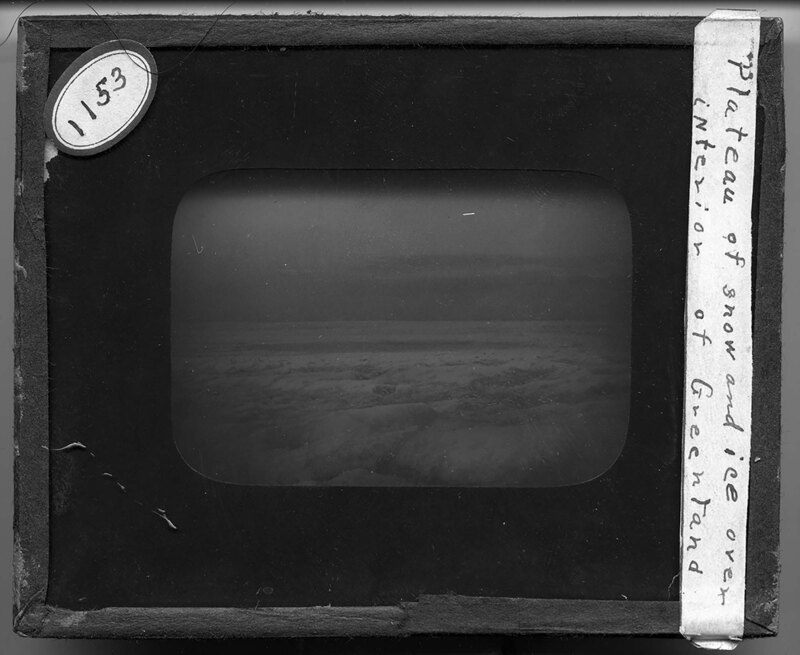
Landscape of an ice and snow plateau in Greenland. The ice dams create large holes and divots so the terrain is rugged but there is no vegetation and no buildings.
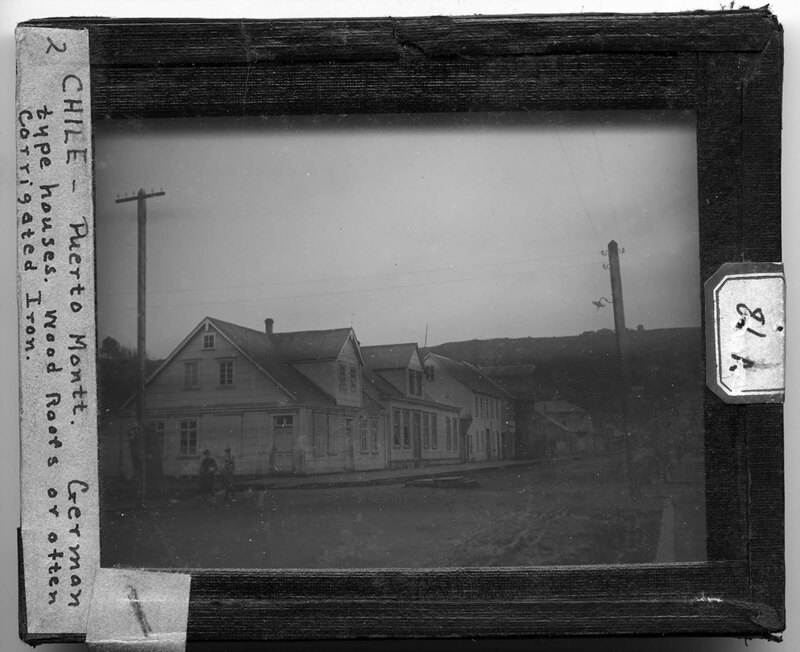
Streetscape with German style houses to the left. Two women walk down the sidewalk in front of the houses, which are all constructed of wooden and a story-and-a-half. Several have large second floor roof dormers, which add extra floorspace in the attic area. Powerlines cross over the dirt roadway, which has deep ruts in it that are filled with water. Mountains can be seen in the background.
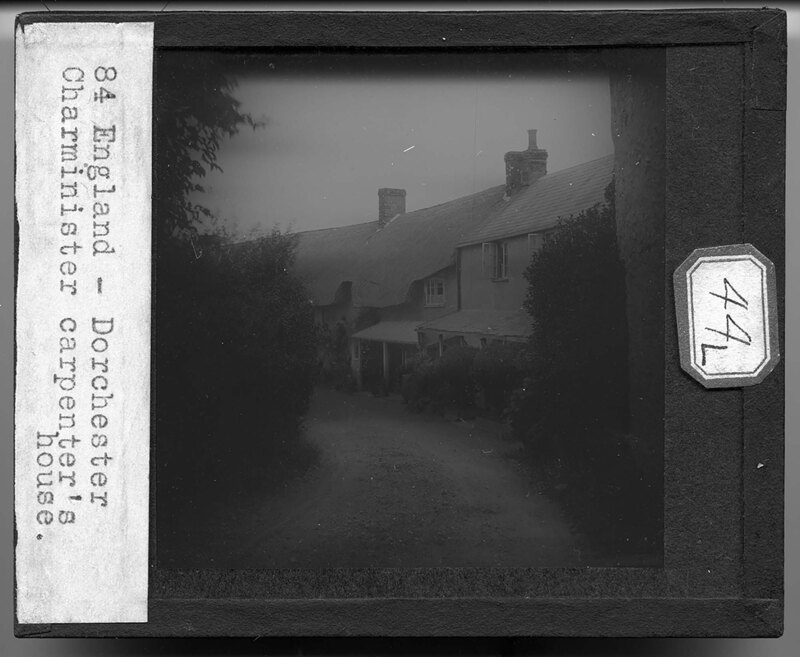
Streetscape of 84 England. It is noted that this is the house of Dorchester Charminister's carpenter. The houses are all row houses and have connecting thatch roofs. The houses also share fireplaces because a single chimney rises out of the houses where they connect. Dense vegetation lines the road and obscures the fronts of the houses.
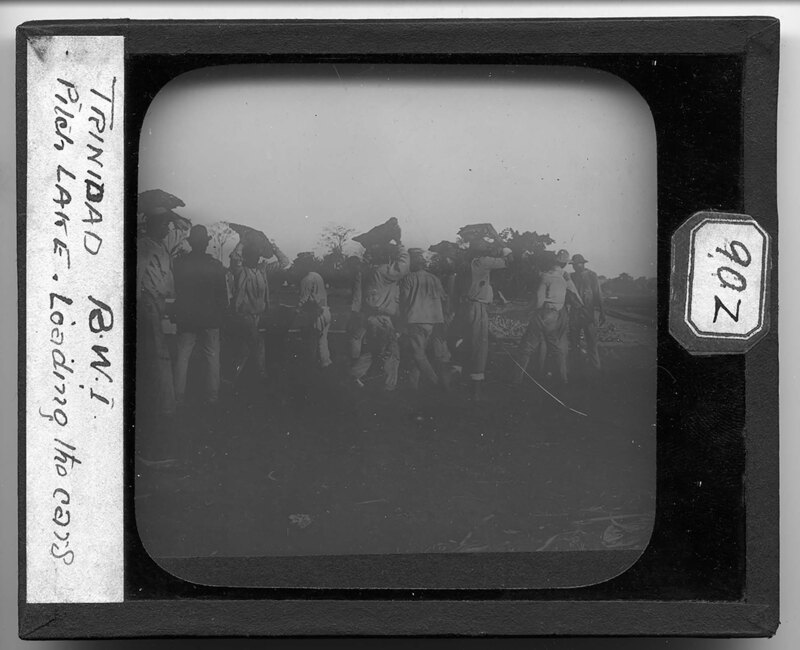
Men working in Trinidad. It is noted they are loading cars with cargo near Pilch Lake. They carry baskets on their heads and are all barefoot. The landscape is relatively flat and most of the trees have been cleared.
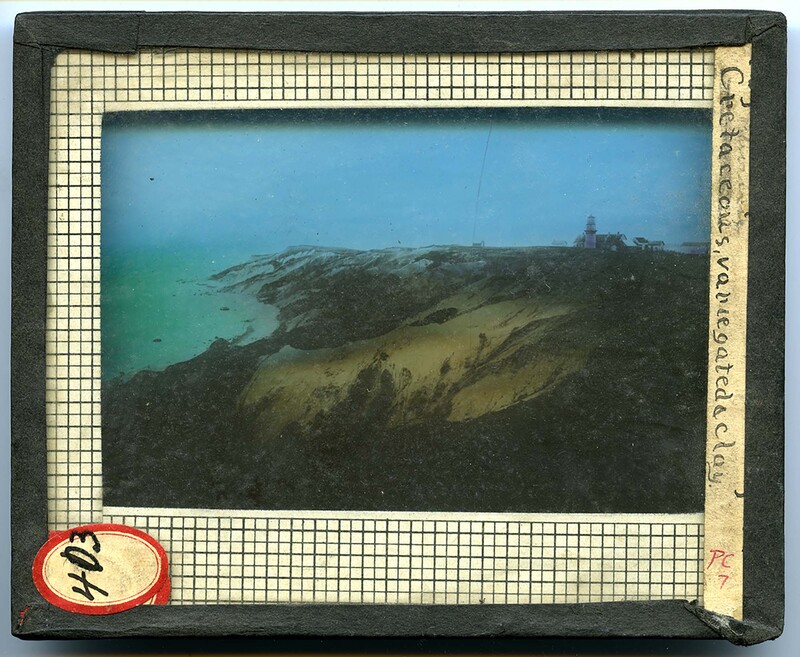
Landscape of a steep shoreline. A lighthouse and several other buildings sit on the bluff to the right but a majority of the steep bank has been eroded and portions of the soil have been exposed. It is noted that the exposed portions are made of clay and are from the cretaceous period. Grass covers the rest of the landscape and a body of water can be seen to the left.
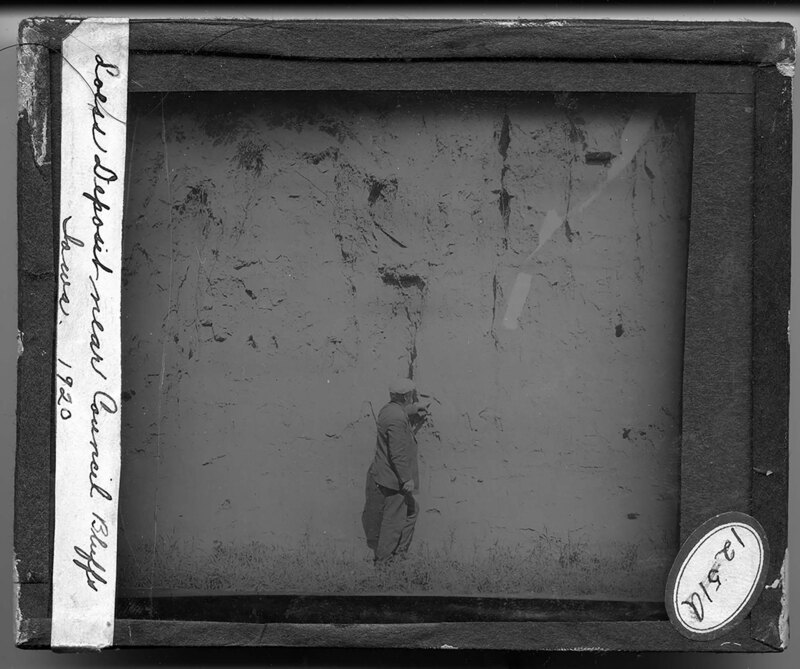
A man inspects rock deposits near Council Bluffs, Iowa in 1920. The rock wall is approximately 20 ft. tall and towers over the man as he inspects a crack in the exposed rock. Vegetation grows out of the side of the rock wall and grass covers the ground at the base of the rock formation.
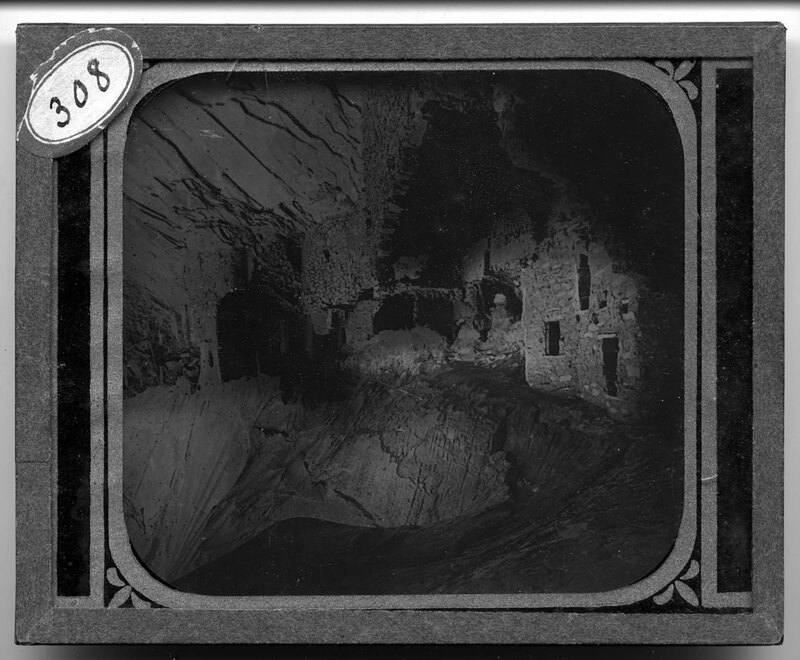
Ruins of a cliff dwelling in Arizona. The remains of the houses sit underneath a large rock ledge that protects the house from the elements. A steep drop-off can be seen below the house in the foreground and a large opening can be seen above the drop-off, presumably where a wall from the house used to be.
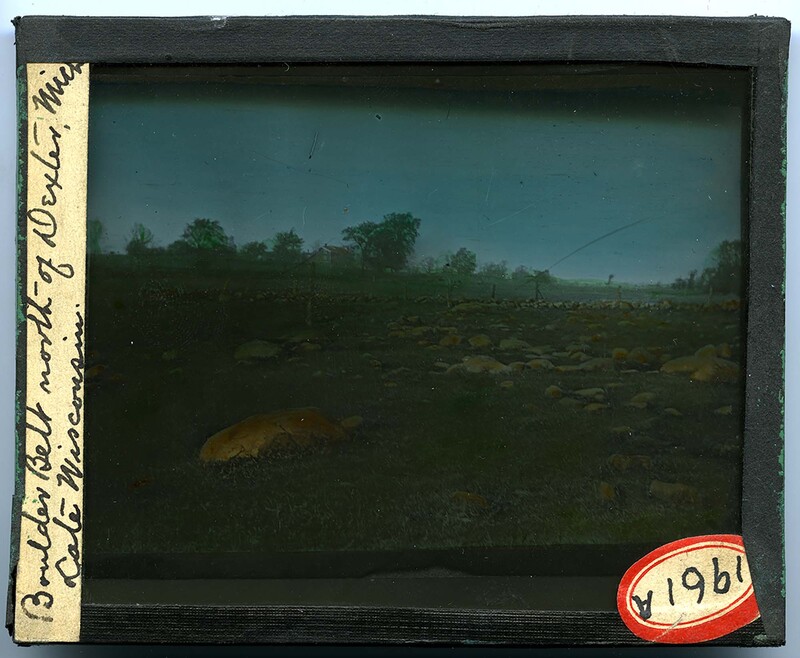
Landscape of a boulder belt in Dexter, Michigan. Large boulders are scattered throughout the field in the foreground, but have been cleared from the field in the background. A farm can be seen sitting on the hill in the distance and a wooden fence divides the two fields.
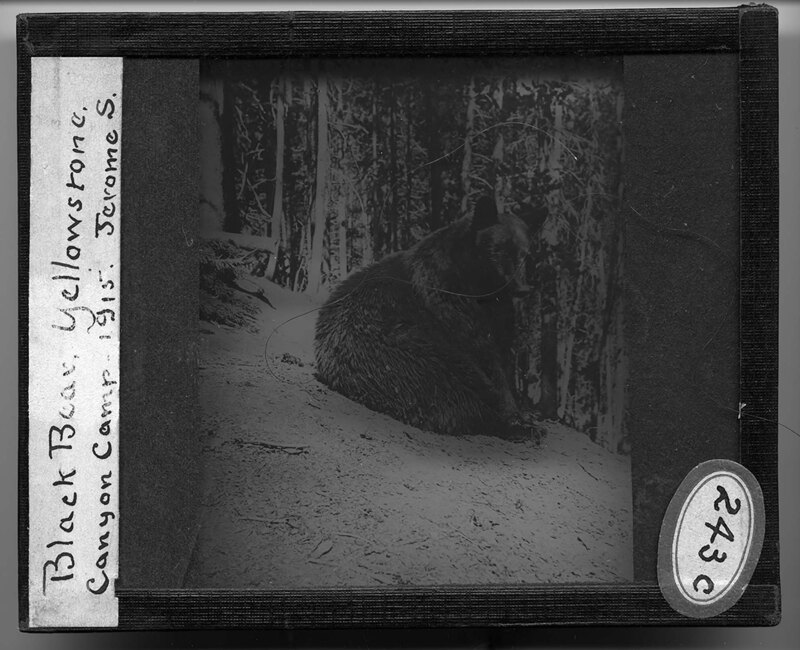
A black bear sitting on a dirt embankment outside of the Canyon Camp in Yellowstone National Park in Wyoming. It is noted that the picture was taken in 1915. A dense stand of trees can be seen in the background.
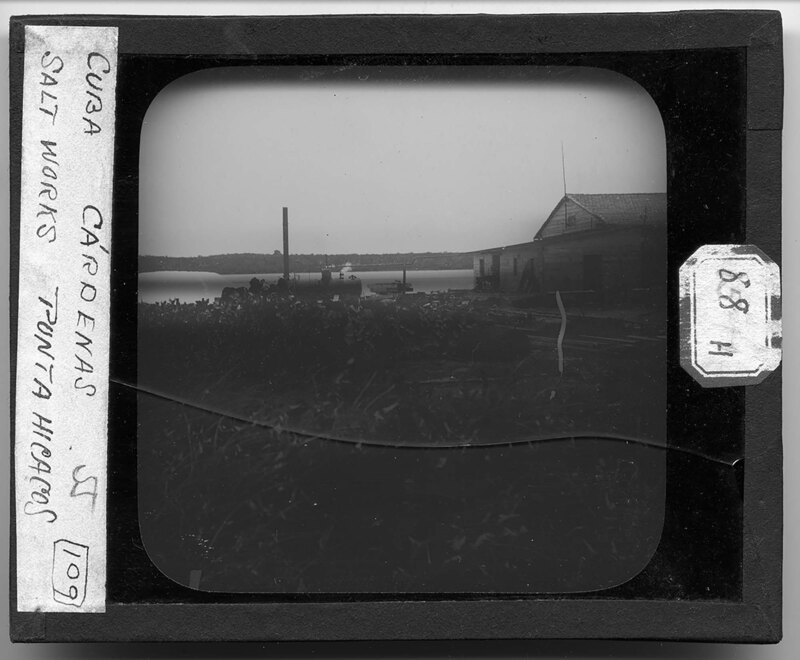
A salt works plant in Cuba. The plant is a single wooden building that is built on the banks of the river in the background. A boiler can be seen to the left as steam escapes the vessel. Vegetation covers the landscape in the foreground and the opposite bank of the river is heavily forested. Industrial equipment is scattered in the grass around the building.
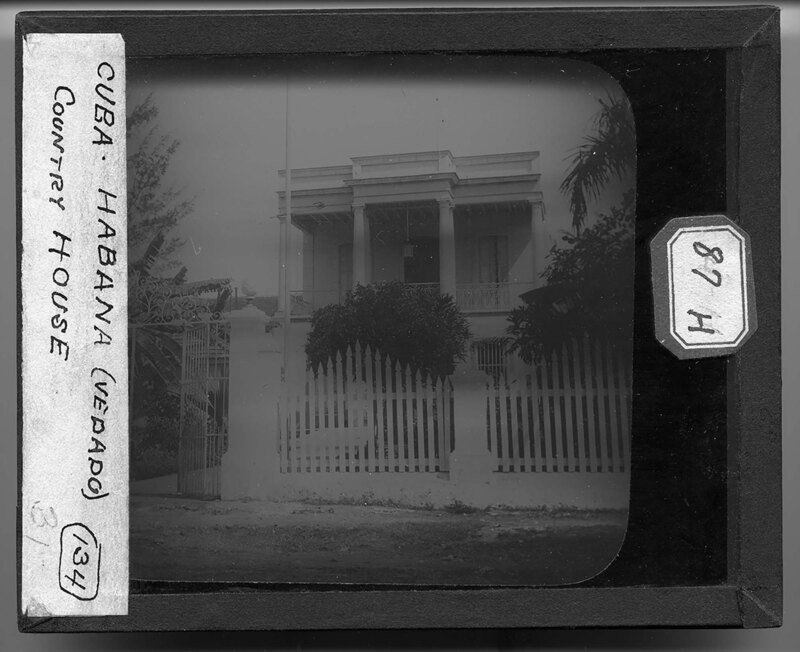
The front of a country house in Habana, Cuba. The house is two-story structure with an extending portico supported by tuscan style columns. The second story has floor to ceiling windows and a doorway that opens onto the porch. A heavy cornice caps the second story porch and the roof appears the be flat. A wooden picket fence surrounds the property and wrought iron gates open to the walkway leading to the house. Palm trees and other bushes obscure the view of the front of the house.
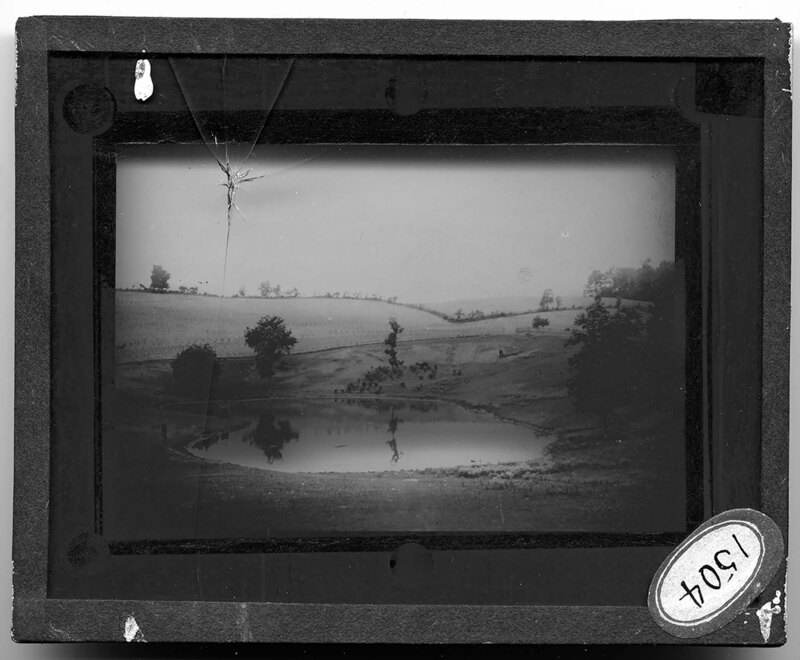
Landscape of a pond in the middle of several cultivated fields. Several people stand on the banks of the pond which is surrounded by hills and vegetation. A portion of the embankment behind the pond has eroded and now has exposed soil that vegetation has not covered. A tree line can be seen in the background, dividing the fields.
View of a spiral galaxy through the Crossley Reflector. It is noted the image shows M51 in cones. The picture is grainy but multiple stars are visible and the arms of the galaxy look like fine dust that surrounds the stars.
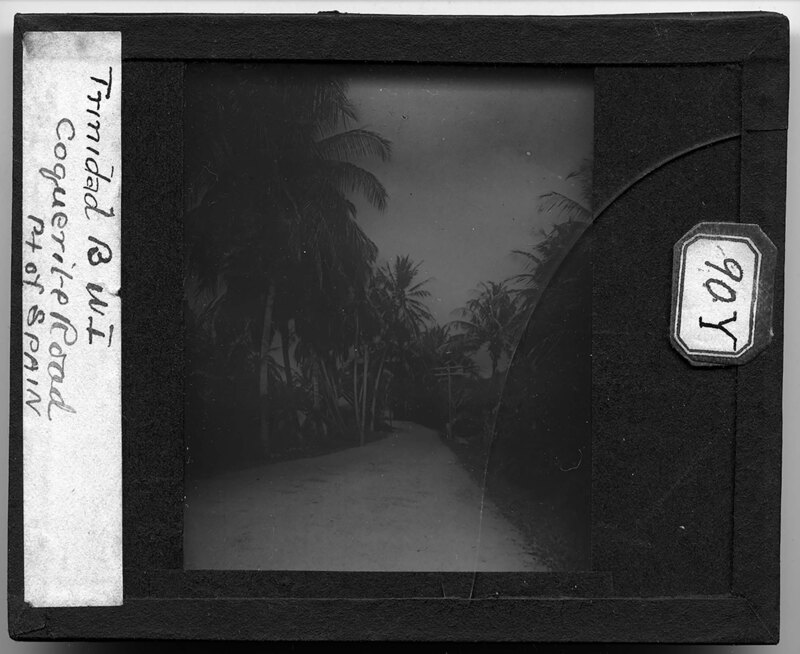
Streetscape of Coquerite Road in Trinidad, Spain. Palm trees line both sides of the dirt roadway and power lines criss-cross between the trees. Dense undergrowth covers the landscape.
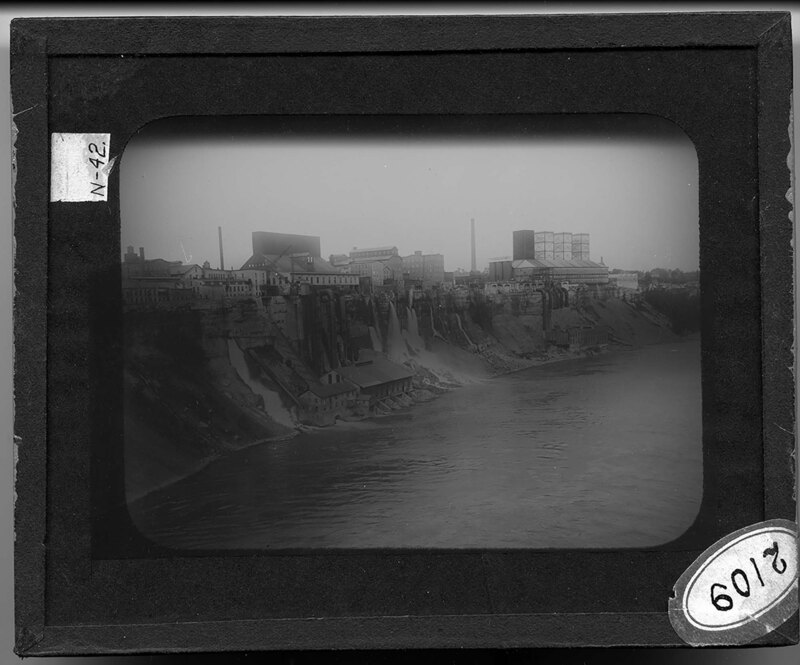
Landscape of an earthen dam and water spillways. Industrial buildings are constructed on the top of the dam, presumably as power plants for the spillways. Water pours through holes in the dam and cascades into the river below. More industrial buildings can be seen in the background as well as further down the river.