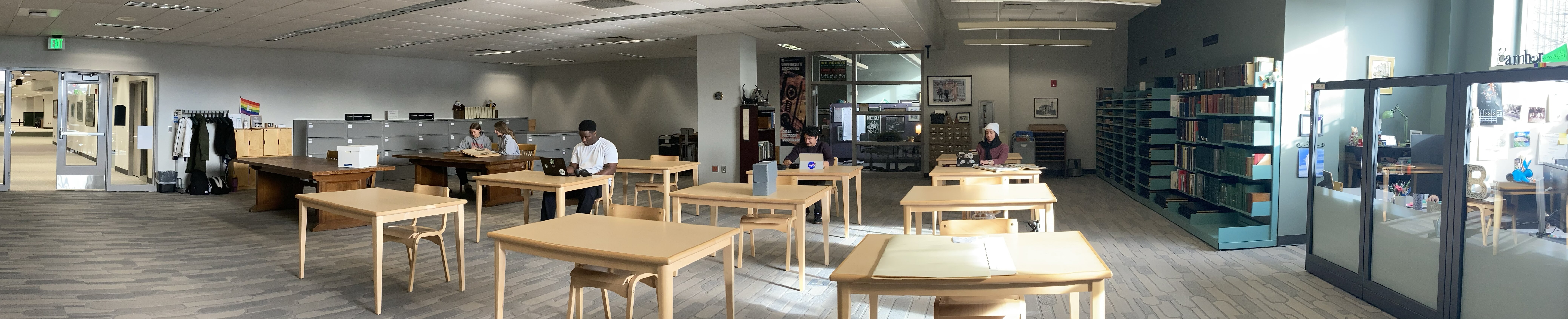
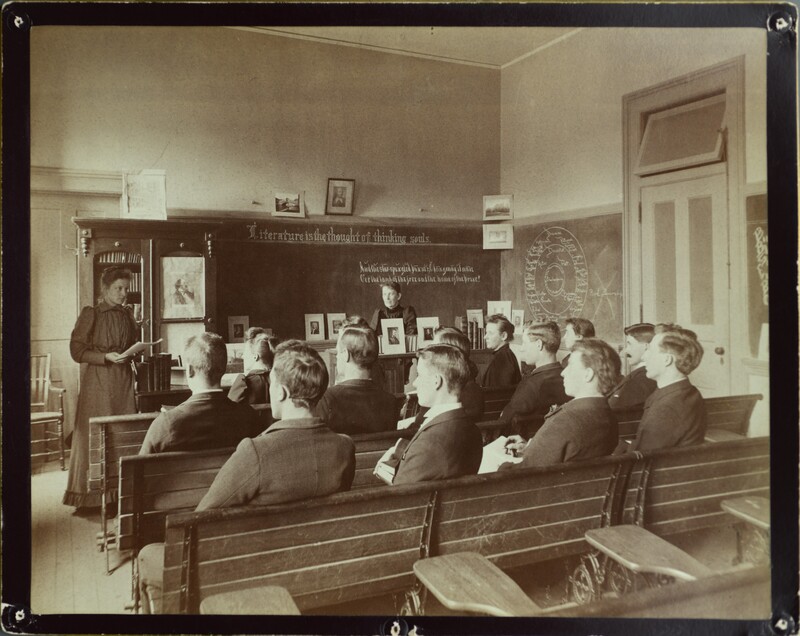
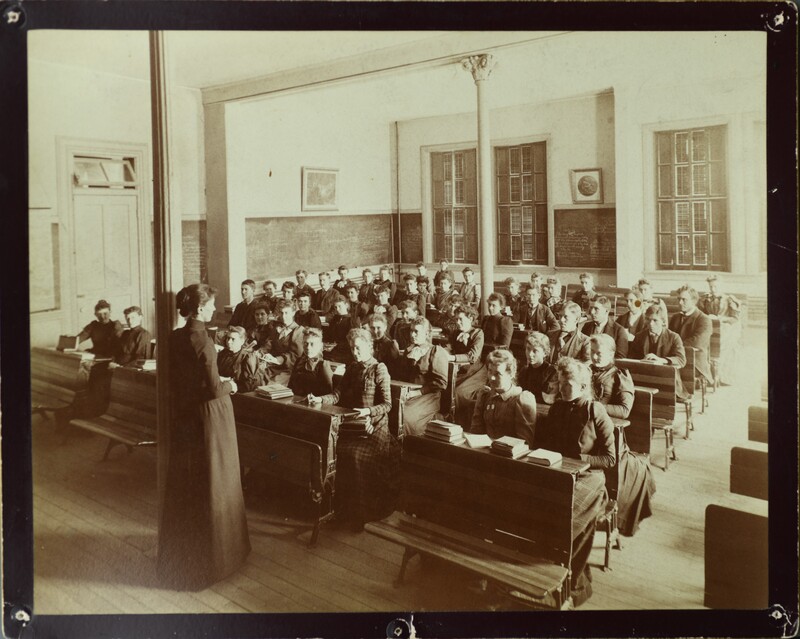
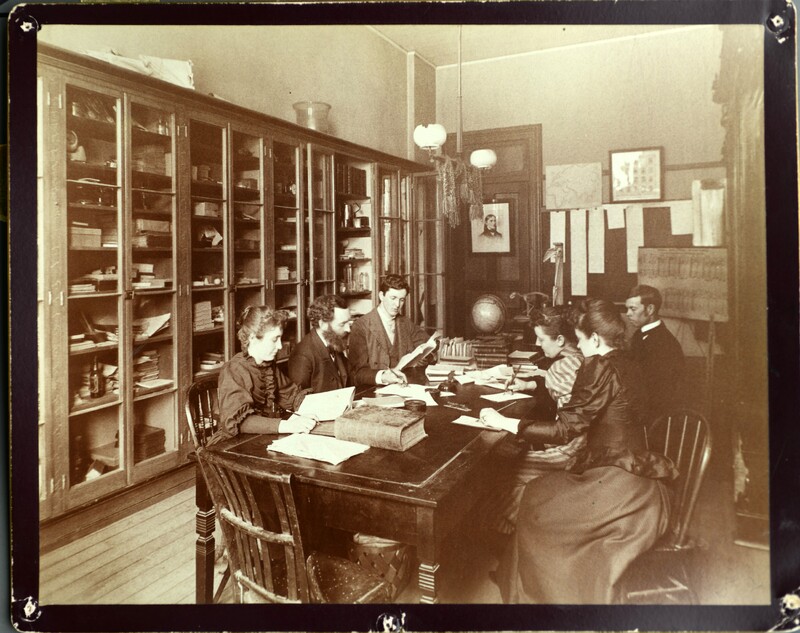
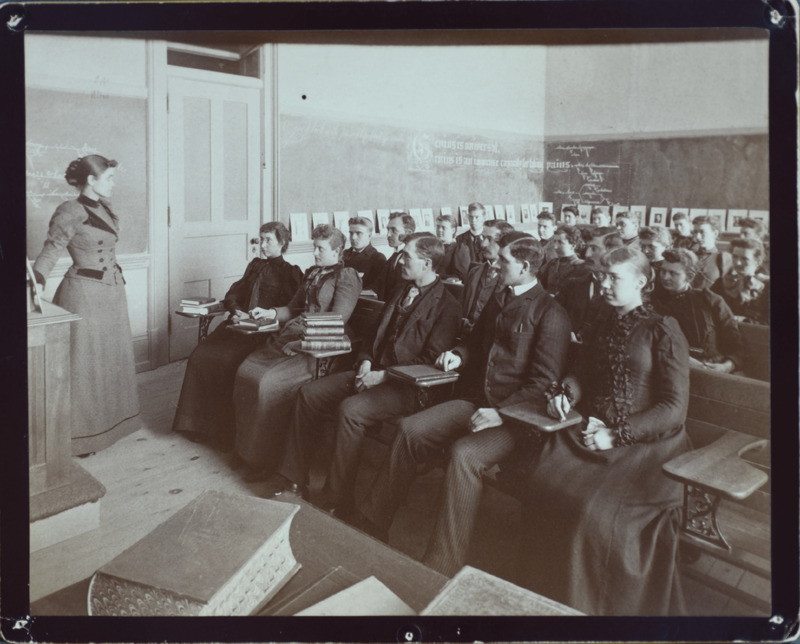
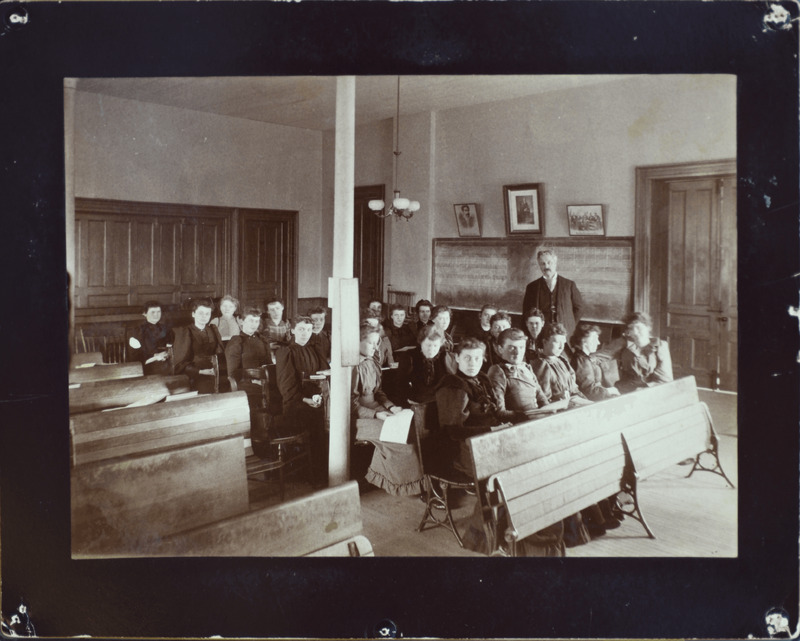
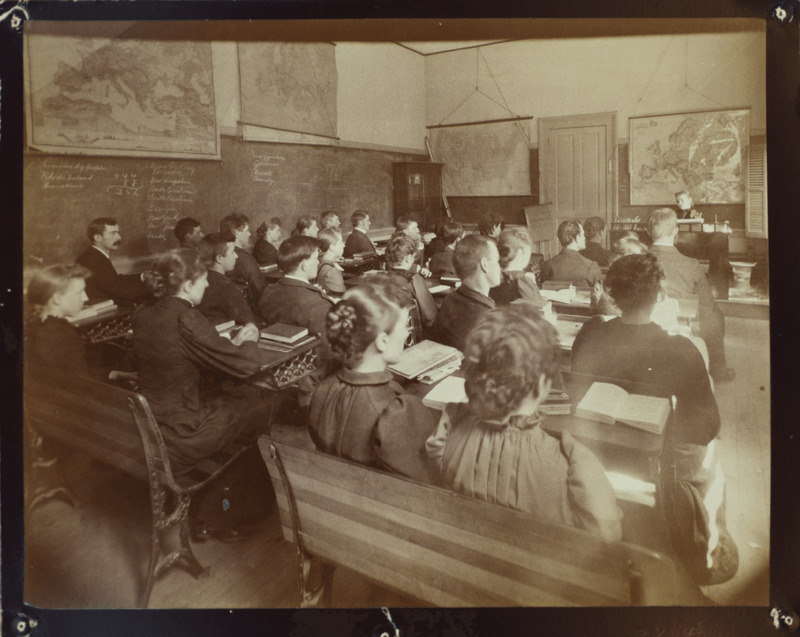
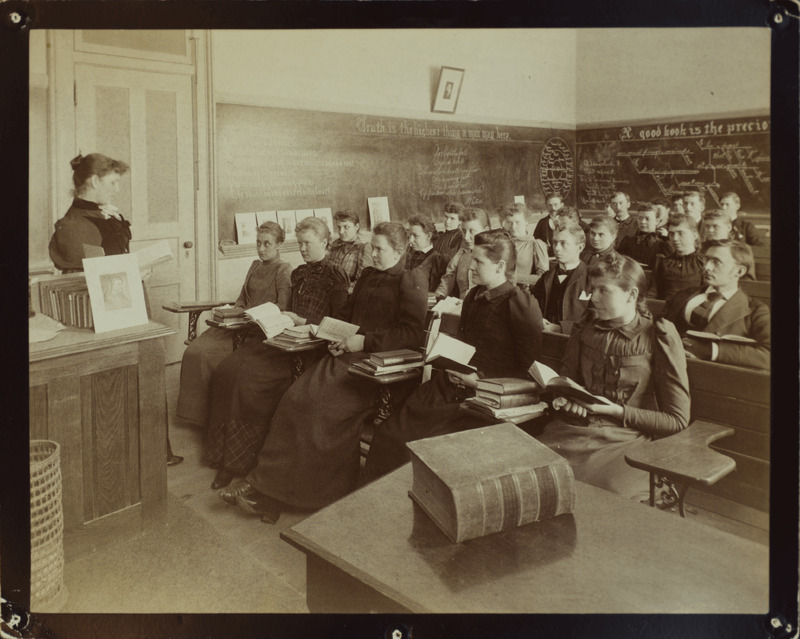
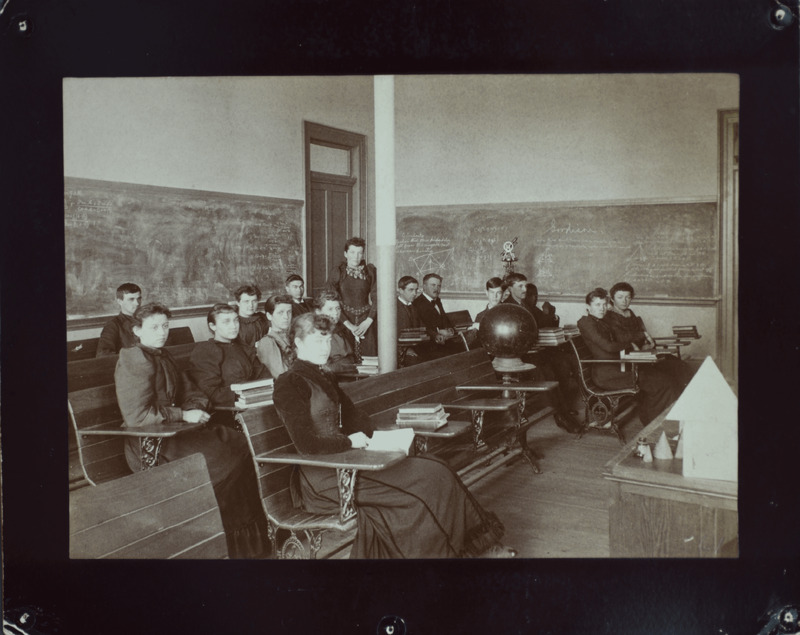
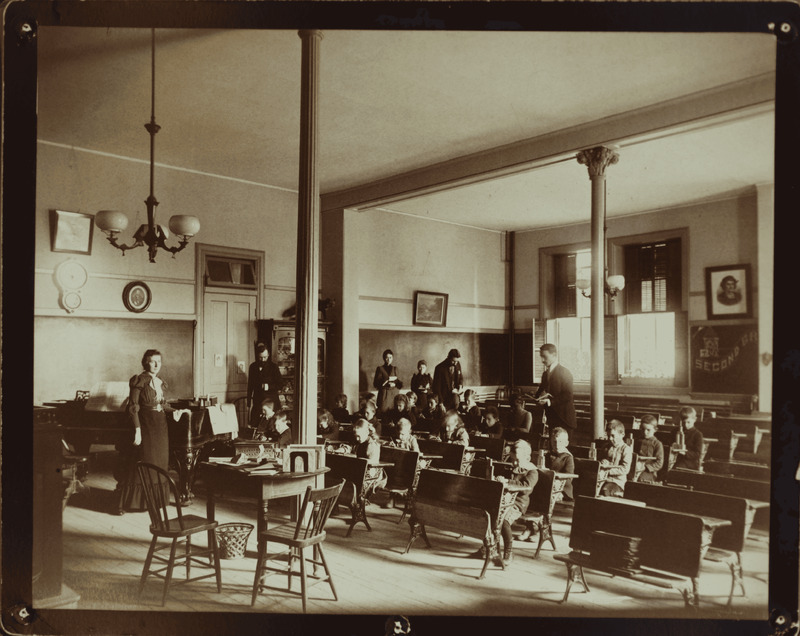
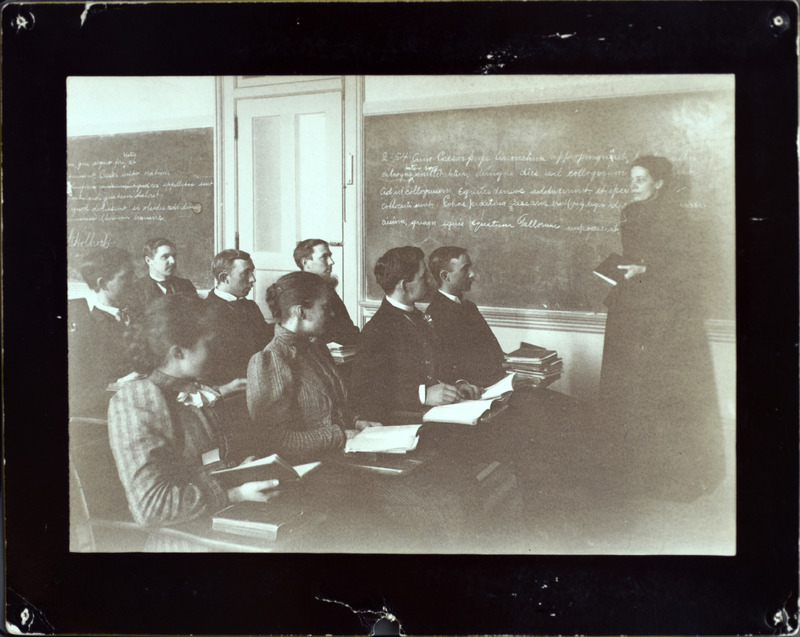
This image depicts a Literature class being led by the woman standing at the front of the room, who is likely Lois McMahon. On the chalkboard, there is a quote by British essayist Thomas Carlyle that reads, “Literature is the thought of thinking souls.” The full literature course extends through four semesters, each semester being devoted to one subject. The four subjects that are covered in the Literature course are: English Literature, American Literature, Old and Middle English, and Masterpiece Study.
This image depicts a history class being taught by Florence Shultes, an instructor in the History and Civil Government department. One of the conditions of admission into the Normal school was that students were required to have knowledge of the significant elements of American history and be able to express critical thinking skills. This is made evident in the 1893-94 Normal register when it states, “History furnishes material for judgements, and unless the pupil has learned to see the relations between the facts, to compare, to judge, that is to think, to use the facts, he is not ready for any such study as Political History.” (p.56)
This image depicts a meeting in the office of the Director of the Training School, Professor Austin George (pictured sitting in the middle on the left side of the table). During the summer of 1863, the same year George graduated from the MSNS, he organized Company E of the 17th Michigan Infantry in the Civil War. After graduating, George moved to Kalamazoo where he worked several positions within the Kalamazoo Public School system, and established a Training School. George returned to the MSNS in 1881, the same year he proposed and started The Normal News, and a year later accepted his role as the Director of the Training School. After significantly expanding and strengthening the Training School curriculum, George left the Normal in 1896 to accept a position as the Superintendent of the Ypsilanti Public Schools.
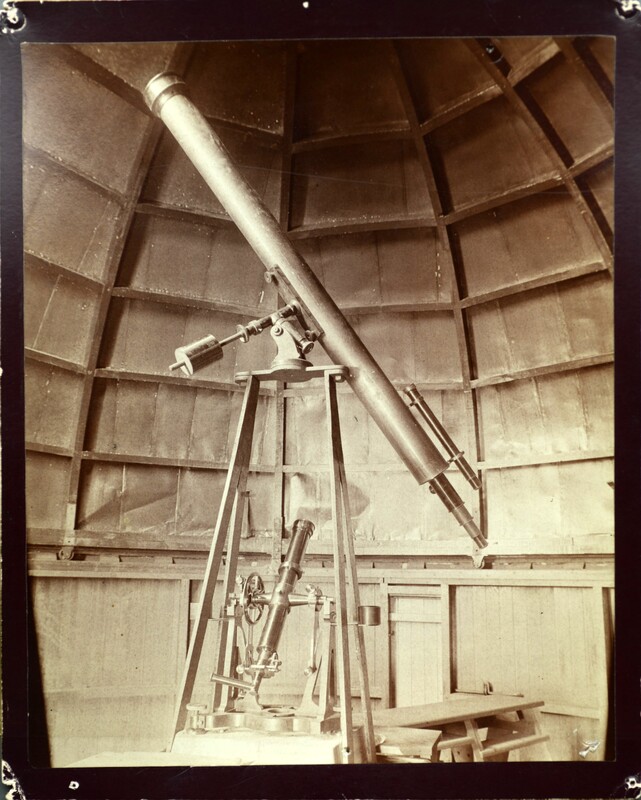
This image depicts the Alvan Clark refractor telescope (large), and the Brandis transit telescope (small). The Alvan Clark 4'' refractor telescope, purchased in 1872 for about $300; Brandis transit telescope purchased in 1876 for $680.00 (small scope sitting under larger telescope). Both of these telescopes were placed in the observatory dome after construction was completed in 1881. In 1893 a tornado carried the observatory dome twenty-five feet, and while both of the telescopes were able to be repaired after the disaster the Brandis was unfortunately lost in the Sherzer Hall fire of 1989. About half of Sherzer was gutted during the fire, marking it one of the most devastating events in our university’s history. The Alvan Clark telescope is currently housed in the Sherzer Observatory.
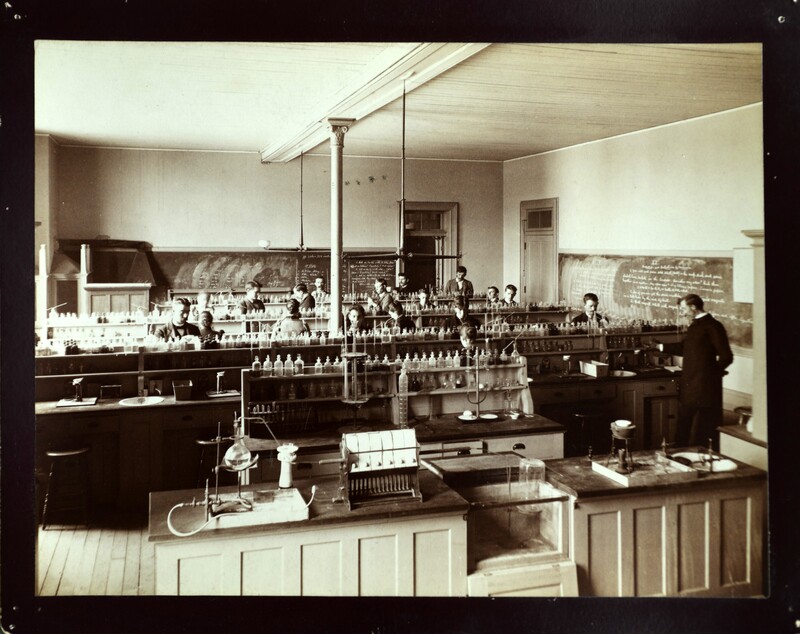
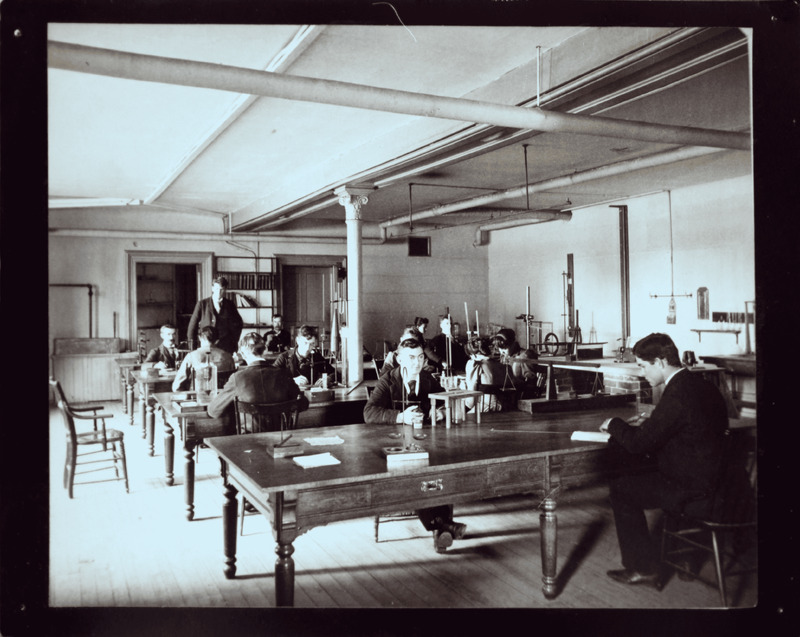
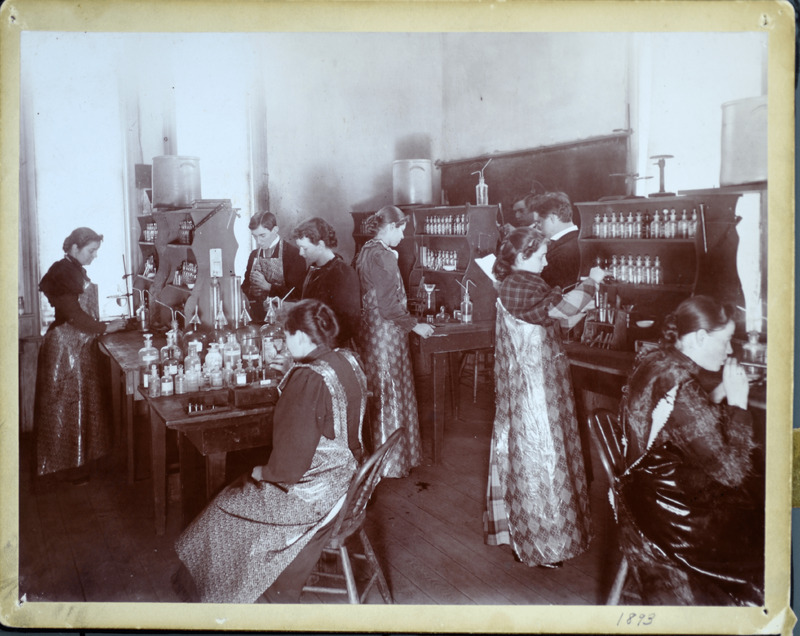
This image depicts students working in one of the school's Physical Science laboratories, likely conducting experiments for one of the Chemistry courses offered by the Normal. As noted by the Normal school register, “in addition to general demonstration work, about one hundred experiments are conducted by the students at their tables.” The chemistry laboratory had thirty stations prepared for student use, stocked with enough equipment for independent experiments.
This image depicts a class being taught in the Conservatory under the direction of instructor Oscar Gareissen. The Conservatory provided a regular four-year course leading to a teaching certificate, and also offered advanced instruction in either vocal or instrumental music. The three instruments available for students to choose from were the piano, violin, and organ. Students who proved to be competent with their instruments were given opportunities to accompany the vocal students and play their own recitals.
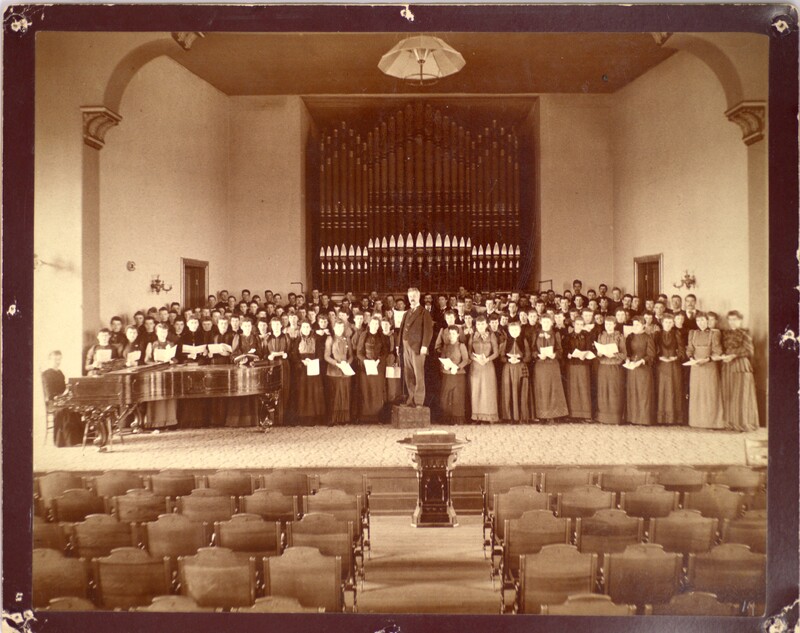
This image depicts the Normal Choir standing behind Director, Frederic Pease, on the stage of the auditorium on the third floor of Old Main. The Normal chorus generally consisted of about one hundred and fifty voices, who would meet daily for one-and-a-half-hour rehearsals. The work in The Normal Choir consisted of preparing music to perform at public school exercises and concerts that would be given throughout the year. The choir also assisted in leading worship during the daily Chapel Exercises that took place in the Normal Hall every morning at 8:20.
This image depicts a Mathematics class being taught by the head of the Math Department, David Eugene Smith. Dr. Smith originally joined the Normal faculty during the 1890-91 school year and would remain in his position until 1898, when he moved back to his home state of New York to be the principal of the Normal School in Brockport. During his seven years at the MSNS, Smith co-authored and published four textbooks relating to mathematics. Today, Smith is considered to be one of the founders of the field of mathematics education, and he was able to make students see the true beauty and depth of mathematics.
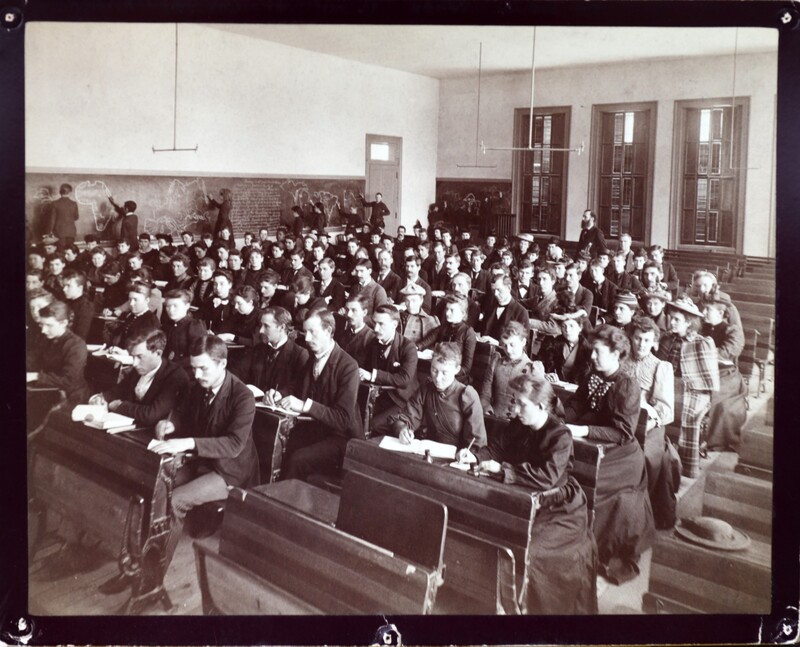
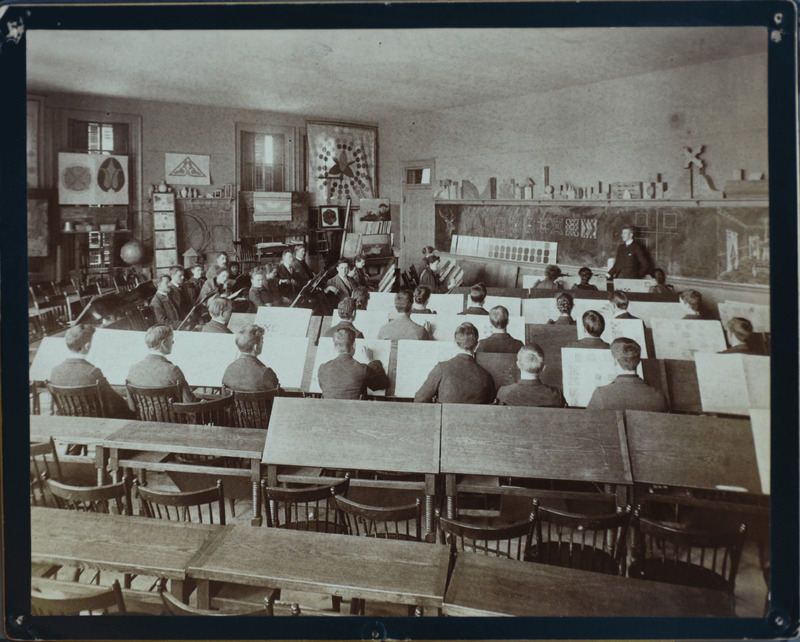
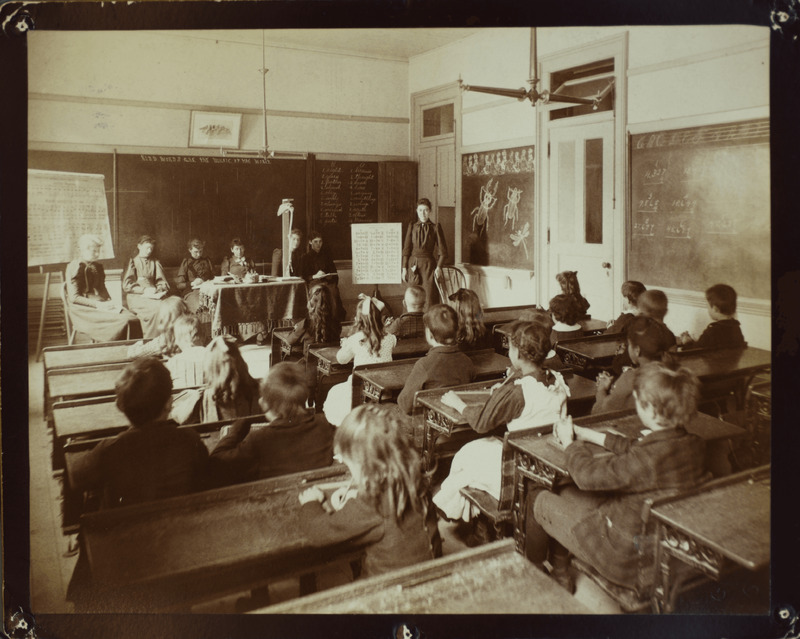
This image depicts a large group of students attending a Geography lecture, as evidenced by the 9 students who are practicing drawing various continents, as well as the state of Michigan on the chalkboard. Professor Austin George can be seen standing in the back of the lecture room watching over the students. Three additions were made to the Old Main Building, front addition in 1874, rear addition in 1881, and third addition in 1883, to expand the schools available facilities, such as the creation of large lecture rooms to accommodate the Normal’s fast-growing student population. The original lecture rooms on campus only had enough space to house about 60 students.
This image depicts an Elementary Physics class being taught by Professor Fred Gorton. The Physical Sciences occupied the majority of Gorton’s free time, which is evident in the fact that, in addition to serving as a part of the Physical Sciences Department, Gorton was a member of the Sociétéde Physique (Physical Society) and the American Academy for the Advancement of Science (Aurora, 1912, p. 49). Fred remained a part of the Michigan State Normal College’s faculty for 50 years, retiring only a few years before his passing.
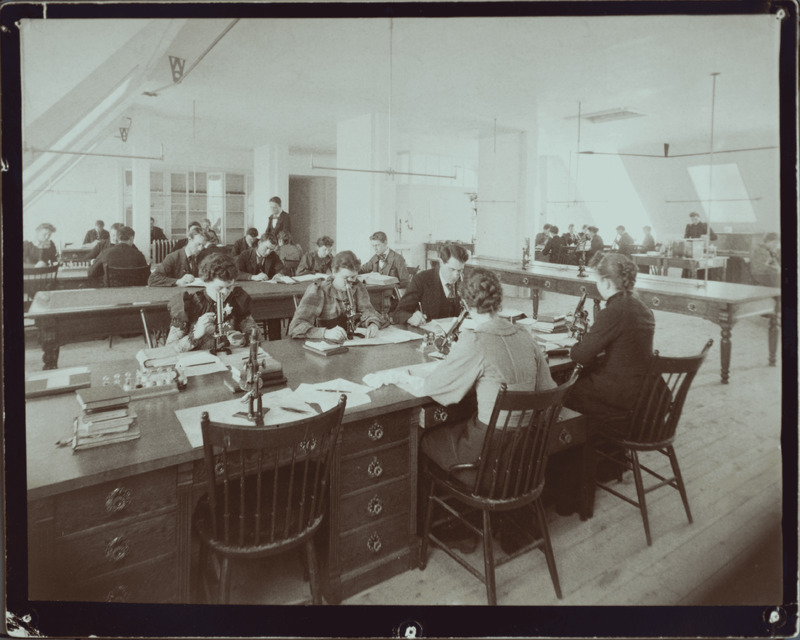
This image depicts students working in the biological laboratory taken during the winter of the 1892-93 school year. The Normal had 66 microscopes in total (36 compounds and 30 dissecting), many of which can be seen being used by students in the photograph. To prepare microscopic specimens for use in the dissecting microscopes, the lab was stocked with a single microtome, a precision cutting instrument that produces extremely thin slices of various biological materials. The Normal had a Thoma and Minot brand microtome (invented in 1886), that was the most advanced microtome available on the market in the late 19th century.
This image depicts another angle of Abbie Pearce’s Literature class (see 4-8). Abbie Pearce was one of 3 founding advisors of the Alpha Sigma Tau sorority that still has chapters at EMU and around the US today. Pearce, alongside Ada Norton (in the Mathematics department), came up with the cultural and ritual aspects of the sorority.
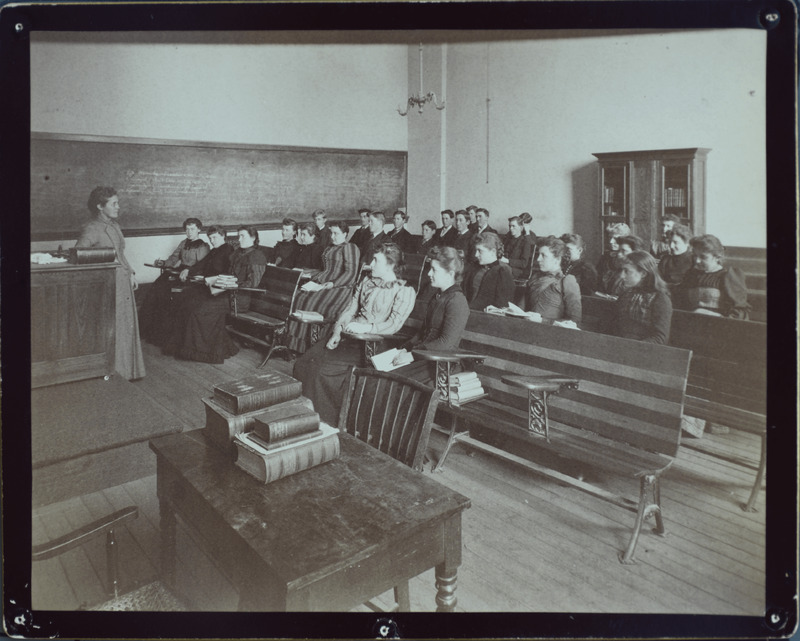
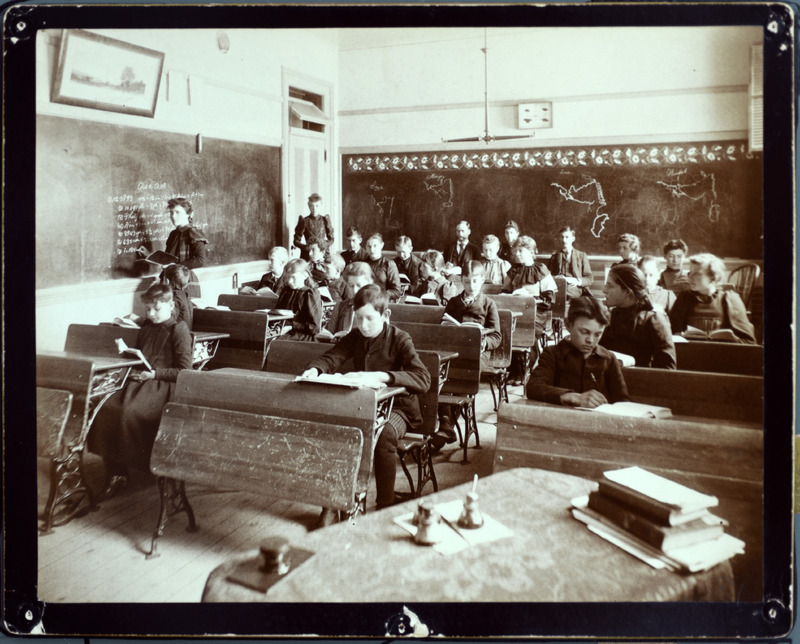
This image depicts a literature class being taught by Abbie Pearce. On the chalkboard lining the side wall is the quote: "Genius is universal, genius is an immense capacity for taking pains" which was a common proverbial saying in the 19th century, and may have originated from English reformer Jane Hopkins. There is another quote left reading: "A good book is the spiritual life blood of a master spirit,” by English poet John Milton. Due to both quotations having a connection to English individuals, this image may depict the last term in the Literary Course that focused on the study of English masterpieces.
This image depicts a Modern Languages class being taught by Annie Patton, who was Dr. Lodeman’s assistant, and the only other German and French language faculty member. There were eight terms for the German course, and six terms for the French course. Students who took all eight terms of the German course were required to teach a German lesson to Training School students to prove their proficiency in the language.
This image depicts a Modern Languages course being taught by the head of the German and French Languages Department, Dr. August Lodeman. Lodeman was a German immigrant who came to the US in 1867 and he joined the Michigan State Normal School faculty in 1872 after having obtained American citizenship. Regarding his comprehension of languages, Lodeman was noted to have few equals and was considered to be at the front of the ranks in his profession.
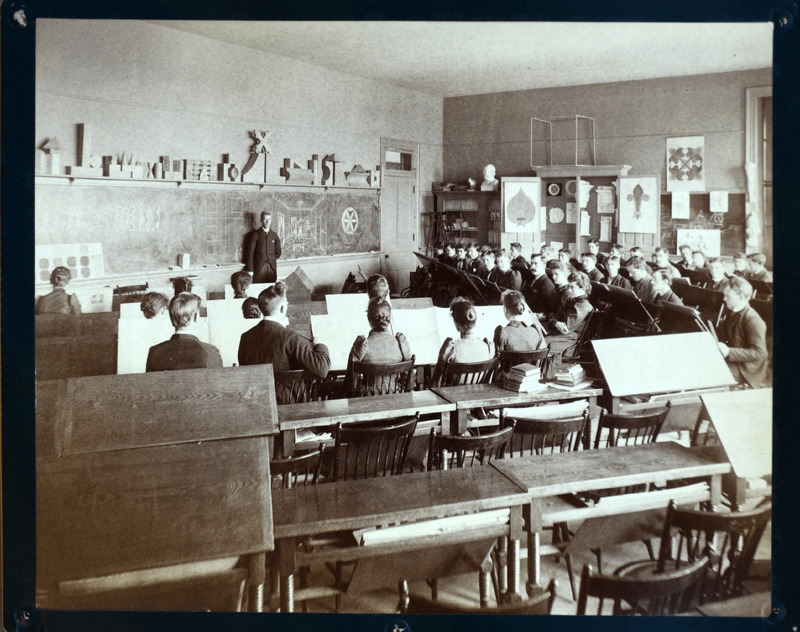
This image depicts the same drawing class depicted in 4-4 from a different perspective. The class in the photograph is likely an elementary level drawing class as there was a focus on geometrical shapes. The elementary class was a modified version of the Drawing curriculum given to Training School students, and was designed to prepare students to teach basic art lessons at the Elementary level. Subsequent Drawing courses built upon the principles taught in the elementary coursework, and senior students would teach lessons to the Training School students under the supervision of the department head for practice.
This image depicts a Drawing class, likely being taught by Charles T. McFarlane before he officially joined the Drawing department. The sole faculty member of the Drawing department listed in the 1892-93 register, John Goodison, passed away sometime around October 1892, a few months before this picture would have been taken. Goodison had been a part of the Normal faculty since 1861, and was highly regarded by both staff and students alike. He was described as being patient no matter the circumstance, and he always had words of encouragement for his students regardless of their talent level.
This image depicts a class being led by Mathematics instructor Emma Ackerman, who joined the Normal faculty in the 1892-93 school year. In addition to being an instructor, Miss. Ackerman acted as the assistant to the head of the Mathematics department, David Smith between 1892-98. She left the Normal in 1898 after receiving her Bachelor's degree in Pedagogics.
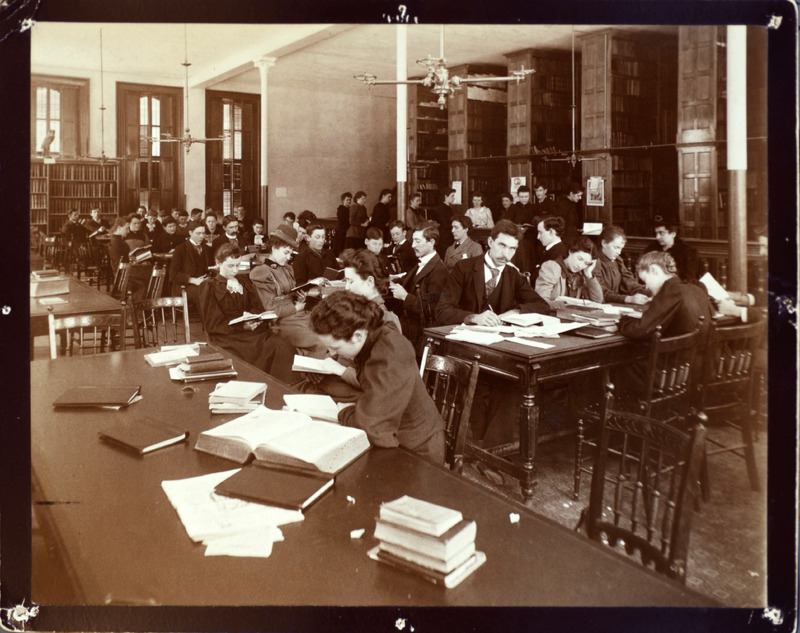
This image depicts a large group of students studying in the library, which did not yet have its own building when the image was taken in 1893. During the 1892-1893 school year, when beloved librarian Genevieve Walton became head librarian, there were approximately 12,000 volumes in the library’s collection. There was a recognition in the Normal School catalog that the library needed to expand to include individual collections for each academic department. While it is clear there was an impressive collection amassed already, the catalog stated that in regards to their laboratories and library collections, “Much is yet to be desired” (p.83).
This image depicts one of the Physical Sciences classes being led by the man who is standing at the back of the classroom appears to be Frederick R. Gorton. Gorton graduated from the Michigan State Normal School in 1892 at the age of 21, and immediately joined the Physical Sciences department faculty. Starting his career at the Normal as an instructor, Gorton eventually went on to receive a Ph.D. from the University of Berlin, Germany, and then worked as a professor at the Normal until his retirement in 1941.
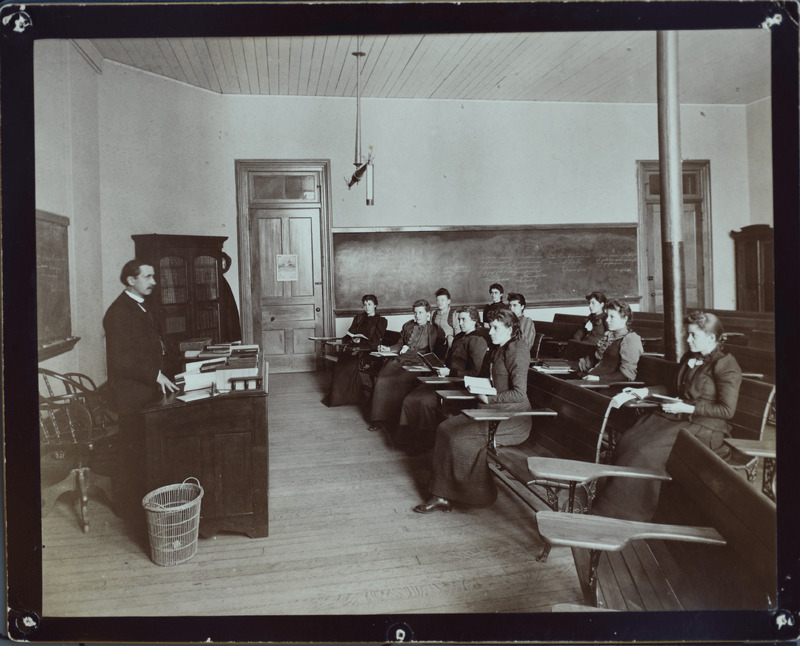
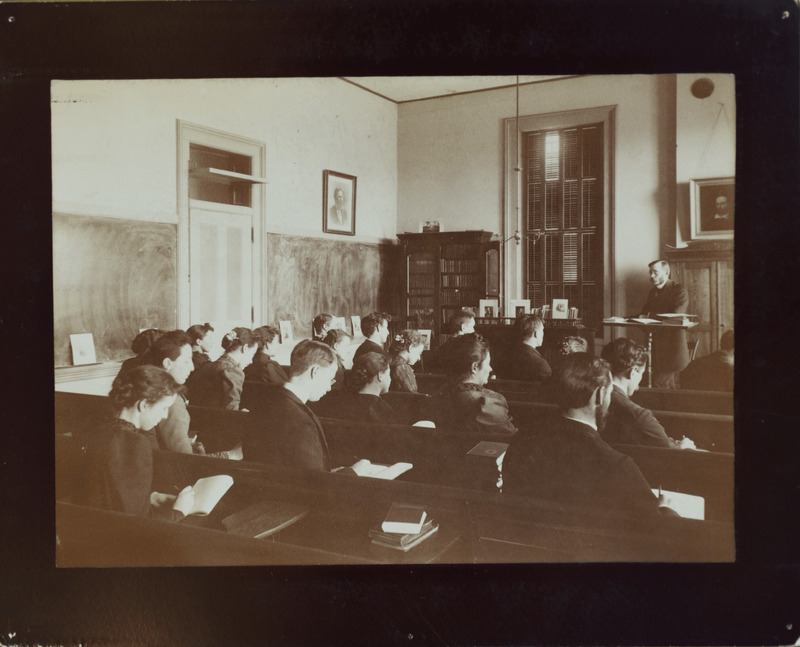
This image depicts an English class being taught by the head of the English Language and Literature Department, Florus Barbour. Instruction in English Language and Literature focused on three sections: Grammar, Rhetoric, and Literature.
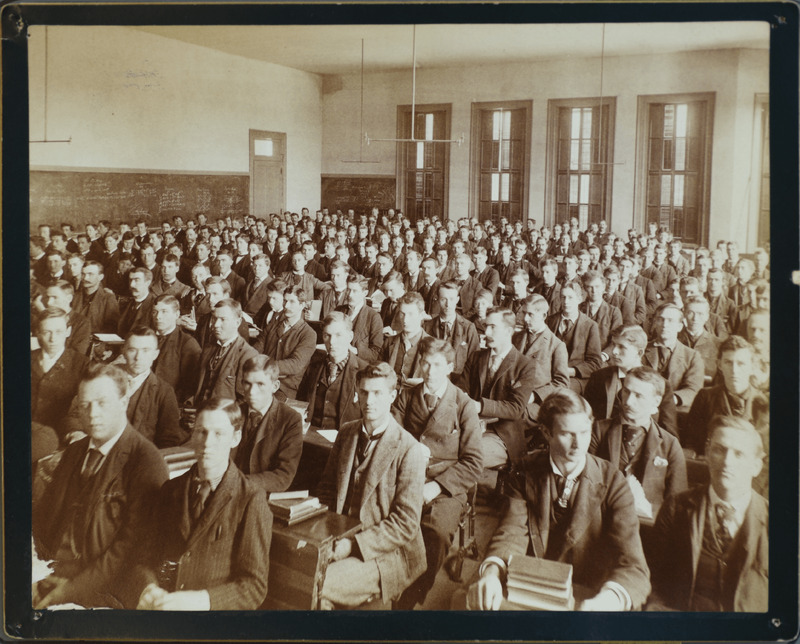
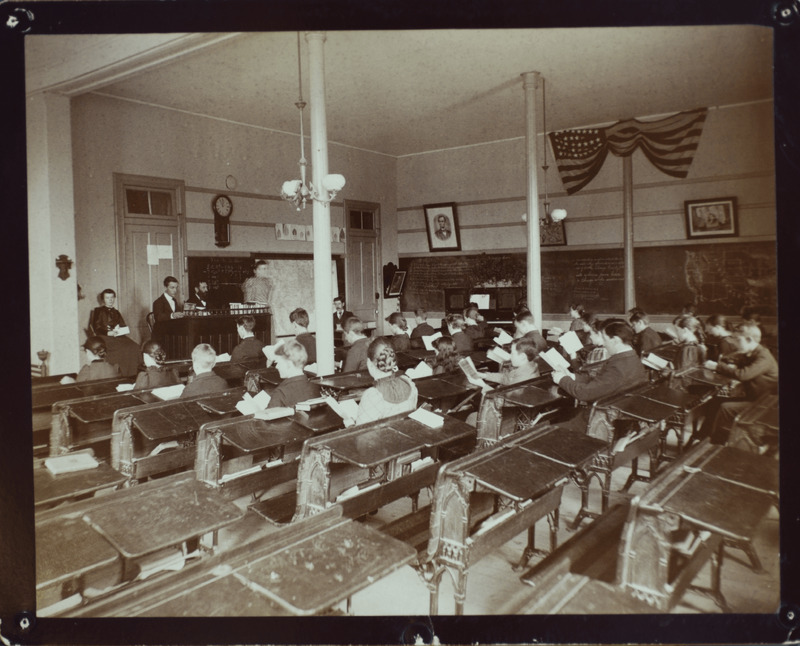
This image depicts male students gathered in an attendance room, and it was possibly taken during one of three yearly “Friday Conversations” led by the Principal or other male staff members. The discussions during the young men’s meetings covered a broad range of topics that were “chiefly determined by passing interests” (Normal Register 1893-94, p.36). These conversations were informal, and followed no schedule or structure.
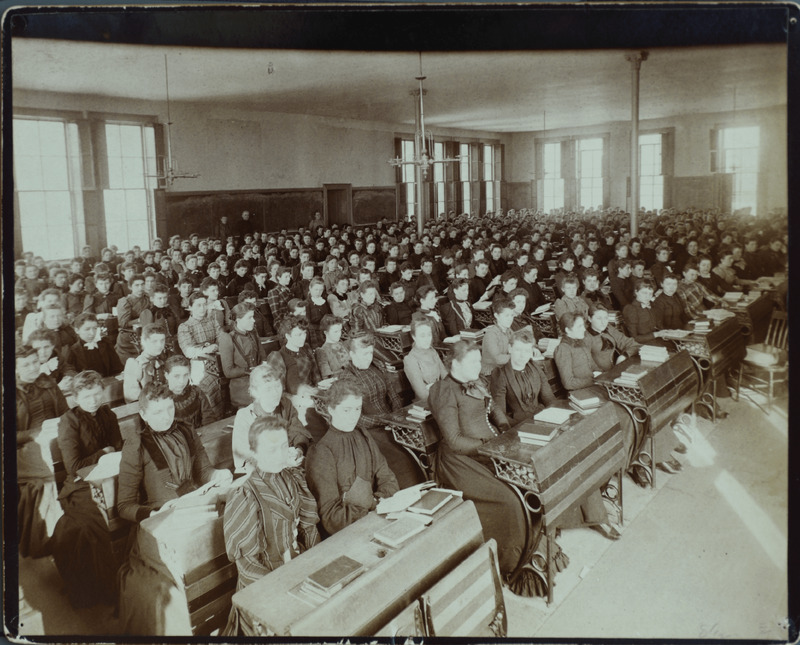
This is another image potentially depicting one of the Friday Conversations, which were voluntary meetings that all female students were invited to attend. During these conversations female faculty members would teach the young women about subjects of practical and professional character. Despite being voluntary, the meetings were well attended as faculty members offered the young women life advice that they would not have the chance to learn in the classroom.
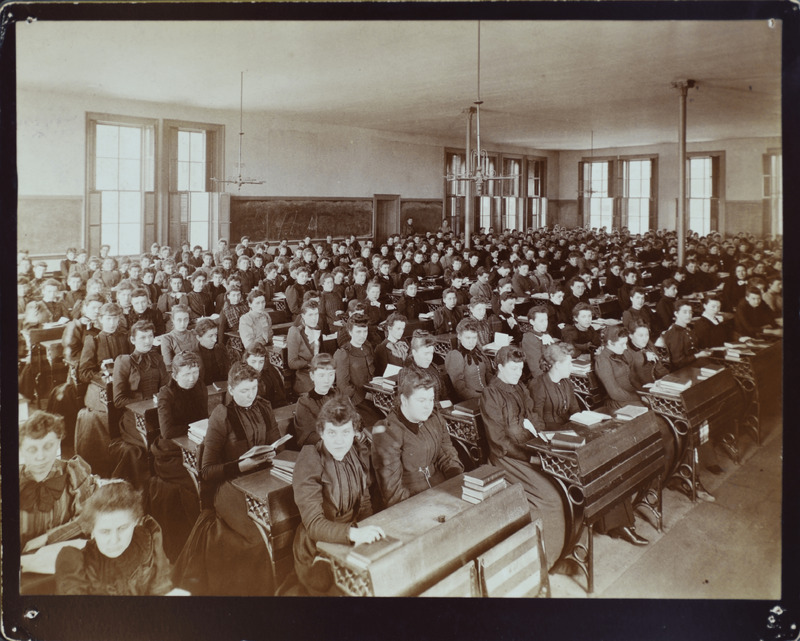
This image depicts female students gathered in an attendance room, perhaps for one of the “Friday Conversations,” that occurred on three Friday afternoons during the school year. These “conversations” would be led by the women faculty members of the Normal, and would last about an hour. The woman standing in the middle at the back of the classroom is likely the head of the History Department, and Preceptress, Julia Anne King. King’s obituary published in the Detroit Free Press in 1919 stated, “Miss. King was unquestionably the best woman educator Michigan has ever had.”
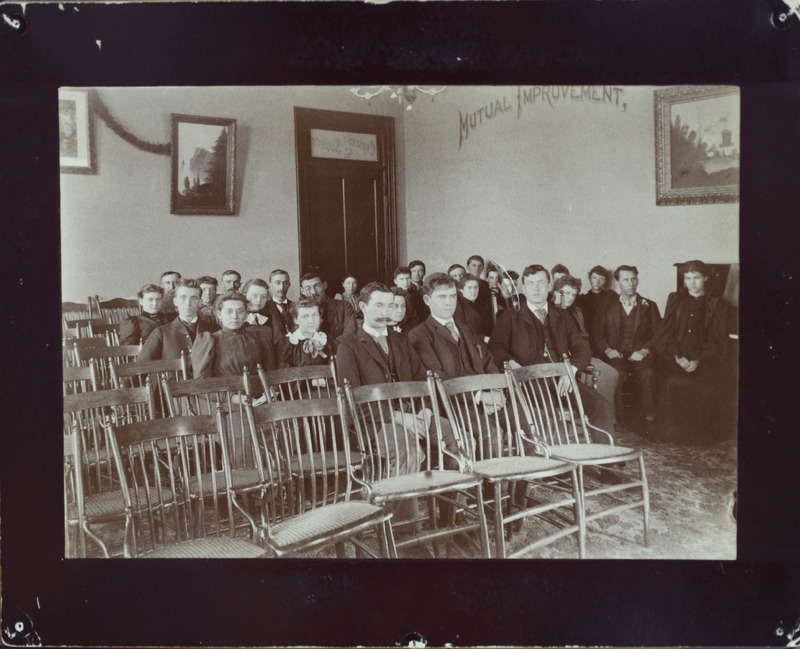
This image depicts a meeting of the Crescent Society, which was the last club added to the Lyceum Societies in the spring of 1882. A part of the society's motto,“Mutual Improvement, Mutual Enjoyment,” can be seen on the wall in the photograph. This motto was chosen because Crescent Society members believed that genuine improvement and enjoyment is not found alone, but with companions. With this in mind, the purpose of the Crescent Society was for members to practice expressing their thoughts in a group setting rather than solely focusing on independent thought and study. - (Aurora 1893, p.77).
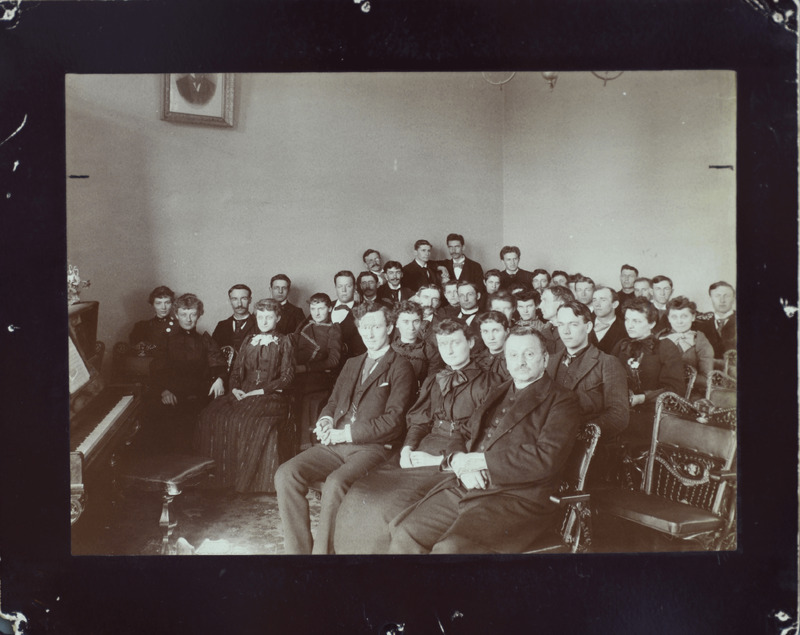
The image depicts a meeting of the Adelphic Society, another of the Lyceum Societies created during the reorganization in 1881. The motto of this society was “Vita sine litteris mors est” which roughly translates to “Life without literature is death.” The purpose of the Adelphic Society was to combine culture with recreation. As such, the Adelphics meeting room was, in 1891, furnished with a piano as well as other necessities to be used for entertainment purposes (musicals and plays).
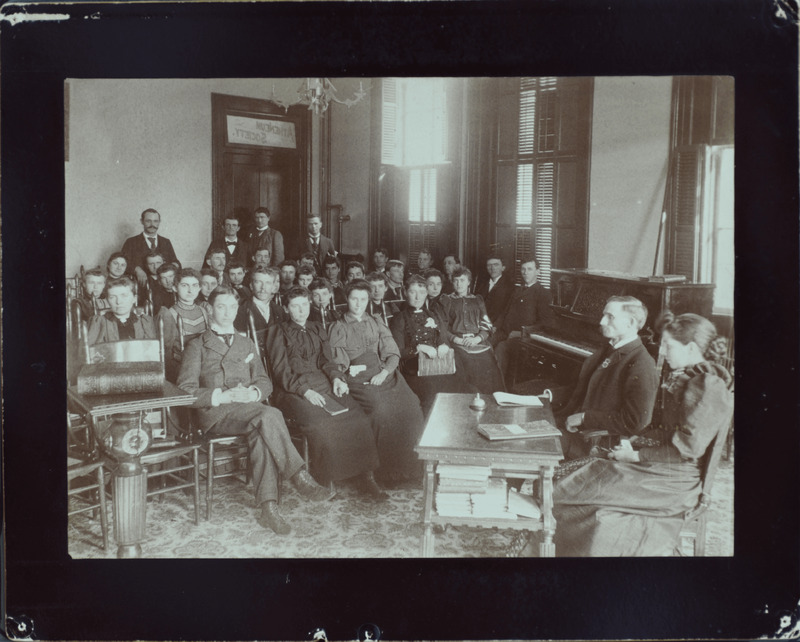
This image depicts another of the clubs that was organized under the Lyceum constitution, the Athenaeum Society. All four of the literary societies had a limit of 60 members, and membership was usually full. According to the 1893 Aurora, the Atheneum was “the most conveniently and finely furnished of the societies, and out of debt.” This student organization prided itself on its weekly programs. In 1893, when this photograph was taken, five out of the eight Normal students who were given commencement honors were members of the Atheneum Society (pg.81).
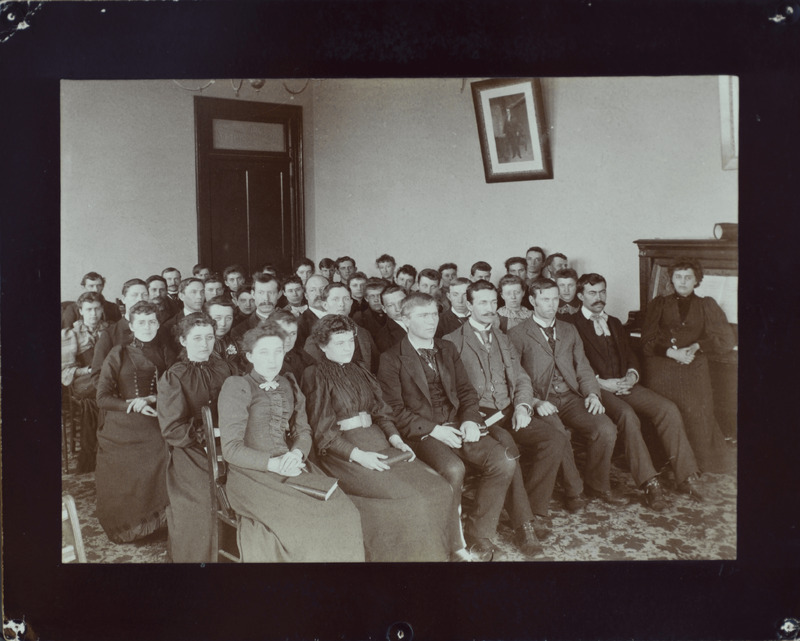
This image depicts a meeting of the Olympic Society, which was one of four literary societies referred to as the “Lyceum Societies.” The Olympic Society was the successor to the Riceonian Literary Society which was started by a group of twelve students in the summer of 1875. The original motto of the Riceonian was “True culture, self-culture,” and the society’s constitution declared that its purpose was to reflect true culture by means of “contact with the thought of the good and the great” (Putnam, 227). The name was changed to the “Olympic” society shortly after 1880 when the Lyceum was reorganized into four literary societies under a single constitution (228).
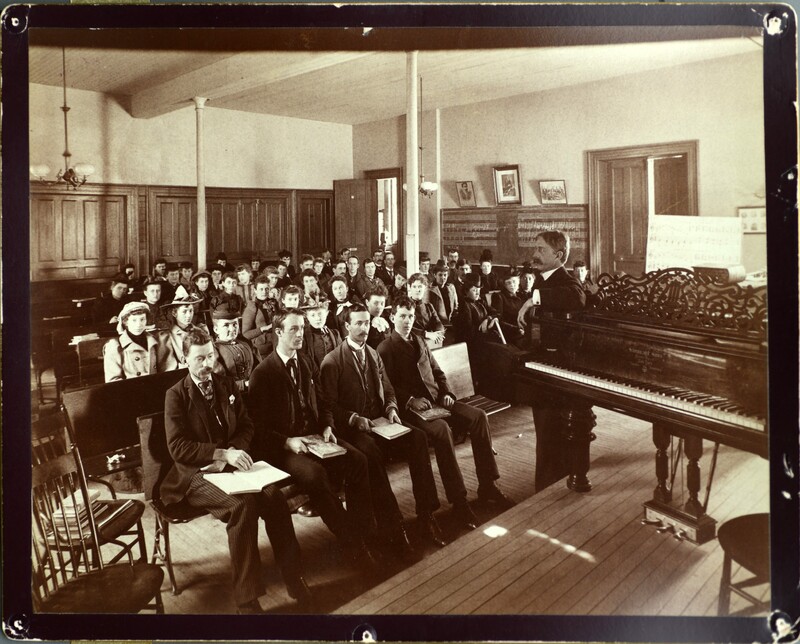
This image depicts a class being taught in the Conservatory Recitation and Lecture room by the Director of the Conservatory Frederic Pease. Music was a required course for graduation. While the Music course offered by the Normal was free, students who wished to receive advanced voice or instrument training had to pay to take courses in the Conservatory. Students who wanted to join the Normal Choir were required to have passed the music course, in which they were taught how to read music and cultivate their voices.
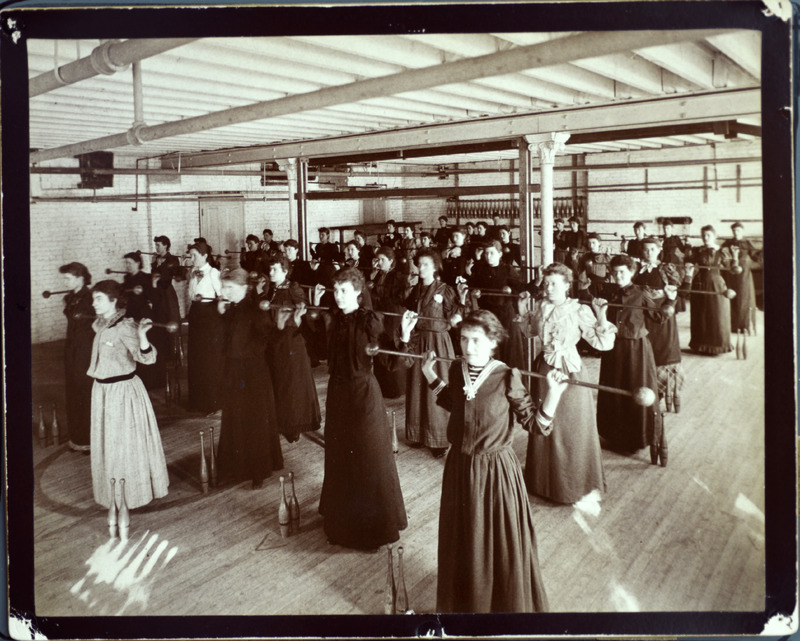
This image depicts a group of female students participating in the Physiology and Hygiene Course that was developed by Lucy Osband in 1886. Osband taught this course in addition to Natural Science courses, but received no extra pay for doing so. In the basement room in the Old Main, Osband’s program included military marching, pulley weights, and “Swedish Routine Movements,” which involved the use of the dumbbells depicted in the photograph. Physical Culture classes had to be held in the basement due to the fact that the campus gymnasium had burned down in 1873. (Pedersen. Article in photo sheets).
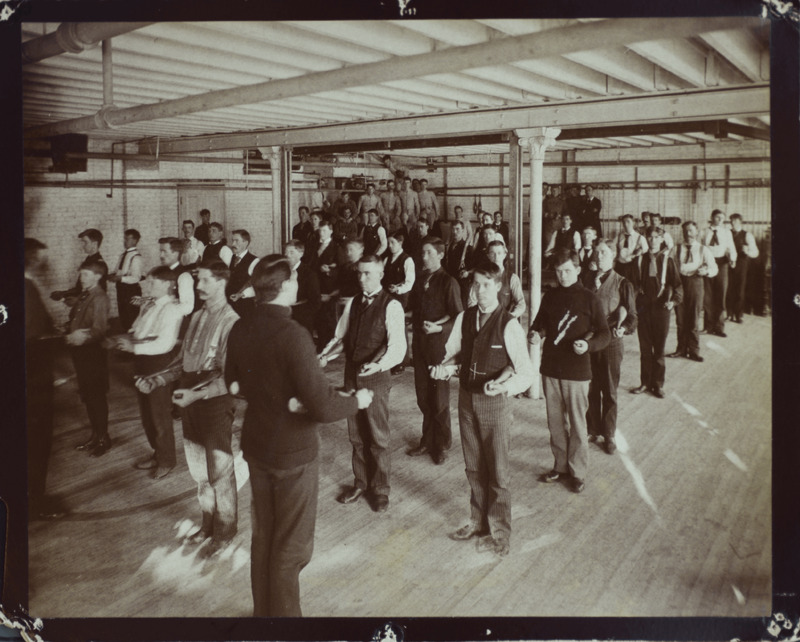
This image depicts a group of male students participating in a Physical Training session, which was held in the basement of the Old Main building. In the winter of 1892-93, when this image would have been taken, Austin George urged the State Legislature to appropriate funding for a gymnasium building. After Professors Sill, Barbour, and George took several trips to Lansing to pitch their idea to the Legislature, $20,000 was appropriated for the construction of the building which was dedicated on May 18, 1894 (Putnam). The Normal School was the first college in the country to offer teacher training in physical education courses.
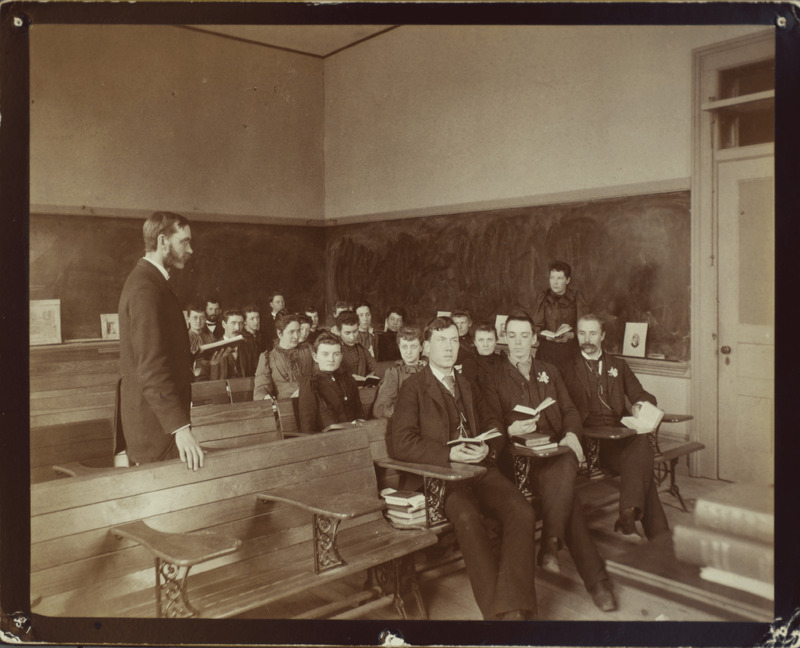
This image depicts a Literature class being taught by the head of the English Language and Literature department, Florus Barbour. When Barbour began his teaching career, he viewed teaching only as a stepping stone to his desired career path of preaching from behind the pulpit. Eventually, however, Barbour grew to understand the importance of public school work and the teaching profession, and grew deeply loyal to the Michigan State Normal School. The English Department head never fully departed from his theological interests, as he impressed upon his students the “value and importance of moral and religious character in teachers” (Putnam).
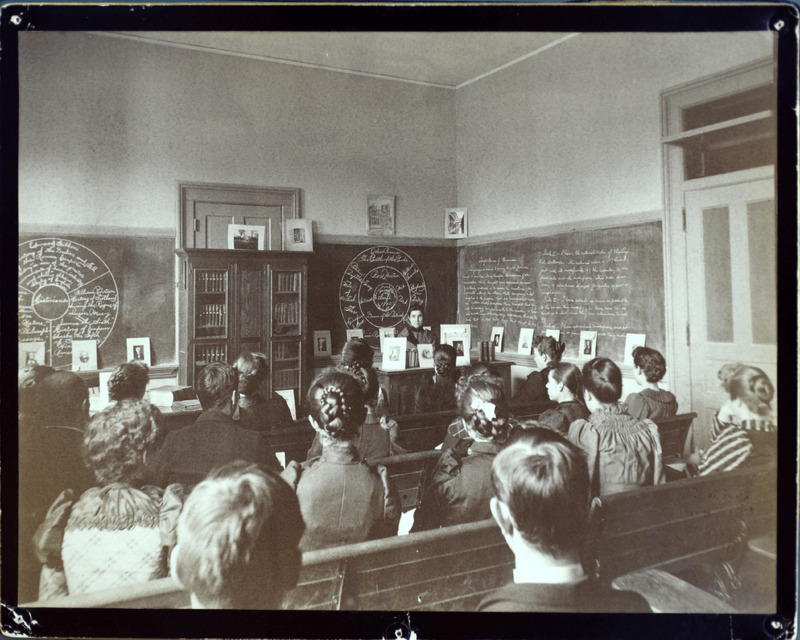
This image depicts a History class being taught by Mary Putnam, who is sitting behind the desk at the head of the room. The History curriculum at the Normal school focused heavily on the history of the Western world, with American and English history being prioritized. The Normal’s General History coursework focused heavily on Greek and Roman history, and the extent to which the history of non-Western cultures were covered is not discussed in the course description. Much of the discussion relating to non-Western societies appears to have been relegated to the Geography department.
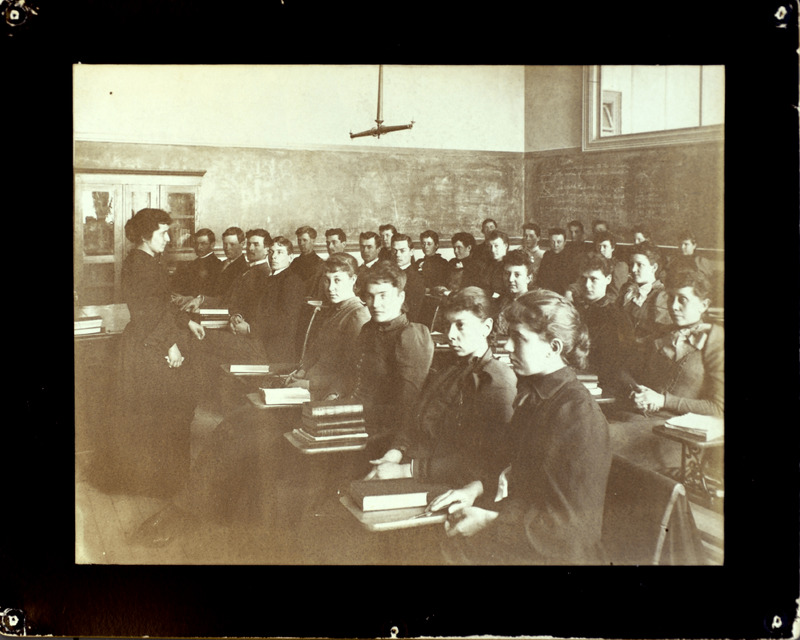
This image depicts a Literature class. There is a prominent quote on the chalkboard that reads, “Truth is the highest thing a man may keep.” Literature played a prominent role in the lives of many students at the Normal, as the four largest clubs at the Normal were literary societies. Additionally the English Language and Literature Department was one of the largest departments at the Normal in 1893 which, along with the Mathematics Department, had four staff members (some departments only had one staff member at the time).
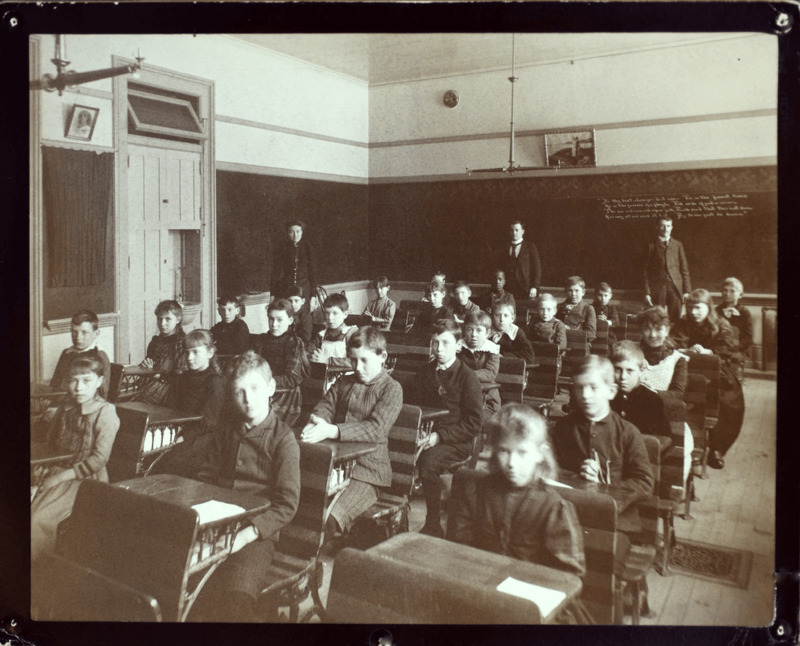
This image depicts a 9th grade class, and despite the caption reading “Training School 9th grade”, this grade was not technically part of the training school, but was created to ease the transition between the Training School and Normal School coursework. As such, there was no specific instructor for 9th grade and students were taught by the same instructors as Normal School students. Additionally, ninth grade students were required to choose either the Classical or the English and Scientific Course in order to determine what classes they would be taking, and when. The main difference between the two courses was that Classical students took Latin or German throughout the year, and English and Science students took English classes.
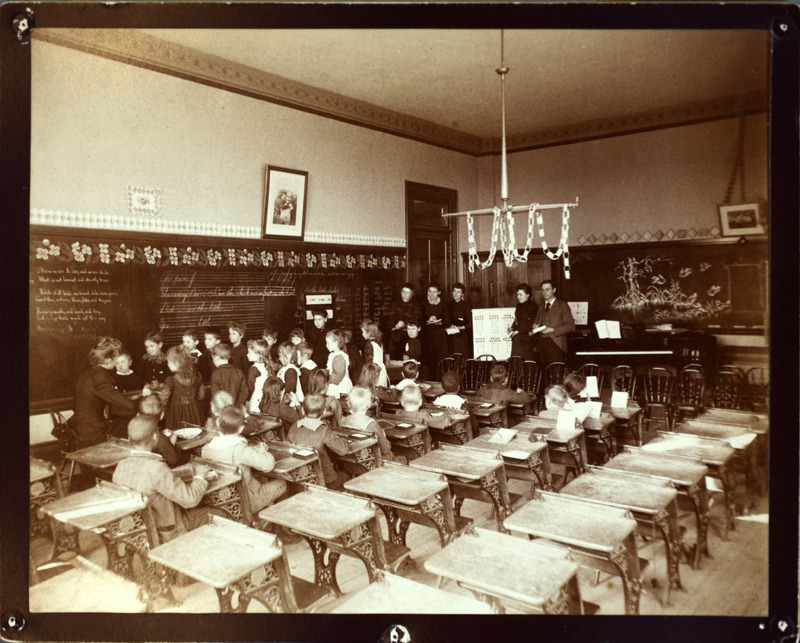
This image depicts a Second grade Training School class which was taught by Maude Ball, who is likely the woman standing near the piano at the front of the room. The director of the Training School, Austin George, can also be seen in this image standing next to the door. Second graders had a similar curriculum to First graders, and was the last grade to have a “Home Knowledge, etc.” section. “Home Knowledge” introduced students to a variety of subjects that would be explored in greater depth in future grades.
This image depicts a math lesson being given to a group of 3rd grade Training School students. The woman standing next to the math equations is likely Harriet Plunkett who taught 3rd grade at the Normal in 1892. Third grade arithmetic consisted of learning numeration to 1,000,000, subtraction, addition, and basic multiplication and division. Students also were also taught about healthy vs. unhealthy foods, and positive eating habits in this grade, as a part of the “General Lessons” curriculum.
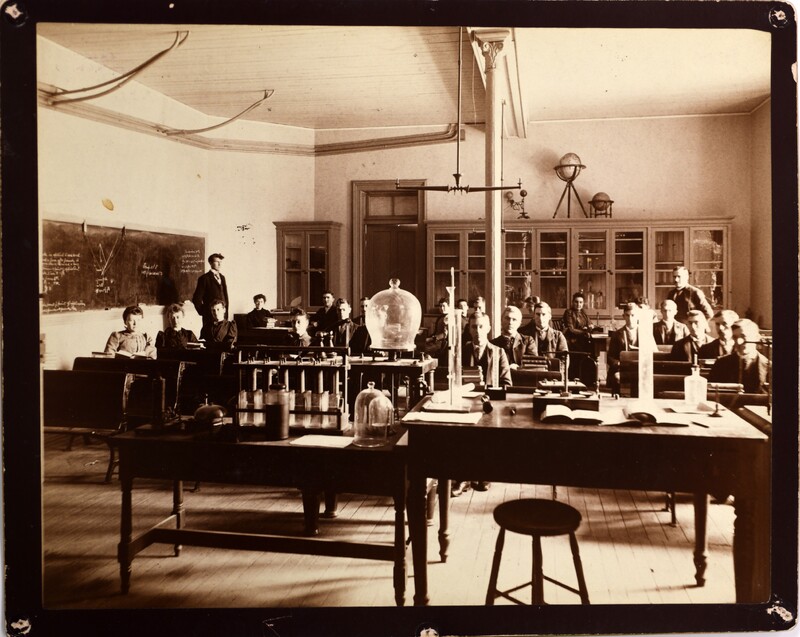
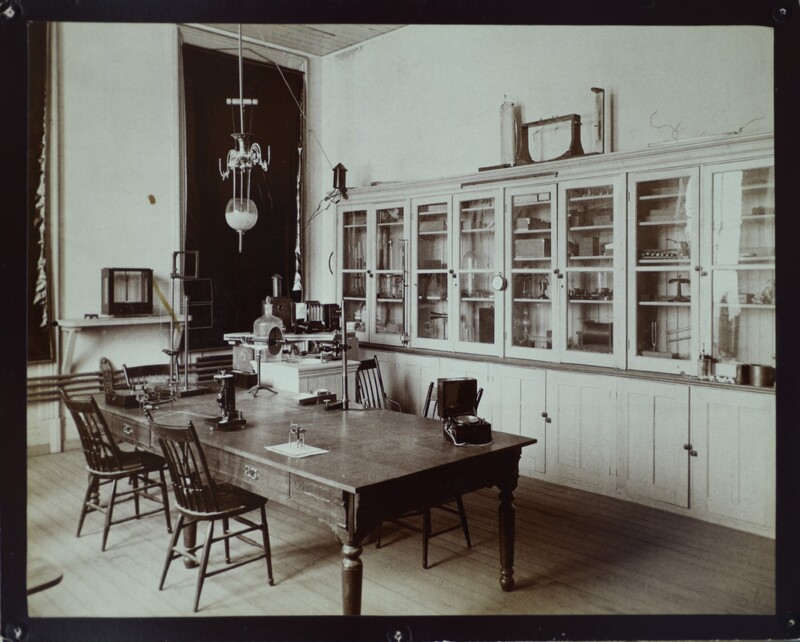
This image depicts a higher physics classroom full of scientific instruments but void of people. Physics and Chemistry were the two main subjects taught in the Physical Sciences department, and both of these subjects involved a lot of hands-on experimentation in the Normal School’s laboratory rooms. The Normal offered five courses relating to the subject of Physics, all of which prepared students to go on to teach physics at the high school level. The Normal register notes that to be a successful Physics student one had to not only experiment, but also “make a special study of apparatus and manipulation and have some practice in demonstration in the presence of a class” (p.55).
This image depicts a 1st Grade Training School class led by Lillian Crawford, who is likely the adult woman seated at the front of the lines of students. In the 1st grade, students were taught to read and write and given basic arithmetic lessons where they learned how to count up to 100. The curriculum also included a section called, “Home Knowledge Preparatory to Geography, Botany, Zoology, etc.”, which explains that first graders were exposed to these subjects through observation lessons relating to natural phenomena, plants, and animals. In addition to standard school subjects, 1st graders were also given lessons in morals and manners to teach them proper school etiquette.
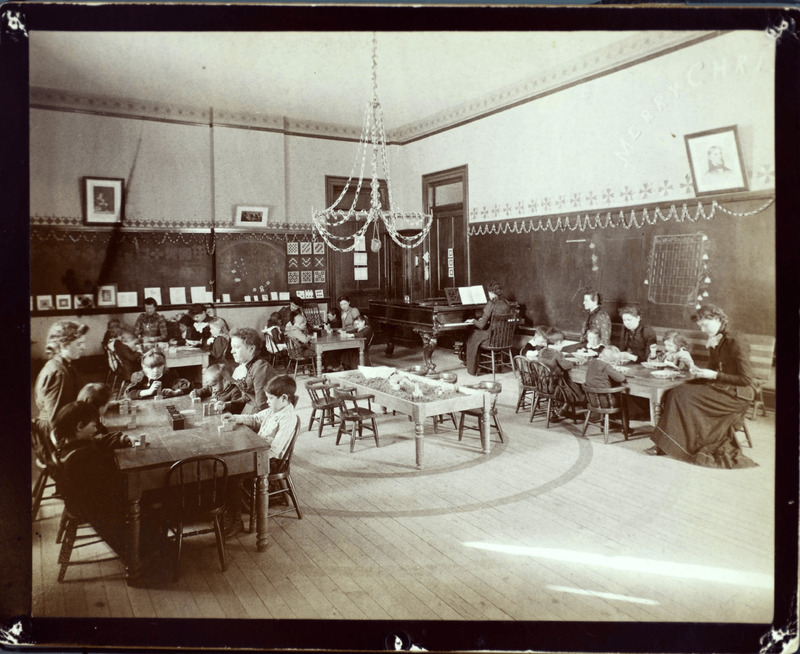
This image depicts a Kindergarten Training School class, which was considered to be a precursor to the “Primary Grades” beginning in first grade. Students as young as four were admitted into the Kindergarten class. The coursework for kindergarteners at the Normal School was rather craft-centric as the register book notes that the children were instructed in over eight different types of crafting from clay-modeling to mat-weaving. Student teachers who wished to work with the Kindergarteners were required to have the ability to sing simple tunes correctly as well as possess “knowledge of pianoforte playing as is required to render the songs and marches of the Kindergarten” in order to graduate.
This image depicts an 8th grade Training School class, being led by student teacher K. Maude Cady, who is likely the woman standing behind the podium. Mathematics instruction expanded to cover Algebra in this year, and Geometry lessons were given daily (7th graders only received one lesson a week). U.S. History was also added to the curriculum for eighth graders in the latter half of the year, and the lessons focused on discovery, colonization/settlement, wars, and the overall development of the United States. There was still no organized science curriculum for Training School students in 8th grade, but students were taught about astronomy and meteorology as a part of their “General Lessons” work.
This image depicts a Physiology Lecture being given by the head of the Natural Sciences (Systematic Botany and Physiology) department, Lucy Osband. One of the main things that this academic department hoped to achieve was instilling a love for scientific truth within Normal students through the help of lessons that focused on utilizing logical reasoning and implementation of the scientific method. Physiology was considered to be an advanced course for senior study, with students having been expected to have learned the basics of the subject in high school. The chalkboard contains evidence that students are being taught about nerves, which indicates that this class is occurring early in the semester when the Physiology curriculum focused on rapid review of the subject with an emphasis on nutrition and the nervous system.
This image depicts a class of 7th grade Training School students, many of whom have their faces buried in their books. This was the first grade to move on from solely focusing on arithmetic, as students had Geometry lessons one day per week. Additionally, Seventh grade was also the first year students learned about the world outside of the Americas in Geography class, as the curriculum focused on “Old World studies” which included the study of Europe, Asia, Polynesia, and Africa. There was no history in the curriculum for Training School students until 8th grade.
This image depicts a 4th grade Training School class taught by student teacher Mary Blount, who is likely the woman standing in the back of the classroom. Fourth grade was the last of the “Primary Grades” before moving into the “Grammar Grades” which began at grade 5. Fourth graders in 1892 studied similar subjects to those taught in modern elementary schools, such as reading and writing, spelling, math, art, and music. While there was no science curriculum for 4th grade students, students in this grade learned about personal hygiene and were given oral lessons in physiology.
This image depicts a Latin language class being taught by Helen B. Muir, who acted as Benjamin D’Ooge’s assistant in the Ancient Languages Department. Due to the fact that “Caesar” can be seen on the chalkboard, it is likely that this was a second year Latin class as the curriculum focused heavily on Caesar’s commentaries. According to the 1892-93 Normal register, “the reading of some good biography of Caesar” was also required. Four years of Latin lessons were offered to all Normal students, but advanced courses were only offered to students pursuing the advanced courses leading to the degree of Bachelor of Pedagogics.
This image depicts students working in one of the Michigan State Normal School physical science laboratories. Due to the presence of vials, beakers, and other jars containing labeled liquids, the students are likely participating in a standard Chemistry class. Within this class, students gained experience with chemical manipulation and experimentation, while being instructed in the properties of carbon compounds. The Advanced Chemistry course also involved the use of the laboratory, but took “the form of individual practice in Chemical Analysis”.
This image depicts a math class being taught by the head of the Mathematics department, David E. Smith, with Principal Sill (the man seated) observing. The academic work in the Mathematics course included all the standard math courses one would have generally taken in high school, with more advanced courses such as Trigonometry, Calculus, Analytical Geometry, etc. generally being offered as electives. Students entering the Normal were only required to have completed Arithmetic and have some familiarity with simple algebraic equations. The reason for the Normal heavily focusing on arithmetic and elementary-level mathematics was due to the fact that the school existed to teach future educators who would likely end up teaching in the elementary - high school levels.
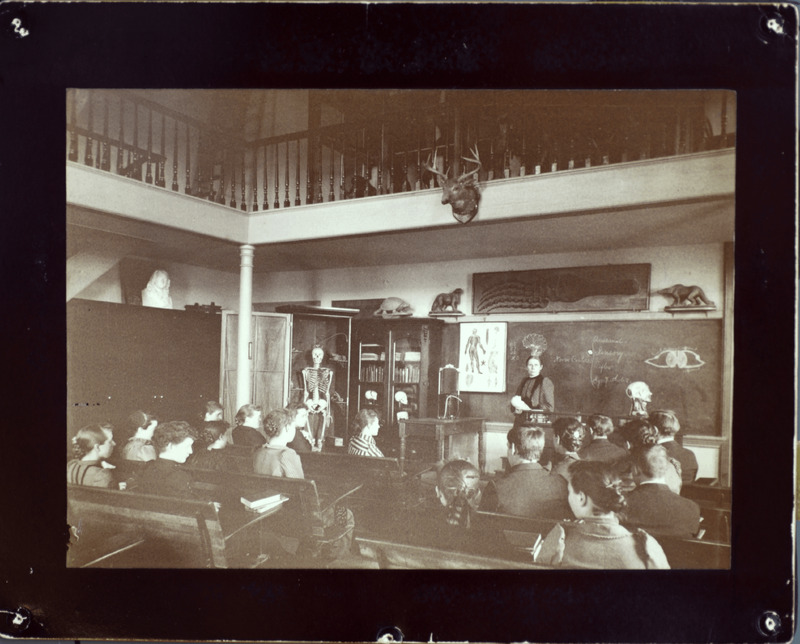
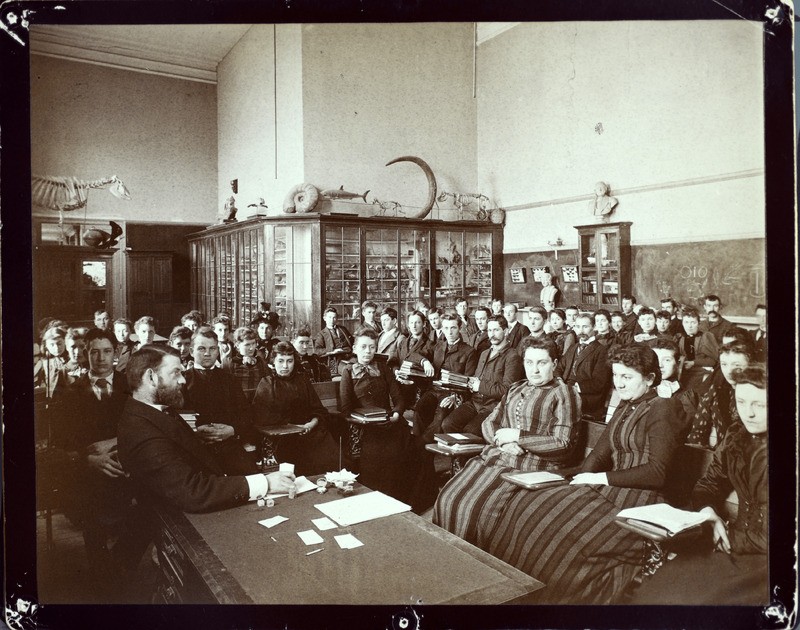
This image depicts a lecture being given by William H. Sherzer, who taught courses relating to Structural Botany, Zoology, and Geology. While this room is identified as the “biological lecture room”, the only course with “biology” or “biological” in its name was Biological Technics, a laboratory course that taught students how to properly handle animal and plant specimens “for purposes of study and illustration.” This class also taught students how to skin and mount birds and small mammals, as well as, clean and articulate skeletons, evidence of which can be seen in and on top of the cabinets in the back of the room. In the late 19th century, the Normal had a collection of over 1000 animal specimens and 2000+ insect specimens.