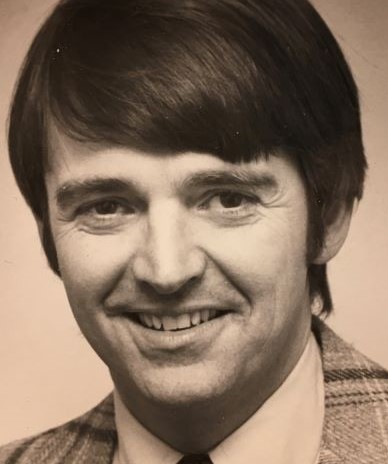
Clifford Woodside was born in Masten, PA. on January 22, 1923. Before completing high school, he enlisted in the Navy. This was immediately following Pearl Harbor. He was 17 at the time. Since he had been in the Sea Scouts, he was immediately assigned to training for gunnery. Clifford was eventually assigned to the USS Portland, and later to the USS Yokes. Clifford saw combat at Midway, Guadalcanal, the Solomon Islands, and the Aleutian Islands. At one time he was at sea for 110 straight days. Although he enlisted for eight years, he did not make the Navy a career. He had married by that time and elected discharge in 1947. Clifford and his wife returned to Ypsilanti, Michigan and he eventually went to work as a salesman for a local Ford dealer. Clifford and his wife lived on Ford Lake until he could no longer live independently. He and his wife now live in an assisted living facility in Ypsilanti, Michigan.
Leon Zimmerman was born in Hersey, Michigan on June 4, 1924 in a town of 206 people. Leon was attending Grand Rapids University when the Japanese bombed Pearl Harbor. He enlisted in the Army rather than being drafted and having no choice of assignment. After numerous tests, Leon was finally assigned to Bombardier training. His first six weeks were spent marching, and doing calisthenics. Eventually Leon was transferred to Las Vegas for gunnery school, followed by Advanced Bombardier School in New Mexico. Leon graduated in 2/4/44 and was sent to England by way of Baltimore and Florida, where he was assigned to a replacement crew in the 8th Air Force. Eventually, his crew was assigned to the 457th Bomb Group. His crew participated in a number of training flights before they went on a mission. Their first mission was uneventful, a "Milk Run," that experienced no flak, no losses, no battle damage. There were many other missions by his crew. Two missions especially stood out for Leon. The first was over Stettin where they took a great deal of flak and were very close to ditching the plane. They did return to England safely however. The other was in Northern Germany. His B17 crew had to bail out because of the extensive damage. After a harrowing jump, he was captured by the Home Guard. His treatment was poor until the regular army took over. Leon and his crew were assigned to a camp that was commanded by a former Luftwaffe General who treated prisoners with respect. It was not a pleasant time but certainly it was not overly difficult. Leon's camp was liberated by the Russians. After spending time in different camps and some time in Paris, he returned home, by troop ship. He met and married his wife after his discharge. They are now in retirement in Jackson, Michigan.
Former Michigan State Senator Anthony Derezinsky (b. 1942) joined the Eastern Michigan University Board of Regents in 1981 and served in that position until his retirement in 1996. In this interview, Derezinsky recounts his formative years with the University of Michigan Law School and Harvard Law before describing his time with the United States Navy serving with the Judge Advocate General Corps in Vietnam, 1968-1971. As a University Regent, Derezinsky played a vital role in the EMU logo/mascot change, placing the value of fairness above all other considerations. Stating that it "rankled my civil liberties heart" to see students offended by the Huron logo and mascot, and known by fellow regents as "Mr. Gavel," Derezinsky describes the process of learning from other institutions how to go about the changing of a logo/mascot that had become synonymous with school spirit and identity for many alumni and community members. Helping to steer the university through difficult ethical waters, Derezinsky traveled the country with EMU President William Shelton to provide insight to schools considering a change of logo/mascot.
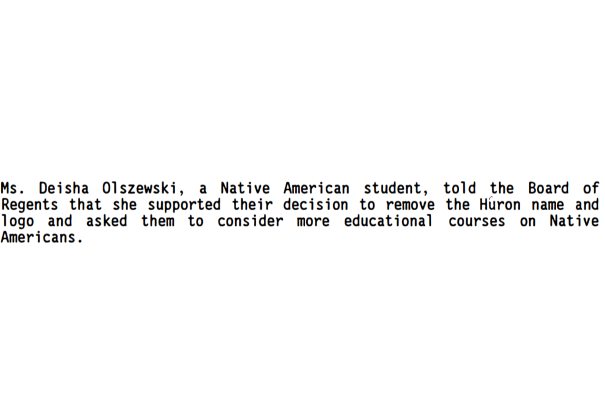
A member of the Native American Student Organization at Eastern Michigan University at the time of the struggle to change the EMU mascot and logo, Deisha [Olszewski] Myles attended nearly every meeting related to the change of what many considered to be an insensitive depiction of Native American culture. Myles speaks of her experience as a student on the Logo Selection Committee, witnessing the tense interactions between university administrators and describing the divisions amongst indigenous participants, divisions that often adhered closely to differing generational values.
During her more than 40 years with Eastern Michigan University, Emerita Assistant Vice President for Student Affairs Glenna Frank Miller served in various capacities and was called a "Human Dynamo" by former Vice President for Student Affairs Laurence Smith for her tireless devotion to the student experience on campus. Serving on the EMU Logo Review Committee and Logo Selection Committee, Frank Miller describes her confidence in newly appointed EMU President William Shelton despite the public backlash from alumni for dropping the EMU Huron, a logo/mascot deemed culturally insensitive by many members of the university community. Adhering to the belief that all community members are harmed by the negative depiction of any one group, Frank Miller details the tension in Board of Regents meetings, the aftermath of the logo and mascot change, and the higher duty of academic institutions to causes of social justice.
Juanita Reid served EMU for 28 years in vital roles such as Vice President of University Relations, Executive Associate to the President and Secretary of the Board of Regents. Reid's integral roles gave her a front row seat to the workings of upper administration and her view of the EMU logo and mascot change reflects this close, professional proximity. Explaining the rationale of the Board of Regents and the president in changing the mascot and logo, as well as the reactions from the community both on and off campus, Reid paints a uniquely vivid portrait of a university enmeshed in the thorny process of altering the identity of a university and committing itself to the cause of inclusivity and social justice.
Longtime Ypsilanti resident and EMU Regent Dr. Richard Robb was named chair of the University Logo Committee and tasked with finding a new EMU logo to replace the Huron. Understanding that the logo was offensive to many students, Robb predicted a quick decision and adjournment. Fending off the ire of alums attached to the logo as well as the frustration and occasional apathy of fellow committee members, Robb found himself entrenched in a much larger debate over the identity of the school itself.
William Everett Shelton (b. 1942) was president of Eastern Michigan University 1989-2000, and is universally recognized for his work to do away with the EMU logo and mascot, seen as culturally insensitive to many inside and outside of the university. In this interview, Shelton recounts his rise to higher education administration from his roots in segregated southern schools, and the turmoil surrounding the change of the EMU logo and mascot. Arriving on the heels of the Michigan Civil Rights Commission recommendation that all Michigan schools with culturally insensitive logos and mascots make changes to those depictions, Shelton was thrust into the spotlight as a brand new university president grappling with painful institutional growing pains. This interview centers around the values espoused by Shelton in his recommendation to the Board that EMU should, in fact, change the logo and mascot, that change is inevitable, and that it was the responsibility of universities to encourage growth and change along with the rest of American culture. Shelton also wrestles with his legacy at EMU as he describes the backlash from alumni unhappy with the logo change and the longterm effects of the Board's decision to drop the Huron logo.
Former Vice President for Marketing and Student Affairs Laurence Smith, worked at Eastern Michigan University from 1975-2000. Smith worked in the capacity of Vice President for University Marketing and Student Affairs where he had overall leadership responsibility for strategic University marketing, communication and media relations, as well as student affairs. Smith played an important role in campus life and served on the EMU Logo Review Committee and Logo Selection Committee. In his interview, Smith describes the state of higher education thirty years ago compared to now; how alumni and community placed value in the institution vs. a symbol; and the selection process for a new logo. Smith speaks in broad strokes about higher education and their role in social justice causes and does not speak to the specifics of the committee's work.
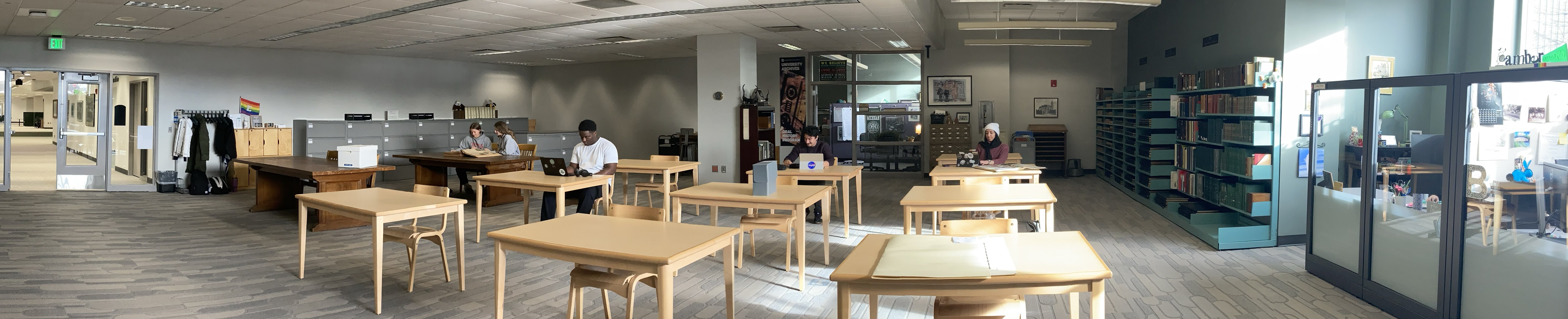
A screen shot of a zoom class taught by Matt Jones in the Winter of 2021 at Eastern Michigan University. The Oral History Methods course, taught out of the University Archives was offered online because of the pandemic.
Closets R4 Clothes was a LGBTQ oriented student radio program from the University of Michigan's WCBN Ann Arbor. The Closets R4 Clothes collection in the Eastern Michigan University Archives contains radio broadcast recordings from 1988 to 1999. This broadcast from June 1991 includes an update on queer news and events in Ann Arbor and Washtenaw County and an interview with Matt Bower from the local Metro Detroit chapter of Copwatch.
Closets R4 Clothes was a LGBTQ oriented student radio program from the University of Michigan's WCBN Ann Arbor. The Closets R4 Clothes collection in the Eastern Michigan University Archives contains radio broadcast recordings from 1988 to 1999. The January broadcast highlights LGBTQ news and events in Ann Arbor and the University of Michigan and includes the reading of a queer poem. The February broadcast begins with news and announcements about LGBTQ events and information in Washtenaw County, and later includes a roundtable discussion from several people about being the child of lesbian or gay parents.
Closets R4 Clothes was a LGBTQ oriented student radio program from the University of Michigan's WCBN Ann Arbor. The Closets R4 Clothes collection in the Eastern Michigan University Archives contains radio broadcast recordings from 1988 to 1999. This May 1990 broadcast includes musical selections, news and announcements on LGBTQ related events and information, and an interview with three guests from the University of Michigan and ACT UP to discuss the status of HIV/AIDS in the country.
Closets R4 Clothes was a LGBTQ oriented student radio program from the University of Michigan's WCBN Ann Arbor. The Closets R4 Clothes collection in the Eastern Michigan University Archives contains radio broadcast recordings from 1988 to 1999. This May 1990 broadcast includes musical selections and a detailed discussion with a University of Michigan PhD candidate Raelynn Hillhouse, who studied extensively in Communist East German and in Soviet influenced Eastern Europe. The conversation with Hillhouse describes the status of LGBTQ people living and expressing themselves in Eastern Bloc countries.
Closets R4 Clothes was a LGBTQ oriented student radio program from the University of Michigan's WCBN Ann Arbor. The Closets R4 Clothes collection in the Eastern Michigan University Archives contains radio broadcast recordings from 1988 to 1999. This September 1990 broadcast includes musical selections and an in-depth interview with three members of the HIV/AIDS advocacy group ACT UP Ann Arbor and a defendant in the Adrian 17 sex scandal in Adrian, Michigan. The Adrian 17 were seventeen male defendants who were all charged with gross indecency for engaging in homosexual acts at a public park. Over half of the men were over 40, married, and had children living in the Adrian community. The local Adrian newspaper published the names and addresses of each defendant on the front page of the newspaper.
Closets R4 Clothes was a LGBTQ oriented student radio program from the University of Michigan's WCBN Ann Arbor. The Closets R4 Clothes collection in the Eastern Michigan University Archives contains radio broadcast recordings from 1988 to 1999. This October 1990 broadcast includes an interview with novelist and gay activist Sarah Schulman.
Closets R4 Clothes was a LGBTQ oriented student radio program from the University of Michigan's WCBN Ann Arbor. The Closets R4 Clothes collection in the Eastern Michigan University Archives contains radio broadcast recordings from 1988 to 1999. The February 1991 broadcast includes LGBTQ news and events in Washtenaw County as well as an interview with LGBTQ novelist Lev Raphael.
Closets R4 Clothes was a LGBTQ oriented student radio program from the University of Michigan's WCBN Ann Arbor. The Closets R4 Clothes collection in the Eastern Michigan University Archives contains radio broadcast recordings from 1988 to 1999. This January 1991 broadcast includes an interview with Ilene Lynch from the domestic violence organization SafeHouse about the topic of lesbian battery.
Closets R4 Clothes was a LGBTQ oriented student radio program from the University of Michigan's WCBN Ann Arbor. The Closets R4 Clothes collection in the Eastern Michigan University Archives contains radio broadcast recordings from 1988 to 1999. This January 1991 broadcast includes an interview with Elise Bryant, a Ann Arbor-based playwriter of the production of "Zoo Zoo Chronicles."
Closets R4 Clothes was a LGBTQ oriented student radio program from the University of Michigan's WCBN Ann Arbor. The Closets R4 Clothes collection in the Eastern Michigan University Archives contains radio broadcast recordings from 1988 to 1999. This January 1991 includes an interview with Indigo Girls singer/songwriter Amy Ray.
Closets R4 Clothes was a LGBTQ oriented student radio program from the University of Michigan's WCBN Ann Arbor. The Closets R4 Clothes collection in the Eastern Michigan University Archives contains radio broadcast recordings from 1988 to 1999. This June 1991 broadcast includes an intro to the twelfth anniversary of the White Night riots in San Francisco that occurred after the assassination of Harvey Milk, musical selections, and a reading of a poem titled "I am a SCAB (Society for the Complete Annihilation of Breeding)."
Closets R4 Clothes was a LGBTQ oriented student radio program from the University of Michigan's WCBN Ann Arbor. The Closets R4 Clothes collection in the Eastern Michigan University Archives contains radio broadcast recordings from 1988 to 1999. This July 1991 broadcast includes information on queer related cinema, LGBTQ news from across the country, musical selections, and a piece by drag queen Vaginal Cream Davis.
Closets R4 Clothes was a LGBTQ oriented student radio program from the University of Michigan's WCBN Ann Arbor. The Closets R4 Clothes collection in the Eastern Michigan University Archives contains radio broadcast recordings from 1988 to 1999. This July 1991 broadcast includes a listing of local queer events in Ann Arbor and Washtenaw County, LGBTQ-related news from around the world, musical selections, and the second half of an interview with Native American and AIDS activist Beth Brant.
Closets R4 Clothes was a LGBTQ oriented student radio program from the University of Michigan's WCBN Ann Arbor. The Closets R4 Clothes collection in the Eastern Michigan University Archives contains radio broadcast recordings from 1988 to 1999. This July 1991 broadcast includes musical selections, information on queer events in Ann Arbor and Washtenaw County, and LGBTQ news from around the world.
Closets R4 Clothes was a LGBTQ oriented student radio program from the University of Michigan's WCBN Ann Arbor. The Closets R4 Clothes collection in the Eastern Michigan University Archives contains radio broadcast recordings from 1988 to 1999. This August 1991 broadcast includes information about queer events in Ann Arbor and Washtenaw County, musical selections, LGBTQ-related news from around the world, and an interview with an Ann Arbor area lesbian male impersonator.
Closets R4 Clothes was a LGBTQ oriented student radio program from the University of Michigan's WCBN Ann Arbor. The Closets R4 Clothes collection in the Eastern Michigan University Archives contains radio broadcast recordings from 1988 to 1999. This February 1995 broadcast includes an interview with famed poet and writer Allen Ginsberg.
Closets R4 Clothes was a LGBTQ oriented student radio program from the University of Michigan's WCBN Ann Arbor. The Closets R4 Clothes collection in the Eastern Michigan University Archives contains radio broadcast recordings from 1988 to 1999. This October 1990 broadcast includes musical selections, information on queer events in Ann Arbor and Washtenaw County, LGBTQ-related news from around the world, and an interview with American cartoonist and original creator of the Bechdel test, Alison Bechdel.
Closets R4 Clothes was a LGBTQ oriented student radio program from the University of Michigan's WCBN Ann Arbor. The Closets R4 Clothes collection in the Eastern Michigan University Archives contains radio broadcast recordings from 1988 to 1999. This December 1990 broadcast includes an interview with the Director Urvashi Vaid of the National Gay and Lesbian Task Force, musical selections, and a sketch comedy piece.
During the fall term of 1920, Harriett Ellen Norton (nee Wallace) kept a scrapbook while attending the Michigan State Normal College (MSNC). Harriett Wallace, known to most as Ellen, was from Bay City, Michigan and a member of the Delta Sigma Epsilon sorority, Le Cercle Francais club, and History club.
She graduated in June of 1922 and remained in the area after graduation with her husband Stanley Norton whose family owned and operated Norton's Flowers. Stanley Norton, a member of the Arm of Honor fraternity, also attended the MSNC but withdrew to enlist in the military during World War I.
Materials in the scrapbook include invitations to on and off campus events, dance cards, correspondence, clippings, receipts, and photographs. Many of the campus invitations are from the Arm of Honor and Kappa Phi Alpha fraternities.
Please note, the book was scanned so that on pages where items were folded the page was scanned multiple times each time exposing more of the materials in the scrapbook.
Male graduate, likely college, dressed in a cap and gown, flanked by three adult men in suits wearing hats and two women wearing formal dresses. They are all surrounding a large rock etched with "Class of 1873" and behind them are a row of trees.
A male graduate holding a diploma flanked by an adult man in a suit and an adult woman in formal dress. They are standing next to a rock etched with "Class of 1873," opposite two more adult men in suits and an adult woman in formal dress.
Three adult men dressed in suits standing next to a rock etched with "Class of 1873." Two are holding their hats and one has a hat placed on the ground behind him.
Heck Hall, a large building with tall rounded windows behind bare trees. There are icicles covering the building, four small silhouettes of people to the left of the building, and one man standing by the door.
Three graduates, one holding a book, one holding a book and a purse, and one holding a mortarboard cap outside a building with a crowd of people in the distance.
A procession of women in long skirts and hats wearing large white bows on their backs. They are walking across a road in front of a large house next to a smaller house with an automobile behind them.
Heck Hall, a tall building with tall rounded windows covered in icicles with a large fire escape ladder leading from the roof of the building to just above the door.
Heck Hall, a large building with tall rounded windows covered in icicles and several bare trees, with silhouettes of three people standing to the left of the building.
Heck Hall, a large building with tall rounded windows covered in icicles behind with a large gnarled tree trunk. There is a group of people in coats and hats walking in through the door.
A male graduate holding a diploma in front of a field with trees, and the shoulder of another person cut off next to him. The negative has been cut by its previous holder.
An older and younger man in suits sitting on flat cart with large wheels. The younger man has a camera bag and the building behind them has signs saying "Des Plaines" and "American Express Co."
A ship sailing away from shore billowing steam with buildings in the background and the prow of another ship on the left edge of the image. There are three decks filled with people on the boat.
Two men, one sitting on a flat cart with large wheels and the other standing next to him in front of a building with a sign that says "Des Plaines." Another sign above a door says "American Express."
Two boys crossing a railroad track in front of a stopped train with a man sitting on the front next to a billboard saying "This is Dowagiac, Home of the Famous Genuine Round Oak"
A small boat labeled "Police Harbor and River Service" on each end. There are two men in suits sitting towards the front next to a furled American flag.
A mechanical dredge out on the water billowing steam. There is a sign that says "Dredge No. 7 Great Lakes Dredge & Dock Co" and several workers standing on the deck. In the distance is a steamboat looking low in the water with several figures standing on the deck.
A two-car train across a field billowing smoke. There is a lone figure standing outside the first car in a white shirt. Behind the train are a few trees and two residential houses.
A three-story hotel next to train tracks with a sign that says "The Midland" and below that "Fred Sachau Proprietor." A woman with a white shirt and long black skirt stands with her arms at her hips next to two rocking chairs on the porch.
A dock by a small lake house with a banner that says "Windermere." The right side of the image has part of a boy's face and arm and behind him is another small rowboat with a woman in a white hat.
A man looking towards the camera in a suit and tie wearing a trilby hat sitting in a train car across from a woman in a large straw hat. There are circular windows around the car and rows of empty seats.
A crowd watches a low-flying plane. There is a group of men in suits and hats and one woman standing away from them next to a wire fence in a large straw hat and a white dress. Beyond the fence is a seating area with rows of empty chairs.
A large house with a wraparound porch and a Model T car parked in the yard. The porch appears to have been built around a large tree growing through the middle of the roof.
The back of a biplane. There is a crowd of men in suits and hats gathered around the front of the plane. One of the flaps has large letters that say "Brodie."