In this interview Zizel and Rae share their experiences at Ypsi Pride, noting that they moved to Ypsi about a year ago for school. Both Zizel and Rae express that they love the artist alley, the community feel of Ypsi Pride, and want to remind everyone to stay slaying.
In this interview EMU alum and community member Kevin Werner shares his experiences at Ypsi Pride, noting that he continues to come every year because he loves the community. Werner also explains that he was the first student to transition while living in the dorms at EMU in the early 2000s, is currently producing Stonewall the Musical, and discusses his involvement in trans support groups and the Outloud Chorus.
In this brief interview, queer elder Terry shares his experiences at Ypsi Pride, noting that the older he gets the happier he is in his own skin and that he is happier younger queer generations have it easier.
In this interview a women dressed like La Llorona, Disha Myles, shares her experiences at Ypsi Pride, explaining that she is dressed the way she is to draw attention to abortion rights. Myles expresses concern for the future of abortion access, her hopes for the Presidential election, and urges everyone to register to vote.
In this interview Max Taylor, a photographer for the Eastern Echo, shares their experiences working at Ypsi Pride. Taylor expresses that they enjoy capturing moments of raw emotion, and like to take pictures of people having fun in groups and smiling. They also discuss photo taking etiquette, being able to connect with others over their ace pin, and passes on the message that you should live your truth.
In this interview community member Leif shares their experiences at Ypsi Pride, explaining that they were there reading Tarot for This, That, and the Odder Thing. Leif also speaks about their time living in London and France, the lack of a goth scene in the Ypsi area, and the fact that Ypsi has an "anything that's weird" scene instead that they prefer.
In this interview Chris Joly shares how she and her partner brought a Pride Center to Jackson, MI, and the tragedy that followed shortly after Jackson's first Pride Event. Joly explains that her house was set on fire, which claimed the lives of her 2 dogs and 3 cats, by an arsonist, and her partner at the time, Nikki Joly was wrongfully accused of the arson and ended up spending over two years in prison. Joly explains how that fire and everything that followed after changed her and Nikki, resulting in their separation.
In this interview community member Ellie shares her experiences at Ypsi Pride, explaining that this is her first Pride since coming out as a lesbian. Ellie also discusses her opinions on the importance of Pride, self-acceptance, and the importance of keeping a journal.
In this interview community member Leslie Davenport shares their experiences at Ypsi Pride, detailing that their first Pride was the first time they felt they were in a safe place. Davenport shares that they are deaf but love music, and they are still exploring what music they like after recently leaving Christianity. They share that Ypsi Pride is full of friendly people but would be more accessible if there was an interpreter by the stage.
In this interview with community member Jesse Carr they share their experiences with Ypsi Pride, detailing that this is their second Ypsi Pride. Carr discusses their recent autism diagnosis and the positive impact it has had on their ability to enjoy Pride, and expressed to younger generations of queer people that living to adulthood is worth the wait despite the hardships.
In this interview community member Glenisha "Glen" Berryman shares their experiences at Ypsi Pride, explaining that this was their second Ypsi Pride. Berryman discusses the community impact of Ypsi Pride, a powerful experience they had at a Hozier concert, gardening as a form of self-care, and the beauty of being queer.
In this interview community member Damien Babcock shares his experiences with Ypsi Pride, detailing that it was his first ever Pride event due to growing up in a conservative environment that restricted his ability to accept his queerness. Babcock explores the happiness he feels now that he is living in Ypsi, his interest in taxidermy and insects, and how being transgender is the best thing somebody can be.
In this interview a genderfluid community member named Audrey shares their experiences with Ypsi Pride, explaining that they were grateful to be there. Audrey explores their history with activism, detailing their involvement with the encampment for Palestine on U of M's diag, the work they do preserving queer history, and their radio show. They express that they want others to have compassion for themselves and those around them, and that the future is worth fighting for.
In this interview EMU student Leslie Arcure shares their experiences with Ypsi Pride, specifically exploring how Ypsi Pride is less corporate/capitalistic then other Pride events she has gone too. Arcure also discusses her interest in film and political history, some of her favorite films, and reading books on conservatism as a self-identified socialist.
In this interview longtime Ypsi residents Rachel Resin and Shoshanna Wechter share their experiences with Ypsi Pride. Wechter explains that she was at the first one in 2017, helped plan in 2018, and loves that Pride is in Depot Town because she lives there. Both Resin and Wechter share that they love the Ypsi community and how they can't walk outside without seeing someone they know.
In this interview longtime Ypsi resident Nicolette Lelli shares their experiences at Ypsi Pride, explaining that their first pride was in 2017, the same year they came out to their friends and family. Lelli discusses the fear they experienced as a queer person living in Florida, having to move back to Michigan, and the happiness she feels to be able to see rainbow flags everywhere.
In this interview Kassie Keil explores their experience with Ypsi Pride, sharing that the first one they attended was in 2021 when they moved to Ypsi. Keil explores their involvement in the Fun Girl Dance Company, explaining that it is a safe space that helps them explore their queerness through their art. They also discuss recently discovering that they are intersex, the journey of processing those feelings, and the community impact of events like Ypsi Pride.
In this interview longtime Ypsilanti resident Elize Jakobsen shares their experiences at Ypsi Pride, explaining that they were involved in the planning of the first Ypsi Pride and have been involved ever since. Jakobsen also details other events they have helped organize in Ypsi such as, the Festival of the Pollinator, and how they have felt comfortable at many other events around Ypsi as a queer person.
In this interview Ypsi native Sidney Murray Heed shares her experiences at Ypsi Pride, detailing that she worked on the planning board remotely while attending a theatre program at Dell'Arte International performing arts school in California. Heed explains how she has felt most comfortable in the circus community since she didn't always feel comfortable in queer spaces as a queer woman who was attracted to men. Heed also goes on to explore more spaces she is comfortable in, her involvement in the Church, favorite pride memories, and plans for future involvement in Ypsi Pride.
In this interview Ypsi native Roberto Frausto shares their experiences at Ypsi Pride, detailing that they first attended a few years ago when they were coming to terms with their identity. Frausto shares that they identify as two-spirit, and they did not find that label for themself until they were in their twenties. Frausto also explores the power of queer connection, their thoughts on drag, and their love for their hometown of Ypsilanti.
In this interview longtime Ypsi resident Amber Fellows explains her experiences with Ypsi Pride, sharing that she attended the first one in 2015 and helped book live entertainment. Fellows explains that Pride is needed, but she finds more solace in other parts of the community, noting that Ypsi is known for being a queer haven. She also shares her experiences with Motor City Pride, impacts of the pandemic on Pride, and reminicises on running a zine table called Fag Rag Zines.
In this interview Michael Faunce shares their experiences with Ypsi Pride, sharing that they attended one previously working the booth for their church, Blue Ocean. Faunce explains that the lead pastor is a lesbian so they feel very welcomed there, and in the larger Ypsi community in general. They explain that while Pride helps increase tolerance towards queer people they hope one day labels won't matter and people can just be accepted as they are.
In this interview longtime Ypsi resident Thomas Droste explains their experiences with Ypsi Pride, explaining that 2023 is the first time they've attended. Droste explores that this is the first year they fully considered themselves apart of the queer community, sharing that they love the drag shows and thinks that events like Ypsi pride show that Ypsi cares about all of its residents.
In this interview Ypsi native Kenneth Curtis shares their experiences with Ypsi Pride, the first of which they attended in 2017. Curtis's first Ypsi Pride inspired them to start a GSA [Gay-Straight Alliance] at their high school, and later opened the door for them to join the Ypsi Pride board in 2021. They explain the difficulties of throwing Pride during pandemic, the importance of community spaces, and the hopes that Ypsi Pride will continue to grow and improve.
In this interview an anonymous parent and their child share their experiences with Ypsi Pride. Anon shares how they have been coming to Ypsi Pride for many years, and explains that while their child, who is autistic, does not normally like big gatherings they love pride events. Anon also explains how they did not meet another queer person until they were an adult so they want to expose their child to the beauty that exists in the queer community.
In this interview longtime Ypsi resident Grey Grant shares their Ypsi Pride experiences detailing that they first attended in 2021 to reunite with an old friend. Grant also details that they've been lucky finding a large queer community and queer spaces, and that their first pride was in their hometown of Winston Salem, NC, in the early 2000s. Grant also shares the importance of community for millenials and Gen Z, the joy of seeing so many trans people in Ypsi, and being happy to be at pride.
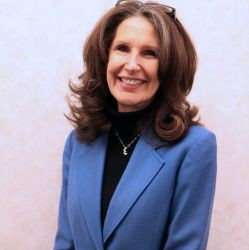
Donna Winkelman is a member of the Center for Jewish Studies advisory board and a dedicated member of the local Jewish community. Originally from Huntington Woods, Winkelman first moved to Ann Arbor while attending U of M--where she later met her husband, Tom. She became part of the CJS team after learning about it from friend and neighbor, Decky Alexander. Both strong supporters of the center, Winkelman and her husband developed the Donna Winkelman and Thomas Easthope Endowed Scholarship in Jewish Studies, which funds students taking travel courses. In this interview, she talks about finding community, her experiences in the Peace Corps, and why travel opportunities are important for students and non-students alike.
Cole Nelson is an EMU alum who earned a degree in political Science in 2022. During his time at Eastern he worked in the Center for Jewish Studies with founding director, Marty Shichtman. Nelson worked closely with Shichtman, helping with things like event planning and updating the website. In this interview, he talks about his experiences at EMU, being hired as Shichtman's assistant, and how the center stayed afloat at the height of the Covid-19 pandemic.
Brad Axelrod is a clincical neuropsychologist with the Department of Veterans Affairs in the Detroit area, and a member of the EMU Center for Jewish Studies advisory board. A Chicago native, Axelrod made his way to Ann Arbor while working on a degree in clinical psychology. Both he and his wife, Robin, engaged in the local Jewish community early on and formed stronger relationships once their children started Hebrew Day School. Axelrod has served on many different community boards across Washtenaw county, like the Jewish Community Center's film festival committee and the Partnership2Gether Program. He and Robin became involved with CJS shortly after its formal introduction in 2012, when Marty Shichtman invited them to join the advisory board. In this interview, Axelrod talks about his early Jewish upbringing and education, the most memorable CJS events he's attended, and the valuable education the Center provides to students, the university itself, and the community.
Pam Landau is professor emeritus, two time EMU alum, and Center for Jewish Studies advisory board member. Landau is a certified sex educator and therapist who taught classes in the Psychology Department from 1982 to 2023, and still serves as the faculty coordinator for the human sexuality minor. She is one of the earliest supporters of the Center for Jewish Studies and long-time board member, and is considered by founding director Marty Shichtman to be one of the program's anchors. In this interview, Landau talks about her career at EMU and most influential colleagues, what it was like when the Center was just beginning, and what she hopes their programming provides for Jewish and non-Jewish students alike.
Jeff Bernstein is a professor of political science and Director of the Faculty Development Center at EMU. Bernstein, alongside colleagues like Decky Alexander and Pam Landau, is another one of the Center for Jewish Studies' earliest supporters. He started teaching classes at EMU while working on a graduate degree from U of M and was later hired as a full time faculty member. Up until its move off campus, Bernstein served as a board member for Hillel, alongside CJS Founding Director Marty Shichtman. He was appointed director of the Faculty Development Center in 2021 and continues to serve on the CJS faculty advisory board. In this interview, Bernstein talks about the things that formed his Jewish identity, the changes in Eastern's Jewish student body over the years, and just how much work went into developing and maintaining the Center.
Sam Hirsch is Vice Chair of the EMU Foundation Board of Trustees and member of the Center for Jewish Studies advisory board. A retired pathologist from the University of Michigan, Hirsch first stepped into the EMU community while his daughter was a student here; and joined CJS in part because the founding director, Marty Shichtman, was her favorite professor. Since then, he's developed a greater appreciation for Eastern and the things that distinguish it from U of M. In this interview, Hirsch talks about his unexpected place at EMU as an outsider, what being on the advisory board means, and how he's seen the center's impact continue to grow.
Robin Axelrod is CEO of Axelrod Coaching and Consulting and a member of the Center for Jewish Studies advisory board. A licensed social worker and established leader in the Metro-Detroit area, she became part of CJS after first hearing about it while working at the University of Michigan. Axelrod's time with U of M has provided her with a unique insight to the experiences of Jewish college students, which she is able to bring forth into her work in the advisory board here. In this interview, she talks about the things that helped shape her Jewish identity, being one of the first graduates of Judaic Studies at U of M, and the opportunities CJS provides to EMU students and beyond.
Mary and Art Schuman are two of the most passionate members of the Center for Jewish Studies advisory board and became involved early on. They have been strong supporters of the program, contributing whatever way they can, financially or otherwise. They created the Art and Mary Schuman Endowment for Jewish Studies Lectures and Performances, and they also sponsor an annual lecture series on Eastern's campus. In Fall 2024 with the first-floor renovation of Halle Library and dedication of the Center's new space, the Schumans were honored with a plaque recognizing their dedication. In this interview, Art and Mary each talk about their different upbringings, the meeting where Art first heard about the plans for CJS, and why it's so important to them.
Jill Hunsberger is Associate Vice President for Advancement at EMU and a long time supporter and advisory board member of the Center for Jewish Studies. Since making her way here in 1999, Hunsberger has established herself as a dynamic and engaged community leader through her work with the EMU Foundation and the EMU Chapter of Women in Philanthropy. She became involved with the Center for Jewish Studies early on and helped to advance its inital growth and development. In this interview, Hunsberger talks about her deep rooted background in community service, developing university programs from start to finish, and how the Center can teach people what it means to be good community citizens.
Decky Alexander is a professor of drama and theater education and the Director of Engage@EMU. Alexander has become a well known community member across Washtenaw County through her theater education programs and work with organizations like the Jewish Federation of Greater Ann Arbor. She is the founder of CloseUp theater troupe and has been another long time supporter and board member of the Center for Jewish Studies at EMU. In this interview, Alexander talks about her Jewish upbringing in Chicago, the strengths of a good community network, and why having a center like this is especially important at EMU.
Bob Erlewine is the Director of the Center for Jewish Studies and professor of religious studies at EMU. In 2022, Erlewine left Illinois Wesleyan University and made his way to EMU as the newly appointed CJS Director. He is the second director of the center, taking over after Marty Shichtman's retirement. With a formal background in Jewish studies, he's been able to develop more academic curriculum and maintain strong community ties. In this interview, Erlewine talks about the things that eventually led him here, why having this center is particularly important at EMU, and where he hopes to guide it moving forward.
Martin "Marty" Shichtman is professor emeritus and the Founding Director of the Center for Jewish Studies at EMU. A professor of English and Literature for nearly four decades, Shichtman taught both graduate and undergraduate level courses in subjects like Arthurian literature and Jewish-American literature. During his tenure at EMU he introduced the first Jewish Studies class, which soon led to the creation of a Jewish Studies minor, and eventually the Center for Jewish Studies. Shichtman served as the center's director from its opening in 2012 to his retirement in 2022 and continues to be involved as a member of the advisory board. In this interview, Shichtman talks about growing up Jewish in Brooklyn, the establishment and growth of the Center, and how much he's seen the impact its had both on EMU students and himself.
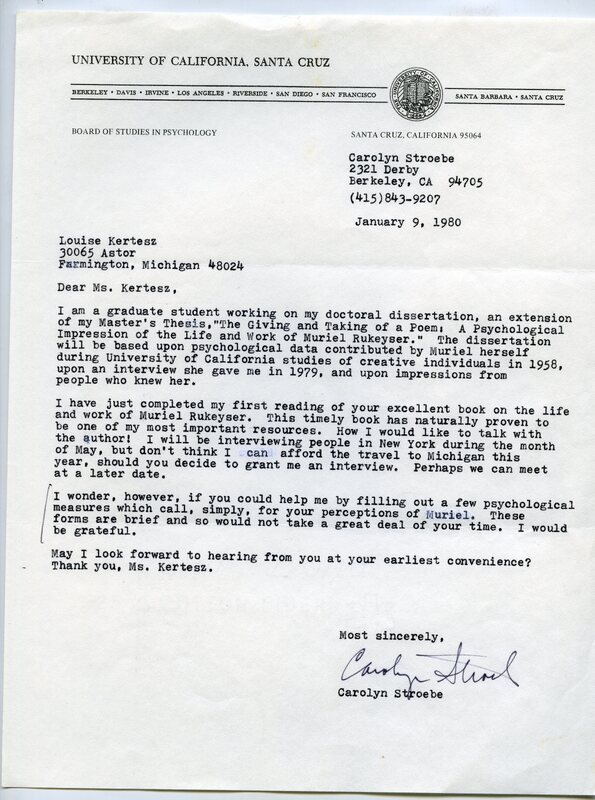
An original, typewritten letter from the University of California in Santa Cruz, dated January 9th, 1980. The letter is from Carolyn Stroebe to Louise Kertesz. Stroebe introduces herself by saying that she is a graduate student working on her doctoral dissertation, an extension of her Master’s Thesis, titled “The Giving and Taking of a Poem: A Psychological Impression of the Life and Work of Muriel Rukeyser.” The dissertation is based on psychological data provided by Rukeyser during a University of California study of creative individuals in 1958; on an interview that Rukeyser gave Stroebe in 1979; and on impressions from people who knew her. Stroebe had just finished reading Kertesz’s book on the life and work of Muriel Rukeyser for the first time, and the book had proven to be one of her most important resources. Stroebe would love to talk with the Kertesz. She will interview people in New York in May, but she doesn’t think she can afford to travel to Michigan this year. If Louise decides to grant Stroebe an interview, they could perhaps meet at a later date. Stroebe wonders if Kertesz can help her by filling out a few psychological measures which ask for her perceptions of Rukeyser. The forms will be brief and would not take a great deal of her time, Stroebe would be grateful. In closing, Stroebe says she is looking forward to hearing from Kertesz.
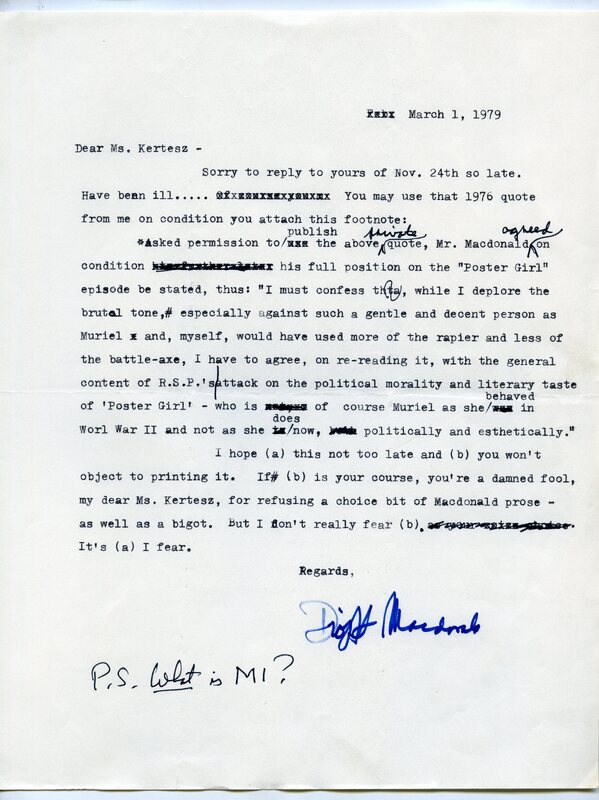
An original, typewritten letter, dated March 1st, 1979. The letter is from Dwight Macdonald to Louise Kertesz. Kertesz had sent Macdonald a letter on November 24th of the previous year, and he apologizes for replying to the letter so late. Macdonald will give her permission to use his quote in her book if she includes a disclaimer that says, “Asked permission to publish the above private quote, Mr. Macdonald agreed on condition his full position on the 'Poster Girl' episode be stated, thus, 'I just confess this, while I deplore the brutal tone, especially against such a gentle and decent person as Muriel and, myself, would have used more of the rapier and less of the battle-axe, I have to agree, on re-reading it, with the general content of R.S.P.'s attack on the political morality and literary taste of ‘Poster Girl’- who is of course Muriel as she behaved in Worl (sic) War II and not as she does now, politically and esthetically.” Macdonald says that he hopes it is not too late and that "you won't object to printing it." He adds that, should she refuse, she is “a damned fool ... for refusing a choice bit of Macdonald prose-as well as a bigot.” However, he really doesn’t fear this. Instead, he fears it is too late to submit it. There is a handwritten postscript on the letter that asks, “What is MI?”. The letter is also filled with typewriter errors, crossed out sections, and added. handwritten words by Macdonald himself.
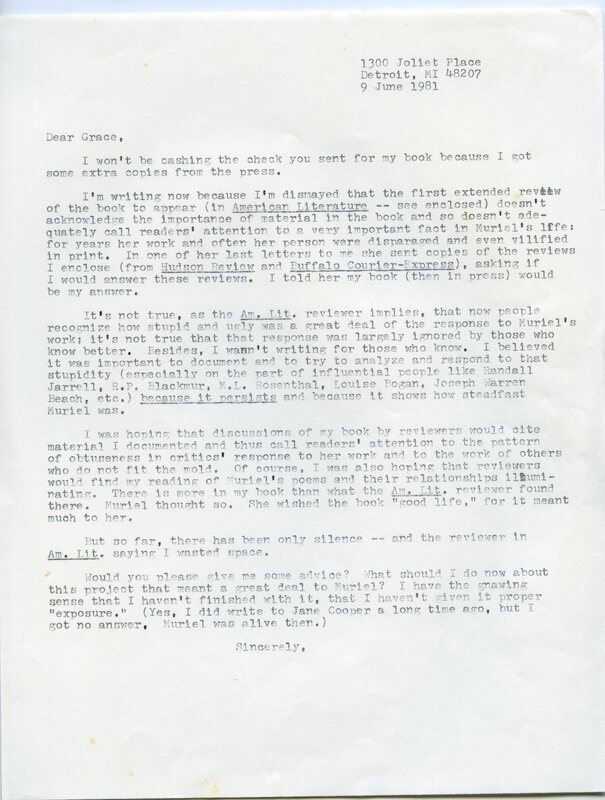
Dated June 9th, 1981, a typewritten letter from Louise Kertesz to Grace Paley. While there is no name after the valediction "sincerely" at the end of the letter, it can be assumed that this letter is from Louise Kertesz to Grace Paley. In the letter, Louise states that she won’t be cashing in the check that Grace sent for her book because she got some extra copies of the book from the press. Louise wrote to Grace because she is upset that the first review of her book, published in American Literature, “doesn’t acknowledge the importance of material in the book and so doesn’t adequately call readers’ attention to a very important fact in Muriel’s life: for years her work and often her person were disparaged and even vilified in print." In one of the last letters Muriel Rukeyser had sent Louise, she had enclosed two negative, even vicious reviews, one from Hudson Review, the other from Buffalo Courier-Express, and asked if Louise would answer those reviews. At the time, Louise reassured her that her book would be the answer. Louise then goes on to say that it is not true, as the American Literature reviewer states, “that now people recognize how stupid and ugly was a great deal of the response to Muriel’s work, it’s not true that that response was largely ignored by those who knew better.” Louise believes that “it was important to document and to try to analyze and respond to that stupidity (especially on the part of influential people like Randall Jarrell, R.P. Blackmur, M.L. Rosenthal, Louise Bogan, Joseph Warren Beach, etc.) because it persists and because it shows how steadfast Muriel was.”
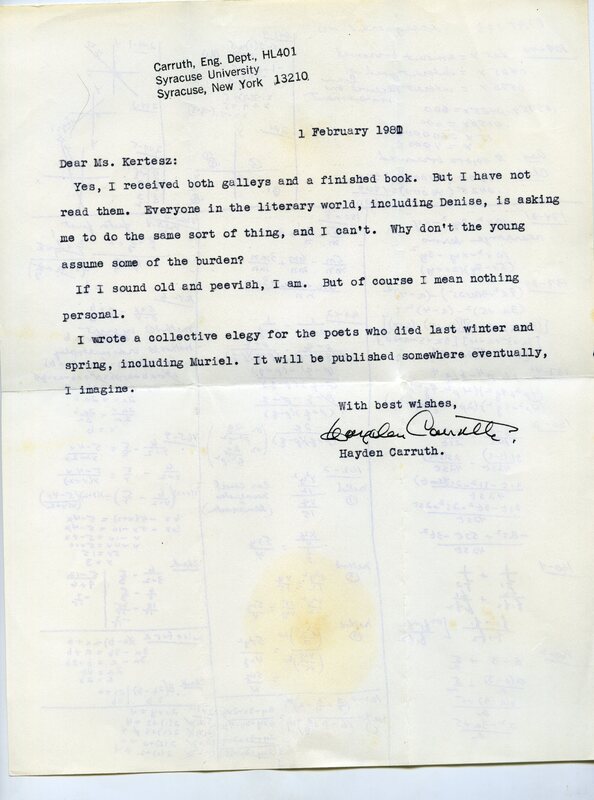
Envelope dated February 2nd, 1981, while the letter is dated February 1st, 1980, and then corrected to 1981. The typewritten letter is to Louise Kertesz from Hayden Carruth from the English Department of Syracuse University. Carruth acknowledges that he received both galleys and the finished book, and that everybody in the literary world, including Denise [Levertov] is pushing him to do the "same sort of thing," but he can’t. He also states that he wrote a collective elegy for the poets who died last winter and spring, including Muriel, and that it will be published somewhere soon. Noteworthy lines: “Why don’t the young assume some of the burden? If I sound old and peevish, I am. But of course I mean nothing personal.”
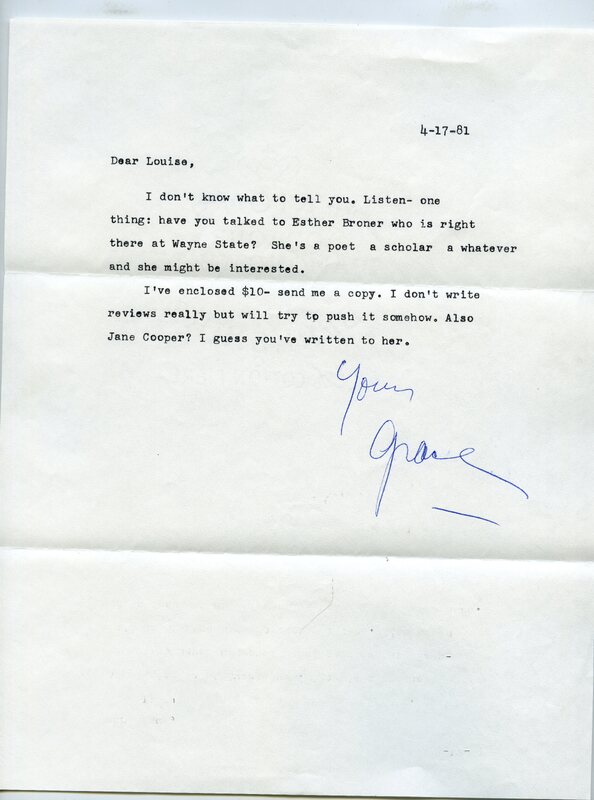
Dated April 17, 1981, from Grace Paley to Louise Kertesz. An original, typewritten letter. Envelope dated April 20th, 1981. Grace states that she doesn’t know what to tell Louise, and suggests she talk to Esther Broner at Wayne State, who is a poet and a scholar and may be interested. Grace enclosed a ten dollar check in the letter, saying she wants a copy of Louise’s book. She also suggests contacting Jane Cooper, but guesses that Louise has already written to her.
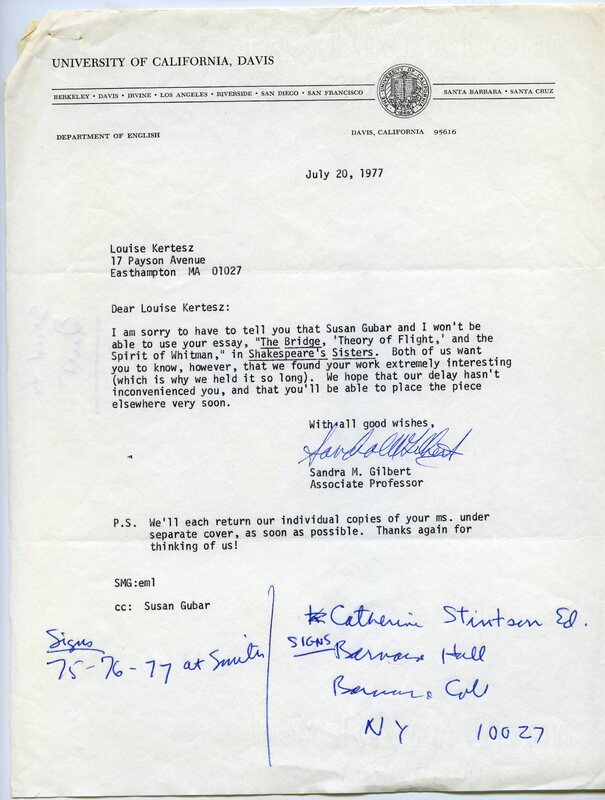
Dated July 20th, 1977. A typewritten letter from Sandra M. Gilbert, University of California, to Louise Kertesz. CC’D to Susan Gubar. They cannot use Louise Kertesz’s essays, “The Bridge, ‘Theory of Flight,’ and The Spirit of Whitman” for their collection Shakespeare’s Sisters. Gilbert adds: "Both of us want you to know, however, that we found your work extremely interesting (which is why we held it so long)."
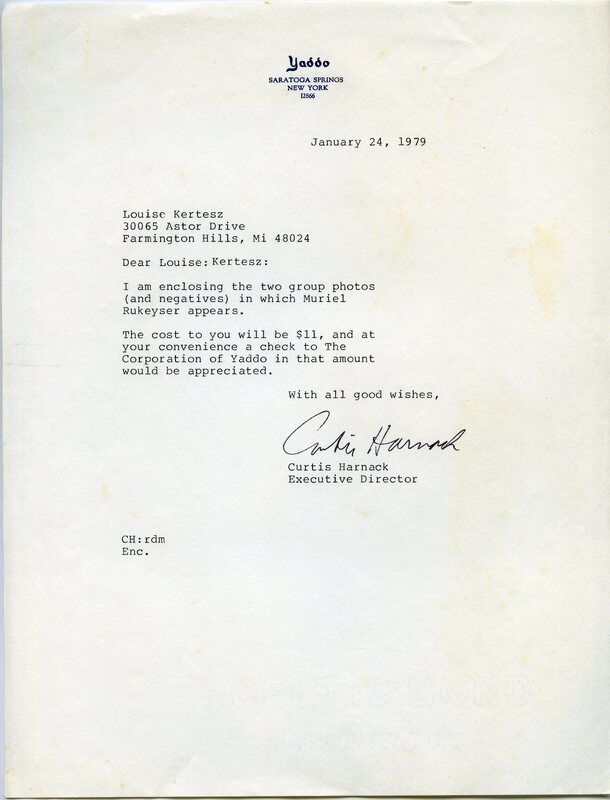
Dated January 24th, 1979. A typewritten letter from Curtis Harnack, Executive Director of Yaddo, to Louise Kertesz. The letter contains two photographs of Muriel Rukeyser. The cost of the photographs was eleven dollars.
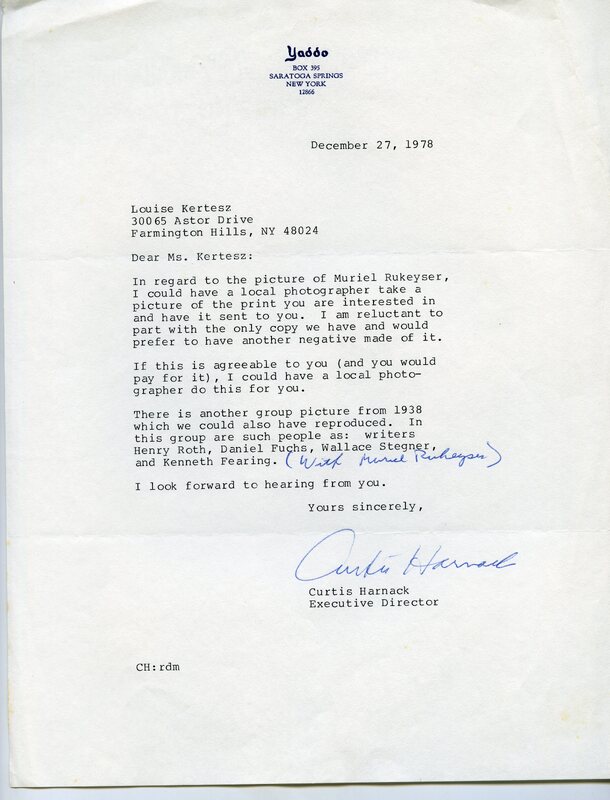
Dated December 27th, 1978. A typewritten letter from Curtis Harnack, Executive Director of Yaddo, to Louise Kertesz in regard to duplicating the two group photographs of Rukeyser at Yaddo.
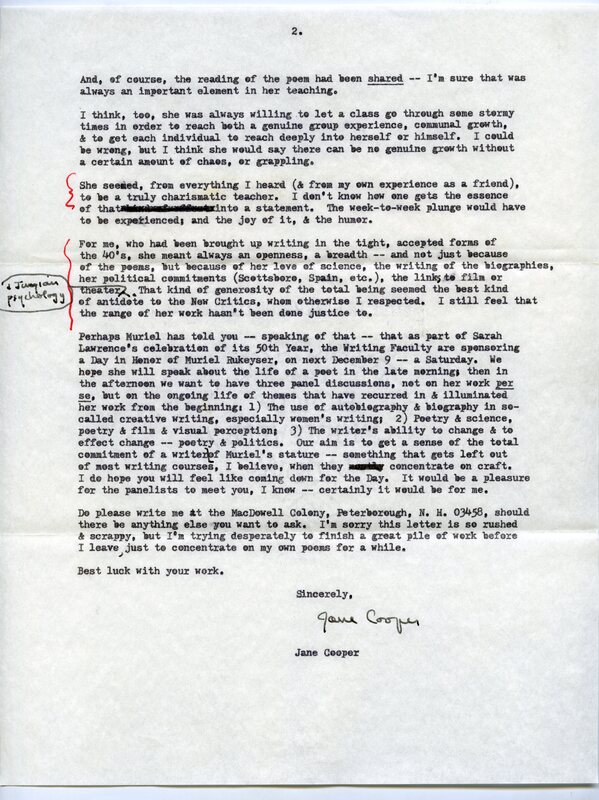
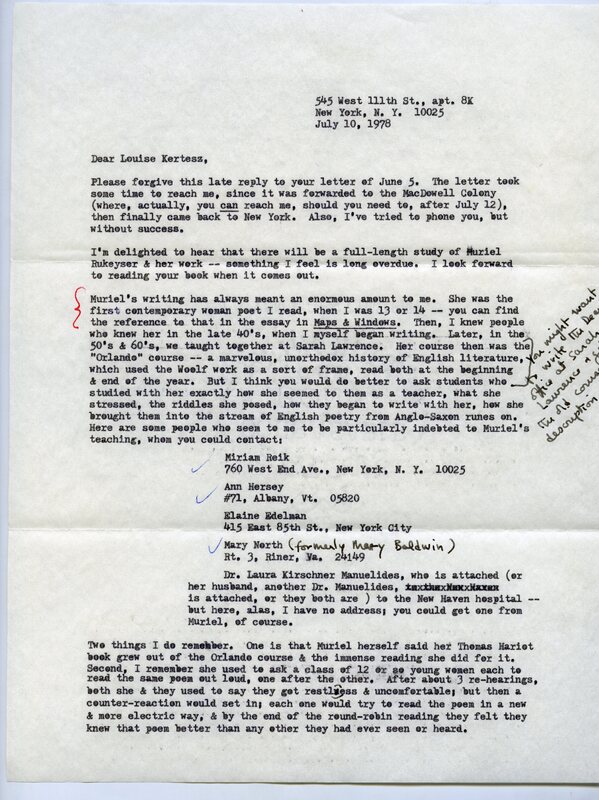
Dated July 10th, 1978. A typed letter from Jane Cooper to Louise Kertesz. Cooper apologizes for replying to the letter so late, and expresses elation that Louise Kertesz is writing a book about Rukeyser. On page two of the letter, Cooper comments on Rukeyser as a teacher, in particular on her willingness "to let a class go through some stormy times in order to reach both a genuine group experience, communal growth, & to get each individual to reach deeply into herself or himself. I could be wrong, but I think she would say there can be no genuine growth without a certain amount of chaos, or grappling."
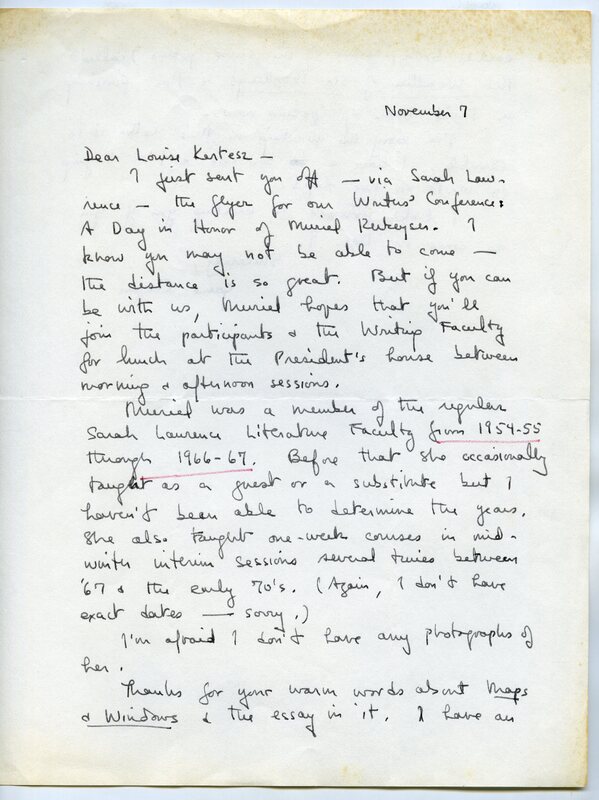
Cooper tells Kertesz "that as part of Sarah Lawrence's celebration of its 50th Year, the Writing Faculty are sponsoring a Day in Honor of Muriel Rukeyser." After describing the planned day-long event, she expresses her hope that Kertesz will be able to attend." Page 2 of 2.
Dated July 10th, 1978. A typed letter from Jane Cooper to Louise Kertesz. Cooper apologizes for replying to the letter so late, and expresses elation that Louise Kertesz is writing a book about Rukeyser. In the letter, Cooper suggests names of former students of Rukeyser to contact. “Muriel’s writing has always meant an enormous amount to me. She was the first contemporary woman poet I read, when I was 13 or 14 … Later, in the 50s & 60s, we taught together at Sarah Lawrence. Her course then was the ”Orlando” course–a marvelous, unorthodox history of English literature, which used the Woolf work as a sort of frame, read both at the beginning & end of the year." Some check marks are next to the names of the students of Rukeyser. Some handwritten notes, apparently by Jane Cooper, are also on the letter. Page 1 of 2.
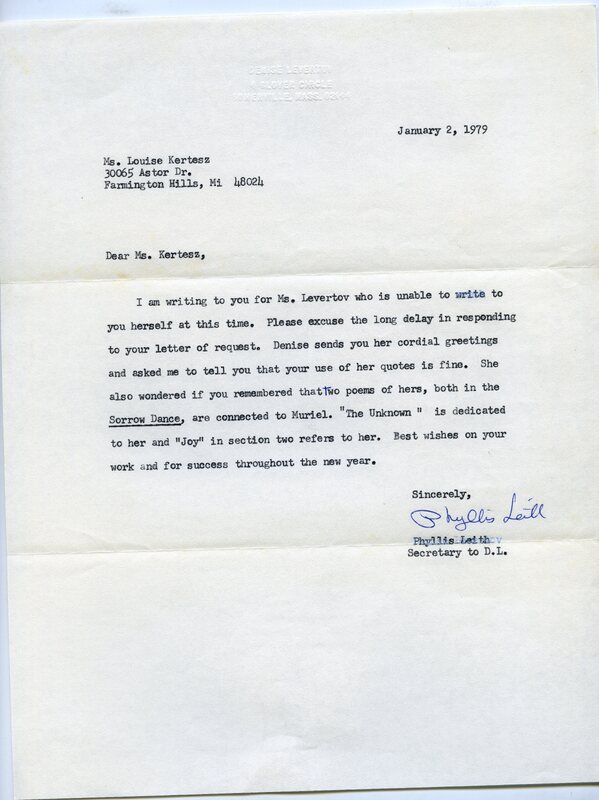
Dated January 2nd, 1979. A typed letter from Phyllis Leith to Louise Kertesz, writing on behalf of Denise Levertov. Levertov gives Louise Kertesz permission to use her quotes in her book, and notes that two of her poems in Sorrow Dance, “The Unknown” and “Joy,” are "connected to Muriel."
Dated November 7th. While no year is mentioned, the letter was obviously written in 1978. A handwritten letter from Jane Cooper to Louise Kertesz. Cooper talks about a Writer’s Conference: A Day in Honor of Muriel Rukeyser [December 9, 1978 at Sarah Lawrence University] that she hopes Kertesz will attend. Cooper regrets not having any photographs of Muriel. The letter is underlined in red (most likely by LK) in some places.
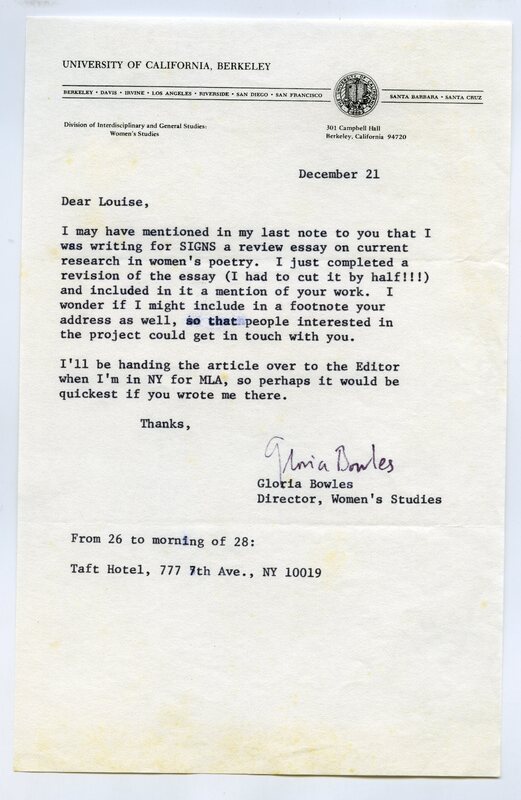
Dated December 21st, Unknown Year. A typed letter from Gloria Bowles, University of California, to Louise Kertesz. Bowles has included a mention of Kertesz’s book on Rukeyser in a review essay for Signs: Journal of Women in Culture and Society.
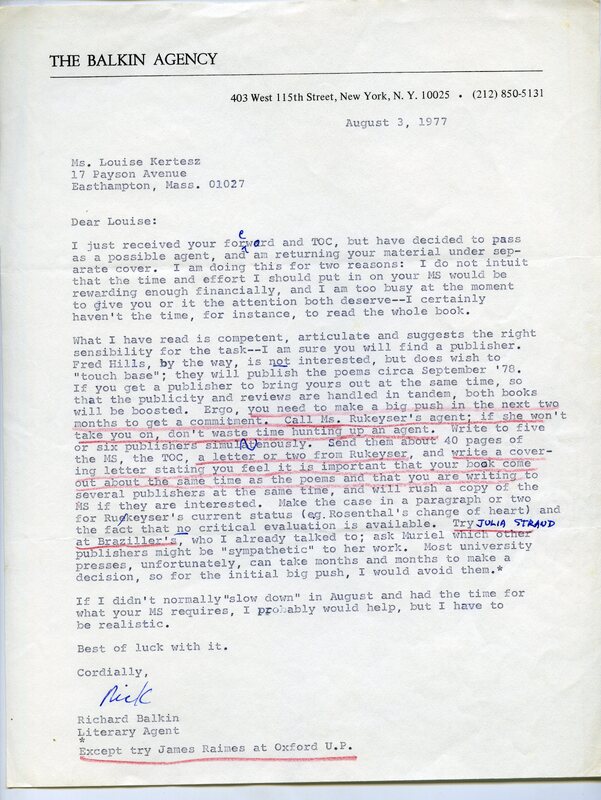
Dated August 3rd, 1977. A typed letter from the literary agent Richard Balkin. Balkin declines becoming the literary agent of Louise Kertesz, to help her publish her manuscript on Rukeyser. He does reassure her that the book will find a publisher, and suggests possible publishers and literary agents. Some handwritten notes, including the name of another agent, are added. Parts of the letter are underlined red, most likely by Kertesz.
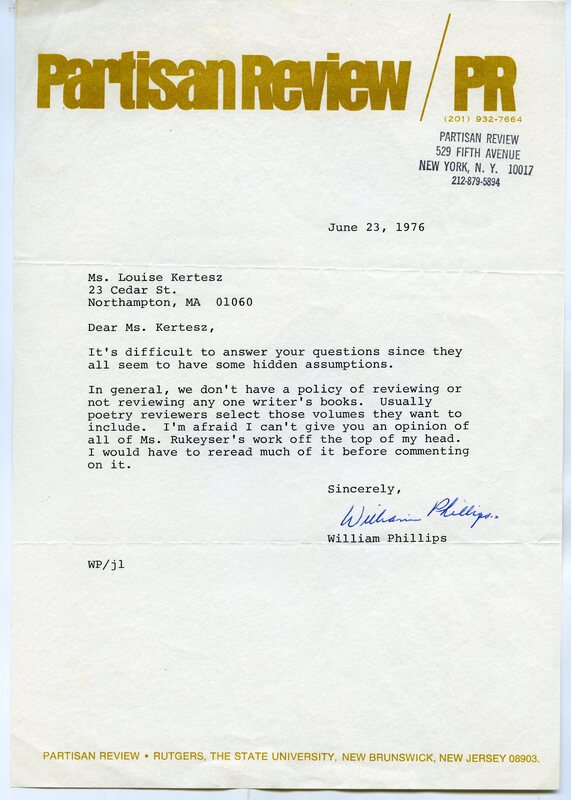
Dated June 23rd, 1976. A typed letter from William Phillips of Partisan Review to Louise Kertesz: “It’s difficult to answer your questions since they all seem to have some hidden assumptions.”
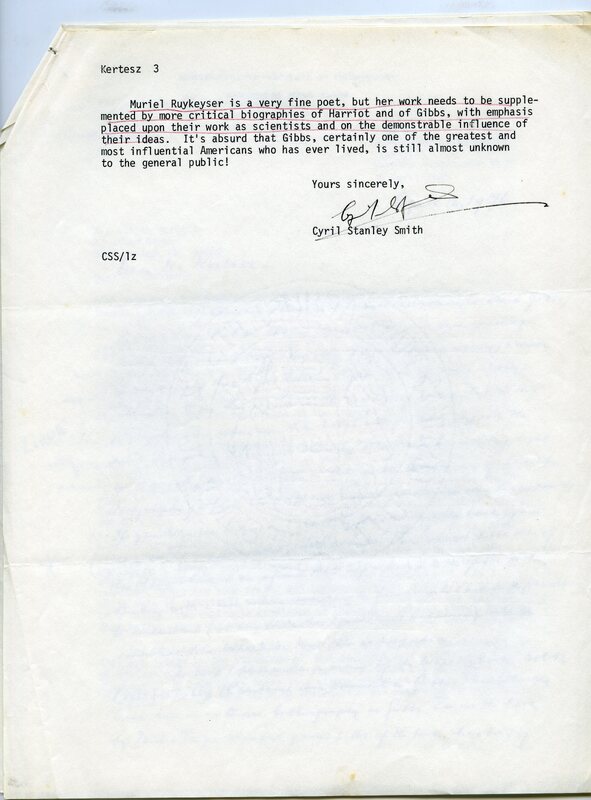
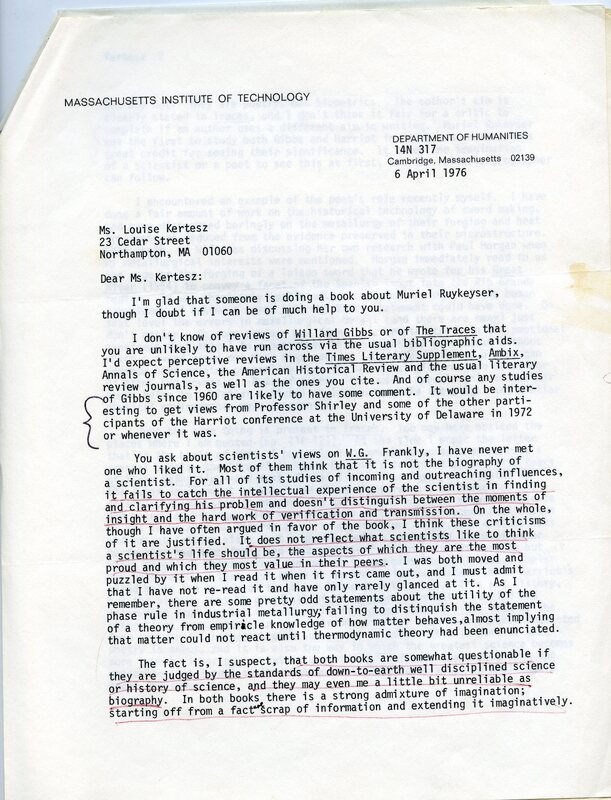
Dated April 12th, 1976, a typed letter from MIT (Massachusetts Institute of Technology) Professor Cyril Stanley Smith to Louise Kertesz, in response to her inquiries about Muriel Rukeyser’s Willard Gibbs and The Traces of Thomas Hariot. On page three, he concludes his letter by calling Rukeyser "a very fine poet." And he adds that "her work needs to be supplemented by more critical biographies of Harriot and of Gibbs, with emphasis placed upon their work as scientists and on the demonstrable influence of their ideas. It's absurd that Gibbs, certainly one of the greatest and most influential Americans who has ever lived, is still almost unknown to the general public."
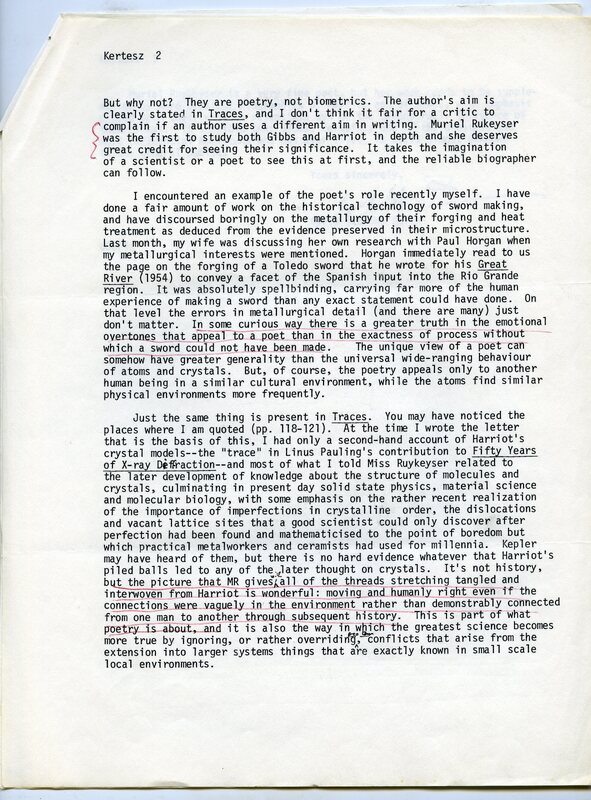
Dated April 12th, 1976, a typed letter from MIT (Massachusetts Institute of Technology) professor Cyril Stanley Smith to Louise Kertesz, in response to her inquiries about Muriel Rukeyser’s Willard Gibbs and The Traces of Thomas Hariot. On page two of the letter, he defends Rukeyser's imaginative extension of facts, writing: "In some curious way there is greater truth in the emotional overtones that appeal to a poet than in the exactness of process..." Page 2 of 3.
Dated April 6th, 1976, a typed three-page letter from MIT (Massachusetts Institute of Technology) Professor Cyril Stanley Smith to Louise Kertesz, in response to her inquiries about Muriel Rukeyser’s Willard Gibbs and The Traces of Thomas Hariot: “You ask about scientists' views on W.G. Frankly, I have never met one who liked it. Most of them think that it is not the biography of a scientist. For all of its studies of incoming and outreaching influences, it fails to catch the intellectual experience of the scientist in finding and clarifying his problem and doesn't distinguish between the moments of insight and the hard work of verification and transmission." Stanley himself, though he often argued in favor of the book, thinks these criticisms are justified. Nevertheless, he "was both moved and puzzled by it" when it first came out. He points out that in both books is a "strong admixture of imagination; starting off from a factual script of information and extending it imaginatively." Page 1 of 3.
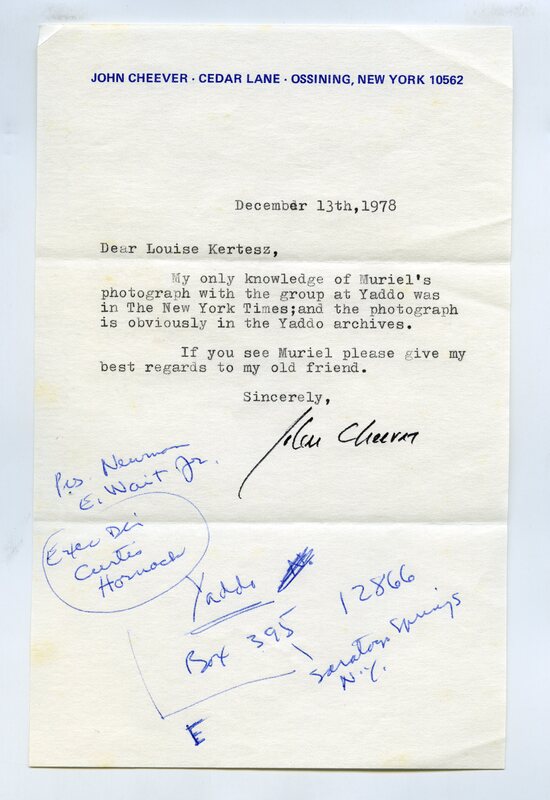
Dated December 13th, 1978. A typed letter from John Cheever to Louise Kertesz, talking about a photograph from Yaddo with Muriel in it. Also contains some handwritten notes by Louise Kertesz.
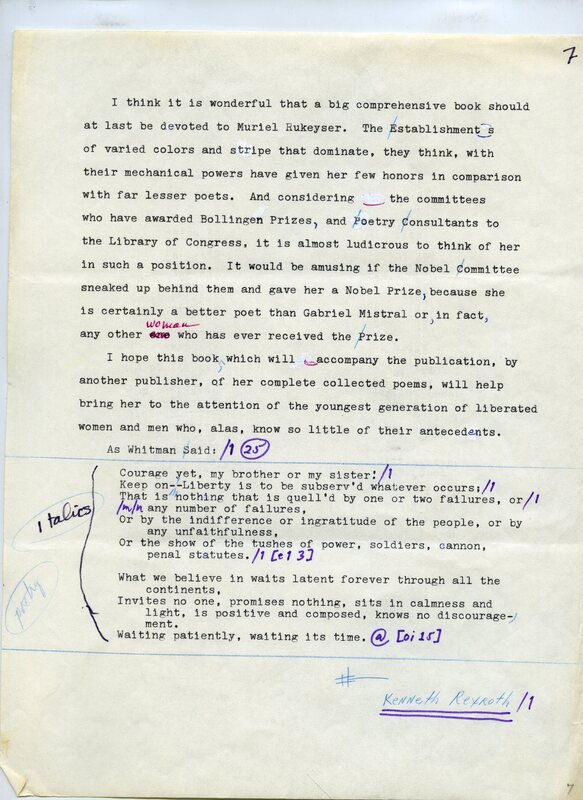
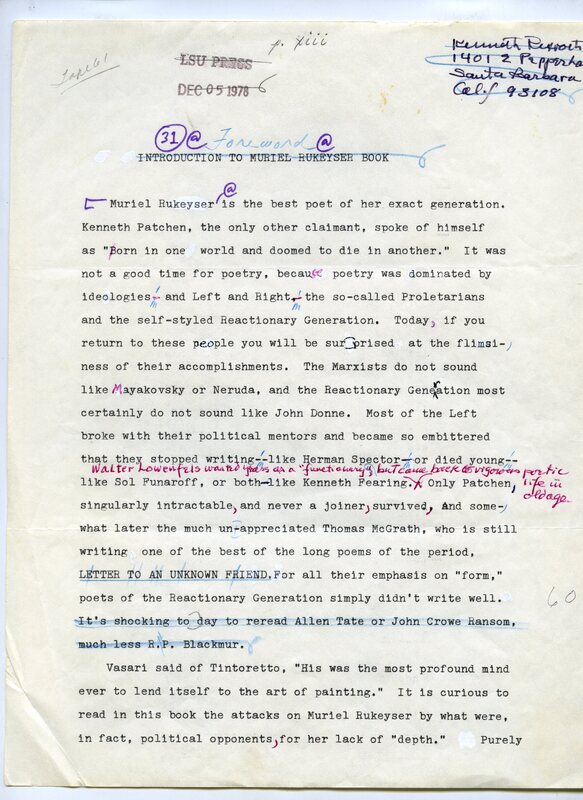
Original copy of Kenneth Rexroth’s introduction to Louise Kertesz’s book on Muriel Rukeyser, dated December 5th, 1978. There are underlines, marks, and additional notes on the introduction papers. Page 7 of 7.
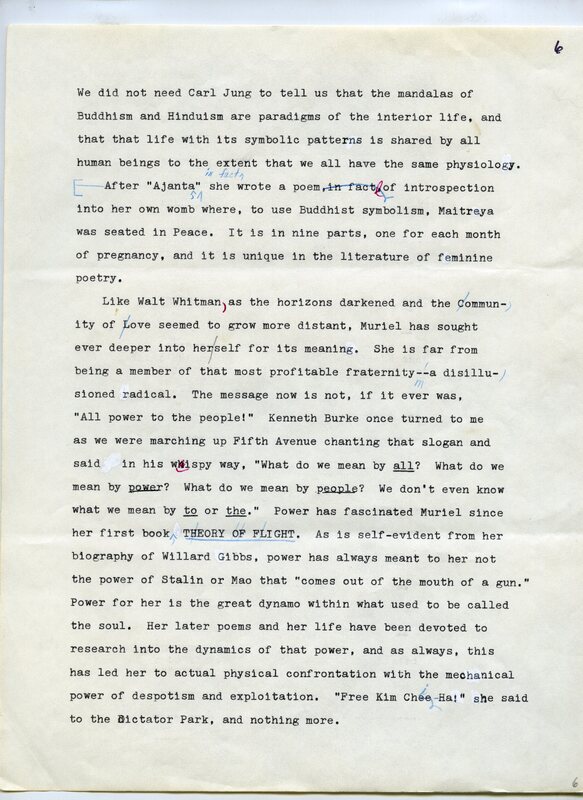
Original copy of Kenneth Rexroth’s introduction to Louise Kertesz’s book on Muriel Rukeyser, dated December 5th, 1978. There are underlines, marks, and additional notes on the introduction papers. Page 6 of 7.
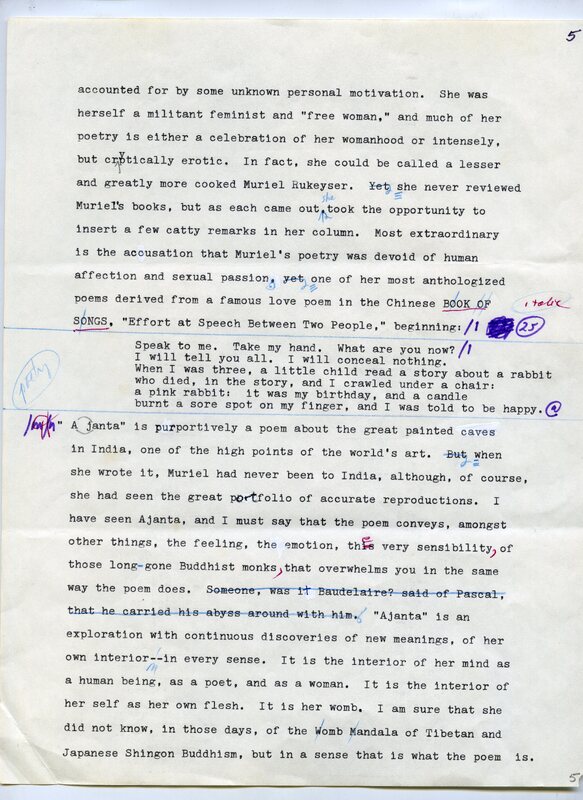
Original copy of Kenneth Rexroth’s introduction to Louise Kertesz’s book on Muriel Rukeyser, dated December 5th, 1978. There are underlines, marks, and additional notes on the introduction papers. Page 5 of 7.
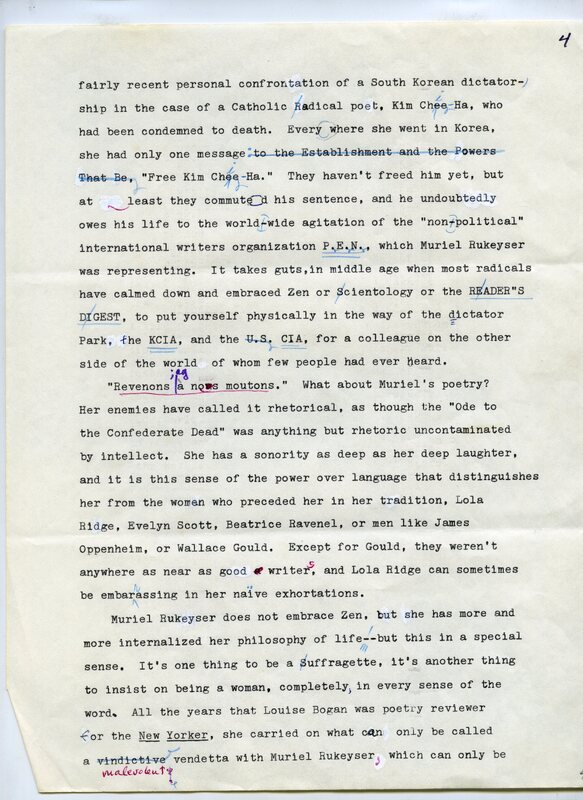
Original copy of Kenneth Rexroth’s introduction to Louise Kertesz’s book on Muriel Rukeyser, dated December 5th, 1978. There are underlines, marks, and additional notes on the introduction papers. Page 4 of 7.
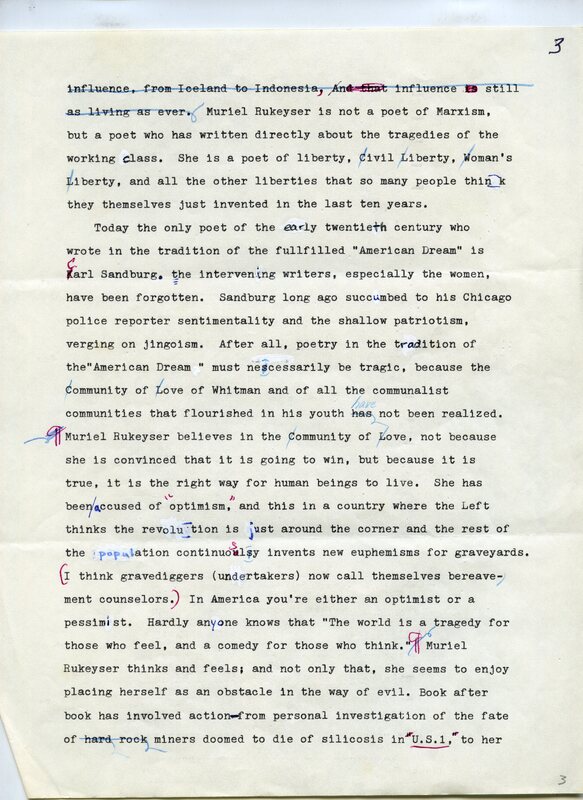
Original copy of Kenneth Rexroth’s introduction to Louise Kertesz’s book on Muriel Rukeyser, dated December 5th, 1978. There are underlines, marks, and additional notes on the introduction papers. Page 3 of 7.
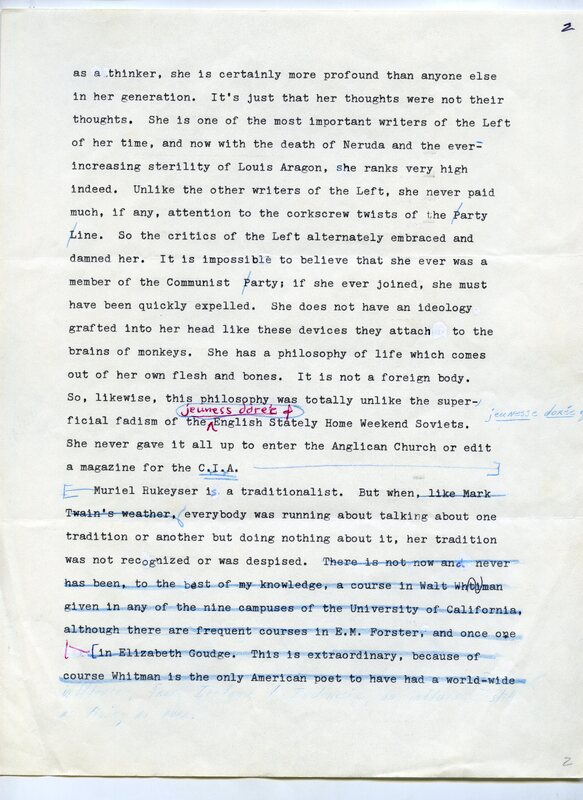
Original copy of Kenneth Rexroth’s introduction to Louise Kertesz’s book on Muriel Rukeyser, dated December 5th, 1978. There are underlines, marks, and additional notes on the introduction papers. Page 2 of 7.
Original copy of Kenneth Rexroth’s introduction to Louise Kertesz’s book on Muriel Rukeyser, dated December 5th, 1978. There are underlines, marks, and additional notes on the introduction papers. Page 1 of 7.
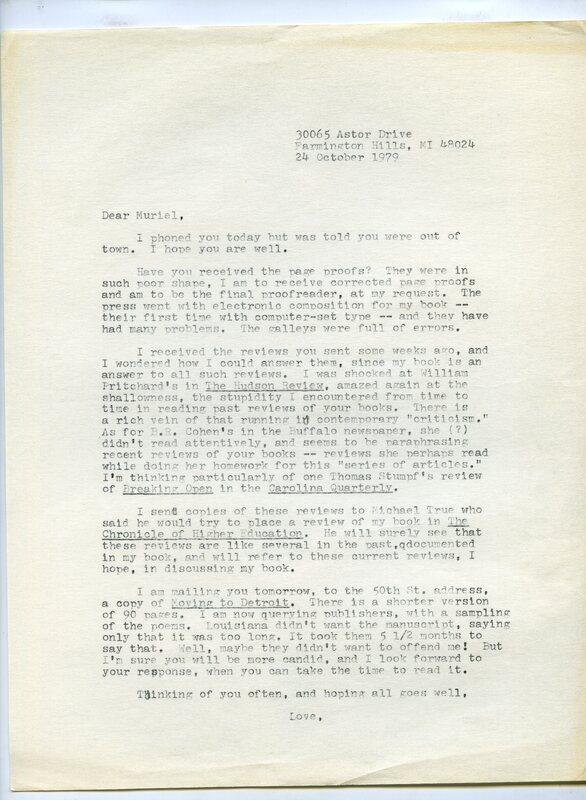
An original, typewritten letter dated October 24th, 1979. The letter is from Louise Kertesz to Muriel Rukeyser. Louise begins the letter by saying that she had phoned Rukeyser earlier today, but she was told that Rukeyser was out of town. Louise hopes that Rukeyser is doing well. Louise asks Rukeyser if she has received the page proofs. The proofs were in such poor shape that Louise requested that she will be the final proofreader for the corrected page proofs. The press went with electronic composition for her book, which is their first experience with computer set type, and they have had many problems. The galleys were full of errors. Louise received the reviews that Rukeyser had sent her a few weeks ago, and she wonders how she could answer them, since her book is an answer to all of these reviews. Louise was particularly shocked at William Prichard’s review in The Hudson Review, and amazed at the “...shallowness, the stupidity I encountered from time to time in reading past reviews of your books.” "There is a rich vein of that running in contemporary 'criticism.'” Louise then states that B.R. Cohen, in [her?] review in the Buffalo Newspaper "didn’t read attentively, and seems to be paraphrasing recent reviews of your books." Louise sent copies of these reviews to Michael True who said he would try to place a review of her book in The Chronicle of Higher Education. True will see that the reviews that Rukeyser sent Louise are like several others documented in Louise’s book. Louise hopes that True will reference these reviews in his review of Louise’s book. She is also mailing to Rukeyser at her 50th St. address a copy of Moving to Detroit. There is a shorter version at 90 pages. Louise is now querying publishers, with a sampling of the poems. Louisiana didn’t want the manuscript, saying only that it was too long. It took five and a half months for them to say that. Perhaps they didn’t want to offend Louise, but Louise is sure that Rukeyser will be more candid. She is looking forward to Rukeyser’s response, when she gets time to read it. Louise ends the letter by saying that she is thinking of Rukeyser, and she hopes that all is well.
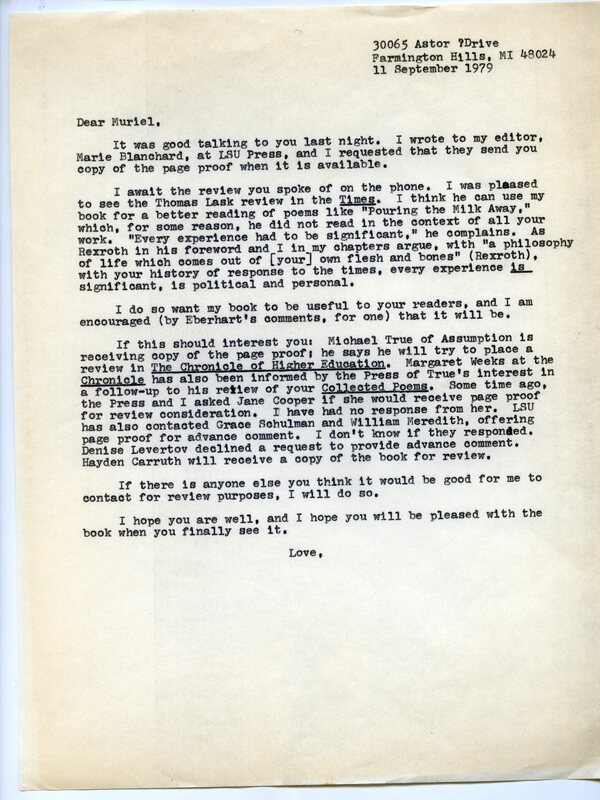
An original typewritten letter dated September 11th, 1979. The letter is from Louise Kertesz to Muriel Rukeyser. Louise begins the letter by saying that it was good to talk with Rukeyser last night. Louise had written to her editor at LSU Press, Marie Blanchard, and requested that they send Rukeyser a copy of the page proof when it is available. Louise is waiting for the review that Rukeyser spoke of on the phone. Louise was pleased to see the Thomas Lask review in the Times. She thinks that Lask will be able to use her book for better readings of some of the poems, such as “Pouring the Milk Away,” which he did not read in the context of all of Rukeyser’s work. Lask stated that “Every experience had to be significant." Kenneth Rexroth argues that the poems show “... a philosophy of life which comes out of [your] own flesh and bones.” Louise states that “...with your history and response to the times, every experience is significant, is political and personal." Louise does want her book to be useful to Rukeyser’s readers, and has been encouraged by Eberhart’s comments that it will be. Louise informs Rukeyser that Michael True of Assumption is receiving a copy of the page proof, and he says he will try to place a review in The Chronicle of Higher Education. Margaret Weeks at The Chronicle had also been informed by the Press of True’s interest in a follow-up of his review of Rukeyser’s Collected Poems. Some time ago, Louise and the Press had asked Jane Cooper if she would read the page proofs in order to review the book. Louise received no response from her. Louise had also contacted Grace Schulman and William Meredith, offering page proofs for advance comment. Louise does not know if they responded. Denise Levertov declined a request for advanced comment. Hayden Carrruth will get a copy of the book for a review. If there is anyone else that Rukeyser would recommend for a review, Louise will contact them. Louise ends the letter by saying that she hopes that Rukeyser is well, and that she will be pleased with the book when she sees it.
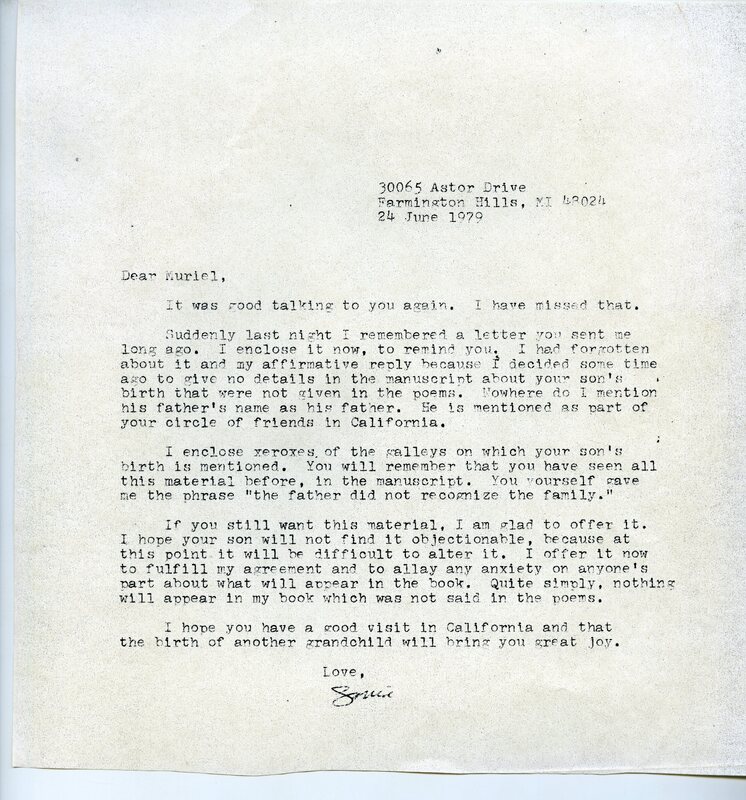
Photocopy of a typewritten letter, dated June 24th, 1979. The letter is from Louise Kertesz to Muriel Rukeyser. Louise begins the letter by saying that she enjoyed talking to Rukeyser again, and that she had missed that. Last night, Louise had remembered a letter that Rukeyser sent her long ago. Louise is enclosing it in the envelope to remind Rukeyser about it. Louise had forgotten about it and her reply because Louise had decided some time ago to give no details in the manuscript about the birth of Rukeyser’s son that were not given in the poems. Louise did not mention his father’s name as his father. His name was only mentioned in the list of people in California that Rukeyser knew. Louise encloses xeroxes of the galleys on which Muriel’s son’s birth is mentioned. Rukeyser should remember that she had seen the material before in the manuscript. Rukeyser had given the statement that the father “did not recognize the family.” If Rukeyser still wants that material, Louise would be glad to offer it. Louise hopes that Rukeyser’s son will not find it objectionable because it would be hard to alter at this point. Louise sends the information to Rukeyser now to honor her agreement and to allay any anxiety on anyone’s part about what will appear in Louise’s book. "Simply put, nothing will appear in my book which was not said in the poems." Louise ends the letter by saying that she hopes that Muriel has a good visit in California and that the birth of another grandchild will bring her great joy.
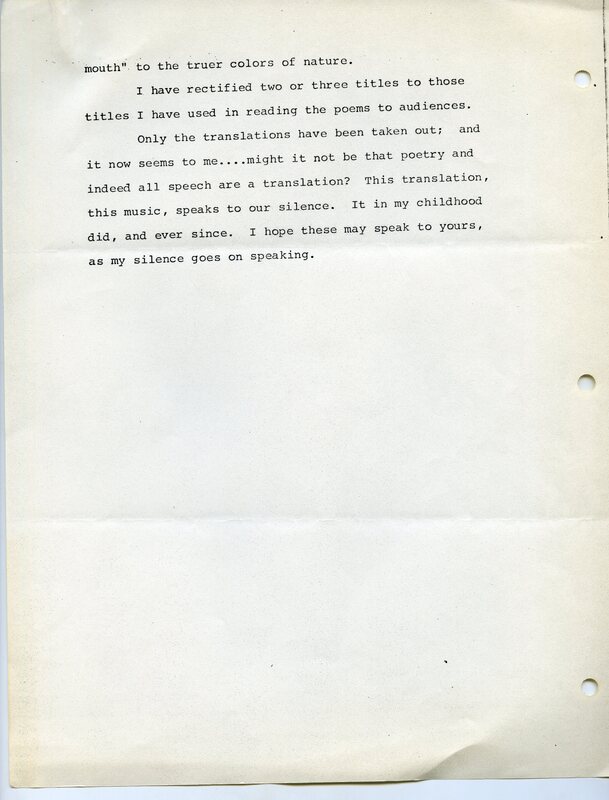
Type-written three-page Preface to The Collected Poems of Muriel Rukeyser. The preface was written by Rukeyser, and dedicated, in a hand-written note on the upper right of page one, "for Louise with Love, Muriel." Page 3 of 3.
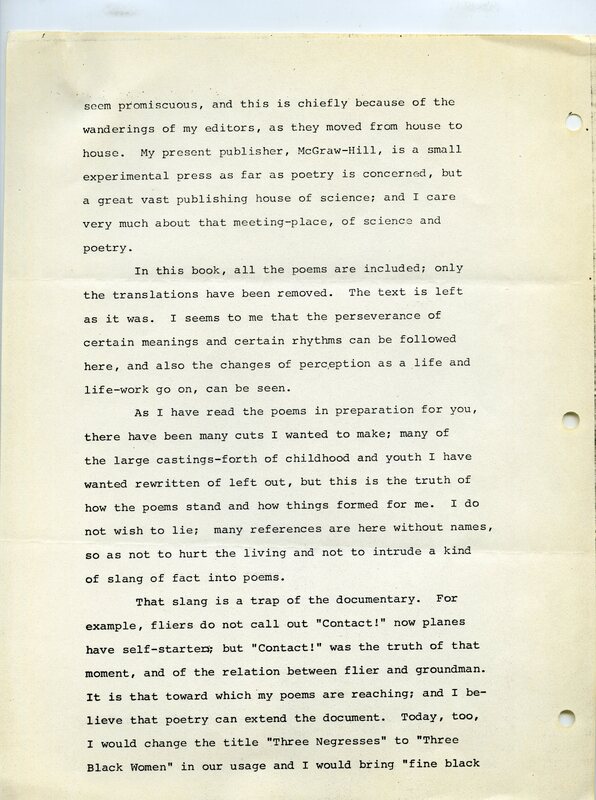
Type-written three-page Preface to The Collected Poems of Muriel Rukeyser. The preface was written by Rukeyser, and dedicated, in a hand-written note on the upper right of page one, "for Louise with Love, Muriel." Page 2 of 3.
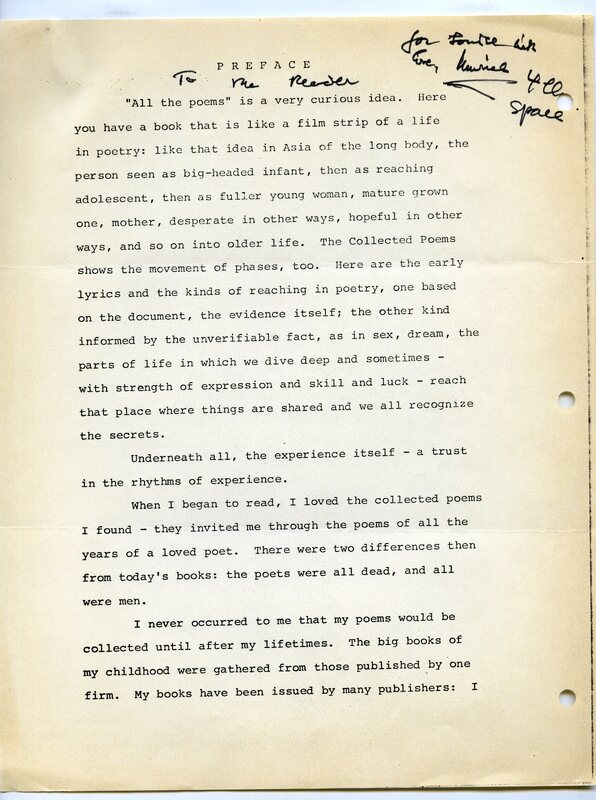
Type-written three-page Preface to The Collected Poems of Muriel Rukeyser. The preface was written by Rukeyser, and dedicated, in a hand-written note on the upper right of page one, "for Louise with Love, Muriel."
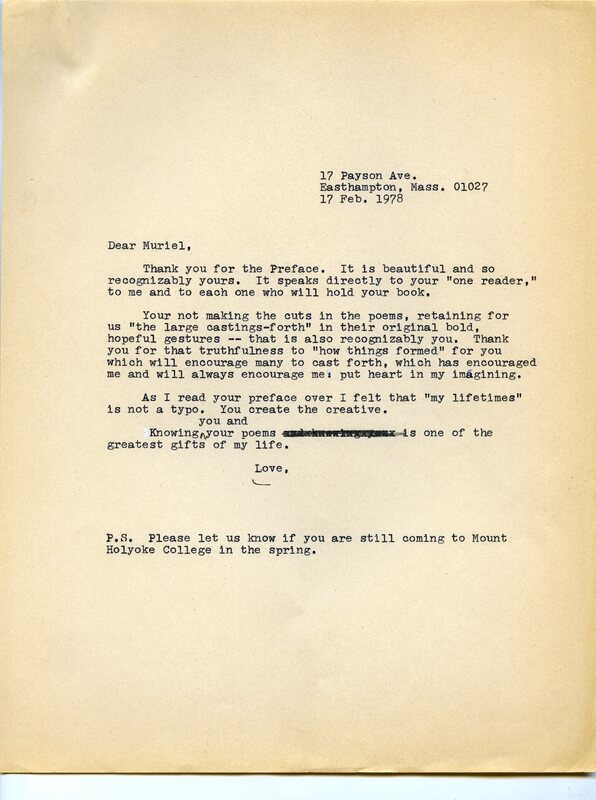
Original letter, dated February 17th, 1978 , written by Louise Kertesz to Muriel Rukeyser and attached to a typed copy of Rukeyser's preface to her forthcoming Collected Poems. Louise begins the letter by thanking Muriel for the Preface to the book. The Preface is “...beautiful and so recognizably yours.” It speaks directly to Rukeyser’s “one reader,” to Louise and to each person who will hold Rukeyser’s book. Louise then states that the fact that Muriel did not cut the poems, and that “...retaining for us the large castings forth in their original bold, hopeful gestures—that is also recognizably you.” She thanks Rukeyser for her truthfulness in “'how things formed' for you which will encourage many to cast forth, which has encouraged me and will always encourage me: put heart into my imagining." As Louise read the Preface over and over, she felt like “my lifetimes” was not a typo, and that Rukeyser creates the creative. Louise ends the letter by saying that knowing Rukeyser’s poems is one of the greatest gifts of her life. There is a postscript to the letter that asks whether or not Rukeyser is still coming to Mount Holyoke College in the Spring.
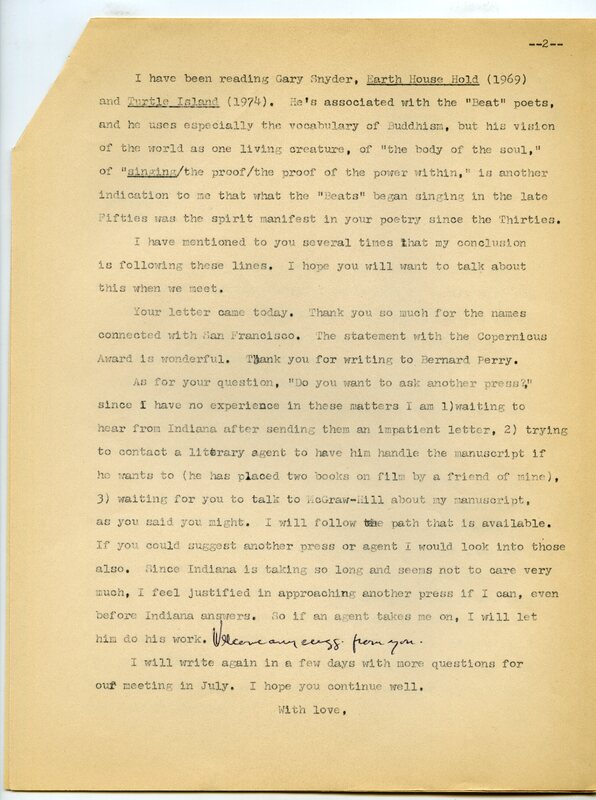
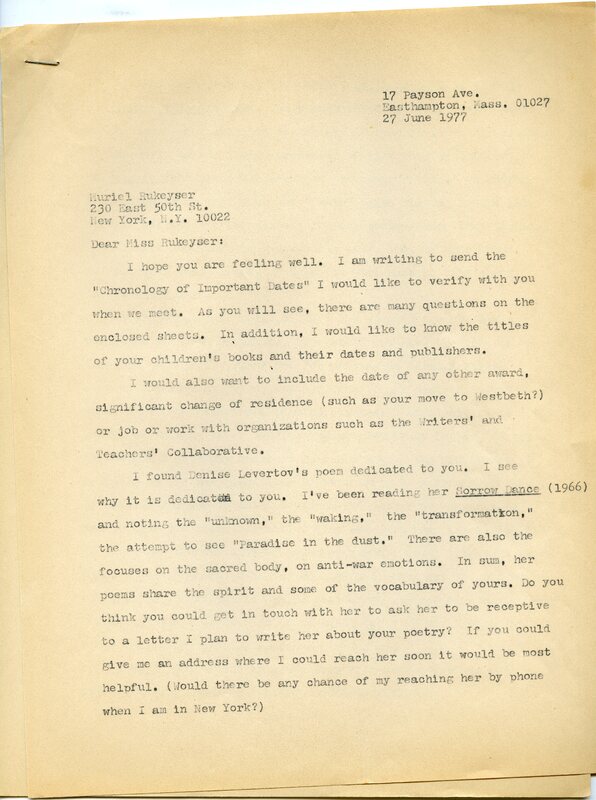
An original, two-page letter, dated June 27th, 1977. Presumably from Louise Kertesz to Muriel Rukeyser. Louise is sending Rukeyser “The Chronology of Important Dates” that she would like to verify with her when they meet. Louise is also enclosing many questions in an envelope. In the “Chronology of Important Dates" Louise wants to include the date of any of Rukeyser’s awards, significant changes in residence, or Rukeyser’s work with organizations such as the Writers’ and Teachers’ Collaborative. Louise found Denise Levertov’s poem dedicated to Rukeyser. She had been reading Levertov’s Sorrow Dance, and noted the “unknown”, the “waking,” and the “transformation,” and also the attempt to see “Paradise in the dust.” Levertov's poems, she notes, "share the spirit and some of the vocabulary of yours." Louise asks Muriel to find out if Levertov would be receptive to inquiries about her poetry. Louise has also read Gary Snyder's Earth House Hold and Turtle Island. Snyder is associated with the Beat poets and uses Buddhist terms, but his vision of the world as one living creature, or “the body of the soul,” and of “singing/the proof/the proof of the power within” is another indication that "what the Beats' began singing in the late Fifties was the spirit manifest in your poetry since the Thirties." Louise hopes Muriel will talk with her about this when they meet. Rukeyser’s letter listing the names of people whom she knew in San Francisco had arrived that day. Louise thanks her for her letter, and for writing to Bernard Perry. Louise also says that Rukeyser’s statement for the Copernicus award was wonderful. As for Rukeyser’s question, “Do you want to ask another press?” Louise replies that she has no experience in these matters, and is trying to hear from Indiana after sending them an impatient letter, trying to contact a literary agent and have him handle the manuscript, and finally, waiting for Rukeyser to talk to McGraw-Hill about her manuscript, as Rukeyser said she might do. Louise will follow the path that is available. If Rukeyser could suggest another press or agent, Louise would look into those as well. Since Indiana is taking so long and does not seem to care very much, Louise feels justified in choosing another press if she can, even before Indiana answers. So if an agent takes Louise on, she will let him do the work. Louise ends the letter by saying that she will write again in a few days with more questions for her and their meeting in July. Louise hopes Muriel continues to do well. There is a sentence of handwriting on page two of the letter.
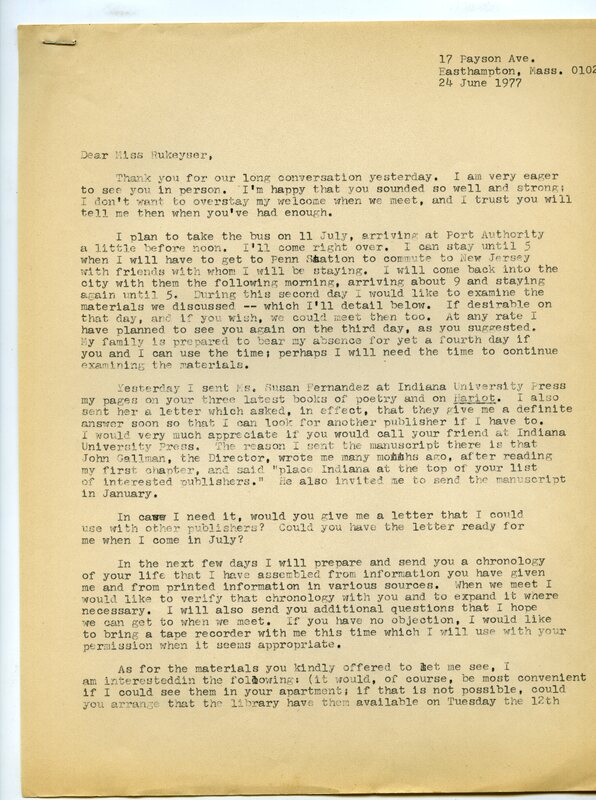
Original typewritten letter, dated June 24th, 1977. The letter is from Louise Kertesz to Muriel Rukeyser. Louise thanks Rukeyser for their long (phone) conversation the day before. She is very eager to see her in person. Louise is happy that Muriel sounded so well and strong, and expresses concern about not overstaying her welcome when they meet. Louise plans to take the bus on July 11th, arriving at Fort Authority a little before noon. Louise will come right over. She can stay until 5, which is when she will have to go to Penn Station to commute to New Jersey, where she will be staying with friends until the following morning, arriving at Rukeyser’s at about 9 and staying again until 5. During the second day, Louise would like to examine the materials that they have discussed which she will detail later in the letter. If desirable, Louise will see her again on the third day, as Rukeyser suggested. Louise’s family is prepared to bear her absence for a fourth day if she and Muriel could use the time. Yesterday, Louise sent Susan Hernandez at Indiana University Press her pages on Rukeyser’s three latest books of poetry and on Hariot. Louise also sent the press a letter which asked if they would give her a definite answer soon so she can look for another publisher if she has to. Louise would appreciate it if Rukeyser could call her friend at Indiana University Press. The reason that Indiana University Press was on the top of the list of publishers is that John Gallman, the director, wrote Louise many months ago after reading the first chapter of her book, saying, “Place Indiana at the top of your list of interested publishers.” He also invited Louise to send the manuscript in January. In case she needs it, Louise asks if Rukeyser can give her a letter that she can use with other publishers, and if Rukeyser can have the letter ready by the time Louise meets with her in July. In the next few days, Louise will prepare and send Rukeyser a chronology of her life that she assembled from information that Rukeyser had given her and from printed information from various sources. When Louise and Rukeyser meet, Louise would like to verify that chronology and expand it if necessary. Louise will also send her additional questions that she hopes Rukeyser can answer when they next meet. If Rukeyser has no objections, Louise would like to bring a tape recorder with her which she will use with Rukeyser’s permission when it seems appropriate. As for the material that Rukeyser offered to let Louise see, Louise says it would be best to look at it in her apartment, but Rukeyser can also arrange for the library to have it available on Tuesday the 12th. The letter cuts off here, and no information about what Louise wanted to see is given. It is highly probable that the letter went on for another page.
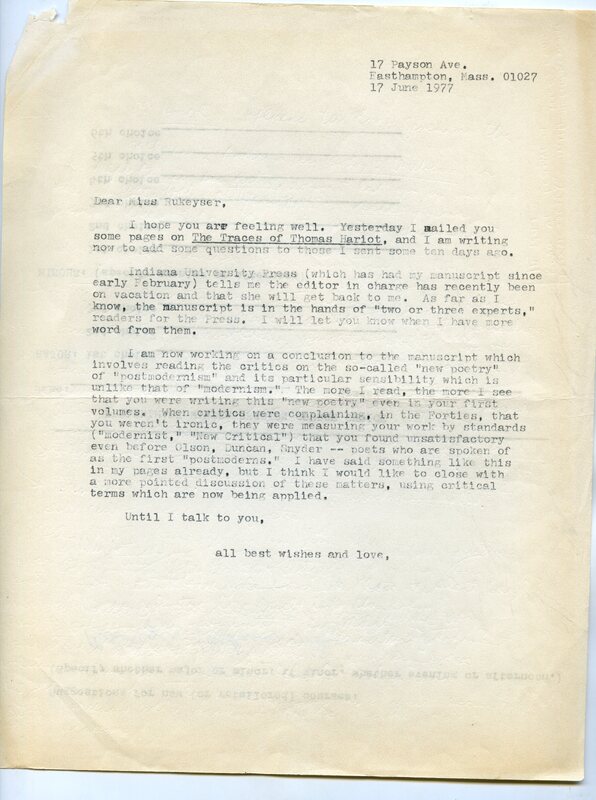
Original typewritten letter, dated June 17th, 1977. The letter is from Louise Kertesz to Muriel Rukeyser. Louise hopes Rukeyser is feeling well, and tells her that she mailed her a few pages on The Traces of Thomas Hariot, and that she is writing now to ask a few questions about those pages. Indiana University Press, who had Louise’s manuscript since early February, told Louise that the editor in charge went on vacation, and that the manuscript is in the hands of two or more experts. Louise will let Rukeyser know if she hears anything from them. Louise is now working on a conclusion to the manuscript which involves reading a critic on the so-called “new poetry” of "postmodernism,” the particular sensibility which is unlike that of “modernism.” The more Louise reads, the more she sees that Rukeyser was writing this ”new poetry” even in her first volumes. When critics were complaining in the Forties that Rukeyser wasn’t ironic, they were measuring her works by standards that Rukeyser had found unsatisfactory even before Olson, Duncan, and Snynder, who are poets now spoken of as the first “postmoderns.” Louise had said something like that already, but she thinks she would like to close with a more pointed discussion of these matters, using critical terms which are now being applied. The back page of the letter is a course selection sheet.