
“Dungeons & Dragons.” SpongeBob Medieval Armor Comparison to Real Life Armor by Sean Harris
“Dunces and Dragons” is an episode of the SpongeBob SquarePants cartoon series that uses medieval parody and armor to illustrate the characters’ roles in the narrative. In this exhibit, we compare several different armor styles to show how the cartoon armor was inspired by real-life pieces and to highlight their similarities in character development. Specifically, this analysis focuses on SpongeBob’s and Patrick’s choice of helmets, Sandy’s plate armor, and Planktonamor’s knights, and seeks to understand how the characteristics of real medieval armor influenced each character’s design for the show. Furthermore, this exhibit illustrates how the SpongeBob episode uses medieval parody to convey meaning through the armor the characters wear and how that reflects their roles.
The name of the episode, “Dunces and Dragons,” is similar to Dungeons & Dragons (D&D), the leading tabletop role-playing game globally, which has video game, movie, and television spinoffs. Not only is the name similar to the SpongeBob episode title, but the fantasy characteristics and traits of the armor are also similar to those of characters in Dungeons & Dragons. Based on the name alone, we could assume that the characters in the SpongeBob episode reference preexisting medieval material influenced by the D&D universe.
The episode begins with SpongeBob and Patrick volunteering to participate in a medieval seahorse race. The two end up waking up in a medieval version of Bikini Bottom after being knocked off their horses. Planktonamor, the evil wizard who has been destroying the kingdom with his dragon jellyfish, has captured the king’s daughter. Prior to being captured, the princess relayed a prophecy stating that SpongeBob and Patrick would be the ones to save the princess and the kingdom. SpongeBob and Patrick then go on a quest to save the princess. Along the way, they encounter Sandy, who is acting as the knight in charge of protecting Planktonamor’s property. SpongeBob ends up saving Sandy’s life, and she has a change of heart and helps them into the castle and past the evil armed knights. The story’s main protagonists—SpongeBob, Patrick, and Sandy—then engage in an altercation with the jellyfish dragon and fail. However, they eventually succeed by feeding Krabby Patties to the dragon; in doing so, the dragon turns on the wizard, and they are able to save the day.
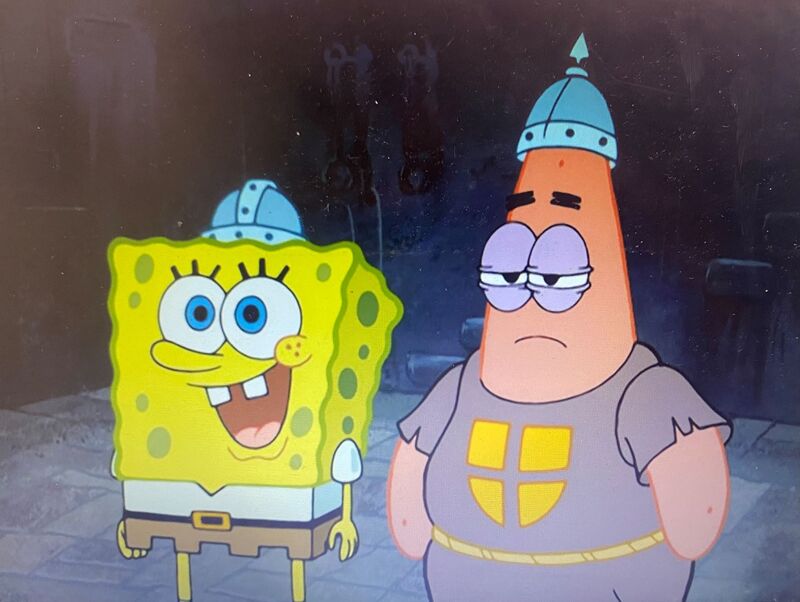
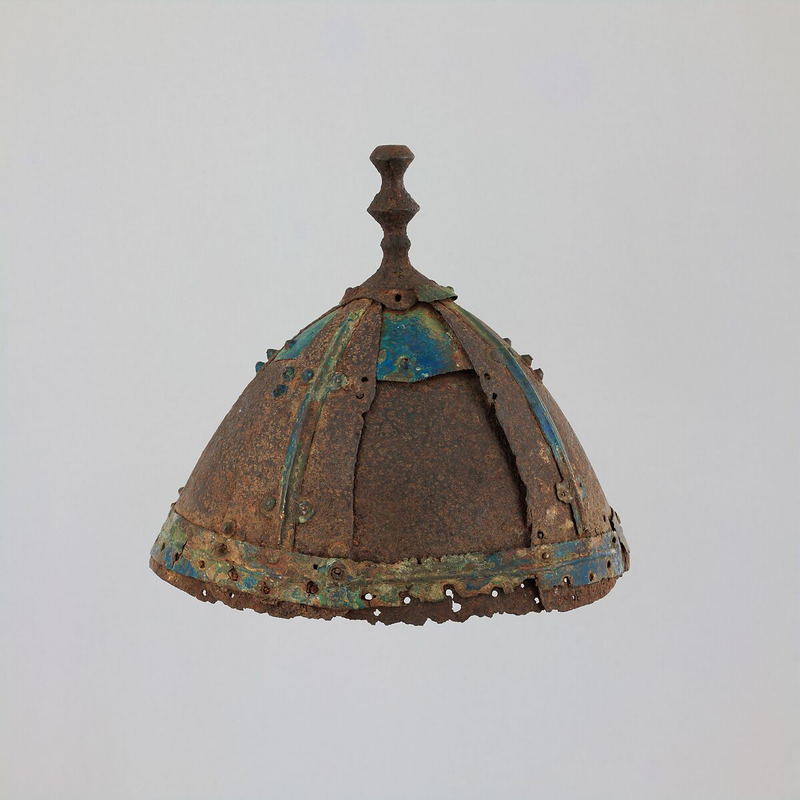
In the collection of the Metropolitan Museum of Art, there is a medieval helmet very similar to the ones Patrick and SpongeBob wear throughout the episode. According to the Metropolitan Museum of Art, it is called the Eight-Plate Helmet and is dated to the 8th–10th centuries. The helmet likely originates from Tibetan culture and is made of iron, copper alloy, and leather (Metropolitan Museum of Art 2026), which makes it look very similar to the helmets that SpongeBob and Patrick wear. This style of helmet is a distinctive piece of armor from Tibet. Distinctive characteristics of later Tibetan helmets include the fundamental eight-plate design, the slightly curved edges of the outer plates on the helmet bowl, and the uniquely Tibetan shape (Metropolitan Museum of Art 2026). These same traits seem to appear in SpongeBob and Patrick’s helmets.
When rewatching the episode, one notices that the material appears cheaper and conspicuously homogeneous. In addition, they wear only helmets, not full-body armor, and the quality of the helmets is lacking. It can be argued that this reflects SpongeBob’s and Patrick’s level of stature in combat; specifically, that their combat capabilities are low. Both of their helmets are similarly semicircular, and while the illustrators of this SpongeBob episode may not have seen the Met’s specific helmet, it is undoubtedly the case that they were influenced by some of this helmet’s design ideas, directly or indirectly.

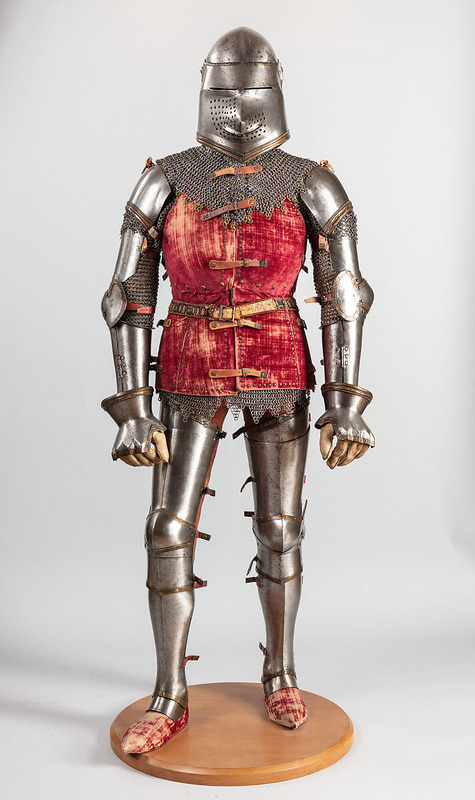
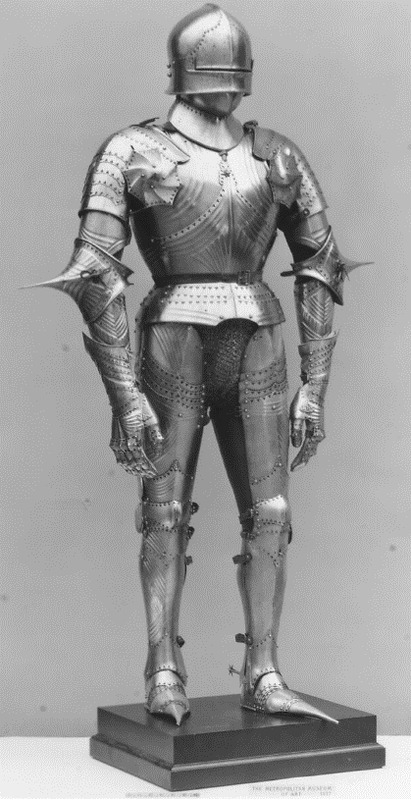
There is armor at the Metropolitan Museum of Art that is similar to Sandy’s, known as fifteenth-century armor from Italy. According to the Metropolitan Museum of Art, it was assembled and refurbished in the 1920s from various components recovered from the remnants of the Venetian stronghold at Chalcis, on the Greek island of Euboea, which had been captured by the Turks in 1470. The goal was to showcase a complete suit of armor in the style used around 1400, a period for which no intact armor is known to exist in any collection (Metropolitan Museum of Art 2026).
There are many similarities between this suit and Sandy’s. First, there is a nonmetallic decorative mid-body covering, which is known to function as an identifier or symbol of a person’s identity (Cartwright 2018). Second, the armor provides full-body protection, including the arms, feet, and legs, as well as hand protection through plate-metal armor. Key characteristics of the armor include the initial design of the brigandine (a body defense made of many overlapping plates affixed inside a doublet), featuring two large breast sections and brass edging along the visible plates. Some of the brass at the upper edge of the left cuisse (thigh protection), the bottom edges of the right greave (lower leg protection), and the visor are original (Metropolitan Museum of Art 2026).
The character Sandy serves as a protector of the wizard, so her armor design illustrates her toughness. She is a capable, heroic, strong, and knowledgeable knight, unlike SpongeBob and Patrick. That is why she wears a full-body protective outfit.
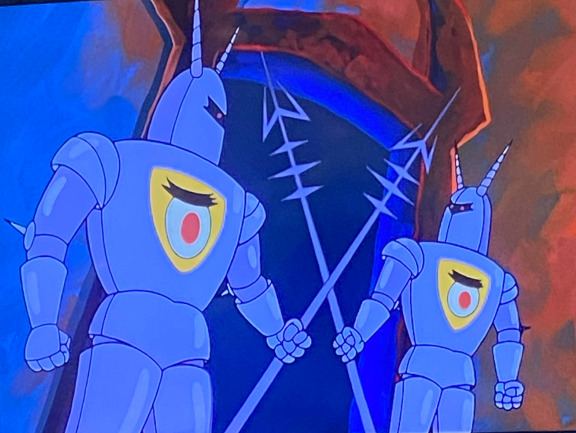
German armor of the period also resembles the armor worn by Planktonamor’s knights, with the spikes that protrude from the elbows. The helmet is particularly similar as well, with the face being nearly fully covered by metal. The armor extends over the full body, including the hands and legs. The outfit is even paired with a sword in both settings. Overall, this is the most fully protective armor seen in the cartoon. This armor is worn by Planktonamor’s guards, who protect the Evil Wizard’s palace. These characters require the most intense armor because they serve as the final protectors of the wizard’s home—the last line of defense for the powerful wizard, who has several enemies. The armor demonstrates the knights’ toughness and high capabilities. In neo-medievalism, darkness is often used to intimidate and create fear. Showing only red eyes surrounded by darkness in the helmet suggests mystery and feels ominous. The knights must be highly sophisticated because they wear their best armor, which covers their entire faces.
Through this research, it is clear that there are definite similarities to real-life medieval armor. According to Gregory, “‘neomedievalism’ is a repurposing of medieval imagery to represent contemporary values and problems and to engage contemporary audiences” (Gregory 2013: 135). This shows viewers that while digital medievalism—that is, neo-medievalism in modern digital media—may not be 100% accurate, it still provides some educational value about the medieval era.
This episode is important because the cartoon writers use familiar neo-medieval ideas and exaggeration to help convey the characters’ personalities. It is especially significant because SpongeBob SquarePants is a children’s cartoon, and for many kids, it serves as their first medieval experience. The characters’ armor could shape perceptions of medieval armor and its use by engaging a young audience. It was my first learning experience about the medieval period at five years old, in February 2006, when the episode first aired. According to Firriolo, “Dunces and Dragons” was one of the most highly rated episodes of SpongeBob SquarePants, drawing 8.56 million viewers, many of whom were presumably children (Firriolo 2024). It is also widely known that Burger King distributed toys featuring the episode’s characters with kids’ meals, and additional toy sets could be purchased separately. Many of these toys were physical representations of the characters in medieval armor. Through these toys, children could interact with the armor physically, creating a deeper connection between the cartoon characters’ roles and real-life medieval armor.
“Dunces & Dragons” demonstrates how neo-medieval content influences modern perceptions of the medieval period and offers a representation of this era to younger audiences at an impactful age. While there are factual elements, the episode also contains many fictional neo-medieval ideas because it was meant to be comical and entertaining. The episode shapes children’s ideas about medieval societies and armor, potentially imprinting neo-medieval ideas as historical facts. Even so, there is still some accurate history that can be learned by watching this episode.
Bibliography
Cartwright, Mark. "Medieval Heraldry." World History Encyclopedia, 22 May 2018, www.worldhistory.org/Medieval_Heraldry/.
Firriolo, Andrew. "To Celebrate the 25th Anniversary of SpongeBob SquarePants, I Ranked the 25 Greatest Episodes." BuzzFeed, 1 May 2024, www.buzzfeed.com/andrewfirriolo/top-25-spongebob-episodes.
Gregory, Rabia. "Citing the Medieval: Using Religion as World-Building Infrastructure in Fantasy MMORPGs." Playing with the Past: Digital Games and the Simulation of History, edited by Matthew Wilhelm Kapell and Andrew B. R. Elliott, Bloomsbury Academic, 2013, pp. 134–152.
Metropolitan Museum of Art. Fishing in the Sea. The Metropolitan Museum of Art, www.metmuseum.org/art/collection/search/25099.
Metropolitan Museum of Art. Leaf from the Ramayana of Rama and Sita. The Metropolitan Museum of Art, www.metmuseum.org/art/collection/search/21928.
Metropolitan Museum of Art. Armor. The Metropolitan Museum of Art, www.metmuseum.org/art/collection/search/23205.