
Final Fantasy 14 and Medieval Geography by Antonio Bienko
The video game series Final Fantasy, created by the game developer Square Enix, has a long history of adapting medieval ideas and aesthetics. One of the most prominent examples is its popular massively multiplayer online role-playing game (MMORPG), Final Fantasy XIV (FFXIV). FFXIV features an extensive setting whose world-building closely reflects the medieval world—more specifically, modern perceptions of it. The game draws heavily from the medieval period, not only in its aesthetic but also in the overall design of its world. For those beginning their journey in FFXIV, players are introduced to the world of Etheirys, a magical land that has endured numerous calamities.
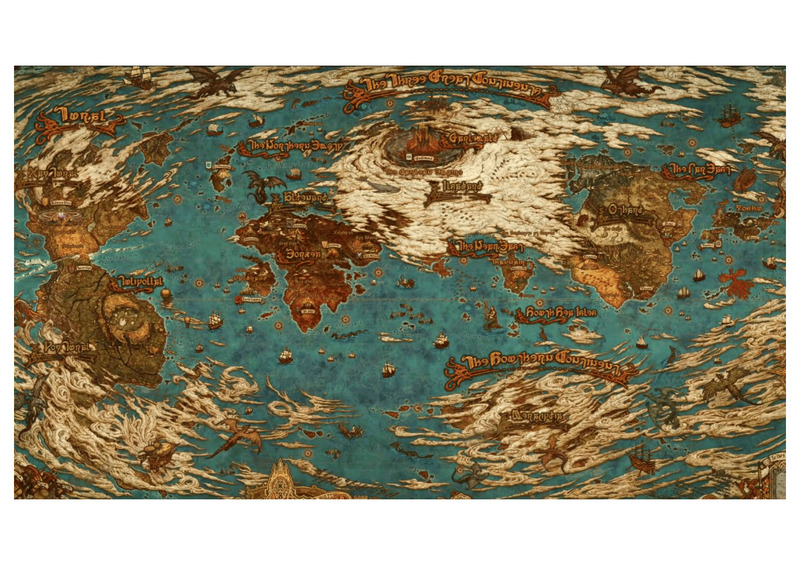
A closer look at the world map of Etheirys reveals strong parallels to the medieval mappa mundi, one of the most common map styles of the Middle Ages. The mappa mundi is typically based on a circular design that represents regions of medieval Europe, Asia, and Africa. Compared to modern maps, it lacks geographic accuracy, instead reflecting what people in the Middle Ages believed to be true about the world.
This resemblance highlights how FFXIV draws not from historically accurate cartography, but from the medieval perception of the world. By adopting a similar conceptual approach, the game reinforces a sense of myth, belief, and cultural worldview rather than scientific precision. In doing so, it uses medieval mapping traditions as a foundation for world-building, shaping how players understand space, culture, and history within Etheirys.
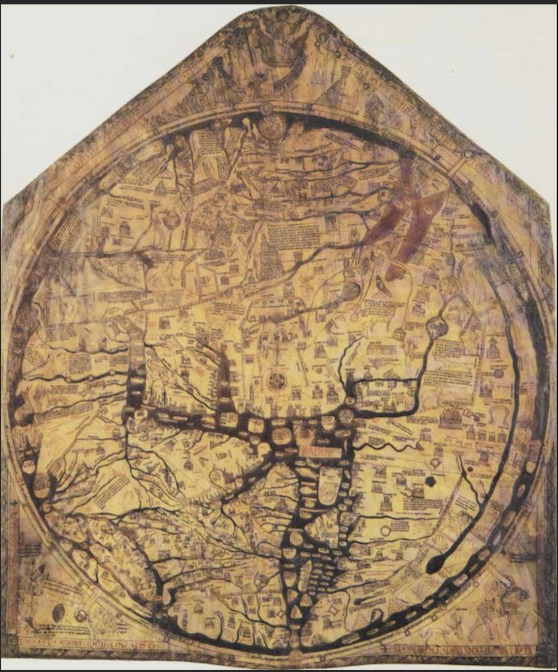
Harvey, Paul D A. Mappa Mundi: The Hereford World Map
The first major point of comparison is the inclusion of animals and illustrations across the map as a way to indicate what can be found in different regions. This type of marginalia serves as a visual guide, highlighting notable features or creatures associated with specific areas. Final Fantasy XIV incorporates this idea by depicting various creatures along the edges of its maps, such as dragons—figures that are both common in video games and closely associated with medieval-inspired aesthetics. Unexplored or lesser-traveled regions are often obscured by heavy cloud cover, limiting the viewer’s visibility and reinforcing a sense of the unknown. Finally, the map itself takes on a yellowed, parchment-like tint, a stylistic choice that echoes both historical manuscripts and a familiar visual trope in video games.
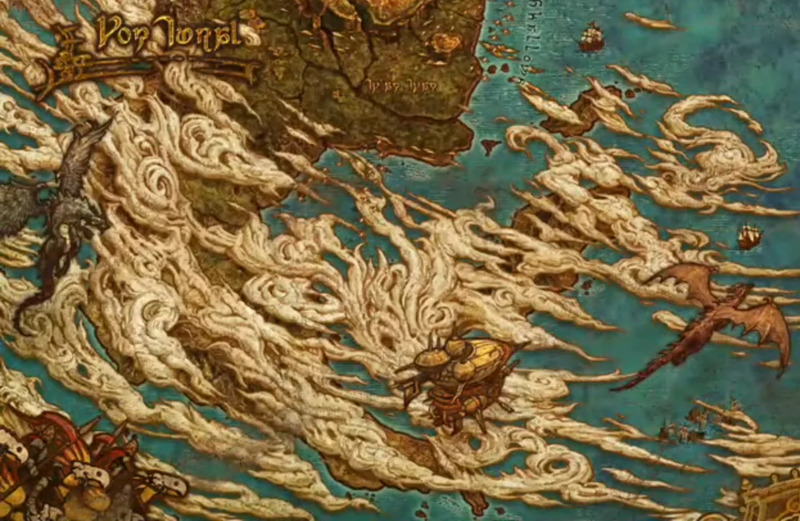
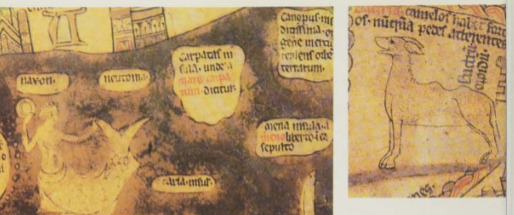
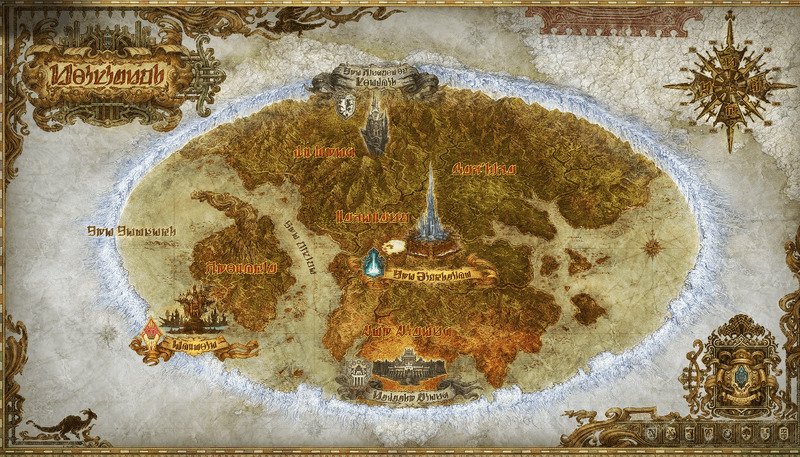
This figure presents another map from FFXIV, featuring the continent of Norvrandt, and once again it displays several aspects of medieval inspiration. The map highlights large structures to represent key locations and is arranged in a circular format around a centralized city, similar to how the medieval mappa mundi places Jerusalem at its center. Norvrandt is also separated from the main world of Etheirys, reflecting the game’s engagement with the concept of multiple realms. This idea appears in many games with medieval-inspired settings, such as Dungeons & Dragons and its system of multiple planes. The mappa mundi likewise reflects a belief in layered or divided worlds, further reinforcing the connection between these two mapping traditions.
Another distinctly medieval concept is the idea that the space beyond the map represents a separate or unknown realm. In FFXIV, this appears as the white, empty space surrounding Norvrandt, known as “the Empty.” Similarly, the outer border of the mappa mundi is often interpreted as the “House of God,” marking the boundary between the known world and the unknown divine.
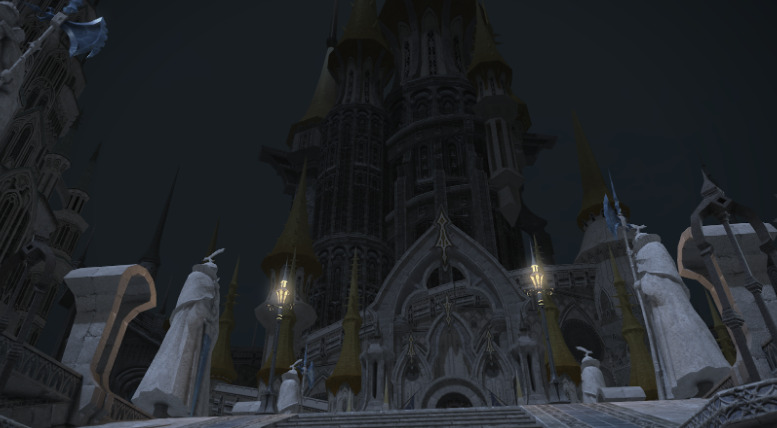
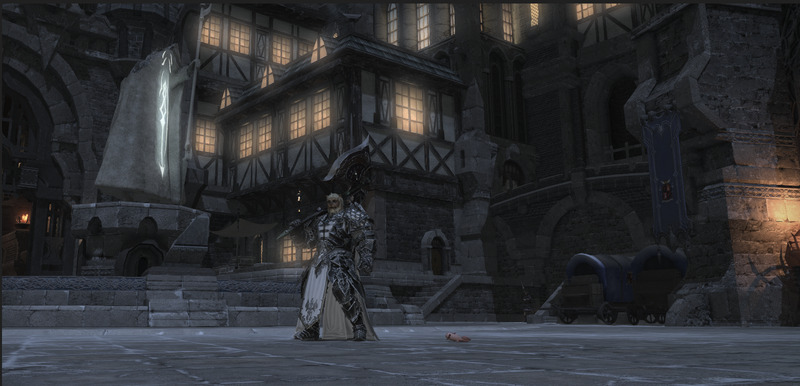
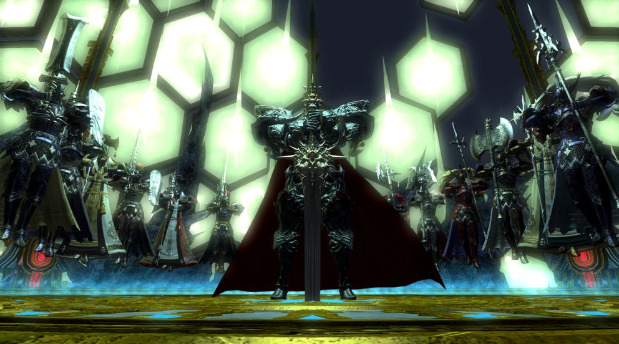
Taking a closer look at some of the nations featured in FFXIV we can see even more connections to medieval traditions. The cold northern nation of Coerthas is a religious state ruled by an archbishop and features dark, Gothic-inspired architecture, most prominently in its capital city, Ishgard. Large, towering cathedrals, heavy use of religious iconography, and a city governed by a theocratic system all reflect elements commonly associated with medieval Europe and Gothic aesthetics. To further reinforce this influence, Ishgard’s storytelling draws heavily from Arthurian legend. The archbishop takes on the role of King Thordan and is accompanied by his twelve Knights of the Round, directly paralleling King Arthur and his legendary knights. While Ishgard represents a more traditionally European interpretation of a medieval society, the game’s designers expand beyond this model. They also depict other regions using medieval themes as a foundation, incorporating influences from broader areas such as Eurasia to create a more diverse and expansive world. This shift demonstrates how FFXIV does not rely on a single vision of the medieval past, but instead reimagines multiple cultural interpretations, allowing each region to express its own identity while still remaining grounded in a shared medieval framework.
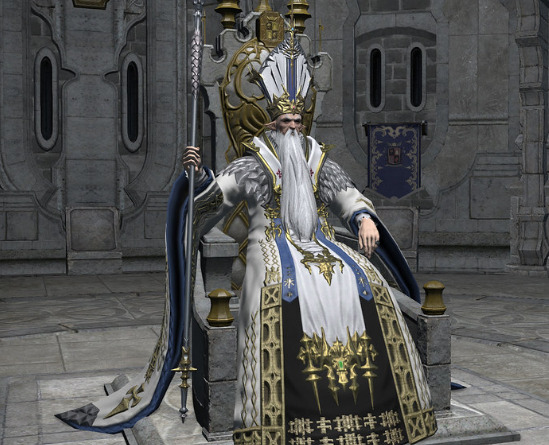
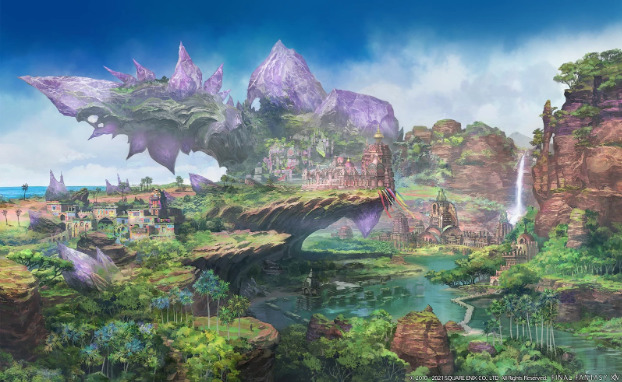
Thavnair is a nation located to the east of the game’s starting region. It draws heavily from Indian and Middle Eastern influences and is depicted as a thriving trade-based society with a strong emphasis on alchemy. Its primary city, Radz-at-Han, bears clear similarities to the historical city of Baghdad. Medieval Baghdad was well known as a center of learning and alchemical study. Many influential scholars originated there, including Jabir ibn Hayyan. As Samir S. Amr notes,
“He learned chemistry (alchemy), pharmacy, philosophy, astronomy, and medicine. He became the court alchemist during the reign of Caliph Haroun al-Rashid and was a physician working for his grand ministers (vizir), the Barmakids” (Amir 2007: 53–54).
Baghdad was also home to the House of Wisdom, a major center of intellectual activity before its destruction during the Mongol siege of 1258. This institution preserved and advanced early studies in alchemy, which later contributed to the development of modern chemistry. Scholars such as Jabir ibn Hayyan authored influential works, including Kitab al-Rahma al-Kabir (The Great Book of Mercy) and Kutub al-Mi’a wa al-Ithna ‘Ashara (One Hundred and Twelve Books). Similarly, FFXIV presents Thavnair as a hub of alchemical knowledge. As the game’s official lore describes, “The Great Work, a settlement in Thavnair, the birthplace of alchemy, [where] the practitioners of House Daemir are renowned for the craft of their concoctions” (see, the Final Fantasy Wiki entery for Thavnair 2026).
These parallels make it clear that Thavnair draws direct inspiration from the historical significance of medieval Baghdad. However, like the other regions within FFXIV , it does not attempt to replicate history exactly. Instead, it adapts key cultural and intellectual elements to construct a recognizable yet reimagined version of the medieval world. This pattern of selective adaptation across regions ultimately highlights how the game uses medieval history not as a strict blueprint, but as a flexible foundation for world-building—leading into a broader understanding of how medieval aesthetics are reshaped for modern audiences.
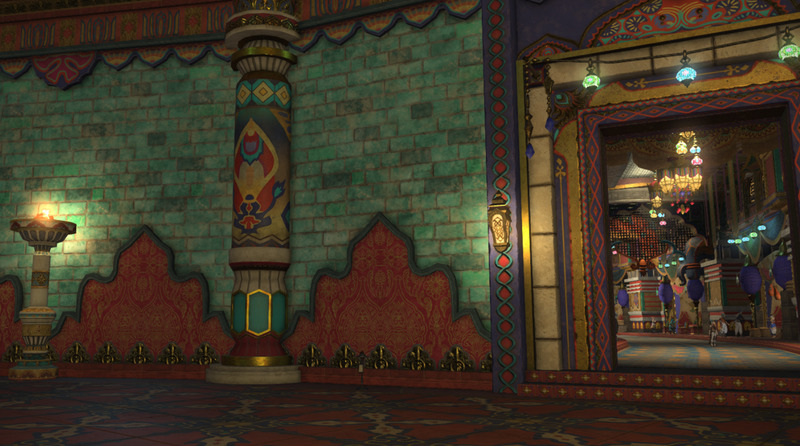
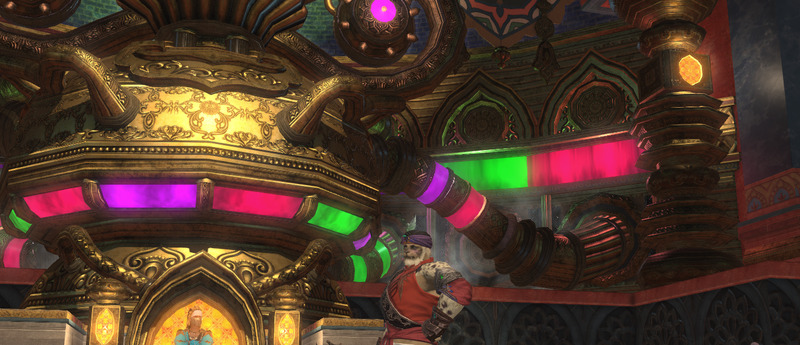
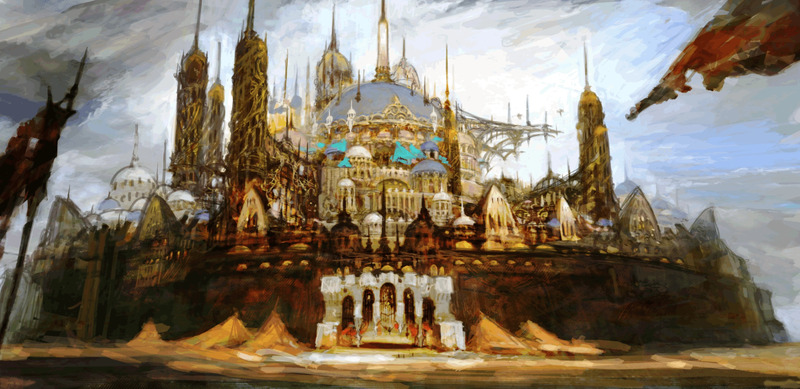
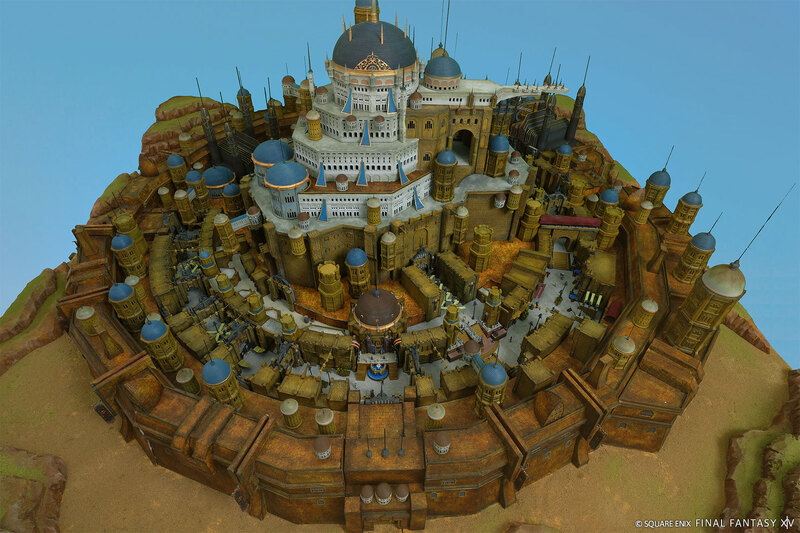
Ul’dah is perhaps even more representative of Baghdad, as the city is circular in form and situated within a desert environment. It is also a major center of trade, further reinforcing this connection. While Thavnair reflects Baghdad through its emphasis on alchemy and its abundance of natural and intellectual resources, Ul’dah mirrors the city’s more physical and structural characteristics. Historical descriptions of Baghdad, particularly those by al-Ya‘qubi, praise the design of the “Round City,” founded in 145/762 by Caliph al-Mansur: “In the centre of a huge esplanade, with no other buildings, rose a palace topped by an immense green dome” (Micheau 2008: 224). Similarly, Ul’dah features a prominent domed structure that rises above the rest of the city, echoing this defining architectural element. This comparison further demonstrates how FFXIV selectively draws from key features of medieval cities, adapting both their cultural significance and physical design. This pattern continues in the comparison between medieval Constantinople and the city of Sharlayan within the game.
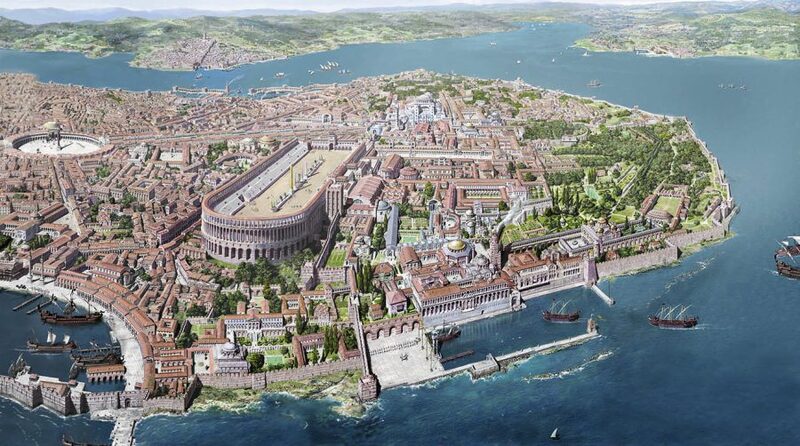
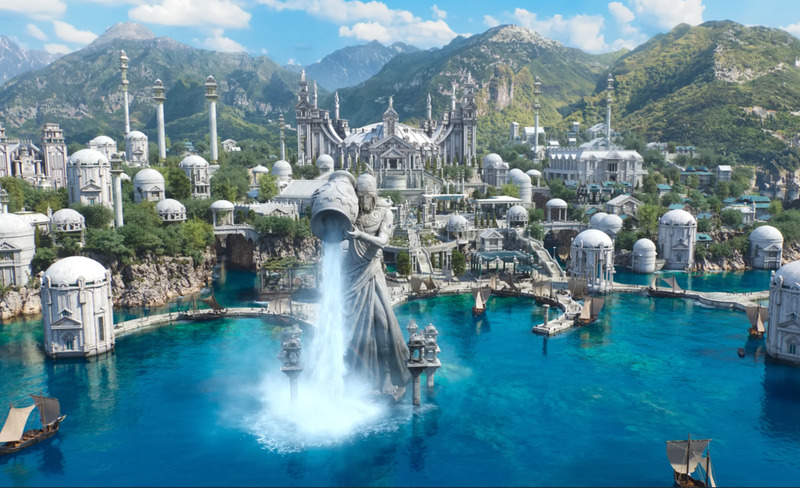
At first glance, several similarities emerge when comparing this illustration of Constantinople by Antoine Helbert to the depiction of Sharlayan. Although Helbert’s work is a modern interpretation, it helps visualize how an imperial city may have appeared during the Middle Ages. Like Constantinople, Sharlayan is portrayed as both a political center and a major seat of knowledge. A clear sense of Sharlayan’s identity can be drawn from an in-game description: “The Sharlayans were the keepers of wisdom both old and new. Their mastery over magic and aether was unsurpassed, and even the Garleans knew to fear them” (spoken by the character Minfilia Warde in Final Fantasy XIV).
Similarly, Byzantium was known for its comparatively advanced systems of higher education during the medieval period. As Constantinides notes, “Among the first acts of Michael VIII for the restoration of the old prestige of the capital was the re-establishment of an institution for higher education, and George Akropolites became its head” (1982: 32). Constantinople functioned as a major intellectual center in the Middle Ages, much like Sharlayan, which is home to the Studium. As described in the Encyclopaedia Eorzea, “True to its reputation as the cradle of knowledge, Sharlayan is home to numerous private study halls and schooling facilities, but it is the prestigious Studium which represents its foremost institution of learning” ( from the Encyclopaedia Eorzea v.3, 2023: 124). Like the Studium, Byzantine institutions of higher learning were accessible to those seeking education. Constantinides further explains, “Access to this school was given to those who wished to obtain a higher education, and it is reported that a large number of students attended Akropolites’ classes. This undoubtedly reflects the great enthusiasm of the Byzantines for higher education as soon as it was available” (1982: 32). Sharlayan’s Roman-inspired architecture and its cultural emphasis on knowledge make it a compelling parallel to medieval Byzantium.
Through examining both the maps featured in the game and its various city-states, it becomes clear how strongly the designers of Final Fantasy XIV draw from medieval geography and cultural structures. As the game continues to expand, it is likely that future updates will further adapt and reinterpret medieval regions through a modern lens. Ultimately, Final Fantasy XIV is just one example of how contemporary video games continue to draw inspiration from the Middle Ages, ensuring that medieval landscapes persist in digital form for years to come.
Bibliography
Amir, S. 2007. “Arab and Muslim Physicians and Scholars” Annals of Saudi Medicine Volume 27.1.
Constantinides, C. N. 1982. Higher Education in Byzantium in the Thirteenth and Early Fourteenth Centuries, 1204-ca.1310. Nicosia: Cyprus Research Centre.
“Final Fantasy Wiki.” Finalfantasy.fandom.com, finalfantasy.fandom.com/wiki/Final_Fantasy_Wiki.
Salma K. J., et al. 2008. The City in the Islamic World. Leiden: Brill.
Square Enix . Encyclopaedia Eorzea Vol. 3. 2023.