
The Architecture of Minas Tirith in the Medieval By Ashlyn Hodel
Throughout history, creators have drawn inspiration from earlier time periods. Whether in architecture, artwork, or digital media, many creations reflect elements of the past. One such example is Minas Tirith from The Lord of the Rings. Through its layered defenses, architectural details, and symbolic design, it demonstrates how J.R.R. Tolkien—and later filmmakers—drew inspiration from the medieval world.
Gondor rises to a peak of power, almost reflecting Númenor, and then fades slowly to a decayed Middle Age, a kind of proud, venerable, but increasingly impotent Byzantium
In Letter 131, written to explain his work to a friend, Tolkien states, “Gondor rises to a peak of power, almost reflecting Númenor, and then fades slowly to a decayed Middle Age, a kind of proud, venerable, but increasingly impotent Byzantium” (Carpenter 1981: 157). Here, Tolkien directly compares Gondor to Byzantium, suggesting that he viewed its rise and decline as mirroring the historical trajectory of Constantinople. This comparison highlights how the history of Minas Tirith reflects broader patterns of rise and fall throughout Middle-earth. In addition to these historical parallels, its influence is also evident in the city’s symbolic design.
Minas Tirith, first seen in The Fellowship of the Ring, is a towering city of white stone built across seven tiers. It is fortified with multiple defensive walls and crowned with numerous towering structures, culminating in the Hall of Kings at its summit. The city faces the land of Mordor—also known as the “Land of Shadow”—which serves as the stronghold of the Dark Lord Sauron.
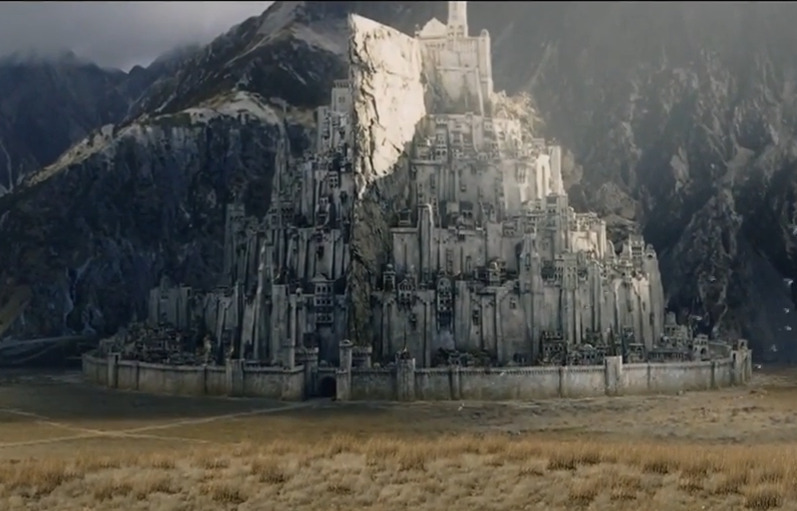
Minas Tirith strongly reflects elements of medieval Gothic architecture. The city is portrayed as a place of light, standing as a protector of Middle-earth against the darkness of Mordor. Its name, Minas Tirith, directly translates to “Tower of Guard” (Tolkiengateway.net 2025). While the city maintains a sense of beauty and light, it does not lose its strength or authority.
The influence of the High Gothic style can be seen in the city’s elevated structure, its many arches, and its intricate stonework. Although Gothic architecture is often associated with darkness today, its original purpose was to bring light into buildings (Ralls 2016). Similarly, Minas Tirith features numerous windows that allow light to fill the city. In a world without electricity, this architectural approach would have been essential in creating a bright and livable environment.
The citadel at the top of Minas Tirith closely resembles a cathedral. Towering at the highest point, it reaches toward the sky, echoing the vertical emphasis of medieval cathedrals, which were designed to feel as though they were being “lifted up.” In addition to creating this airy, spiritual effect, the citadel also represents a center of power. In the medieval period, structures were often built in harmony with the surrounding landscape to enhance their authority. Positioned at a high elevation, the citadel allows it to be seen by the people below while also providing a strategic vantage point over the surrounding lands.
Along with the symbolism of the gothic architecture, Minas Tirith also has many physical features that connect it to medieval architecture. Minas Tirith has these massive, layered walls that help slow the attack of the Orcs during the movie Return of the King. The walls of Minas Tirith can be connected to Constantinople’s land walls. The land walls were made of stone and there were many different layers, with each wall higher than the last. The first layer was the low outer wall to slow attackers. After that came the middle wall and lastly the inner wall. These walls were used to protect Constantinople from enemies (Ousterhout, 2019: 144-147). Like Constantinople, Minas Tirith has many different walls that create many layers of the city, and each wall stands higher than the last. Along with the connections to Constantinople, there are also connections to medieval castles.
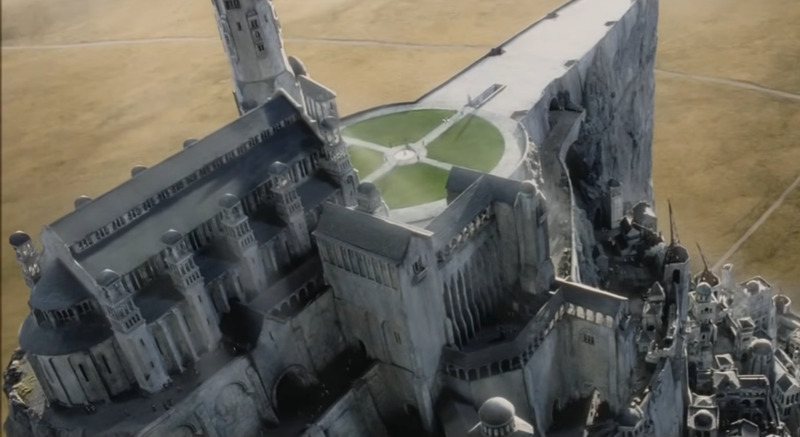
At the very top of Minas Tirith is the Hall of Kings. The Hall of Kings has many features that show the influence of medieval architecture. During the medieval period, the churches were very influenced by the Roman basilica. The medieval basilica was a big building for communal gatherings. There were many rows and an aps at the end, and the nave lit by clerestory windows on the upper walls (Ousterhout, 2019: 11-17). The building of the Hall of Kings resembles a basilica very closely. At the end of the building, you can see the round aps. Along with the double roofed design and the clerestory windows. In the medieval basilica, the altar would sit in the aps, and the rows would be where the people gathered would reside. Inside the Hall of Kings, like the church basilicas, the throne for the king to sit on resides in the aps. These features are clearly drawn from the medieval basilica.
At the very top of Minas Tirith stands the Hall of Kings. This structure features many elements that reflect the influence of medieval architecture. During the medieval period, churches were heavily influenced by the Roman basilica, a large building designed for communal gatherings. Basilicas typically included rows of columns, an apse at one end, and a nave lit by clerestory windows along the upper walls (Ousterhout 2019: 11–17).
The Hall of Kings closely resembles this architectural form. At the end of the building, a rounded apse is visible, along with a double-roofed design and clerestory windows that allow light to enter from above. In medieval basilicas, the altar was placed within the apse, while the nave provided space for congregants. Similarly, in the Hall of Kings, the throne is positioned within the apse, reinforcing its role as the focal point of authority.
Although The Lord of the Rings is a work of fantasy, Minas Tirith is not simply an imagined city, but one shaped by real historical influences. Its defensive walls echo those of Constantinople, while its basilica-like features and Gothic-inspired design reveal clear connections to medieval architectural styles. By drawing on these elements, J.R.R. Tolkien—and later filmmakers—created not just a fantasy setting, but a city grounded in historical representation. This incorporation of realism into fantasy worlds enhances their depth, making them feel more meaningful and authentic to audiences.
Bibliography
Ousterhout, R. G. (2019). Eastern medieval architecture : the building traditions of Byzantium and neighboring lands. Oxford University Press.
Carpenter, Humphrey, and Christopher Tolkien. The Letters of J. R. R. Tolkien. Houghton Mifflin Company, 1981.
Swallow, R (2014). Gateways to Power: The Castles of Ranulf III of Chester and Llywelyn the Great of Gwynedd, Archaeological Journal, 171:1, 289-311, DOI: 10.1080/00665983.2014.11078268
“Minas Tirith.” Tolkien Gateway, 16 Nov. 2025, tolkiengateway.net/wiki/Minas_Tirith.
Ralls, K. (2016). Gothic cathedrals : a guide to the history, places, art, and symbolism. Ibis Press.