
The Medieval Influence on Tarot's Creation by Jaime Williams
From Playing Cards To Tarot Cards
Most people have played a card game at least once in their lives, whether it be Go Fish, Solitaire, Crazy Eights, Spades, or others. Many have also heard of tarot, an esoteric form of divination that is sometimes regarded as a party trick. What most people do not realize, however, is that tarot developed from playing cards and dates back centuries.
In fact, playing cards originated in ninth-century China during the Tang Dynasty. From there, they spread throughout Asia and eventually reached North Africa. Over time, these cards were adapted into what later became Mamluk cards, which arrived in Europe in the 1300s (“Trzes’ Mamluk Deck”). During this period, Islamic forces entered regions such as Northern Italy, Sicily, and Spain, and the Italians adapted these cards into their own games. One such game became Carte de Trionfi (Cards of Triumph), which evolved to incorporate medieval Christian themes as well as imagery reflecting everyday life.
Another Italian development was a game called tarocchi, in which cards were randomly laid out and stories (sortes, or destinies) were created based on the cards drawn. This practice gradually developed into a form of divination, with one of the earliest essays on the subject published in the 1540s by Marcolino in Le Sorte. Over the following centuries, tarot decks became more standardized in terms of number and structure, although their names and imagery continued to evolve.
Today, tarot has become a sensationalized commodity in the modern 21st-century world. It is now possible to visit a local museum and purchase a tarot deck or guidebook from the gift shop, or to encounter tarot readers on social media platforms. One particularly popular medium for tarot-inspired content is video games, a globally enjoyed hobby. Tarot allows individuals to engage with an art form that exists outside of their daily lives while exploring different systems of knowledge—much like video games do. Ultimately, the digitization of this historical and esoteric practice is a logical development, reflecting a broader and ongoing search for meaning and guidance.
The Mamluk Empire and Playing Cards
The Mamluk Empire ruled Syria and Egypt for much of the medieval period, roughly between 1250 and 1517. This system first appeared in the Abbasid Caliphate in the 800s and continued even after the Ottomans overthrew the Mamluks in the 1500s. The term mamluk means “owned” in Arabic, referring to soldiers who were enslaved and brought in from outside sources, as there was no hereditary claim to their positions. These armies mainly consisted of boys around 13 years of age—often Circassians from the Caucasus or others from regions north of the Persian Empire. This elite force served the personal needs of sultans (high-ranking rulers), enforcing their authority and even being sold to regional Islamic governments. The Mamluks remained an influential group within Egyptian Islamic society until the 19th century (Waterson, 2018).
There were two distinct eras in Mamluk history: the Bahri period (1250–1381) and the Burji period (1382–1517). Islamic society operated under a feudal-like hierarchy, with the sultan at the top and subordinate lords supporting him through loyalty and service. In thirteenth-century military society, high-ranking lords, or amirs, maintained their own mamluks, while the sultan controlled the largest number. Succession was often determined through power struggles, with candidates relying on their power bases, consisting of armed men and loyal client lords (Waterson, 2018).
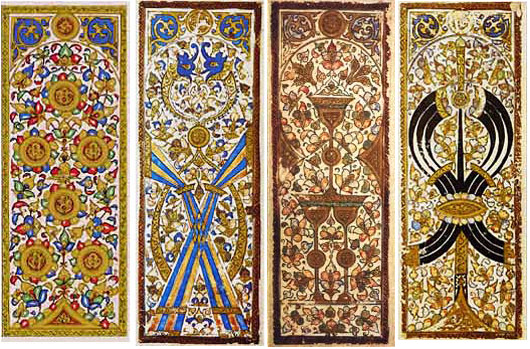
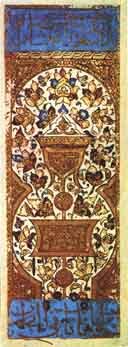
Mamluk playing cards included both suit cards and court cards, corresponding to numbered and persona cards, respectively. The suits were Coins, Polo Sticks, Swords, and Cups. Each of the four suits contained three court cards, forming a 52-card deck. Inscriptions appeared at the top and bottom of the cards, often accompanied by translations. These inscriptions typically encouraged the player and implied a high value for the card.
Interestingly, the numeric cards with upper inscriptions were ranked above the court cards. Card values did not follow modern expectations of increasing order; in some cases, cards numbered 1–10 could rank differently depending on the suit. For example, Coins (darāhim) and Polo Sticks (jawkan) decreased in value from one to ten, while Swords (suyūf) increased in value across the same range. The Polo Sticks suit also displayed variation in its symbols between cards 1–3 and 4–10. The Cups suit (tūmān), a non-Arabic term of Persian and/or Turkish origin meaning “10,000” or “myriad,” signified high value and notably lacked upper inscriptions (Dummett and Abu-Deeb 1973).
Court Phrases:
Malik (ملك) = King
Na’ibn malik (نائب مالك) = Governor / Deputy of King
Na’ibn thani = (نائب ثاني) = Second Governor / Second Deputy of King
Ahad al arkan malik (أحد أركان ملك ) = “one of the pillars of the king” / Helper (higher than governor cards per Mayer, seen as separate card but is overall another type of King card)

Arabic Vocab:
 أحد - Ahad = one/single/unique
 أركان - Arkan = pillars/foundations/cornerstones
 ملك - Malik = king/sovereign/owner
 نائب - Na’ibn = deputy/second-in-command/assistant
Words that refer to Allah: Al-Ahad & Al-Mali
The Westernization of Playing Cards
In 1370, Mamluk playing cards entered Italy and Spain through trade ports, where their Arabic designs were gradually adapted into European styles (Tarot Heritage 2019). The original suits evolved into swords, batons, cups, and coins, while the court cards were transformed into medieval figures: King, Queen, Knight, and Valet/Page (Tarot Heritage 2012). Initially known as Saracen or Moorish cards (naibi, naip, naipes), the 52-card Mamluk deck later expanded with the addition of 22 trump cards, known as the Arcana (Bostock 2025).
There was also the introduction of four Queen cards, though their precise origin and function remain unclear (Mealin 2025). Over time, these additions standardized the deck to 78 cards. In Italy, these decks became known as carte da trionfi. Between 1371 and the 1460s, references to playing cards appeared frequently in city ordinances, account books, and inventories across Italy, Spain, France, Germany, and Belgium (Tarot Heritage 2012).
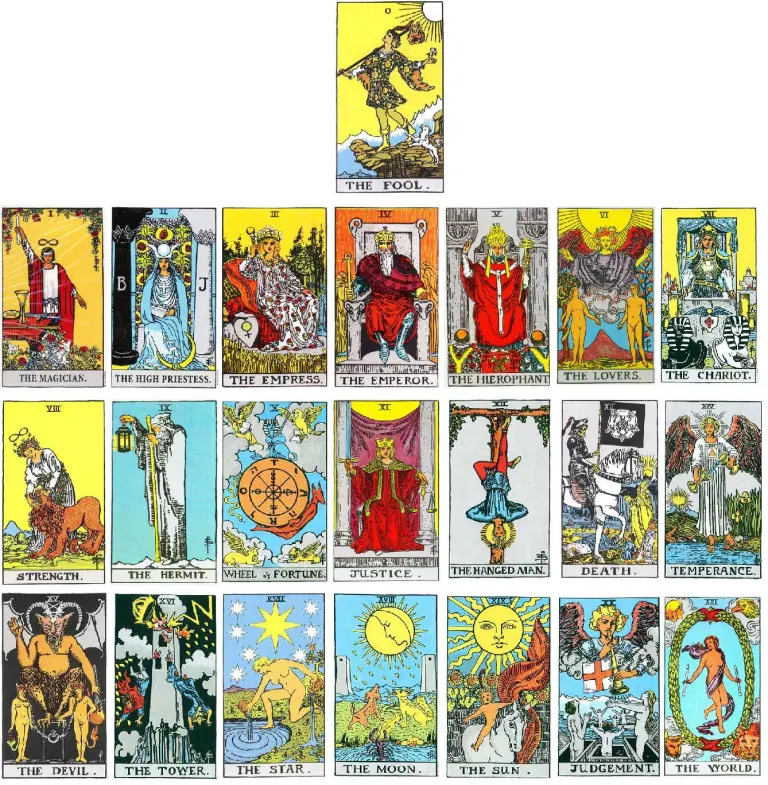
The Major Arcana are numbered 0-21, listed as:
0: The Fool               11: Justice
1: The Magician           12: The Hanged Man
2: The High Priestess     13: Death
3: The Empress            14: Temperance
4: The Emperor            15: The Devil
5: The Hierophant         16: The Tower
6: The Lovers             17: Star
7: The Chariot            18: The Moon
8: Strength               19: The Sun
9: The Hermit             20: Judgement
10: Wheel of Fortune      21: The World
Visconti-Sforza Deck
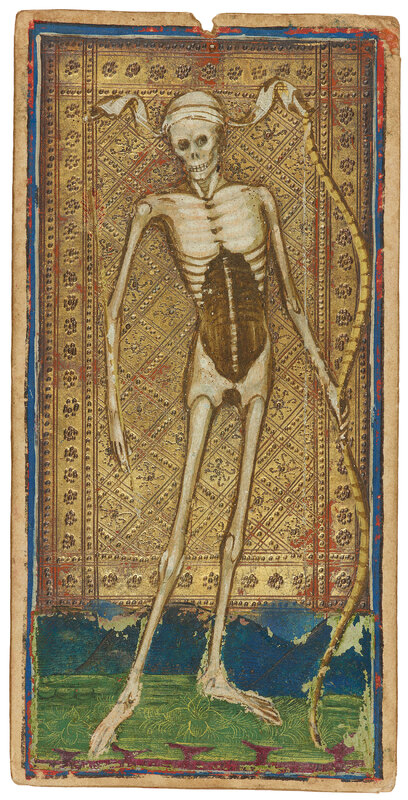
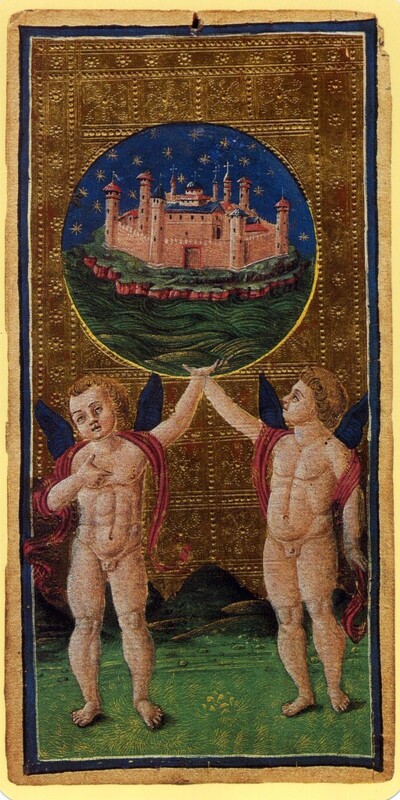
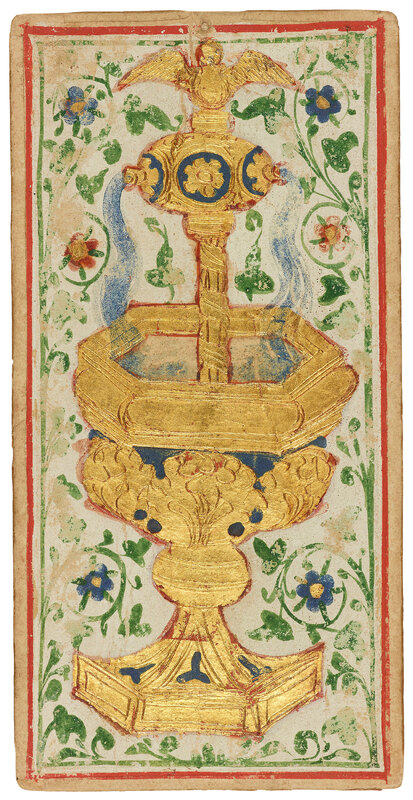
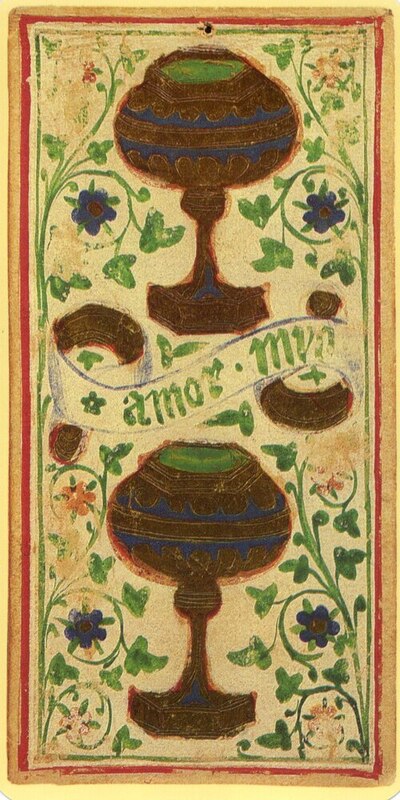
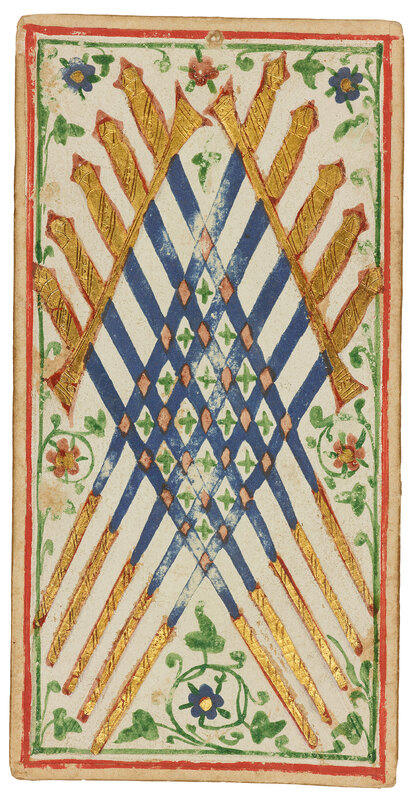
Around 1450, Bonifacio Bembo created the Visconti-Sforza tarot deck after Francesco Sforza requested either carte da trionfi (trump cards) or, if unavailable, carte da giocare (playing cards) (Tarot Heritage 2012). This request highlights the continued connection between playing cards and tarot. Sforza’s letter also suggests that a standard trionfi deck already existed and was widely accessible. During the Renaissance, trionfi cards were highly popular, reflecting a cultural period characterized by the interplay between the mundane and the arcane, the divine and the mortal, and science and religion.
As time progressed, the term trionfi shifted to refer to another game played with standard playing cards. During the 1500s, tarocchi appropriati became a popular parlor game in which players improvised humorous poems based on tarot cards to describe the cardholder (Tarot Heritage 2012). Notably, the game was not condemned by the Church but rather regarded as entertainment.
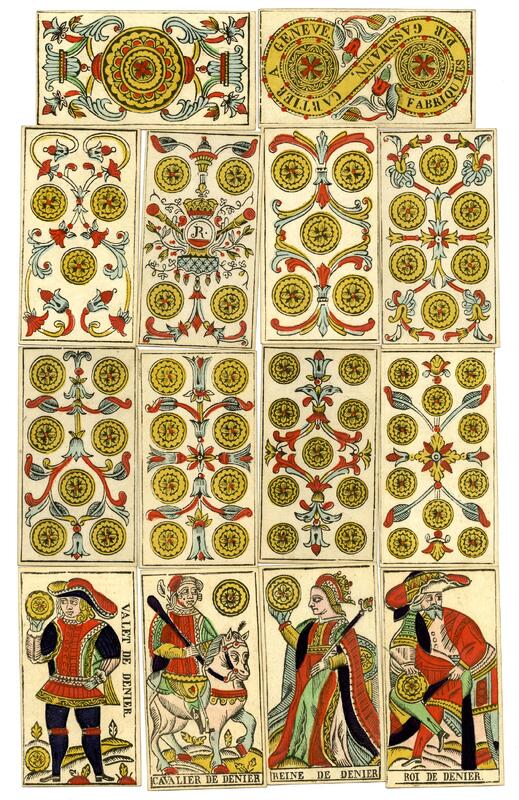
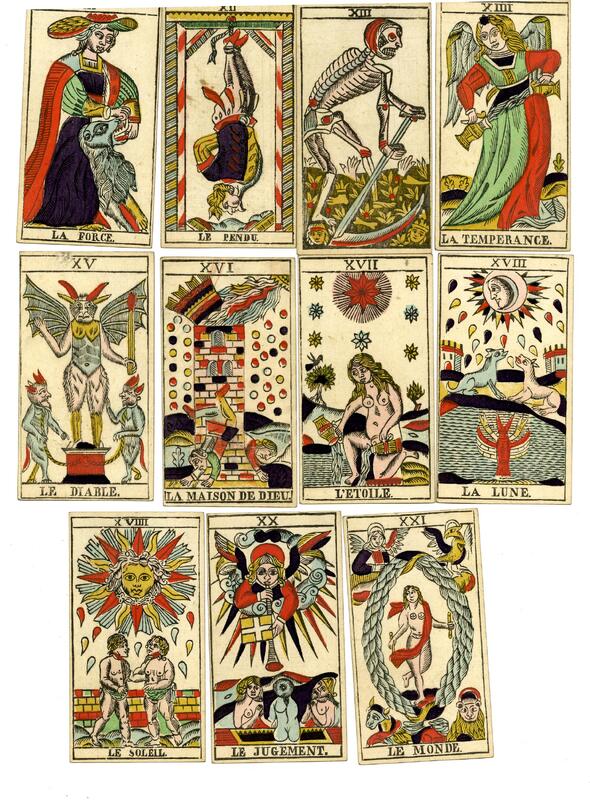
By the early 1600s, tarot had spread to France, where the Tarot de Marseille was developed. Its suits—batons, swords, cups, and coins—retained similarities to earlier Arabic designs, including curved swords and floral motifs. However, decks were now printed rather than hand-painted, leading to changes in artistic detail. By the 1700s, the Major Arcana had become standardized with established meanings, and tarot was increasingly used as a divination tool (Roberts 2018).
Tarot de Marseilles
Ettellia Deck
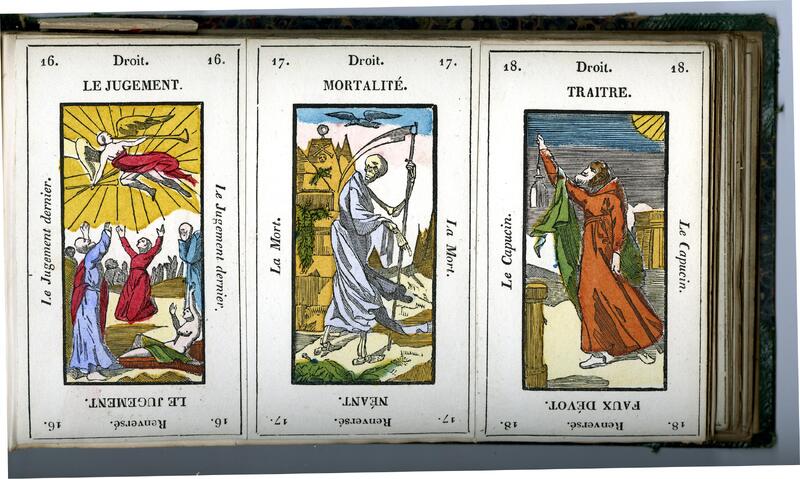
Various occultists later wrote about tarot and its origins, sometimes inaccurately linking it to ancient Egyptian practices (Tarot Heritage 2012). Many were particularly interested in figures such as Isis and Thoth, the latter associated with writing and later identified with the Greco-Roman god Hermes (Mercury) (Battistini 2007: 138). Mercury was often regarded as the patron of alchemy and occult sciences (Battistini, 2007: 279). The Etteilla deck reflects some of these influences. Notable occultists who contributed to tarot’s development include Eliphas Lévi, Paul Christian, S. L. Mathers, Ely Star, A. E. Waite, and Aleister Crowley (Tarot Heritage 2012; Roberts 2018).
20th & 21st Century Manifestation
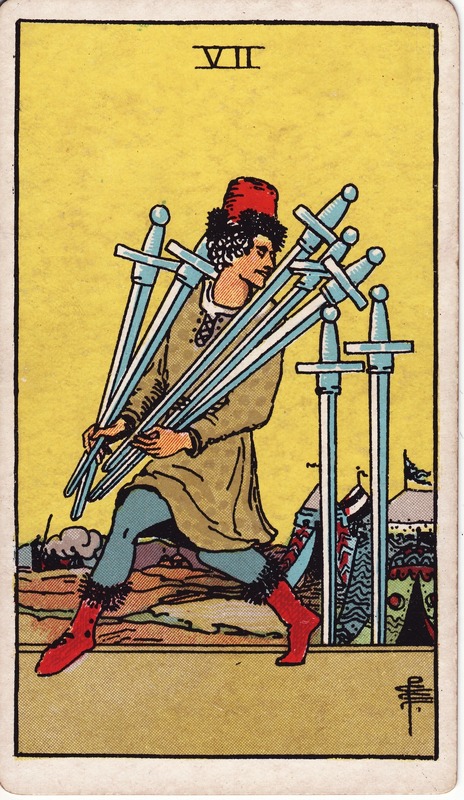
When people think of tarot today, they often imagine the 78-card Rider–Waite–Smith deck, created in 1909 by A. E. Waite and illustrated by Pamela Colman Smith. This deck was designed according to the teachings of the Hermetic Order of the Golden Dawn, a secret society within the Western esoteric tradition. Smith introduced allegorical imagery with Christian influences not seen in earlier decks. For example, the Papess became the High Priestess, and the Lovers card shifted from depicting a medieval couple to an Adam-and-Eve-inspired scene (Kaplan 2018: 74–76).
Aleister Crowley’s Book of Thoth was another influential 20th-century esoteric text, serving as a guide to his Thoth deck and broader system of Western magic (Battistini 2007: 216). Since then, hundreds of tarot variations have emerged, including digital adaptations in media and video games. The digital revolution allowed for different interpretations and interactions with tarot to arise.
Rider-Waite Deck
Tarot Cards in Video Games
The Cosmic Wheel Sisterhood

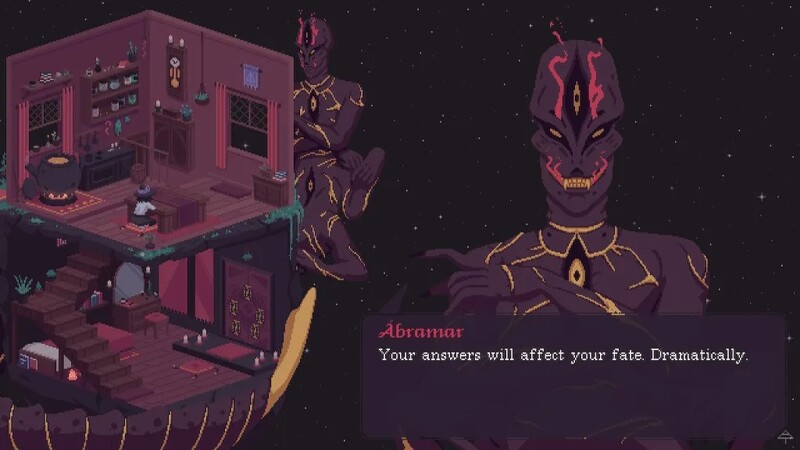
A modern example is The Cosmic Wheel Sisterhood, a tarot-themed video game created by the developers of The Red Strings Club. The game follows a witch named Fortuna, who is exiled by her coven to an asteroid for a thousand years without her tarot deck (Bookstacker 2023). Two hundred years into her sentence, she makes a pact with a being named Ábramar to change her fate (Hawes 2023). This grants her new powers and allows her to reconnect with her coven. The core gameplay involves creating a personalized tarot deck using elements such as fire, water, air, earth, and void. Players construct cards by combining backgrounds, symbols, figures, and Arcana, with each element carrying distinct meanings and gameplay effects (Hawes, 2023). Tarot readings guide interactions with other characters, influencing outcomes and generating resources for further card creation. Main themes within the game focus on identity, mental health, loneliness within isolation, the need of community, personal responsibility, as well as the overall absurdity of life.
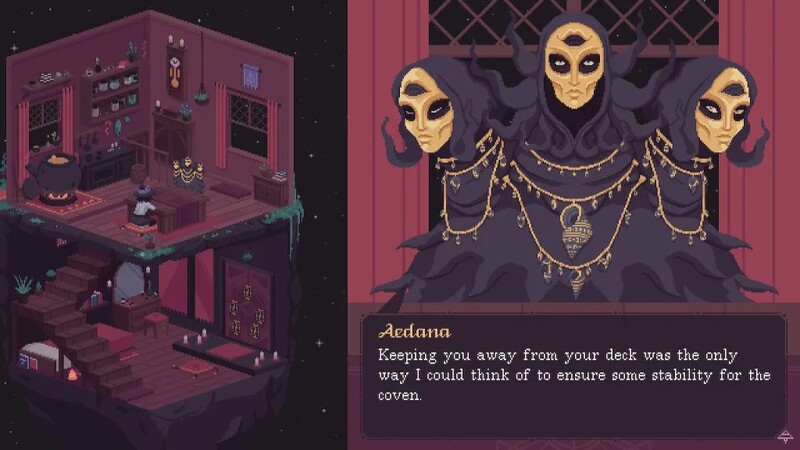
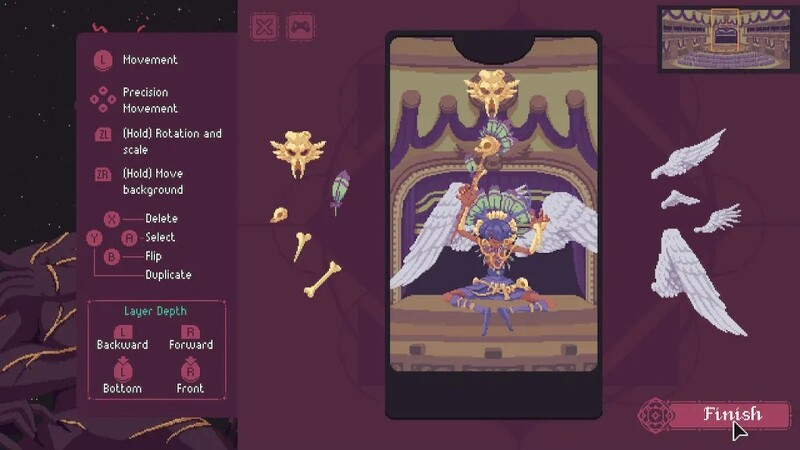
Despite being created in 2023, the Cosmic Wheel of Sisterhood embraces a more hand-crafted 90s pixelated representation, with a split-screen of a 3-D replica of Fortuna’s space and her point-of-view. It’s like we’re both observing her and being her, an echo of the transitional space within magic. The first digital tarot games were developed in the 1980s, mainly as puzzle or virtual fortune-telling applications. The Cosmic Wheel of Sisterhood echoes this with a higher rate of character interactions. This game features a separate secret space, literally in outer space, for the divination, reminiscent of the medieval alchemical fortresses which were a conduit of the divine and the immortal soul (Battistini 2007: 340).
Overall Significance
The evolution of tarot, a paper card game, turning into an entirely digital format is logical as the principal aspect of the game: providing an opportunity for community in an ever-changing world. From the King and his Governors to the Fool and the Tower, all the way to Fortuna and Abramar. The Medieval world and the modern 21st-Century both have been impacted by new technologies and mindsets unprecedented in time. The Enlightenment brewing during the Medieval era mirrors the Hyper-Digital Age currently brewing now in the early 21st Century. The current generation may not know about the Mamluk Empire or the Hermetic Order of the Golden Dawn, but they can learn about tarot through a video game such as The Cosmic Wheel of Sisterhood, echoing the Medieval period almost 700+ years later. The search for self-actualization is a perpetual internal journey inherent to human-life, with tarot offering a measure of solace and freedom during this process.
Tarot’s Timeline Up to The 21st-Century
- 800s - Playing cards a Chinese invention that made its way down the Silk Road to Persia, India, and then into the Arab world
-
1300s - card playing reaches Mamluk Sultanate
- Suit Cards: Ace-10
- Court Cards: 4
-
1370 - Mamluk playing cards enter Italy and Spain through ports. The Arabic design is Europeanized
- Suit Cards: swords, batons, cups, and coins
- Court Cards: King, Queen, Knight, Valet
- 1371 Spain – First written reference to playing cards in Europe, referred to as naip.
- 1377 – 1460s. Numerous written references to playing cards in Italy, France, Germany, Belgium: in city ordinances against gambling, account books of aristocrats, inventories of merchants. Initially referred to as Saracen or Moorish cards (naibi, nahipi, naips, naibbi). Later in Italy tarot decks were called carte da trionfi.
- 1450. Visconti Sforza deck created for the Visconti and Sforza dukes of Milan by Bonifacio Bembo.
-
1500s. The old name trionfi shifts to another game played with a regular pack of cards.
- Tarocchi appropriati is a popular parlor game where humorous poems based on a tarot card are invented on the spot to describe the person holding the card.
- 1600s. Italian tarot reaches France and eventually the Tarot de Mairseille is created.
- Early 1700s. Chosson style decks produced by Madenie of Dijon, Payen of Avignon, Heri of Switzerland and others.
- 1730-1830. The height of popularity for Tarot games, with the rules and decks standardized.
- Late 1700s. The Grandpretre deck refers to the Pope and Papesse as the High Priestess and High Priest respectively.
- 1856-1861. Parisian Eliphase Levi publishes Dogma and Ritual of Transcendental Magic, a grand thesis of western magical tradition that gives Tarot an important place. Englishman Kenneth Mackenzie visits Levi and is inspired to create the Cypher Manuscript and Book T, both basis for the Hermetic Order of the Golden Dawn teachings.
- 1863. In Paris, Paul Christian publishes Red Man of the Tuileries, a novel that describes Egyptian Tarot cards and uses the term Arcana for the first time.
- 1888. In London, William Westcott and S. L. Mathers launched the Hermetic Order of the Golden Dawn after obtaining MacKenzie’s papers (Cypher Manuscript and Book T). S. L. Mathers also publishes The Tarot: Its Occult Signification, Use in Fortune Telling, and Method of Play. In France, Ely Star publishes an astrology book using Paul Christian’s teachings on Tarot and his card names, which influenced Egyptian decks. His use of the term Major and Minor Arcana was adopted by Papus.
- 1896. The Falconnier-Wegener cards are published. They are the first truly Egyptian deck based on Paul Christian’s descriptions of 1870.
- 1909. A. E. Waite publishes the Rider Waite deck and the accompanying book the Pictorial Key to Tarot. These become the bedrock of Anglo-American tarot. Aleister Crowley then publishes Liber 777 which divulges all the Golden Dawn’s rituals and teachings. This demystifies secret societies and democratizes esoteric teachings.
- 1910. Tarot of the Bohemians by Papus (1889) translated into English. One of the most important books on French esoteric Tarot.
- 1912. Aleister Crowley publishes the Golden Dawn’s Book T which contains their Tarot teachings in his magazine The Equinox.
- 1917. The first American tarot book. Hariette & F. Homer Curtiss published The Key to the Universe or a Spiritual Interpretation of Numbers and Symbols, a book on esoteric tarot illustrated with the Rider Waite Smith, Egyptian, Tarot de Marseilles and Wirth decks.
- 1917. In the USA, DeLaurence Company pirates the Rider Waite deck and Waite’s book The Pictorial Key to Tarot.
- 1918. In the USA, C.Z. Zain publishes instructional courses for his Church of Light which contain the first English translations of Paul Christian’s teachings. He uses the Falconnier-Wegener Egyptian card designs for his deck.
- 1920. In the USA, Paul Foster Case founded B.O.T.A. whose teachings draw heavily on the Golden Dawn.
- 1926. In Paris, Oswald Wirth’s book Le Tarot des Imagiers du Moyen Age was republished.
- 1927. In London, Dion Fortune establishes the Society of Inner Light and begins her teaching and writing career.
- 1929. In the USA, J. Augustus Knapp and Manly Palmer Hall create what came to be known as the Knapp-Hall Tarot published in 1978 which combines Wirth and Egyptian imagery.
- 1930. In Paris, Paul Marteau, owner of Grimaud publishing house, produces a re-colored Converted TdM which is currently the standard divination deck in France.
- 1931. In Istanbul, Forty-three cards from the Mamluk card deck, named Mulūk wa-nuwwāb (kings and deputies), were discovered.
- 1938-1942. London. Frieda Harris creates the original oil paintings for Aleister Crowley’s Thoth deck.
- 1942. In London, Original paintings by Frieda Harris for Crowley’s Thoth deck are exhibited in a gallery.
- 1951. In Britain, The Witchcraft Act is repealed allowing Tarot decks to be printed and sold freely.
- 1959. In the USA, University Books began printing the Rider Waite Smith deck and the Pictorial Key to Tarot giving it widespread distribution.
- 1974. New Tarot by Hurley & Horler is one of the first radically redesigned decks that breaks with Rider Waite imagery. They worked on it from 1961-67 while living part time at Esalen in Big Sur, California.
- 1975. Mountain Dream Tarot by Bea Nettles. The first deck that’s based on photographs.
- 1976. Womanspirit Circle in Santa Cruz, CA is the birthplace of several feminist decks which appeared in the late 70s such as A New Woman’s Tarot and the Amazon Tarot.
- 1984. Mary Greer publishes Tarot for Yourself, a workbook that guides the reader through forming personal meanings for the cards rather than memorizing received card meanings. Golden Dawn astrological and elemental attributions are disseminated.
- 1980s-’90s. Golden age of small, individually-owned tarot magazines such as Tracy Hoover’s Winged Chariot, Crystal Sage’s Tapestry and Geraldine Amaral’s Celebrating the Tarot.
- Mid 1990s. The Tarot community goes global thanks to the internet. Alt_Tarot and Tarot_L (Yahoo) are pioneering discussion lists.
- 1996. The books A Wicked Pack of Cards followed by The History of Occult Tarot in 2002, as well as research into tarot history by Michael Dummett and independent researchers who share their findings online, debunk occultist theories of Tarot’s ancient origins.
- 1997. First World Tarot Congress in Chicago organized by Janet Berres.
- 2000s. 21st Century (The Digital Age) Begins