
History and Fantasy: Armor in The Witcher 3: Wild Hunt by Kai Greter
Armor is one of the most recognizable symbols of the medieval world. In medieval history, armor often reflected the culture of its time through its materials, construction, and level of ornamentation, revealing a region’s technological capabilities, climate, and social hierarchy. Modern media frequently portrays medieval armor as a blend of historical accuracy and fictional design, combining recognizable elements of real armor with exaggerated forms, materials, and decorative details. Rather than simply copying historical armor, fantasy media selectively chooses familiar elements and alters them to build a coherent fictional world. A clear example of this can be seen in the armor found in The Witcher 3: Wild Hunt.
The Witcher 3: Wild Hunt is a fantasy role-playing game set in a world inspired by medieval Slavic folklore. The game showcases a wide variety of armor worn by the main character and numerous others throughout the story. It primarily follows Geralt of Rivia, a witcher—a mutated monster hunter with enhanced abilities, trained to kill supernatural creatures and travel between regions for hire. The events of the game take place between 1272 and 1275 CE.
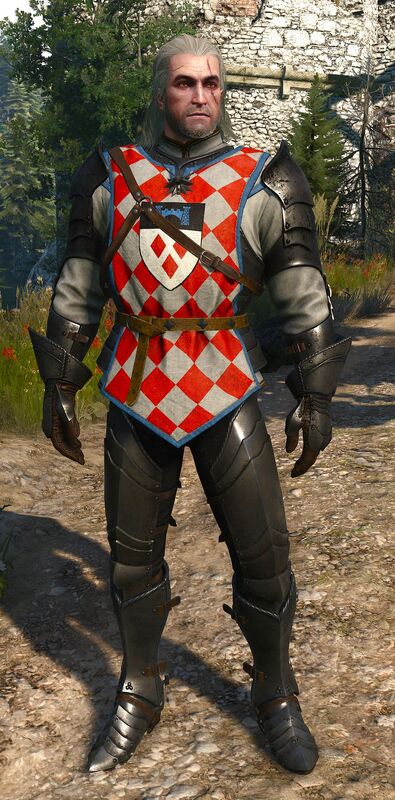
This essay focuses on three specific armor sets: Sir Geralt of Rivia’s Armor, Undvik Armor, and Grandmaster Feline Armor. By examining these examples and comparing them to armor from around the thirteenth century, this essay explores how the game’s designs align with historical armor traditions and where they diverge into fantasy. These shifts are not inconsistencies but deliberate design choices that demonstrate how historical references are adapted to serve the game’s world-building.
Before analyzing these armor sets, it is important to examine key aspects of thirteenth-century armor. European armor at the time often consisted of a hauberk (a chainmail shirt) and a gambeson (a padded tunic for protection and comfort) (Norris 2001). Warriors also used gauntlets and ailettes for arm and shoulder coverage (Norris 2001), while chausses were worn for leg protection (Norris 2001). In short, the layering of chainmail and padding was typical of the period and serves as the primary basis for assessing the realism of these fantasy armors (Mansoor, 2019). These historical forms act as reference points that fantasy media can adapt and modify for visual storytelling.
Sir Geralt of Rivia’s Armor is a near-stereotypical visual representation of European knightly armor (Mansoor 2019). This particular set consists of steel riveted plates covering most of Geralt’s body. However, this type of plate armor was not widely used until the fourteenth century. During the thirteenth century, most armor was made of iron rather than steel (Mansoor 2019). Steel plate armor was stronger, more refined, and allowed for the smooth, articulated forms seen in Geralt’s armor, whereas thirteenth-century iron-based armor was generally less uniform and relied more heavily on chainmail with limited metal reinforcement (Guilmartin 2024).
By 1275 (as depicted in Blood and Wine), armor with this level of coverage would be out of place. While plate armor did exist, it typically consisted of chainmail reinforced with smaller plates rather than fully articulated riveted armor (Mansoor 2019; Curl 2012: 41). Sir Geralt of Rivia’s Armor appears to be inspired by a later medieval period than the one represented in the game (Curl 2012: 38). Here, historical armor is selectively employed to signal a recognizable “knight” identity, even if it does not align precisely with the thirteenth-century setting.
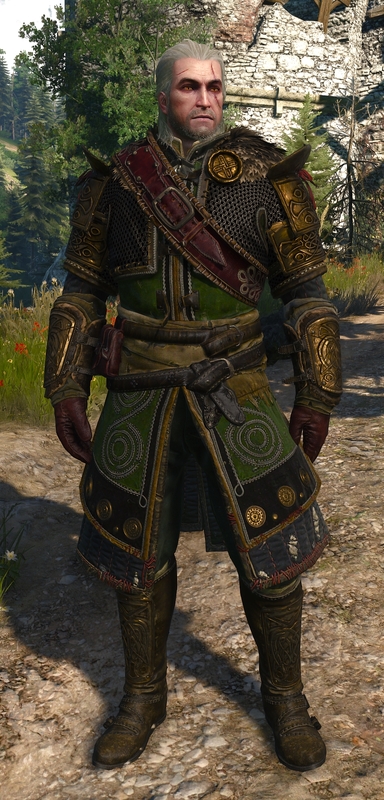
In contrast, Undvik Armor takes inspiration from Norse, or Viking, armor. The set features a long chainmail coat combined with rough leather, fur, and metal, reflecting the cold northern environment associated with the Skellige Isles in the game. However, Viking warriors belonged to an earlier time period, roughly the eighth to eleventh centuries (Cartwright 2018). Their armor typically consisted of chainmail shirts, with heavy clothing used for warmth in colder climates (Hampton 2011: 37).
By the thirteenth century, the Viking Age had ended, and Scandinavian regions had developed into centralized Christian kingdoms that were fully integrated into broader medieval Europe (Anderson 2025). The Undvik Armor appears to combine older Viking imagery with elements of later medieval gear. While the use of fur and leather would be appropriate for a northern climate, the overall design seems to be influenced more by popular perceptions of Viking warriors than by historical accuracy (Cartwright 2018). In this case, Viking-era imagery is selectively repurposed to establish a clear cultural identity for Skellige within the game’s world.
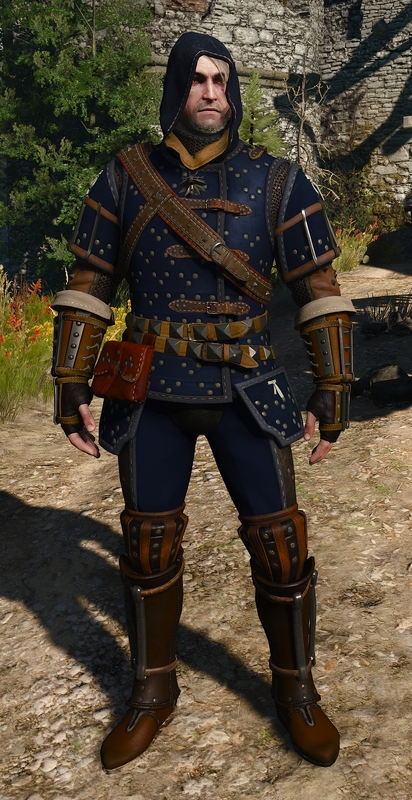
Finally, the Grandmaster Feline Armor is visually distinct compared to the other armor sets. The design emphasizes mobility, featuring fitted leather components, segmented construction, and underlying chainmail while maintaining a sleek silhouette. The combination of leather and chainmail reflects historically plausible thirteenth-century light armor strategies (Mansoor, 2019).
While the concept of lighter, chainmail-based armor is historically grounded, the Grandmaster Feline Armor includes exaggerated elements, such as highly segmented pieces and decorative accents, that are clearly designed for visual impact rather than historical accuracy (Curl, 2012, 41–42). The layering of the armor is more consistent with the time period, but the overall design is not (Curl, 2012, 39). Although it incorporates chainmail and leather, the armor’s tight, segmented construction differs from thirteenth-century armor, which was typically looser and based on layered garments such as chainmail hauberks worn over padded clothing. Therefore, because of its layered construction, this set is more accurate to the thirteenth century than the other two sets.
Overall, Sir Geralt of Rivia’s Armor would not have existed until the following century. Its fully articulated plates emphasize a classic knightly appearance, but it is too historically advanced for 1275. Undvik Armor is visually effective in representing northern cultures such as Scandinavia, but it is too dated for the thirteenth century. Grandmaster Feline Armor is the most historically grounded due to its armor techniques, yet it is too stylized and decorative to be entirely plausible.
By examining Sir Geralt of Rivia’s Armor, Undvik Armor, and Grandmaster Feline Armor, it becomes clear that each set combines historical reference with stylistic design in different ways. One prioritizes visual spectacle, another emphasizes cultural identity, and the third blends historical plausibility with fantasy. Across all three examples, historical armor is not simply replicated; instead, it is selectively drawn from, modified, and recombined to support world-building and meaning within the fictional setting. The armor designs in The Witcher 3: Wild Hunt demonstrate how fantasy media can draw from historical sources and adapt them to serve narrative and world-building purposes.
Bibliography
Anderson, Robert T., Anderson, Stanley Victor, Folke, Hans, Linton, Michael I.A., Nokkentved, Christian. "Denmark.” Encyclopedia Britannica.
Cartwright, Mark. “The Armour of an English Medieval Knight.” World History Encyclopedia, 13 June 2018, www.worldhistory.org/article/1244/the-armour-of-an-english-medieval-knight
Curl, Michael. “The Industry of Defence: A Look at the Armour Industry of the Fourteenth, Fifteenth and Sixteenth Century.” Medieval Warfare, vol. 2, no. 1, 2012, pp. 38–42.
Guilmartin, John F.. "military technology". Encyclopedia Britannica, 22 Oct. 2024.
Hampton, Valerie Dawn. “Viking Age Arms and Armor Originating in the Frankish Kingdom.” ScholarWorks, 2026, scholarworks.wmich.edu/hilltopreview/vol4/iss2/8
Mansoor, Peter. “Armour | History, Types, Definition, & Facts.” Encyclopædia Britannica, 2019.
Norris, Michael. “Arms and Armor in Medieval Europe.” In Heilbrunn Timeline of Art History. New York: The Metropolitan Museum of Art, 2000.