
Medieval Maps and their Influence on Planar Maps for Dungeons and Dragons by Keeva Baker
Dungeons & Dragons is an immersive tabletop role-playing game created in 1974 by Gary Gygax and Dave Arneson. Although created in the 1970s, Dungeons & Dragons—better known as D&D—continues to be a popular role-playing game with strong medieval inspiration. D&D is a collaborative storytelling game played with friends and family that focuses on fantasy and character role-play. The game is highly diverse in its playstyles, with a heavy emphasis on worldbuilding. Various maps help guide players throughout the fantastical world while also serving as an avenue for delivering lore. This is incredibly reminiscent of medieval maps, as they not only guide the viewer but also have a storytelling function.
While typically a tabletop game, digital visualizations of maps within gameplay are becoming increasingly popular. The genre of medieval fantasy is intrinsic to the D&D experience and is often seen as the baseline or expected campaign setting. Within the standard ruleset lies the fundamental lore from which most campaigns are created. While customization is strongly encouraged, the core ideas remain similar: a medieval fantasy world filled with magic, dragons, and mystical creatures, all wrapped in an intense story or plot. It is therefore very important to illustrate the rules of this new world, with the most common and seamless interpretation appearing in the form of a map. A clear example of this is the depiction of other planes and realms within the universe. Similar to works such as the Hereford map or Isidore of Seville’s T-O map, D&D’s planar representations echo the moralities and meanings created by people long ago.
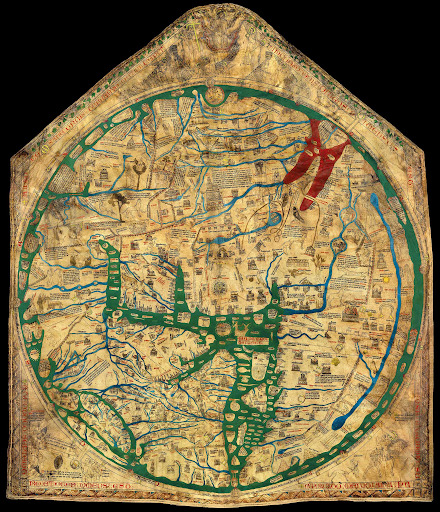
Colorized hereford mappa mundi
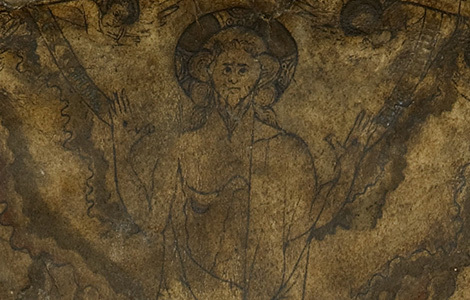
Christ in majesty
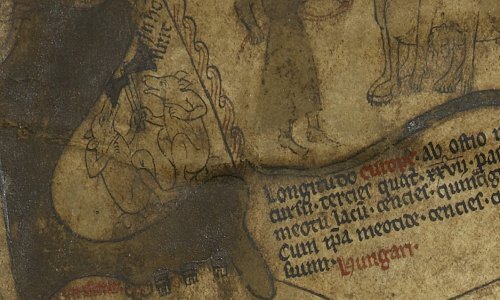
Cynocephali (dog heads)
The Hereford Mappa Mundi is one of the largest and most well-preserved medieval maps to date. Estimated to have been created around the year 1300, it not only illustrates the bounds of the known world at the time but also tells the story of how people viewed the world. As shown in Figure 1, the map is structured as a circle, with the city of Jerusalem at the center. A strong emphasis is placed on the importance of this city, with the entirety of the known world revolving around it. Located at the top of the map in Figure 2 is a depiction of Christ overseeing and protecting all who live below. Beneath that is Eden, a holy land that lies as close to the divine as a mortal can be. Various religious locations and symbols appear within the Hereford map, each serving to incorporate the story of Christ into this depiction of reality.
A very similar mapping mechanic is present in various cosmology models within the Dungeons & Dragons universe. Much like Jerusalem’s central importance, in nearly every depiction of planar maps, the Prime Material Plane—our main “reality”—sits at the center of the visualization (Mearls and Crawford, 2014, p. 303). This parallels the layout of the Mappa Mundi closely, with another similarity being directional morality. In D&D, there are upper holy planes and lower evil planes, each housing creatures aligned with good or evil. Akin to how Christ overlooks Eden at the top of the Hereford map, the upper D&D planes are known as the resting place of the gods and are theorized to be where souls travel after departing from the mortal plane.
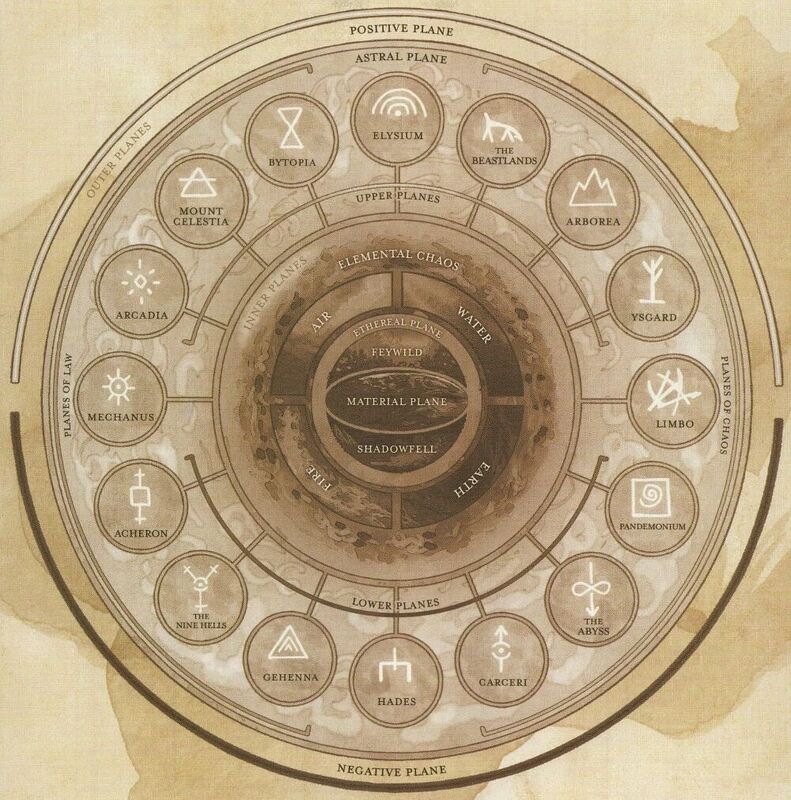
Dungeons and dragons great wheel cosmology map
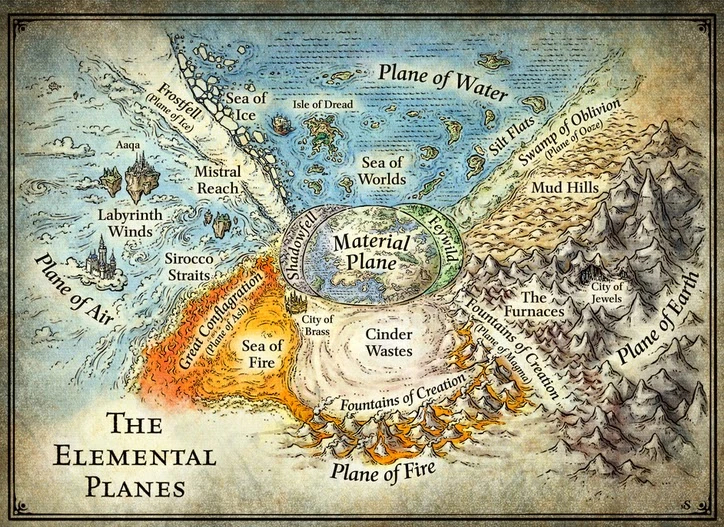
Dungeons and dragons inner planar map
The same is true in reverse, as the D&D lower planes house only evil. These realms are home to demons and devils, including the Hells, the Abyss, and other chaotic realities. This idea of morality being portrayed through a physical mapping of space originated in the medieval era. At that time, a map was more than a chart of space; it also represented the religion, culture, and legends of the people who lived there or created it. Created by Isidore of Seville and known as the T-O maps (Figure 6), these moral mappae mundi, or world maps, are laid out very similarly to the Hereford map.
Consisting of a circular boundary, the form is cut in half horizontally to create two distinct sections. The bottom half is then divided vertically, forming the shape of the letter “T” within the “O” of the map itself, as seen in Figure 7.
Moral maps extended beyond the bounds of charted areas as well. A common feature of medieval maps was the caution and fear directed toward the “others” believed to exist at the edges of the known world. Tales of barbaric dog-headed men (seen in Figure 3), strange beasts, and savage cannibals were recurring narratives illustrated along the edges of such maps. The idea of horrific or fearsome creatures living beyond the known world was a popular belief in the medieval era, reinforced by many maps.
This same idea appears in Dungeons & Dragons, where it is often theorized that ancient, unknowable horrors lie beyond the edges of the planar circle. These distant planes are treated with extreme caution, as fear of the unknown haunts those who venture too far. While not exclusively medieval, the concept of secretive and dangerous groups existing outside the known world was greatly popularized through its inclusion on maps. The myths and legends illustrated in these maps influenced the history and culture of the societies that created them, demonstrating how each part of the map shaped the broader worldview.
The Great Wheel cosmology model in Dungeons & Dragons reflects this approach by focusing on the relationships between each plane and how they contribute to the whole. One example is the relationship between the Material Plane, the Feywild, and the Shadowfell (Crawford, Perkins, and Wyatt, 2014, p. 57). The Feywild and Shadowfell mirror the Prime Material Plane: the Feywild balances the Shadowfell, while the Material Plane serves as the neutral midpoint. This connects again to the ideas of chaos versus law and good versus evil, as seen in both the moral T-O map and the D&D planar map.
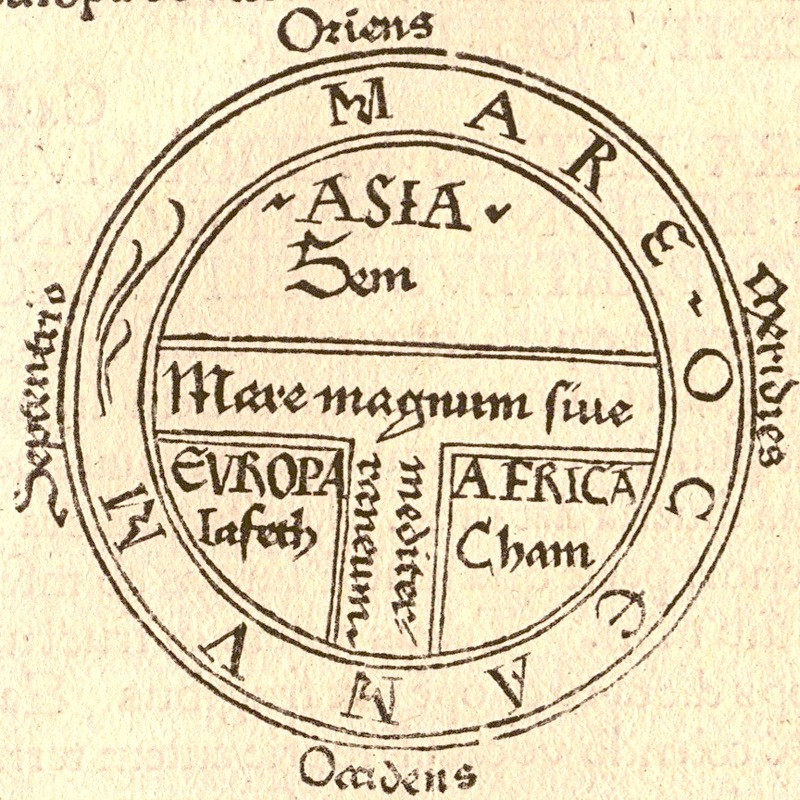
Etymologiae t-o map
Figure 6: T-O map created by Isidore of Sevilla, Etymologiae (Circa 625
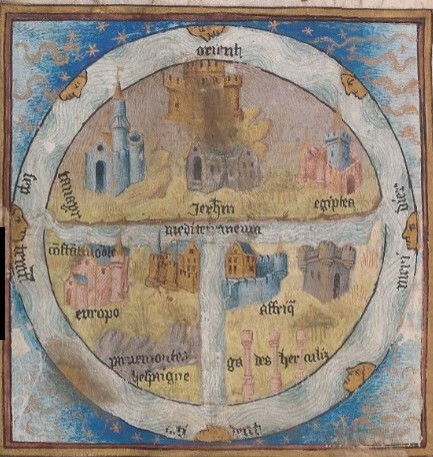
Beinecke t-o map
It is clear that modern Dungeons & Dragons planar representations draw significant inspiration from medieval maps. Beyond visual similarities—such as circular, wheel-like designs and the central placement of important realms—the conceptual storytelling elements also closely mirror one another. Dungeons & Dragons is a game centered on worldbuilding and storytelling, with maps serving as key tools for conveying these narratives. Medieval maps similarly thrived as both conceptual and literal forms of visual storytelling, practices deeply tied to medieval identity. The idea of maps as storytelling devices has persisted through countless works of art, and although the context may change, the fundamental historical concepts remain.
Bibliography
“Did You Know?” Mappa Mundi Exploration | Mappa Mundi Hereford, www.themappamundi.co.uk/mappa-mundi/. Accessed 15 Mar. 2026.
“The First Printed Edition of Isidore’s ‘Etymologiae’ Includes the First Map Included in a Printed Book.” History of Information, www.historyofinformation.com/detail.php. Accessed 16 Mar. 2026.
Clemens, Raymond. “Medieval World Maps (T-O Maps).” Beinecke Rare Book & Manuscript Library, 18 July 2022, beinecke.library.yale.edu/article/medieval-world-maps-t-o-maps.
The Elemental Planes Map, Jeremy Crawford, Christopher Perkins, James Wyatt (December 2014). Dungeon Master's Guide 5th edition. Edited by Scott Fitzgerald Gray, et al. (Wizards of the Coast).
The Great Wheel Cosmology Planar Map, Mike Mearls, Jeremy Crawford (2014). Player's Handbook 5th edition. (Wizards of the Coast).