
Repurposed Architecture as Narrative in Contemporary Media by Lisse Williams
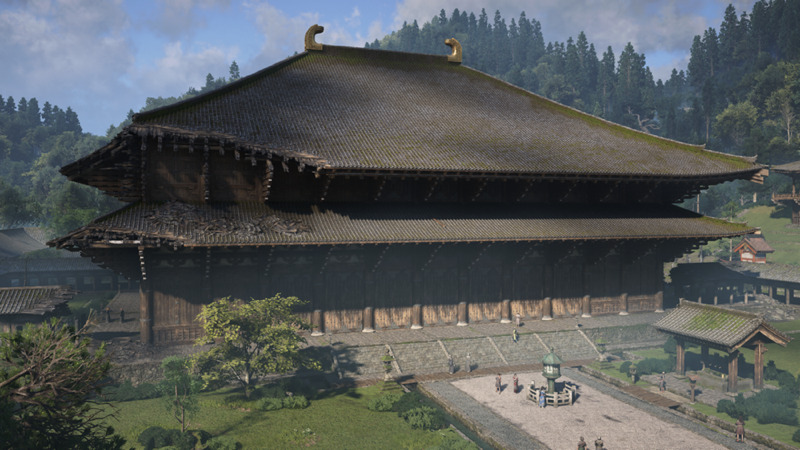
The global medieval period has long been an inspiration for the world of storytelling with artists, writers, and game developers repeatedly turning to the past to activate storylines. Through the ever-developing accessibility to both software, as well as developments with 3D printing and scanning, creators give us intimate access to experience these narratives as rewritten in ways that are both powerful and sometimes problematic. The way we rebuild and interact with these environments tells its own distinct story. How does the way in which a creator incorporates elements of a period or place impact the viewers' experience of it? How can creators ensure that the use of historic architecture is done with care and authenticity? As a path within this conversation, we look at the recreation of two examples of still extant temple grounds in Nara, Japan. Firstly, Ubisoft’s Assassin’s Creed: Shadows game with the Todai-ji temple complex. Secondly, Takashi Murakami’s recreation of the Horyu-ji Hall of Dreams: Yumedono. Both of these still alive and flourishing historic places carry within them culturally sensitive images, adding a layer of complexity to how they are represented (Weinstein 1989: 24-48).
The game developer Ubisoft prides itself on highly researched period-based worlds, with research supported renditions of city and landscapes, creating open world games in which players immerse themselves in historical fiction (The Guardian, 2025: 2). The latest game Assassin's Creed: Shadows takes place in Japan, during the Azucho-Momoyama Period (Ubisoft 2025). The backdrop, feudal Japan at the tail end of the Sengoku period, was a period of unrest and upheaval. The main characters consist of Naoe, a female Shinobi and Yasuke, a Samurai; while the characters work to develop the storyline, we have set them aside to focus on the role of architecture within the gameplay. The gamer's experience of the world hinges on the recreation of the vast architectural landscape; foremost, the presence of various historic places, such as the monumental Todai-ji temple. Assassin’s Creed’s method of re-imagining aspects of the architecture, while claiming historical accuracy within the confines of historical fiction, creates a misaligned understanding of a place through lack of context, inaccuracies of representation, and improper use of imagery (Kageyama 2024). In addition, the muddled blending of fantasy gameplay and inserted encyclopedic add-ons suggest to the player they are actively interacting with an unvarnished narrative.
The use of the Todai-ji complex as a narrative backdrop within Assassin's Creed: Shadows results, I argue, in a distorted perspective of the past. First, the recreation of the Todai-ji Daibutsuden (the Great Buddha Hall) is presented to the player as a run down but still standing complex. Importantly it is assumed that it is an historically accurate rendition, yet, at the time, the Daibutsuden had been razed, and would not be rebuilt until much later (Watsky 2004). While it is possible that some elements of the buildings would have been as depicted in the game, the percieved accuracy that the game designers seek to portray leaves out the historical ambiguity inherent in the Daibutsuden ca. 1579 CE. That is, a medieval Japanese building that had been built, rebuilt, razed, and rebuilt again. The simplicity that the game world provides works to alter the player's understanding of this very important historic structure’s status and role at the time. Secondly, the lack of interior within the main Daibutsuden removes the contextual importance of the place. The decision to make the interior inaccessible relates to the housing of the Great Buddha, whose representation is strictly prohibited for commercial use (Watsky 2004). This chosen aesthetic of the temple complex seems to serve two purposes, foremost is to provide in the game a period aesthetic; a run-down temple complex amidst a period of great shift provides the player with the perception of a long lived past tied to the story arch.
“To fixate on a handful of mischaracterizations or creative liberties in a game of such enormous scope isn’t helpful to anyone and only serves to distract from the fact that it’s unbelievably cool that such an immersive, breathtakingly beautiful portal into 16th century Japan now exists” (Boo 2025).
The ability to interact only with the exterior furthers the argument that this space functions as aesthetic backdrop, offering a stagnant and unchanging perception of a historic building. This deliberate alteration of space to develop narrative is a key example of liberties taken when recreating past worlds within historical fiction. In addition, it speaks to the subtle ways in which creators alter how we view the past. Ubisoft’s claims of striving for historic accuracy suggest that the bones of the place should carry some weight of truth, yet the game took significant liberties with the rendering of the Daibutsuden, altering the sense of the period envisioned. Proponents for Ubisoft’s vision of this period, and the issues that arise can be summed up by author Bernard Boo, whose article suggests that the need for historic accuracy is superseded by the need to focus on the story. This commentary is helpful in understanding the power of these recreations to be both highly immersive, and that regardless of a players understanding that they are fiction, there is still the sense that they are experiencing an unvarnished reality as suggested by the “portal into 16th century."
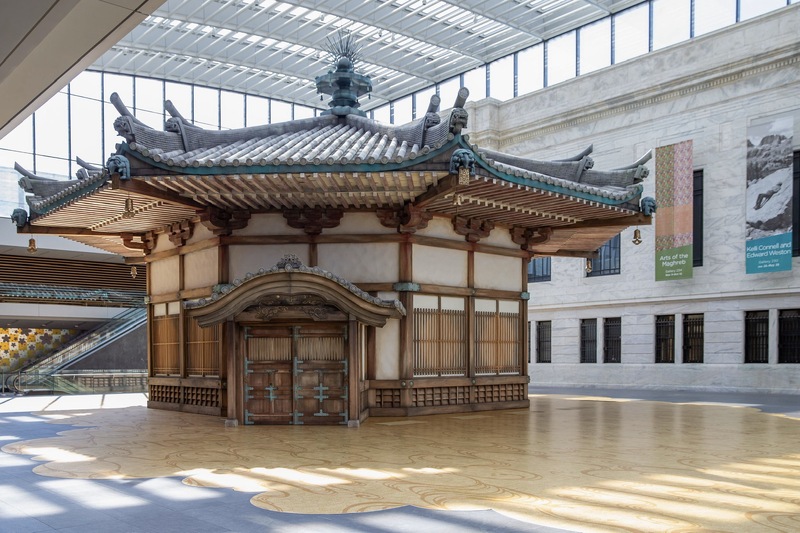
One can see an important divergence from Ubisoft's interpretation of sacred space in the way museums and museum exhbitions handle such issues. Thus, we now turn to Takashi Murakami’s recent 2025 exhibition at the Cleveland Museum of Art, Stepping on the Tail of a Rainbow, with its recreation of the Yumedomo Hall of Dreams (Murakami 2025). Murakami’s re-envisioning of the Hall of Dreams, a portion of the Horyu-ji temple within the exhibition, allows for a multivalent immersive experience of a re-envisioned historic space. In contrast to Ubisoft’s recreation that suggests historic authenticity, yet falters when we understand its inaccuracies, Murakami’s conversation with the past uses historical architecture in combination with creative reinterpretation.
The Yumedono, located in Nara Japan, was built in the 8th century as a memorial hall for the Asuka period Prince Shotoku, and is widely credited for the flourishing of Buddhism and the subsequent inspiration for the building of later temples throughout Japan (Weinstein 2025: 25–48). While the Yumedono was built before the traditional start of Japan's traditional medieval period (ca. 12th–16th centuries), the building remained an important monument throughout Japanese history and provides a futher lens through which to view the Todai-ji temple complex.
Like the Daibutsuden the interior of the Yumedono holds culturally sensitive objects, and choices of each creator transforms the resulting narratives. While the Ubisoft Daibutsuden remains walled off physically and contextually, Murakami's Yumedono opens the doors with a reinterpretation of the original space allowing perspective of, and importantly respect for, the interior of the building. Murakami does not claim to have recreated the original, rather he has allowed the past to blend with his personal vision. The viewer becomes a participant in the story, experiencing a place both regarding what the past which it references, and as transportive, the experience of Murakami’s relationship to the Yumedono and how it is interpreted in modern times
I began this research wanting to show how imperative it is for creators to understand the impact of recreating or reinterpreting spaces. An important key aspect to both examples above is their immersive quality, and how that alters the scope of the need for accuracy, if it is implied. Ubisoft has created an undeniably beautiful world, that I suggest is an ultimately impossible goal due to its striving to be built on a historic template. Murakami’s work avoids this error, by being interpretive, a conversation with the past. As I was myself immersed in research, one pivotal aspect of the creative works kept nagging me. With access to such immersive world building, why not choose to create something entirely new? Murakami’s work at least embraced the future, while not letting go of history. Was Ubisoft’s aim to do something similar, or are they simply pandering to an audience that wants a playground for violence on a beautiful landscape? If so, can’t we do better, shouldn’t we?
Bibliography
“Assassin’s Creed Shadows’ Cultural Discovery Codex Brings Players Closer to History of Feudal Japan.” Ubisoft, www.ubisoft.com/en-us/game/assassins-creed/news/5m8TKmPWSIgE8cb61M8JI6/assassins-creed-shadows-cultural-discovery-codex-brings-players-closer-to-history-of-feudal-japan.
Boo, Bernard. “Assassin’s Creed Shadows Is Proof Historical Accuracy Is Overrated.” Den of Geek, 25 Mar. 2025, www.denofgeek.com/games/assassins-creed-shadows-proof-historical-accuracy-overrated/.
“Daibutsu-Den - 東大寺.” 東大寺 - 華厳宗大本山.
“‘It’s Been A Challenge’: Assassin’s Creed Shadows and the Quest to Bring Feudal Japan to Life.” The Guardian, Guardian News and Media, 17 Mar. 2025, www.theguardian.com/games/2025/mar/17/its-been-a-challenge-assassins-creed-shadows-and-the-quest-to-bring-feudal-japan-to-life.
JAPAN Forward. https://japan-forward.com/new-ubisoft-game-assassins-creed-shadows-why-the-criticism/#:~:text=*Assassin’s%20Creed%20Shadows*%20(AC%20Shadows)%20has%20received,game%20set%20in%20Japan%20is%20cultural%20appropriation.
Kageyama, S. (2024, November 7). New Ubisoft Game “assassin’s creed shadows:” why the criticism?
“Takashi Murakami: Stepping on the Tail of a Rainbow.” The Cleveland Museum of Art, 15 May 2025, https://www.clevelandart.org/about/press/takashi-murakami-stepping-tail-rainbow-opens-cleveland-museum-art. Accessed 11 Mar. 2026.
Todaiji.or.jp/en/information/daibutsuden/#:~:text=Sketching%20and%20using%20a%20flashlight,of%20tripod%20stand%20are%20prohibited.
Watsky, Andrew M. “Hideyoshi and the Sacred.” Chikubushima: Deploying the Sacred Arts in MomoyamaJapan, University of Washington Press, Seattle, WA, 2004, pp. 69–100.
Weinstein, Lucie R. “The Yumedono Kannon: Problems in Seventh-Century Sculpture.” Archives of Asian Art, vol. 42, 1989, pp. 25–48. JSTOR, http://www.jstor.org/stable/20111192. Accessed 12 Mar. 2026