The Medieval Hereford Mappa Mundi's influence on art in the Modern Age through Sky: Children of the Light - By Rachel Gowell
Sky: Children of the Light is an open-world, massively multiplayer online (MMO) game released in 2019 by Thatgamecompany, focused on social connection between players (Sky: Children of the Light Wiki, March 24). The world of Sky utilizes a player-centric environment, with colorful settings and a narrative that explores the journey of life and death. It exists in a fantastical realm defined by the central theme of light versus darkness. While the game has little connection to the laws of the real world, its world-building shares numerous parallels with medieval art, both in the content it presents and in the influence it has on its audience.
The medieval period, spanning roughly 700–1500 CE, was a time when communication across geographical communities was limited by modern standards, yet it thrived through shared artistic expression. Maps functioned not only as navigational tools but also as elaborate artistic works, featuring iconography of prominent figures, animals, and landmarks to provide viewers with a deeper understanding of the world. The Hereford Mappa Mundi (Fig. 1) is one of the largest and most famous maps from this period. Created around 1300 by Richard of Haldingham and displayed at Hereford Cathedral, it reflects how the world was understood within a Christian-dominated European worldview (New World Cartographic 2023).
Both the Hereford Mappa Mundi and the map in Sky serve to tell the story of their respective worlds. Each draws on the lived experiences of its audience—medieval viewers in one case and modern players in the other—to construct a visual narrative centered on life and death.
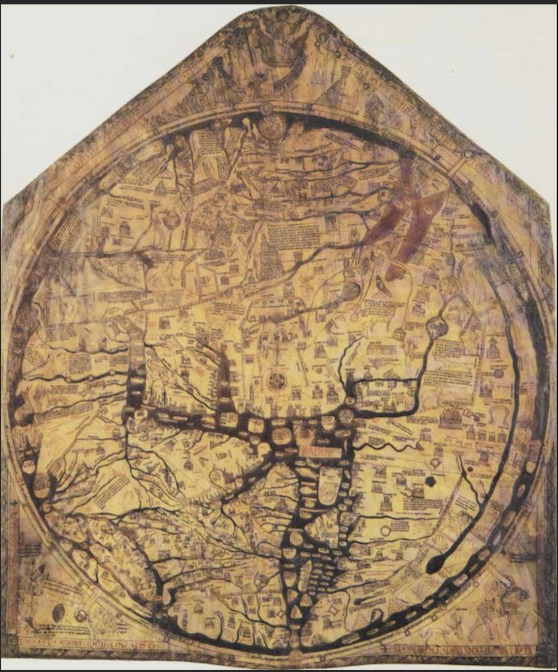
Hereford Mappa Mundi
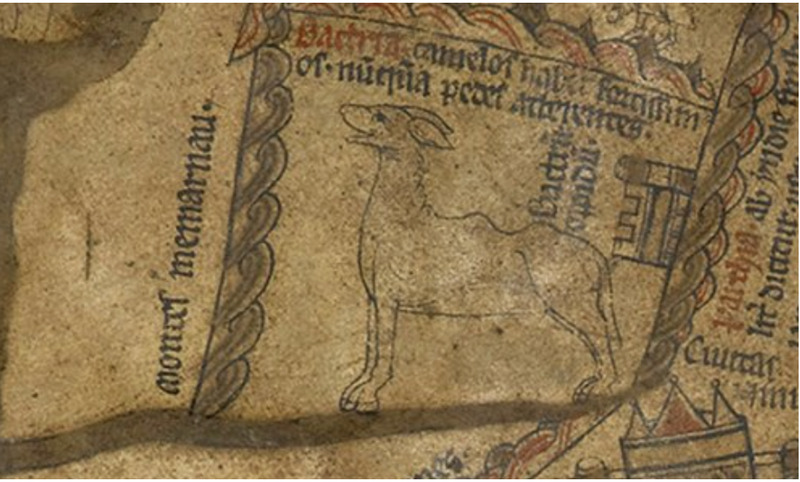
(Figure 2) Camel depicted on Hereford Mappa Mundi, located south of the Memarnau mountains
Animals are scattered across the Mappa Mundi, placed near cities, rivers, and other geographical landmarks, often accompanied by descriptive text. For example, a camel located just below the Memarnau Mountains is labeled with the inscription, “Bactria has extremely strong camels that never wear out their feet” (Mappamundi.co.uk) (Fig. 2). Richard of Haldingham chose to include fauna that were significant to different regions of the world, as these animals helped viewers identify and understand those areas. Bactria, for instance, was known for its strong camels, which were essential for travel and trade.
The animals depicted on the Hereford Mappa Mundi function as storytelling devices, conveying information and shaping perceptions of lands that were unfamiliar to medieval viewers.
An important creature in the story of Sky is the Dark Dragon, which the player encounters upon entering the Golden Wasteland, a desolate desert in ruins. These Dark Dragons track and attack the player, and have become a shared source of fear among the game’s community. The Wasteland is the first realm that forces players to confront the conflicts of the past, marking a shift in tone from bright and peaceful to dark and dangerous.
On the map, the Golden Wasteland is represented by a murky green color, with several Dark Dragons surrounding the central temple (Fig. 3). As there is no written language within the world of Sky, these dragons serve as visual indicators of the dangers players will face in this region.
Both the Hereford Mappa Mundi and the Sky map incorporate animals and creatures as visual guides. While architectural features may not be equally memorable to all viewers, the stories associated with these beings help define regions and make them a recognizable and meaningful part of the world.
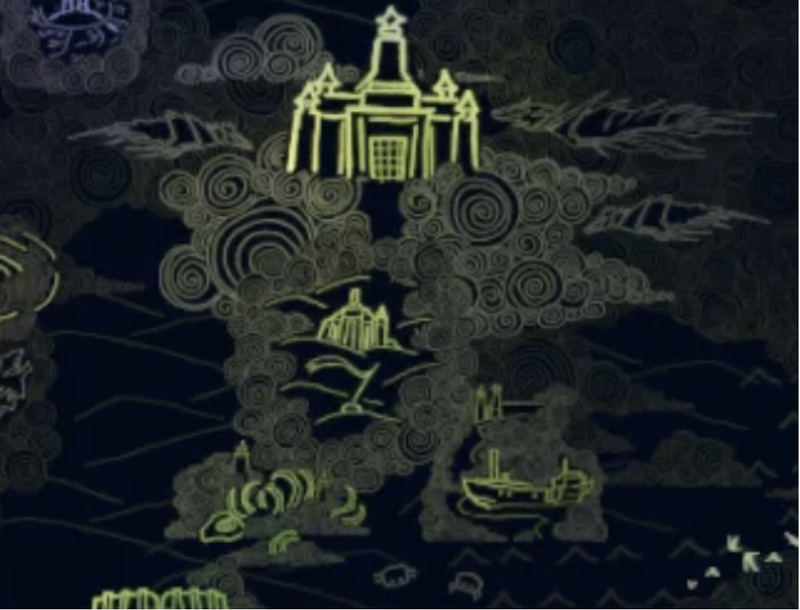
Golden Wasteland Temple
(Figure 3) Dark dragons are surrounding the Golden Wasteland temple icon on the world map
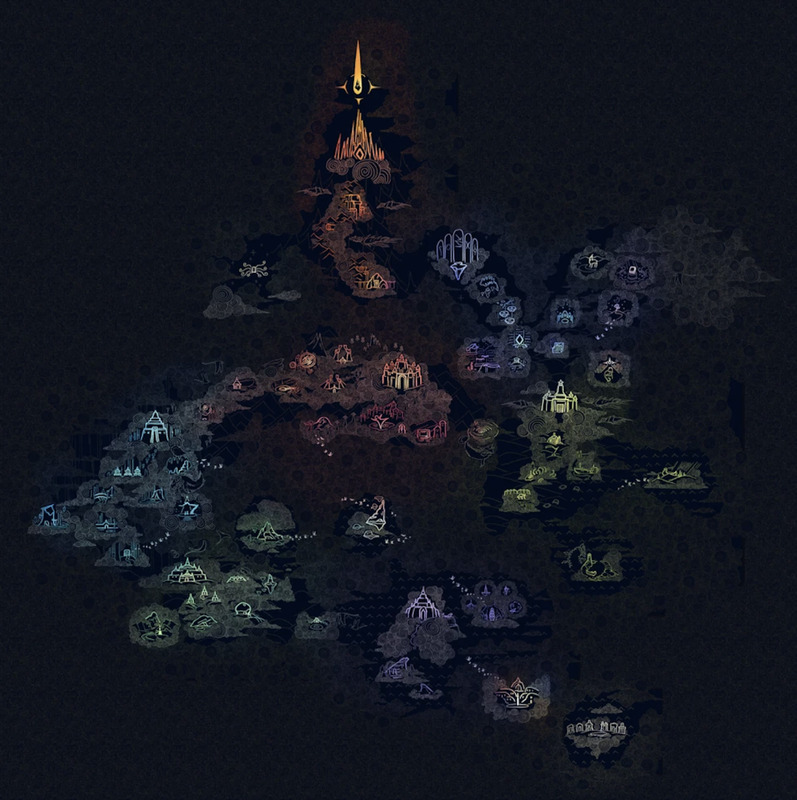
Screenshot of the full map in Sky: Children of the Light
(Figure 4) Children of the Light world Map Completed
As players traverse the world of Sky, maps become an integral part of the experience. Map shrines are scattered throughout the world for players to discover and activate, gradually revealing different regions on the map (Fig. 4). This system encourages exploration; however, the digital map can only be accessed at these specific shrines. As a result, it is a useful tool, but one that remains inaccessible to novice players who are unfamiliar with the locations of shrines in each realm.
During the medieval period, Latin was the dominant written language. However, portions of text on the Mappa Mundi were written in French (Fig. 5), a language typically accessible only to the educated elite.
The Mappa Mundi was designed in ways that limited access for those its creator deemed less worthy of engaging fully with the work. In the margins, an image of Jesus is placed at the top center, indicating that these outer spaces represent Heaven beyond the lands of Earth. Notably, many of the French captions are located within these margins, and their placement appears intentional. Those unable to read French would have been excluded from fully understanding this content, effectively distancing them from the heavenly realm depicted.
As Sky continues to evolve, new regions, quests, and mechanics are introduced, making it increasingly difficult for new players to navigate and understand the game. While it is natural for players to feel overwhelmed when starting a new game, the inaccessibility of certain features parallels the restrictions established by Richard of Haldingham. The Mappa Mundi's visual and textual elements were tailored to a specific, educated audience—those who could read French—and the map itself was only accessible within Hereford Cathedral.
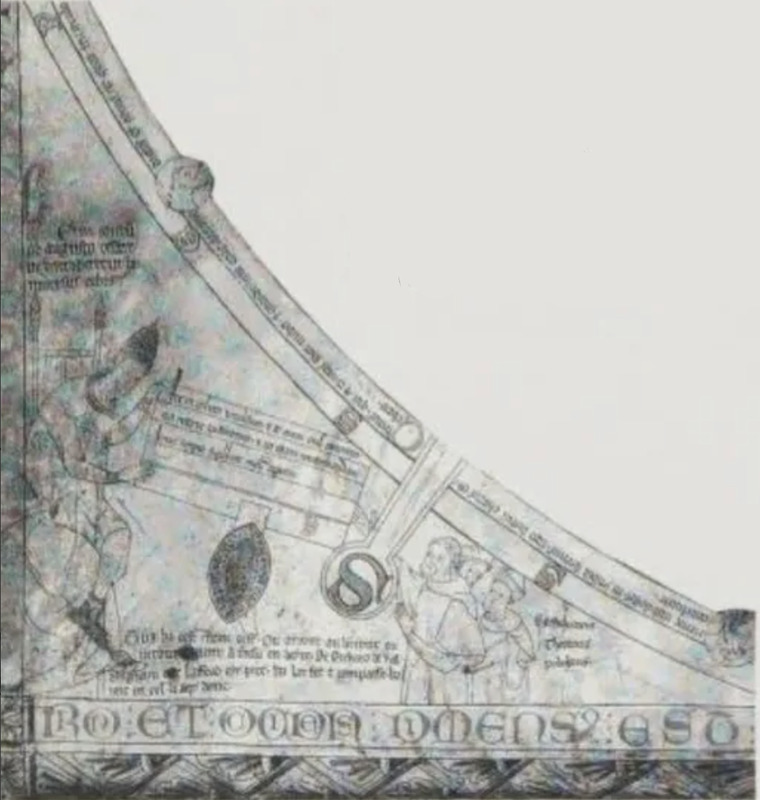
French caption in the bottom left margin of the Hereford Mappa Mundi
(Figure 5) French caption in the bottom left margin of the Hereford Mappa Mundi
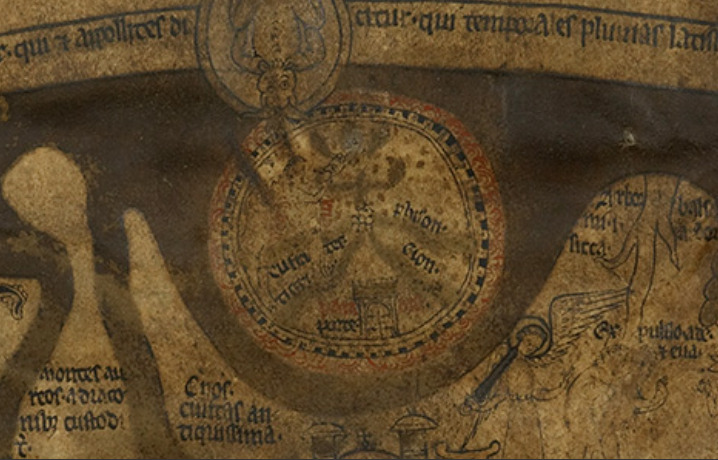
Eden
(Figure 6a) Eden's location at the top (East) of the Hereford Mappa Mundi
Amid the densely detailed Hereford Mappa Mundi, one circular stretch of land at the top stands out: the land of Eden. Positioned at the far eastern edge of the world—where east is oriented at the top rather than the right—Eden is set apart from the rest of the map.
In Sky, each realm is typically named after its environmental characteristics, except for the final realm, the Eye of Eden. This shift in naming draws the player’s attention and signals its importance. On the world map, Eden is likewise placed at the top and separated from other landmasses, mirroring the structure of the Hereford Mappa Mundi (Fig. 6).
Although the realm shares its name with the Garden of Eden from the Bible, the two are starkly different in appearance. The biblical Eden is a lush, life-filled paradise, whereas the Eden in Sky is a desolate landscape marked by death and destruction. Despite these contrasts, both serve as crucial locations within their respective narratives, shaping the stories told by Sky and the Hereford Mappa Mundi.
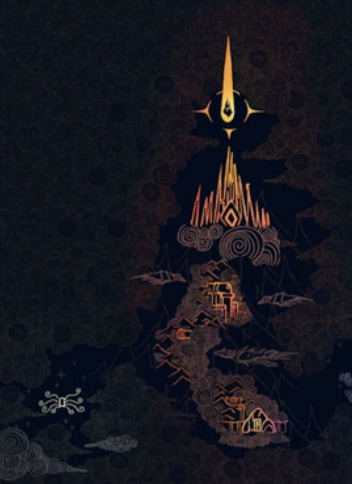
Eye of Eden Temple
(Figure 6b) Eye of Eden Temple, the place of death and rebirth
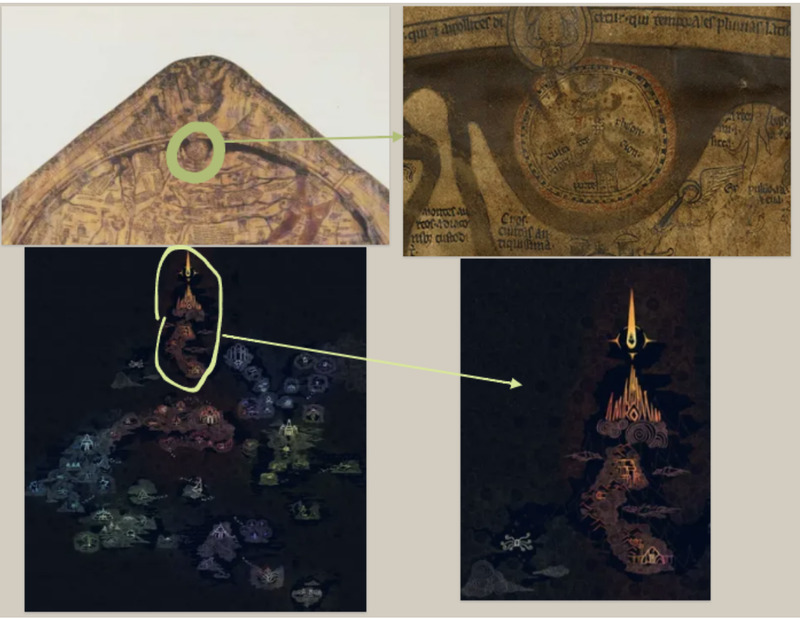
Comparison of Eden's depiction in the Medieval Period and the Modern Age
(Figure 6) A comparason between item ARTH565_JEY_001_B & item SAG479_RJG_001_B
Sky’s Eden is dark, but it is not solely a place of loss. As players move through the level, they sacrifice their light to help those around them ascend. Once the player gives up the last of their light, they die, ascend, and are reborn with greater power and a deeper understanding of the world. The story of Sky is one of rebirth—a process that cannot occur without death.
The Eye of Eden only opens once players have traveled through all the other realms and formed connections with the people of the world. In Eden, they are guided along a path of self-sacrifice and taught that it is not something to fear. All life in Sky follows this cycle: forming connections, reaching the end of one’s time, dying, and then returning as a new embodiment of light, ready to begin again.
Eden is a pivotal realm in Sky because it encourages players to embrace exploration and take risks. It reinforces the idea that forming connections—with both players and non-player characters—is what makes the journey meaningful.
Christian imagery appears along the borders of the Hereford Mappa Mundi, symbolizing Heaven beyond the earthly realm. The map is also geographically inaccurate by modern standards, reflecting both a limited understanding of the wider world and the strong influence of Christian beliefs at the time of its creation. Jerusalem—the site of Jesus’s crucifixion and resurrection—is placed at the center of the Mappa Mundi (Fig. 7), emphasizing the importance of biblical narratives in the medieval worldview.
The Garden of Eden, understood in the Bible as the origin of humanity, is likewise a significant inclusion. Because the Hereford Mappa Mundi was designed to convey a history of the world, its presence reinforces this narrative purpose. In a similar way, the Eye of Eden in Sky functions as a place of rebirth, marking a crucial point in the game’s cyclical story of life, death, and renewal.
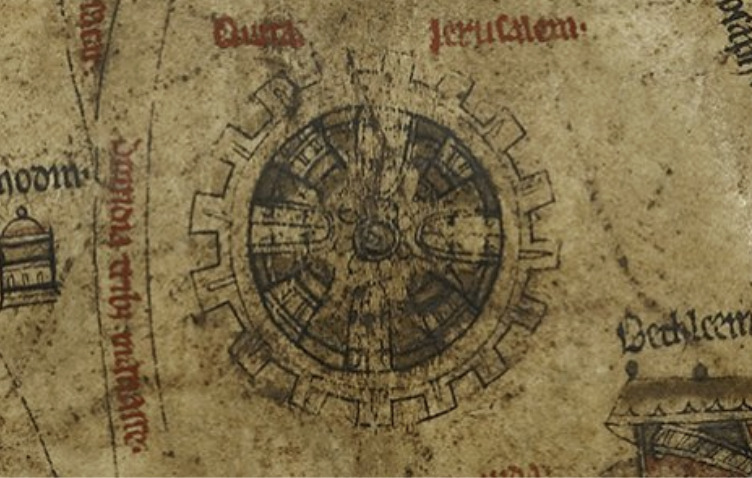
Jerusalem's location on the map
(Figure 7) Jerusalem is placed at the center of the Hereford Mappa Mundi
These concepts represent only a small number of the similarities shared between the Hereford Mappa Mundi and Sky: Children of the Light. Despite being created centuries apart and for vastly different audiences, the themes present in the Hereford Mappa Mundi recur throughout Sky.
Animal iconography appears prominently in both works, serving as a familiar visual language that helps audiences understand the world at a glance. In the Mappa Mundi, regions such as Bactria are associated with strong pack animals, reflecting their cultural and practical significance. In Sky, creatures like the Dark Dragons function similarly, acting as ominous symbols that signal danger in areas such as the Golden Wasteland.
The Hereford Mappa Mundi was designed to convey a narrative of the Earth’s past and its anticipated future, while the map in Sky is shaped by the player’s experiences, actions, and growing knowledge of the world. The Eye of Eden derives its significance from being both the beginning and the end of the player’s journey, mirroring the role of the Garden of Eden as the origin of humanity and the site of the fall in the biblical tradition.
Ultimately, the details incorporated by Richard of Haldingham reflect the worldview and culture of the medieval period, demonstrating how maps functioned as storytelling devices. This approach has continued to influence later forms of media, including modern video games, which similarly use visual worlds to communicate narrative, meaning, and experience.

Bibliography
“Explore Hereford’s Famous Mappa Mundi & Unique Medieval Treasures.” Mappa Mundi, www.themappamundi.co.uk/. Accessed 4 Mar. 2026.
Harvey, P. D. A. 1996. Mappa Mundi: The Hereford World Map. University of Toronto Press.
“The Hereford Mappa Mundi.” Historic UK, 27 Nov. 2023, www.historic-uk.com/HistoryUK/HistoryofEngland/The-Hereford-Mappa-Mundi/.
“Hereford Mappa Mundi.” New World Cartographic, New World Cartographic, 29 May 2023, nwcartographic.com/blogs/essays-articles/hereford-mappa-mundi#:~:text=The%20map%20depicts%20the%20history%2C%20geography%2C%20and,in%20the%20bottom%20left%20of%20the%20map.
“Mappa Mundi.” Hereford Cathedral, www.herefordcathedral.org/mappa-mundi. Accessed 10 Apr. 2026.