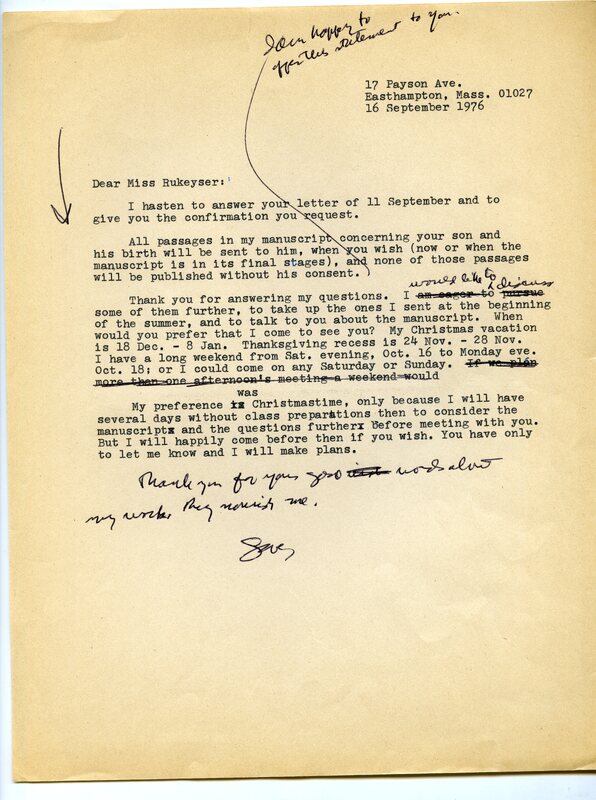
An original typewritten letter [perhaps a draft], dated September 16th, 1976. The letter is from Louise Kertesz to Muriel Rukeyser. Louise begins the letter by saying that she hurried to answer Rukeyser’s letter sent on September 11th. Louise confirms that all passages in her manuscript about Rukeyser’s son and his birth will be sent to him, whenever Rukeyser wished, and that none of the passages will be published without his consent. Louise thanks Rukeyser for answering her questions. Louise would like to discuss some of them further, to take up the ones that she sent Rukeyser at the beginning of the summer, and to talk with her about the manuscript. Louise asks when Rukeyser would prefer for Louise to come and see her. Her Christmas vacation is December 18th to January 6th. Her Thanksgiving recess is November 24th to November 28th. Louise has a long weekend from Saturday evening, October 16th to Monday evening on October 18th, or she could come to see Muriel on any Saturday or Sunday. Her preference is Christmastime, because she will have several days without class preparations then. However, Louise could come before Christmas if Rukeyser wishes. Rukeyser only has to let Louise know and she will make plans. Some sections of the letter are crossed out, with additional writing included.
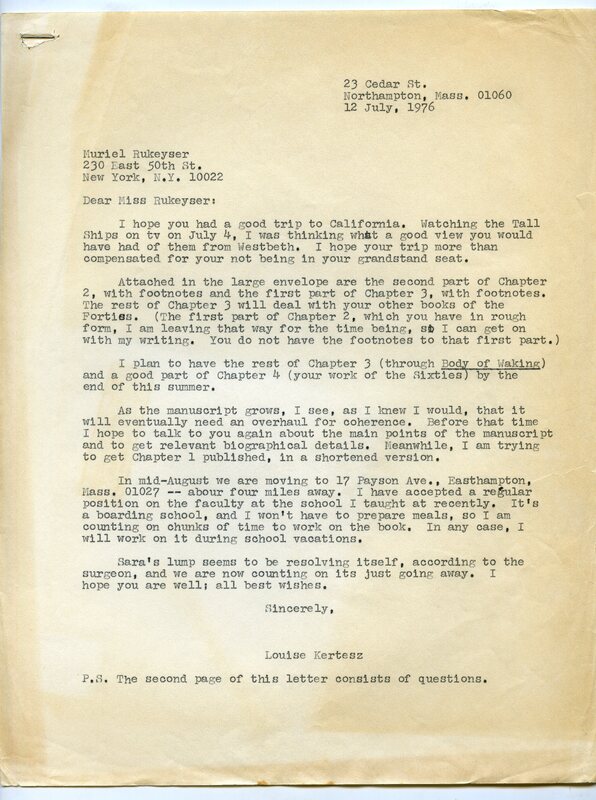
An original, typewritten copy of a letter, dated July 12th, 1976. The letter is from Louise Kertesz to Muriel Rukeyser. Louise begins the letter by saying that she hopes that Rukeyser had a good trip to California. Louise watched the Tall Ships on July 4th and was thinking about what a good view Rukeyser would have had of them from Westbeth. Louise attached the second part of Chapter 2 of her book in the envelope, with footnotes, and the first part of Chapter 3. Chapter 3 will deal with Rukeyser’s books from the 40s. Louise had given Rukeyser the first part of Chapter 2 in rough copy, and she is leaving it that way for the time being. Louise plans to get Chapter 3 and a good part of Chapter 4 done that summer. As Louise’s manuscript grows, she sees that it needs an overhaul for coherence. Before that time, Louise hopes to talk to Rukeyser again and to get relevant biographical details. She is also trying to get Chapter 1 published in a shortened version. In mid august, Louise and her family are moving to 17 Payson Avenue in Easthampton, Massachusetts. Louise accepted a position on the faculty at the school that she taught at recently. It is a boarding school, and she won’t have to prepare meals, so she is counting on a lot of extra time to work on her book. In any case, she will also work on the book on school vacation. Sara’s lump seems to be resolving itself according to the surgeons, and now they are expecting it to just go away. Louise ends the letter by sending Rukeyser her best wishes. A postscript says that the second part of the letter consists of questions.
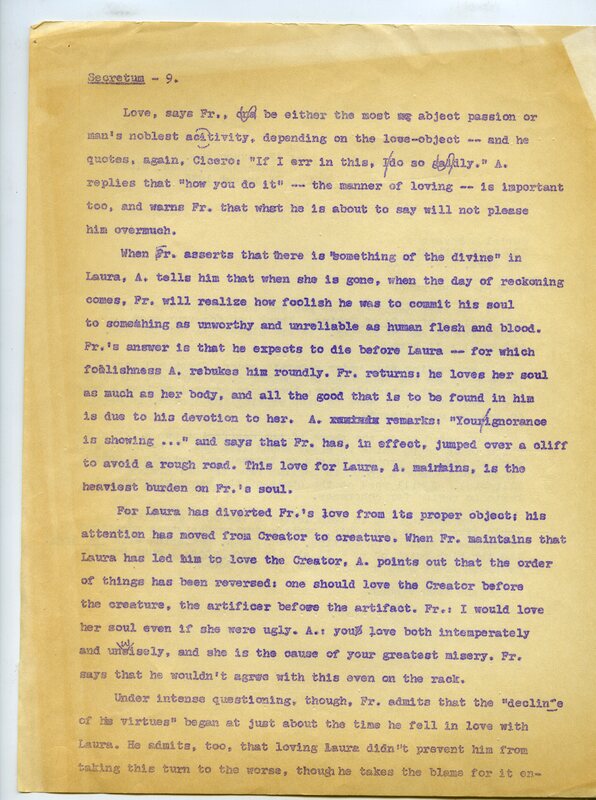
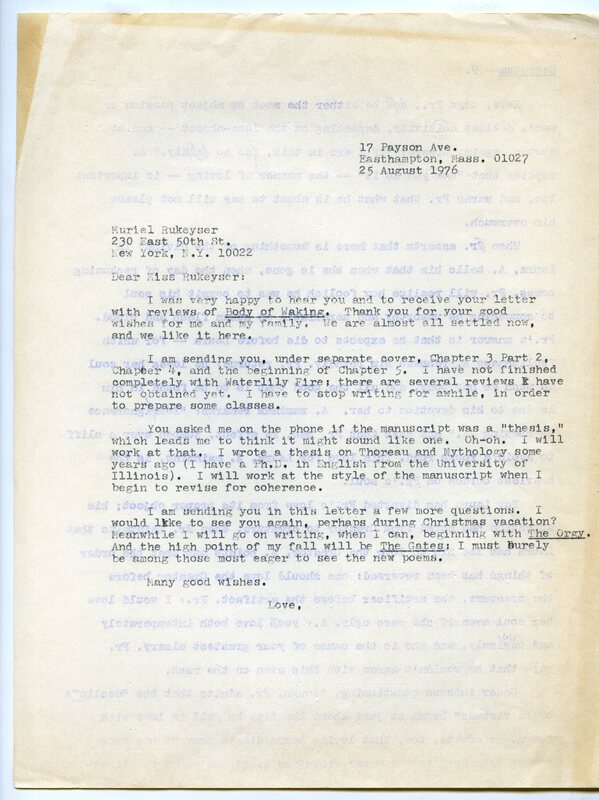
Original handwritten letter, dated August 25th, 1976. The letter is from Louise Kertesz to Muriel Rukeyser. Louise begins the letter by saying that she was happy to hear from Rukeyser and receive her letter with reviews for Body of Waking. Louise also thanks Rukeyser for her fond wishes for her and her family; they are almost settled in their new home, which they like. Louise is sending Rukeyser, under separate cover, Chapter 3 Part 2, Chapter 4, and the beginning of Chapter 5 of her book. Louise has not finished totally with Waterlily Fire, since there are several reviews she has not obtained. Louise will also have to stop working for a while, in order to prepare for her classes. Muriel had asked Louise on the phone if the manuscript was a thesis, which leads Louise to think that it might sound like one. Louise assures Rukeyser that she will make sure it won’t sound like a thesis. Louise had written a thesis on Thoreau and Mythology some years ago, since she has a Ph.D. in English from the University of Illinois, and she will work on the style of the manuscript when she begins to revise for coherence. Louise is sending Rukeyser a few more questions. She would like to see Rukeyser again, perhaps during Christmas vacation. Louise will continue writing while she can, beginning with The Orgy. The high point of her fall will be writing about The Gates. Louise states that she is surely among "those most eager to see the new poems." On the back of the letter is what looks like the fragment of an essay Louise may possibly have written during Graduate School.
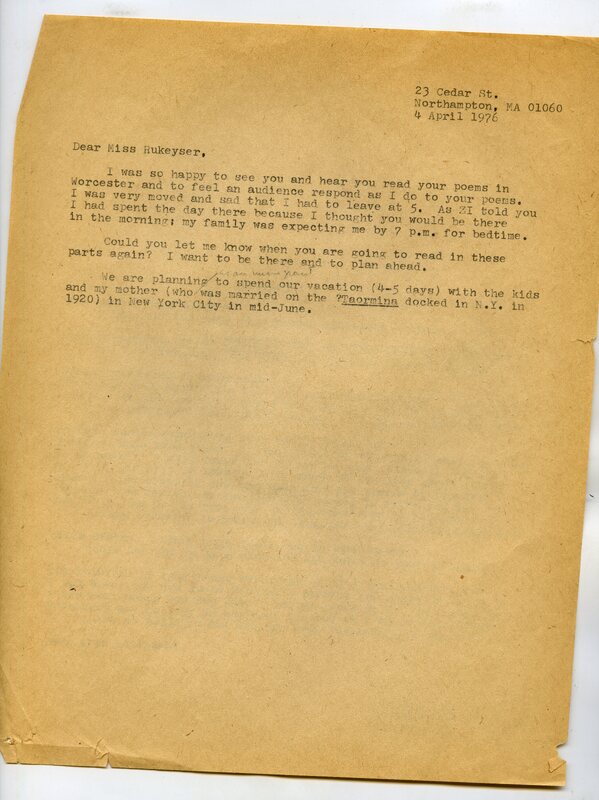
An original, typewritten letter, dated April 4th, 1976. The letter is from Louise Kertesz to Muriel Rukeyser. Louise begins the letter by saying that she was happy to hear Rukeyser read her poems in Worcester, and to see an audience respond to the poems the way she herself did. She was moved by her poems, and was sad that she had to leave at 5 o’ clock. Louise had spent the day there, expecting Rukeyser would be there in the morning, but had to leave early since her family expected her home at 7 pm for bedtime. Louise asks Rukeyser to tell her when she will read the poems again, so she can plan ahead. Louise then says that her family is planning to spend her vacation, which will last 4 to 5 days, with the kids and her mother in New York City in June. Louise tells Rukeyser about her mother, an immigrant from Italy, who in 1920 "was married on the Taormina docked in N.Y., and she has always loved visiting the standards: the Statue of LIberty, etc." Should Rukeyser read her poems in New York, Louise wants to be there. Louise will phone Rukeyser before they come to see whether or not Rukeyser can spare them some time. It would give Louise and Chris, her husband, great pleasure if they could take her to dinner. Louise is enclosing questions with this letter. Louise states that Muriel was very kind to suggest taped replies. If Rukeyser would prefer, they can wait until a meeting in mid-June. Louise then thanks Rukeyser for her warm encouragement, and tells her she is deeply committed to her work. Louise will be teaching Moby Dick for the next few weeks, but she is teaching Rukeyser’s works Breaking Open and The Speed of Darkness in another class. Louise ends the letter hoping that Rukeyser is doing well. Incomplete copy of letter on the back of the sheet.
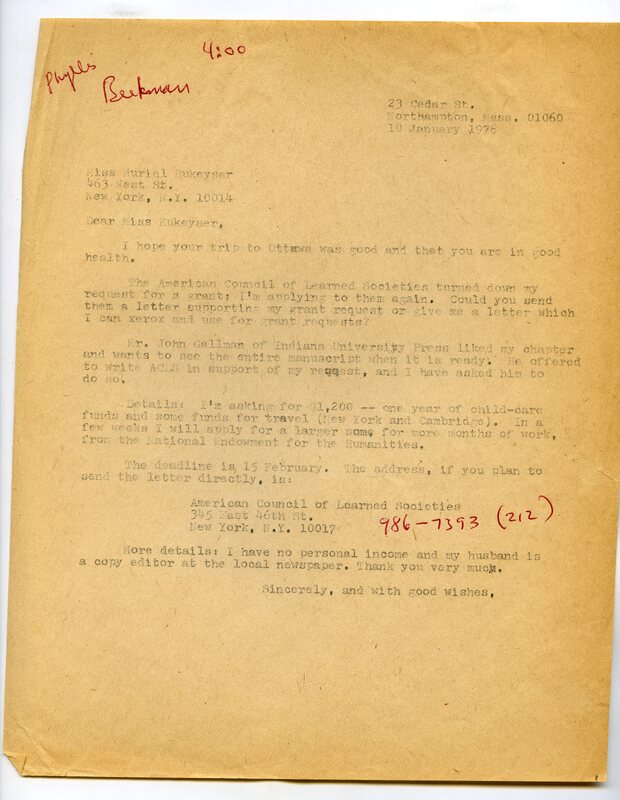
Dated January 10th, 1976. A worn, typewritten letter from Louise Kertesz to Muriel Rukeyser. Kertesz hopes that Muriel’s trip to Ottawa was good and that she is in good health. The American Council of Learned Societies turned down her request for a grant, and she is applying to them again. Louise asks for Rukeyser to send her a letter supporting her petition for a grant. She is asking for $1,200 dollars, for one year of child-care and some funds for travel to New York and Cambridge. (Today, that amount would be approximately $6,028).
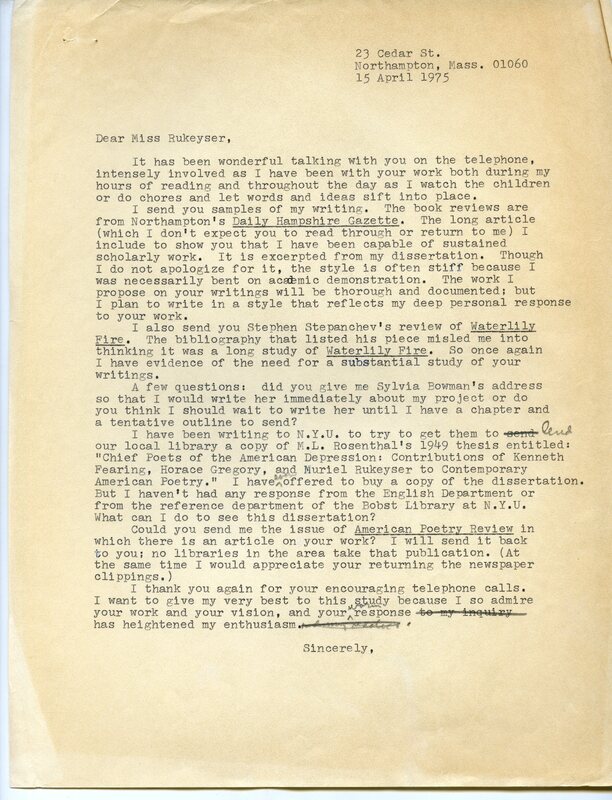
An original, typewritten letter, dated April 15th, 1975. The letter is from Louise Kertesz to Muriel Rukeyser. Louise states that it has been wonderful talking with Rukeyser on the telephone. Louise has been intensely involved with Rukeyser’s work, during her hours of reading and even throughout the day when she watches her children do chores. Louise sent Rukeyser samples of her writing. The book reviews are from Northampton’s Daily Hampshire Gazette. The long article, which Louise doesn’t expect Rukeyser to read fully or even send back to her, is intended to show that she can do scholarly work. It is an excerpt from her dissertation. Louise does not apologize for it, but explains that the style is often stiff because she was bent on academic approbation. The work that Louise proposes to do on Rukeyser’s writings will be thorough and documented, but in a style that reflects her deep personal response to her work. Louise also sent Rukeyser Stephen Stepanchev’s review of Waterlily Fire. The bibliography had misled Louise into thinking it was a long study of Waterlily Fire. Once again, this gives Louise evidence of the need for a substantial study of Rukeyser's writings. Louise wrote to New York University trying to get hold of M.L. Rosenthal’s 1949 thesis entitled “Chief Poets of the American Depression: Contributions of Kenneth Fearing, Horace Gregory, and Muriel Rukeyser to Contemporary American Poetry.” Louise also asks Muriel Rukeyser to send her a copy of American Poetry Review in which her work is featured in an article. Louise will send it back to Rukeyser. Louise ends the letter by thanking Rukeyser for her encouraging telephone calls. Louise wants to give her very best to the proposed study because she admires Rukeyser’s work and her vision, and also due to the fact that Rukeyser’s response has heightened her enthusiasm.
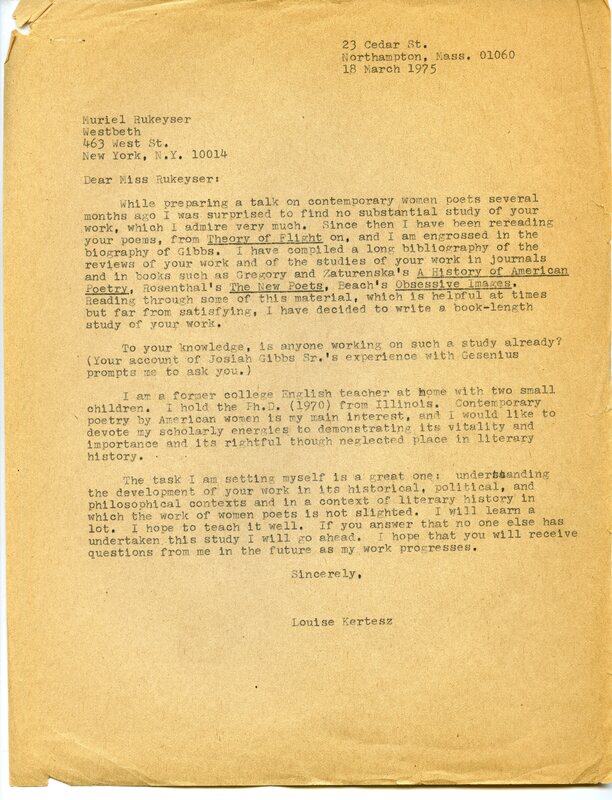
Original, fragile, typewritten letter, dated March 18th, 1975. The letter is from Louise Kertesz to Muriel Rukeyser. This is the first letter Louise wrote to Rukeyser. While Louise was preparing a talk on contemporary women poets several months ago, she was surprised to find that no substantial study had been done on Muriel Rukeyser’s work. Since then, Louise had been reading her poems, from Theory of Flight on, and is currently engrossed in her biography of Gibbs. Louise has compiled a long bibliography of the reviews of Rukeyser's work and of the studies of Rukeyser’s work in journals and in books such as Gregory and Zaturenska’s A History of American Poetry, Rosenthal’s The New Poets, Beach’s Obsessive Images. Reading through this material, which was helpful at times but far from satisfying, compelled her to write a book-length study of Muriel Rukeyser’s work. Louise asks Muriel if she knows whether or not anyone has been working on a study already, Rukeyser’s account of Josiah Gibbs Sr. 's experience with Gesenius prompted her to ask Rukeyser. Louise describes herself as a former college English teacher with a PhD from Illinois, presently at home with two small children. Contemporary poetry by American Women is Louise’s main interest. Louise would like to devote her scholarly energies to demonstrating the vitality of Rukeyser’s work and give it its proper place in literary history. The task that Louise is setting for herself is a great one, which is to understand the development of Rukeyser’s work in its historical, political, and philosophical contexts and in a context in which the work of women poets is not slighted. Lousie will learn a lot, and hopes to teach it well. If Rukeyser says that no one else has undertaken a study of her work, Louise will begin her own. She ends the letter by saying that she hopes that Rukeyser is willing to respond to questions from Louise as the work progresses.
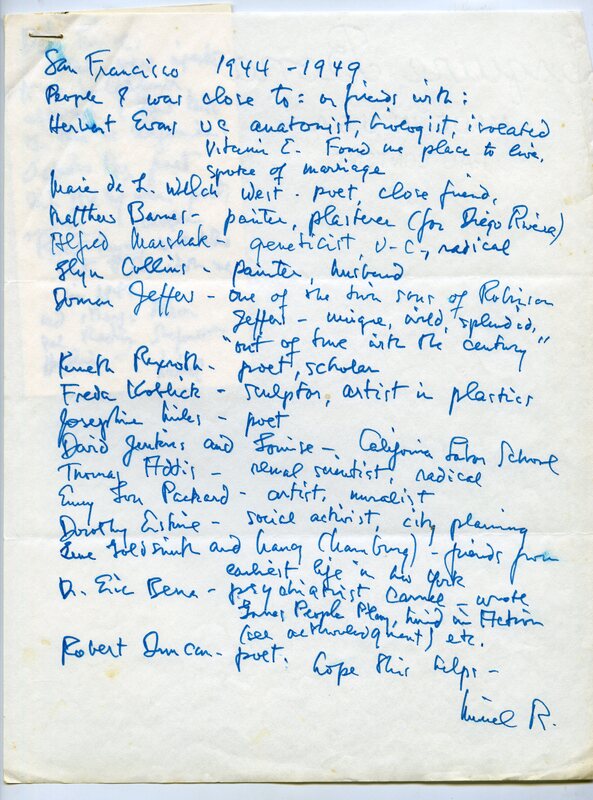
Undated, labeled "San Francisco 1944-1949." Handwritten by Muriel Rukeyser, it contains a list of people whom Muriel was close to and their occupations while she lived in S.F.: Herbert Evans, US anatomist, biologist; Marie de L. Welch, writer, poet, “close friend”; Matthew Barnes, painter, plasterer for Diego Rivera; Alfred Marshak, geneticist, U-C, radical; Glyn Collins, “painter, husband”; Donan Jeffers, “one of the twin sons of Robinson Jeffers–unique, wild, splendid, ‘out of time with the century’”; Kenneth Rexroth, “poet, scholar”; Freda Koblick, “sculptor, artist in plastics; Josephine Miles, poet; David Jenkins and Louise, California Labor School; Thomas Addis, renal scientist, radical; Emmy Lou Packard, artist, muralist; Dorothy Erskine, social activist, city planning; Lena [?] Goldsmith and Nancy Naumburg, “friends from earliest life in New York”; Dr. Eric Berne, psychiatrist Carmel–wrote Games People Play; Robert Duncan, poet. The list is stapled to a postcard from Muriel Rukeyer to Louise Kertesz in which she mentions additional people who “were important to me in California.”
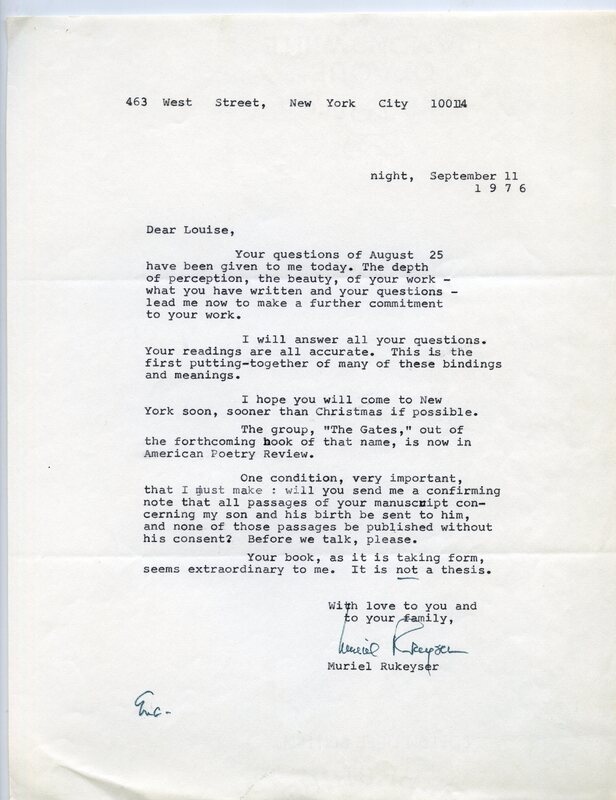
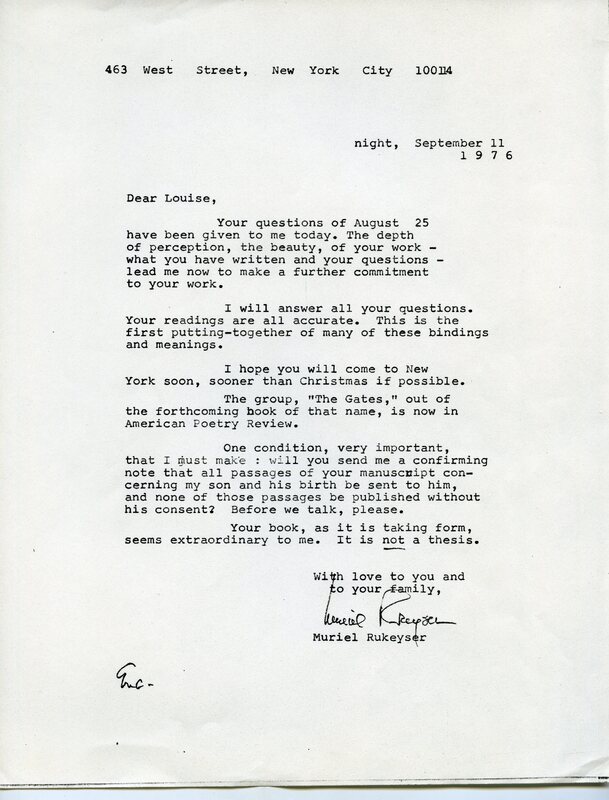
Dated September 11th, 1976. A typewritten note From Muriel Rukeyser to Louise Kertesz. Muriel received Louise’s questions of August 25th, and she praises “The depth of perception, the beauty, of your work - what you have written and your questions lead me now to make a further commitment to your work.” "I will answer all your questions. Your readings are all accurate. This is the first putting-together of many of these bindings and meanings." There is “one condition, very important, that I must make: will you send me a confirming note that all passages in your manuscript concerning my son and his birth be sent to him, and none of those passage be published without his consent?” Muriel ends by saying, “Your book, as it is taking form, seems extraordinary to me. It is not a thesis.”
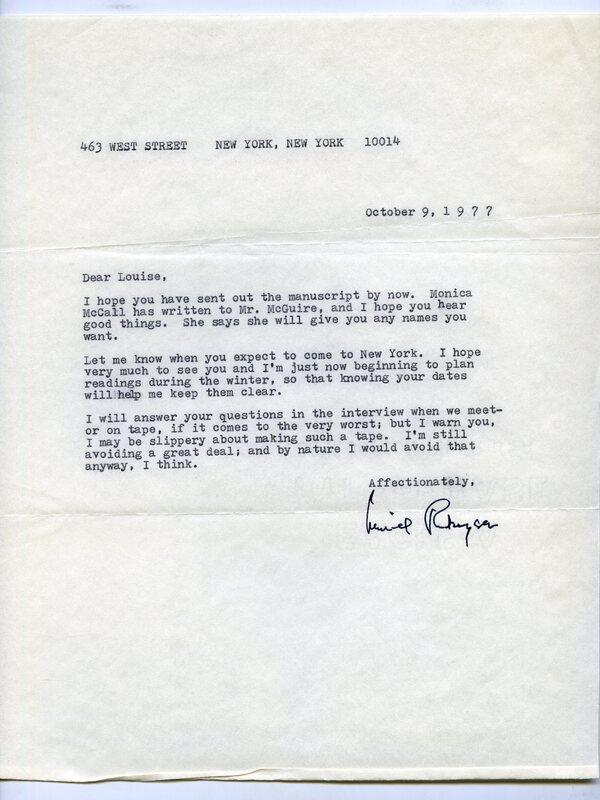
Original, typewritten letter, from October 9th, 1977. The letter is from Muriel Rukeyser to Louise Kertesz. Muriel states that she hopes that Louise has sent out the manuscript by now. Monica McCall has written to Mr. McGuire, and Rukeyser hopes that Louise hears good things. Monica says that she will give Louise any names she wants. Muriel asks Louise to let her know when she intends to come to New York. She is now planning poetry readings that will take place over the winter, so knowing the dates of Louise's visit will help her plan out her final schedule. Rukeyser will answer Louise’s questions in the interview when they meet, or on tape, "if it comes to the very worst." She warns Louise that she may be "slippery" when it comes to making such a tape: "I'm still avoiding a great deal; and by nature I would avoid that anyway...."
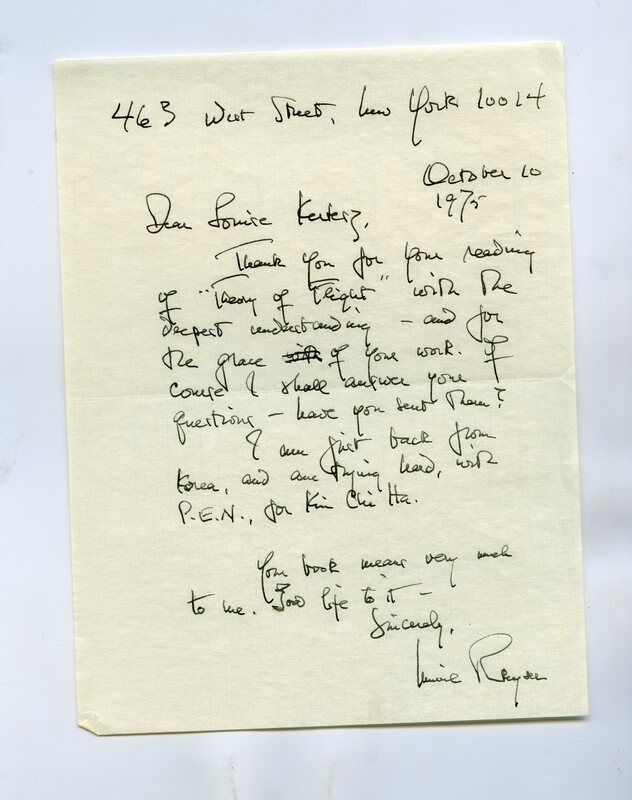
Original handwritten letter, dated October 10th, 1975. The letter is from Muriel Rukeyser to Louise Kertesz. Rukeyser thanks Louise for reading her work, Theory of Flight, "with the deepest understanding - and for the grace of your work." Rukeyser states that she will answer Louise’s questions, and asks if she has sent them. Rukeyser just came back from Korea and is "trying hard, with P.E.N., for Kim Chi Ha." Muriel ends the letter by saying that Louise’s book means a lot to her.
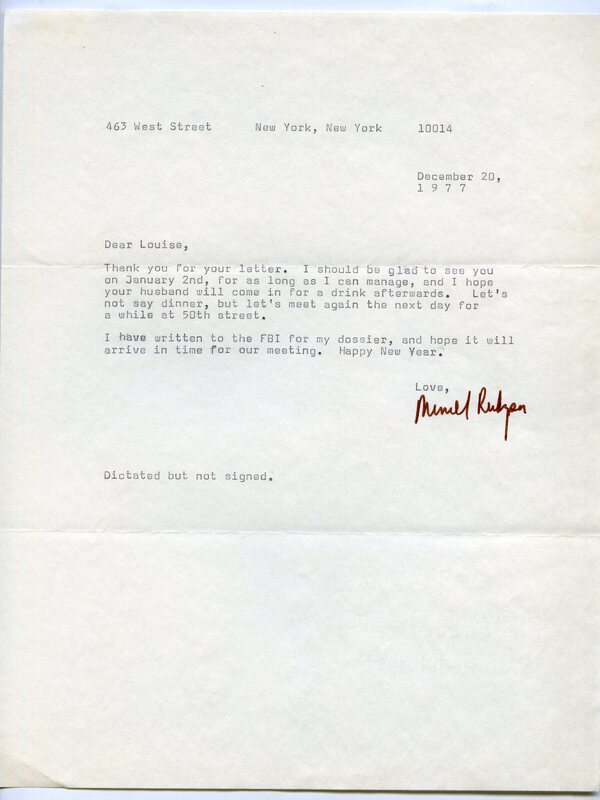
Original, typewritten letter, dated December 20th, 1977. The letter is from Muriel Rukeyser to Louise Kertesz. Rukeyser thanks Louise for her letter. She will be glad to see Louise on January 2nd for as long as she can manage. Muriel hopes that Louise’s husband will come in for a drink afterwards, Muriel doesn’t want to make dinner plans, but wants to meet Louise a little bit the next day at 50th Street. Rukeyser had written to the FBI for her dossier, and she hopes it will arrive in time for their meeting. Rukeyser ends the letter by wishing Louise a Happy New Year.
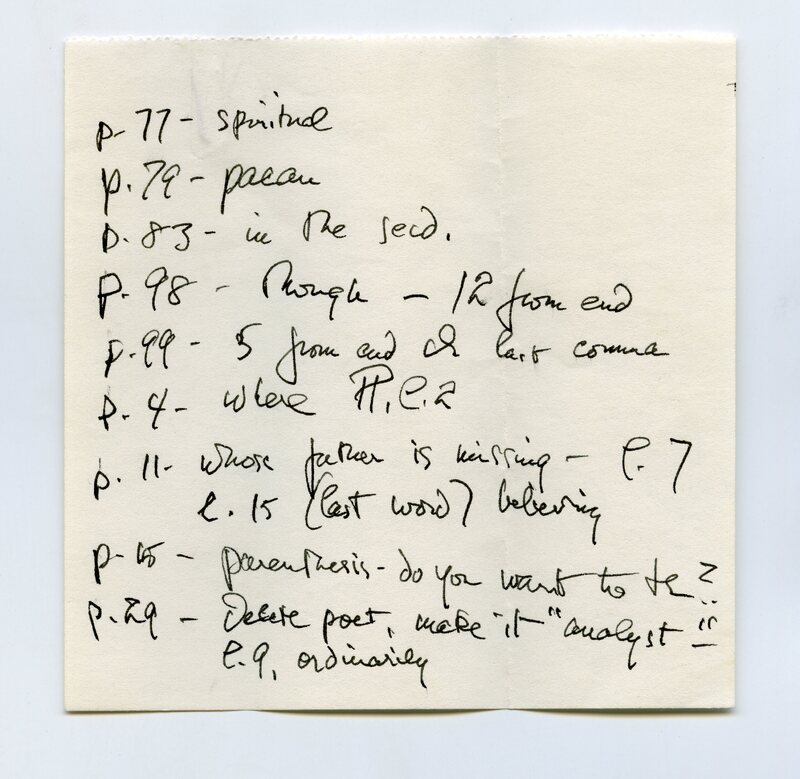
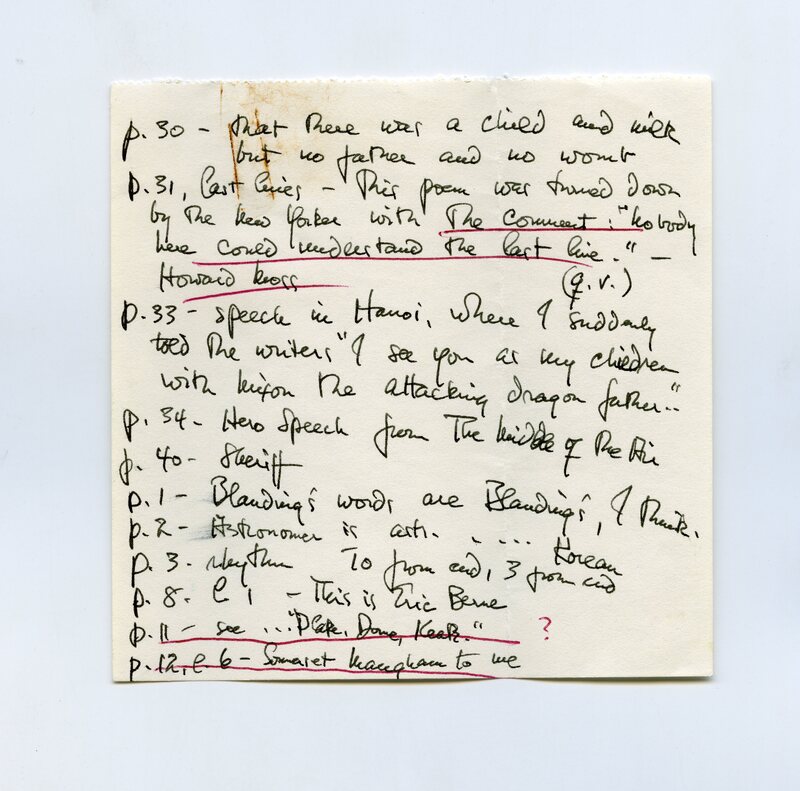
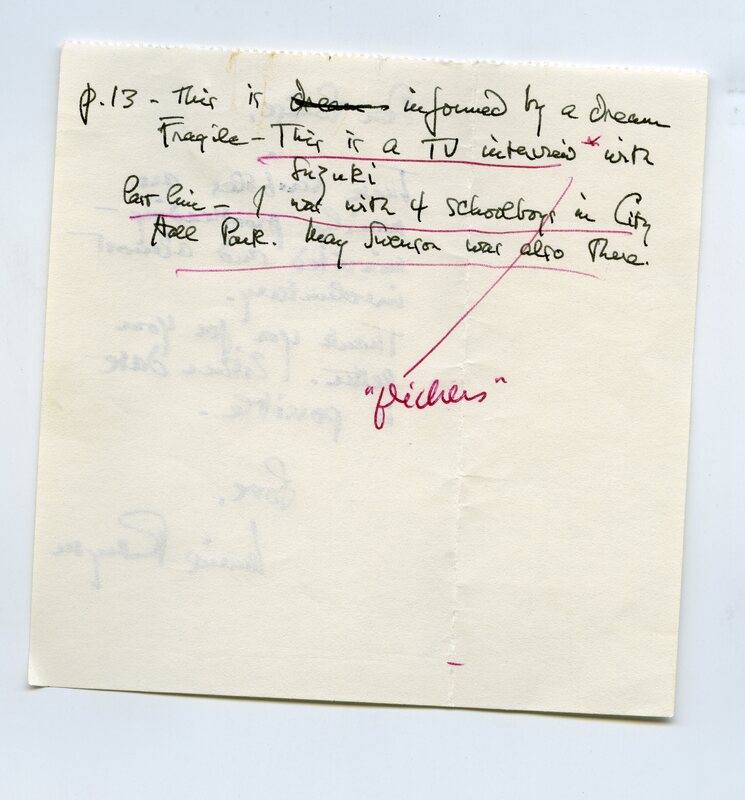
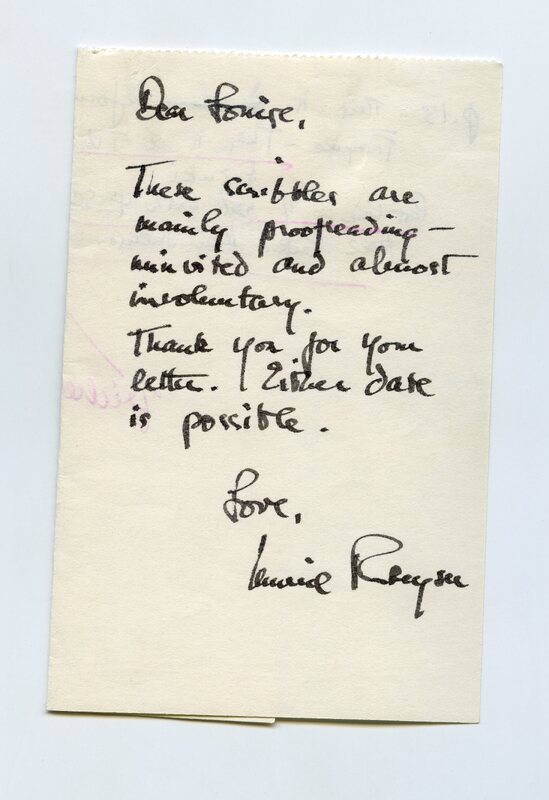
Dated September 8th, 1978, from Muriel Rukeyser to Louise Kertesz. Envelope with three sheets of handwritten editorial notes inside. On the back of one sheet, Muriel writes a short explanatory comment: “These scribbles are mainly proofreading, uninvited and almost involuntary. Thank you for your letter. Either date is possible. Love, Muriel Rukeyser.” The three pieces of paper have page numbers referring to the manuscript of The Poetic Vision of Muriel Rukeyser, with Muriel’s comments next to them. There is a message on the back of the envelope in Muriel’s handwriting: “jotting–a pen just given me by Bill Meredith."
Dated September 8th, 1978, from Muriel Rukeyser to Louise Kertesz. Envelope with three sheets of paper inside. On the back of one sheet, Muriel writes a short note that says, “These scribbles are mainly proofreading, uninvited and almost involuntary. Thank you for your letter. Either date is possible. Love, Muriel Rukeyser.” The three pieces of paper have page numbers with Muriel’s comments next to them. There is a message on the back of the envelope in Muriel’s handwriting: “jotting–a pen just given me by Bill Meredith.
Dated September 8th, 1978, from Muriel Rukeyser to Louise Kertesz. Envelope with three sheets of handwritten editorial notes inside. On the back of one sheet, Muriel writes a short explanatory comment: “These scribbles are mainly proofreading, uninvited and almost involuntary. Thank you for your letter. Either date is possible. Love, Muriel Rukeyser.” The three pieces of paper have page numbers referring to the manuscript of The Poetic Vision of Muriel Rukeyser, with Muriel’s comments next to them. There is a message on the back of the envelope in Muriel’s handwriting: “jotting–a pen just given me by Bill Meredith."
Dated September 8th, 1978, from Muriel Rukeyser to Louise Kertesz. Envelope with three sheets of handwritten editorial notes inside. On the back of one sheet, Muriel writes a short explanatory comment: “These scribbles are mainly proofreading, uninvited and almost involuntary. Thank you for your letter. Either date is possible. Love, Muriel Rukeyser.” The three pieces of paper have page numbers referring to the manuscript of The Poetic Vision of Muriel Rukeyser, with Muriel’s comments next to them. There is a message on the back of the envelope in Muriel’s handwriting: “jotting–a pen just given me by Bill Meredith."
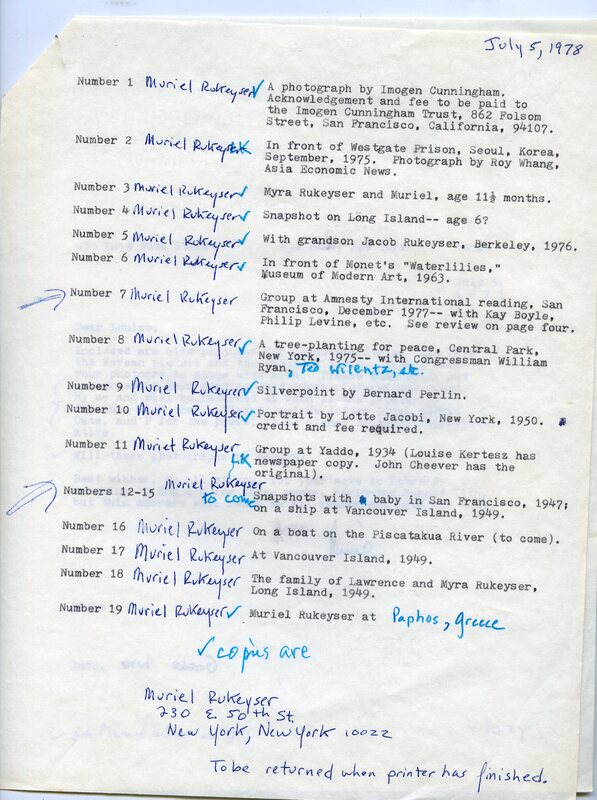
List of typewritten descriptions for photographs that Muriel Rukeyser had prepared for Louise's The Poetic Vision of Muriel Rukeyser, forthcoming from Louisiana University Press. "July 5, 1978," handwritten by Rukeyser at top of page.
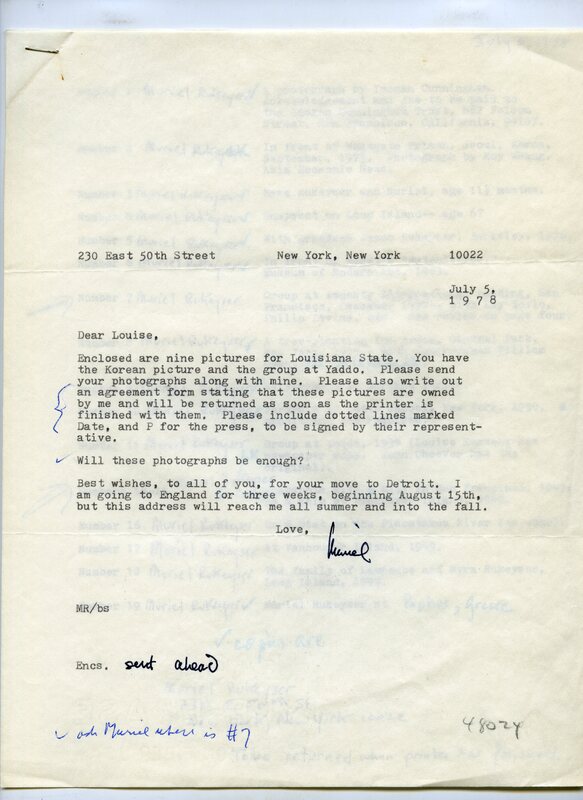
Original typewritten letter, dated July 5th, 1978. The letter is from Muriel Rukeyser to Louise Kertesz. In the letter Rukeyser had enclosed nine pictures for Louisiana State University Press. The letter says that Louise has the Korean picture and the group at Yaddo. Rukeyser asks whether or not these photographs will be enough, and she wishes Louise’s family the best on their move to Detroit. Rukeyser is going to England for three weeks, beginning August 15th, but her address at 230 East 50th Street in New York City "will reach me all summer and into the fall." Stapled to this letter is a page that describes all of the pictures Rukeyser sent to Louise.
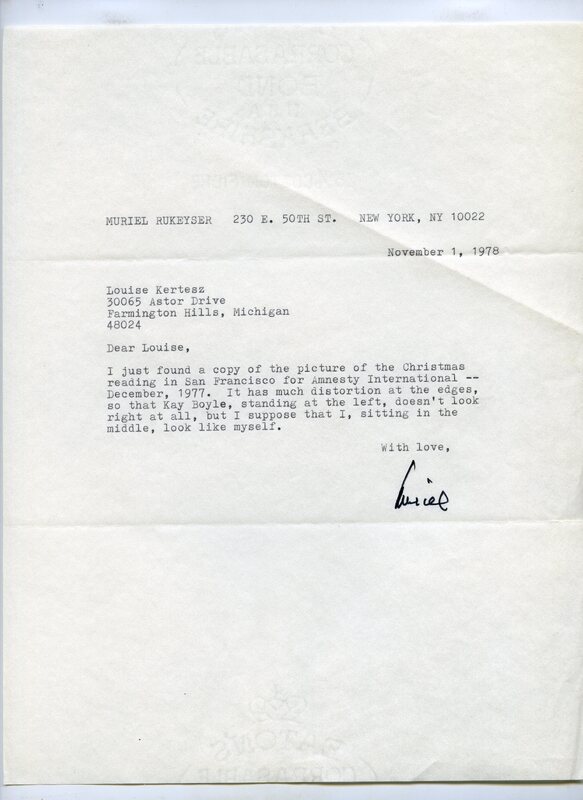
Original, typewritten letter, dated November 1, 1978. The letter is from Muriel Rukeyser to Louise Kertesz. In the letter, Rukeyser tells Louise that she found a copy of the picture of the Christmas reading in San Francisco for Amnesty International in December of 1977. The picture is distorted at the edges, so that Kay Boyle, who was standing on the left of Rukeyser, "doesn't look right at all," but Rukeyser supposes "that I, sitting in the middle, look like myself."
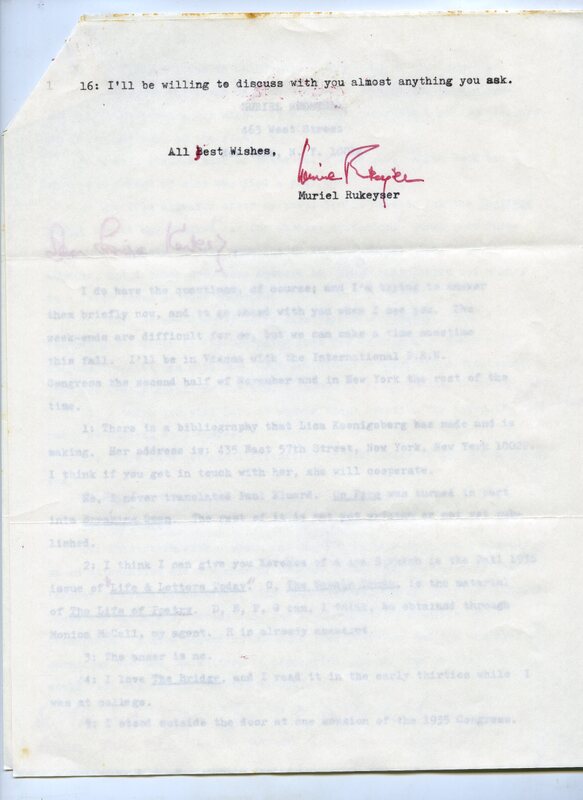
Original typewritten three-page letter, undated, of Muriel Rukeyser to Louise Kertesz, answering sixteen questions. Rukeyser ends her letter by responding to question 16 with the following words: "I'll be willing to discuss with you almost anything you ask." Page 3 of 3.
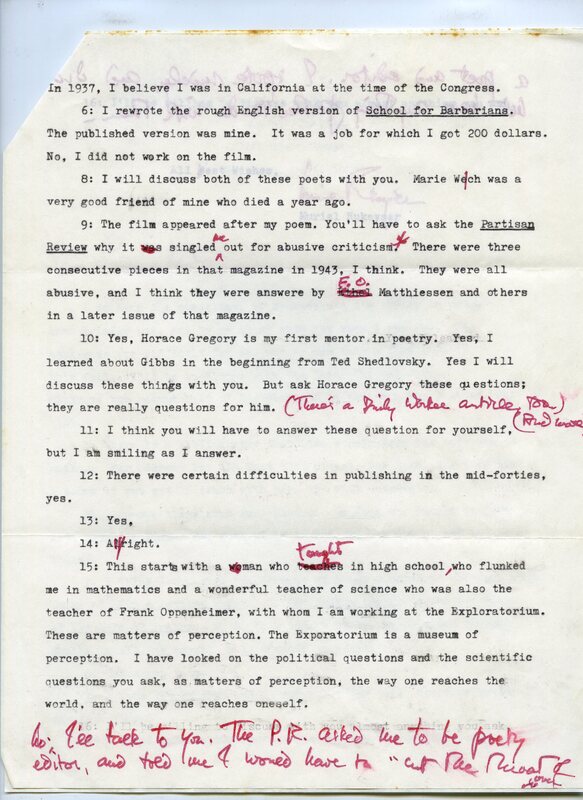
Original typewritten three-page letter, undated, of Muriel Rukeyser to Louise Kertesz, answering sixteen questions. Rukeyser's answers are wide-ranging. In answer to a question about her involvement in the publication of Erika Mann's book School for Barbarians: Education Under The Nazis, she clarifies that "I rewrote the rough English version ... The published version was mine. It was a job for which I got 200 dollars." She also addresses the Partisan Review debacle and suggests that Kertesz ask the editors directly "why it [her poem "Wake Island"] was singled out for abusive criticism." In another answer, she mentions a "wonderful teacher of science who was also the teacher of Frank Oppenheimer, with whom I am working at the Exploratorium ...The Exploratorium is a museum of perception. I have looked on the political questions and the scientific questions you ask, as matters of perception, the way one reaches the world, and the way one reaches onself." Page 2 of 3.
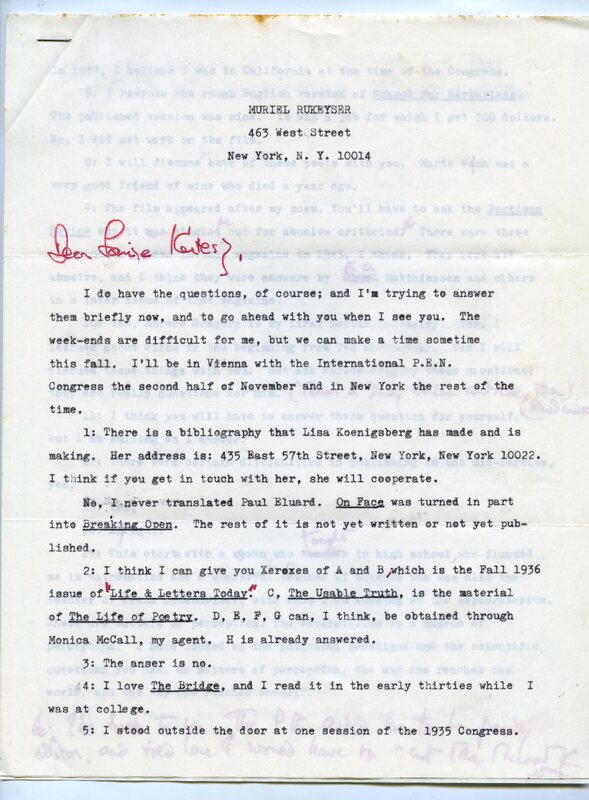
Original typewritten three-page letter, undated, of Muriel Rukeyser to Louise Kertesz, answering sixteen questions. Rukeyser's answers are wide-ranging. She mentions a poem "On Face," which may have been inspired by a Paul Eluard poem: "On Face was turned in part into Breaking Open. The rest of it is not yet written or not yet published." Page 1 of 3.
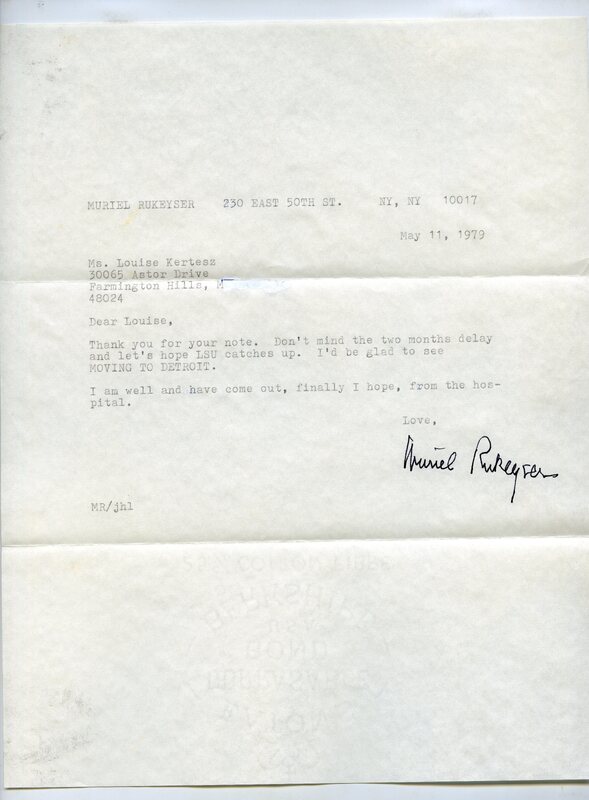
An envelope dated May 21st, 1979, with a letter dated May 11th, 1979. The letter is from Muriel Rukeyser to Louise Kertesz. Rukeyser begins the letter by thanking Louise for her note. Rukeyser also tells Louise to not mind the two-month delay and to hope that LSU catches up. Furthermore, Rukeyser says that she will be glad to see MOVING TO DETROIT [Kertesz''s manuscript of poems which she submitted to Louisiana State University]. Rukeyser ends the letter by saying that she is doing well and that she may be ready to leave the hospital.
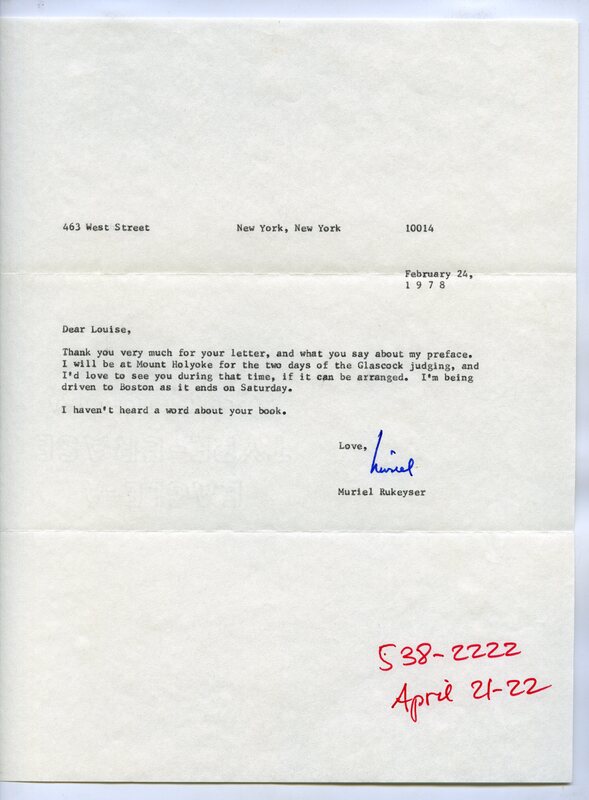
Original typewritten letter, dated February 24th. 1978. From Muriel Rukeyser to Louise Kertesz. Muriel thanks Louise for her letter and what she says about her preface [Rukeyser's preface to The Collected Poems of Muriel Rukeyser, published in 1978]. The letter says that Muriel will be at Mount Holyoke for the two days of the Glascock Poetry Contest, and that she would love to see Louise during that time. Muriel is being driven to Boston as the event ends on a Saturday. The letter ends with Muriel saying that she hasn’t heard a word about Louise’s book.
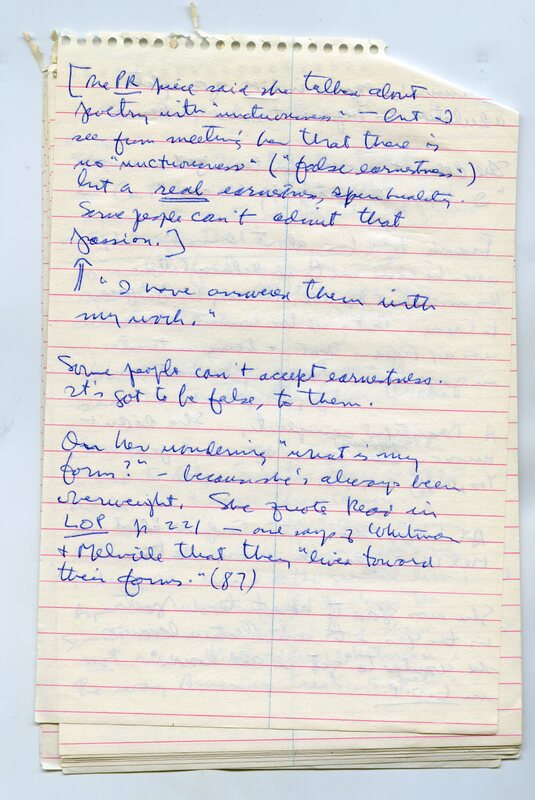
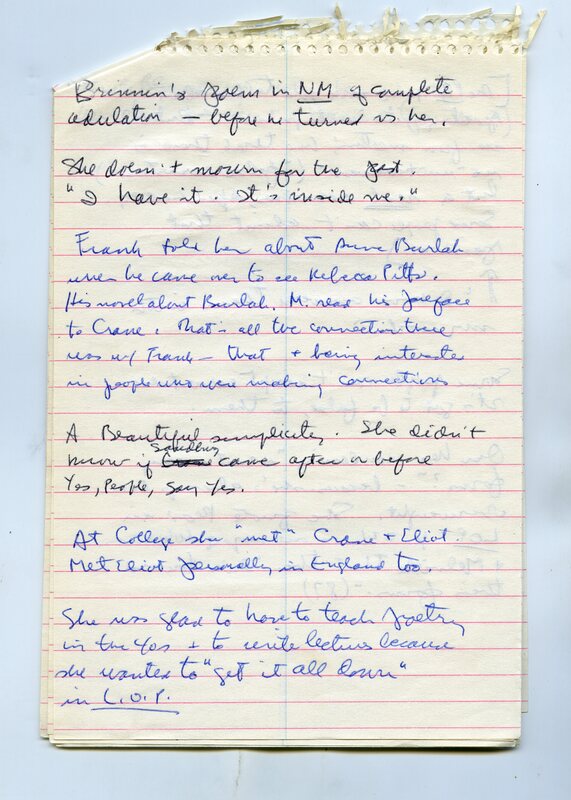
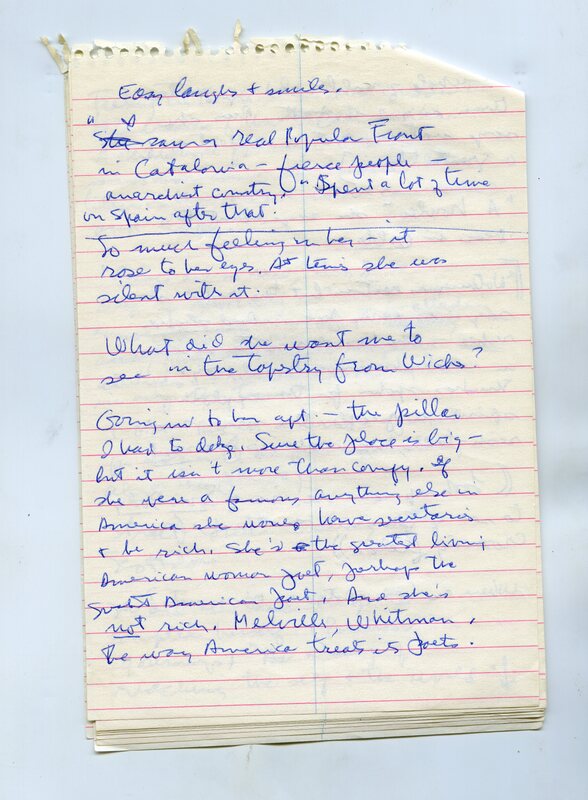
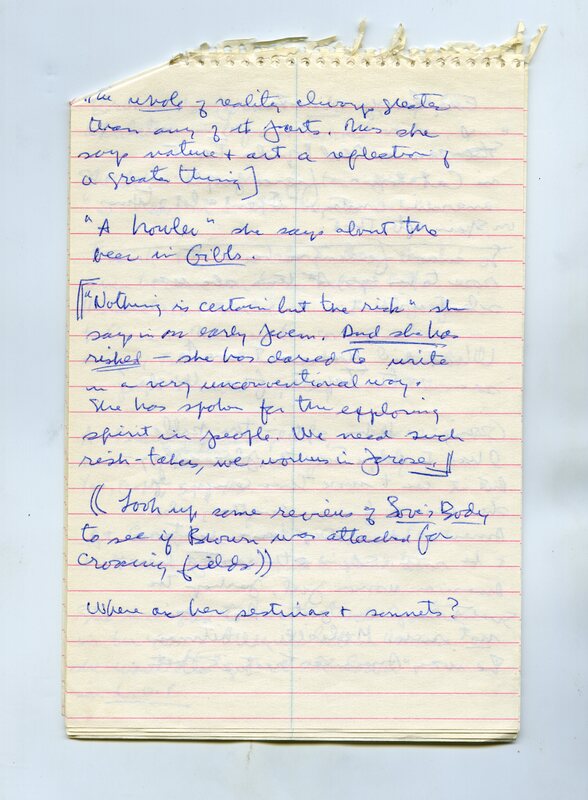
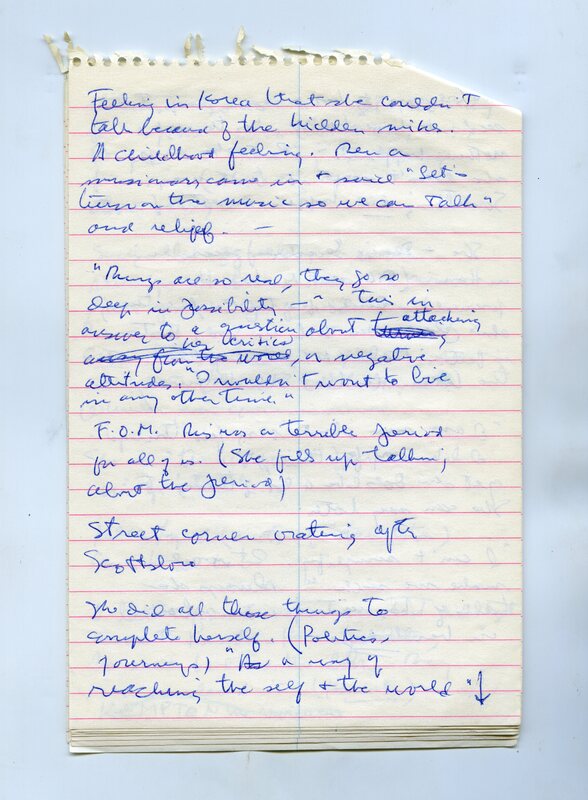
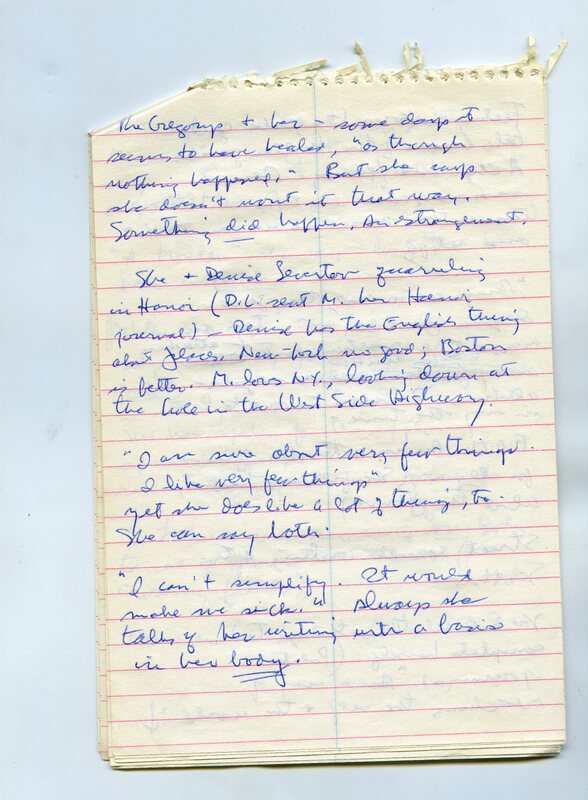
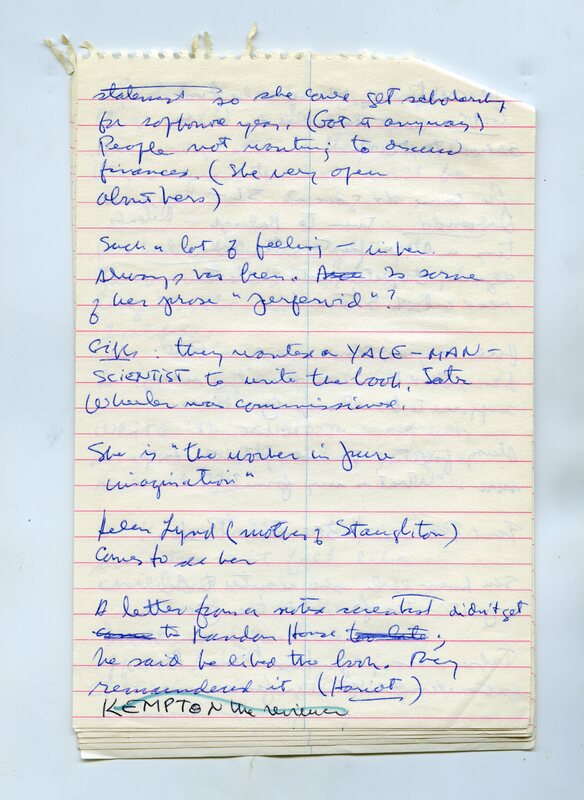
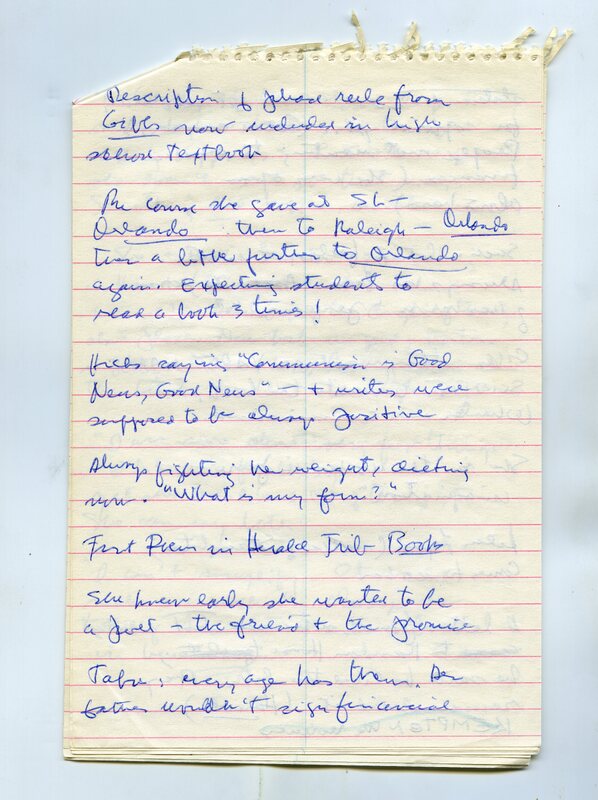
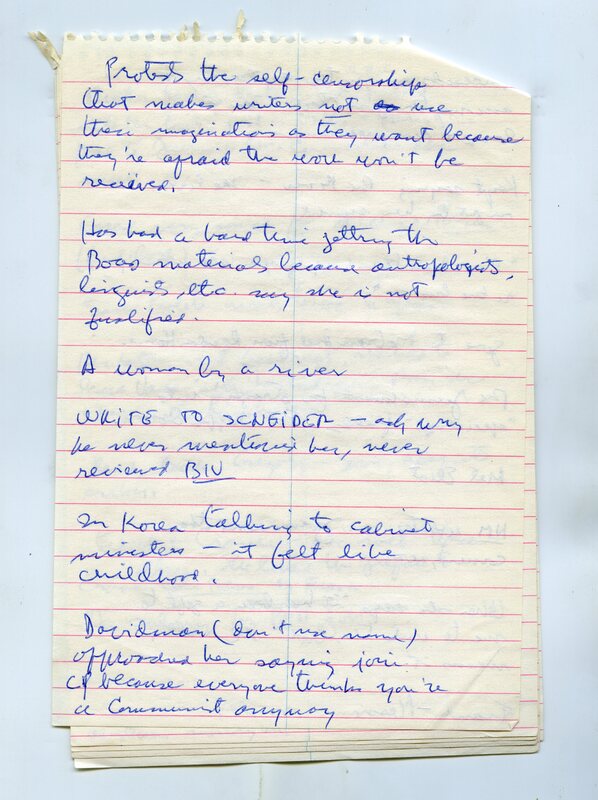
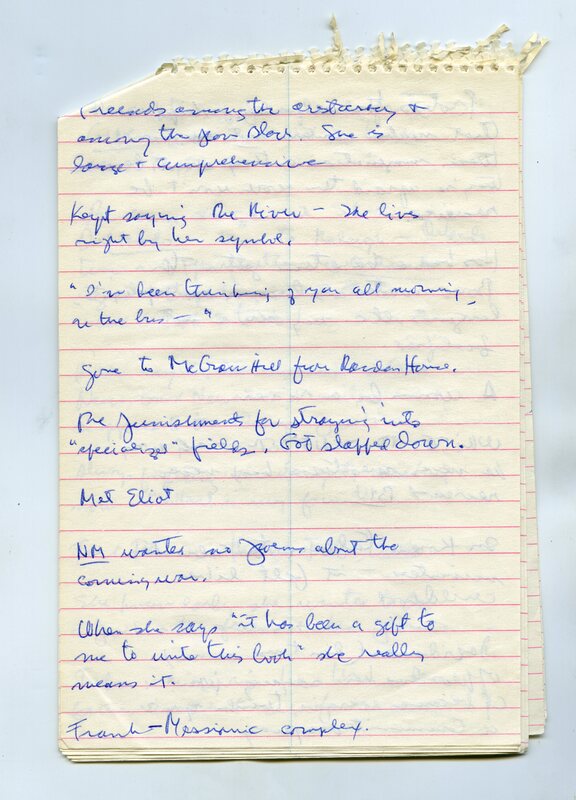
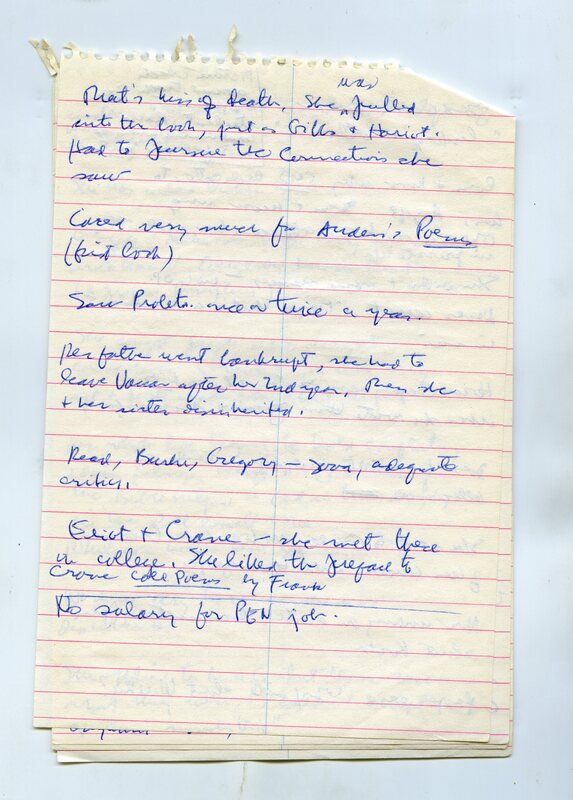
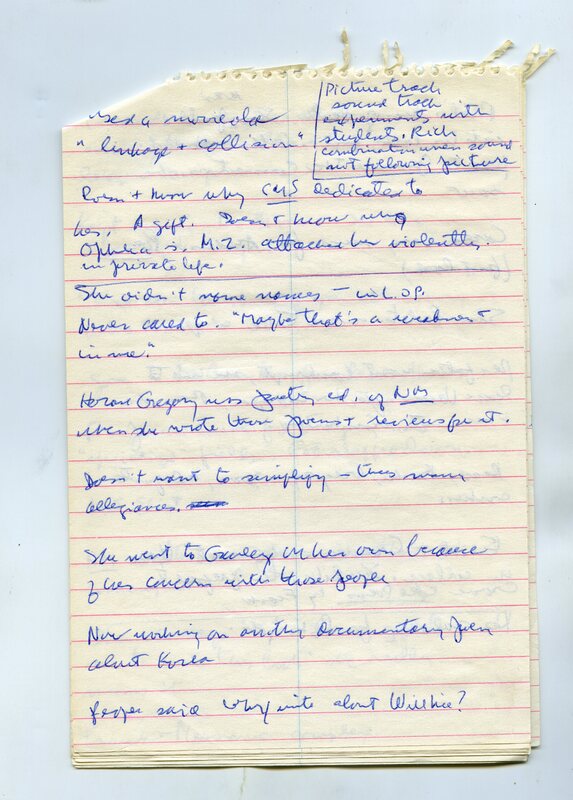
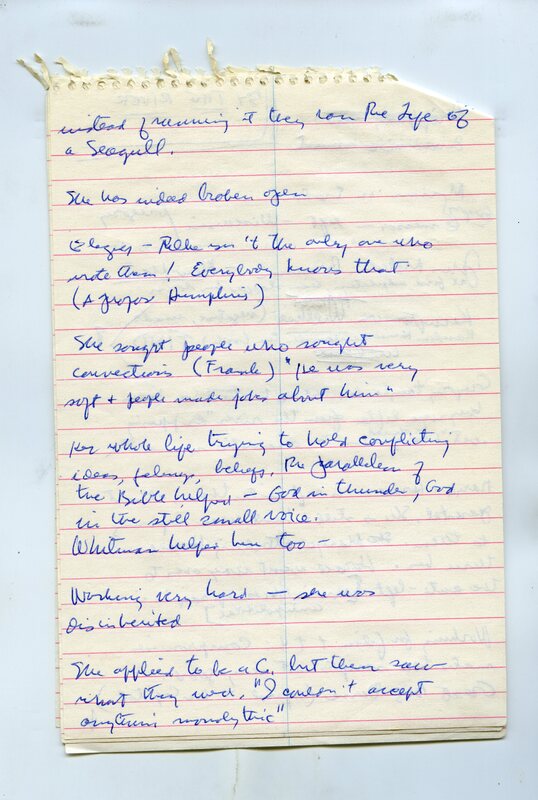
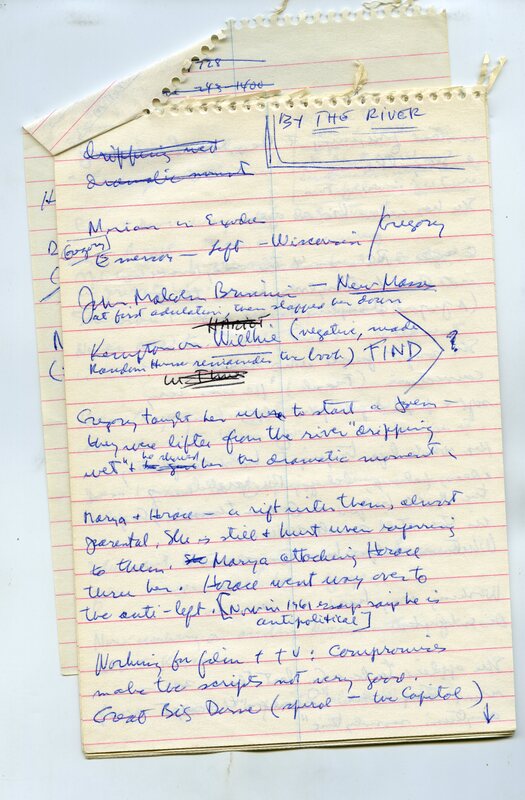
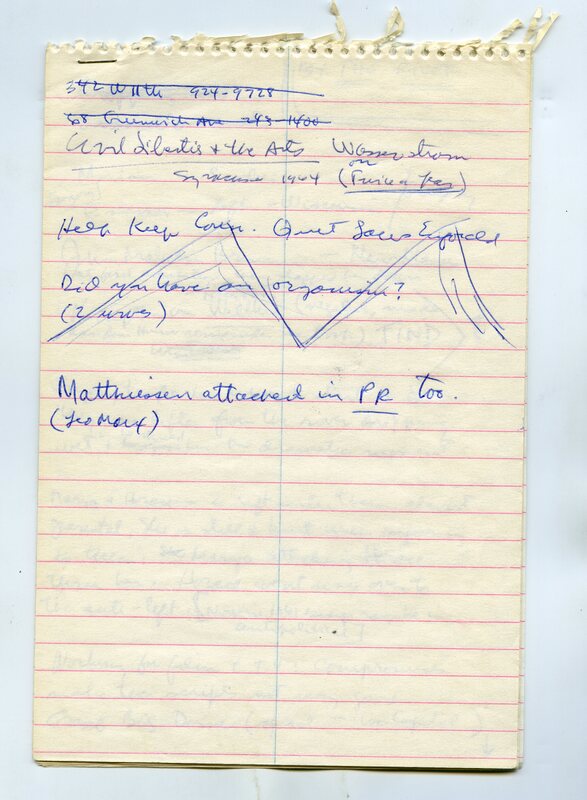
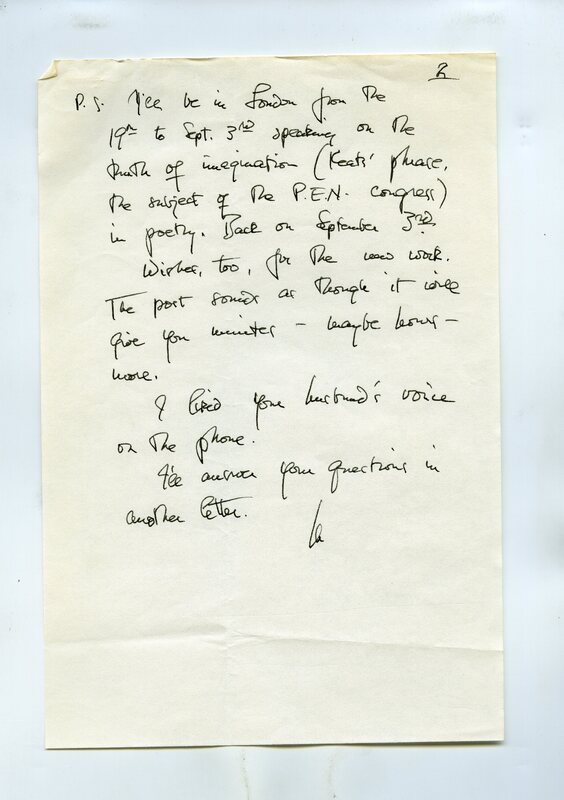
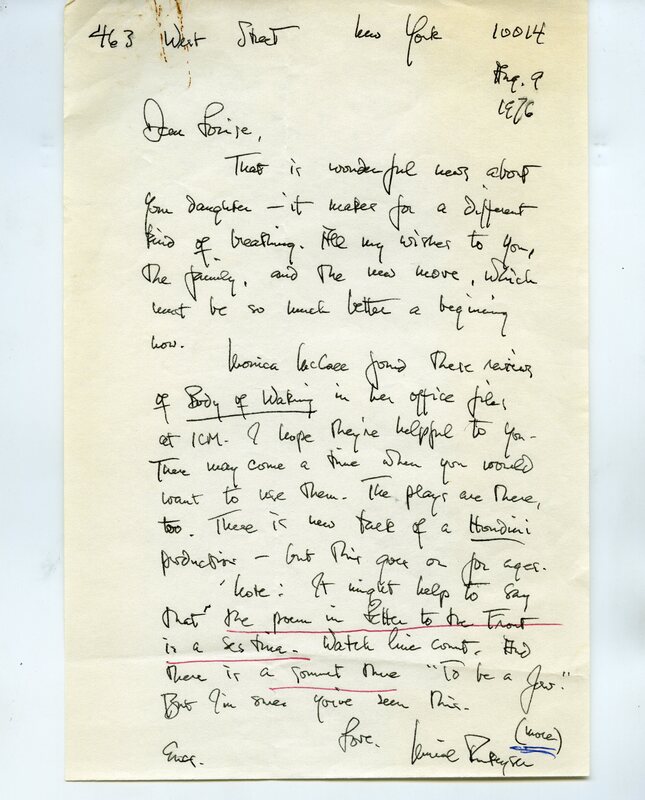
An original handwritten two-page letter to Louise Kertesz from Muriel Rukeyser, dated August 9, 1976. Muriel states that whatever happened to Louise’s daughter is wonderful news, and sends good wishes to Louise and her family. Monica McCall had found reviews of Body of Waking in her office at ICM, along with "the plays." The second part of the letter states that Muriel will be in London from the 19th to September 3rd for the P.E.N. Congress, where she will speak on "the Truth of Imagination" in poetry. Page 2 of 2. The letter is attached with a paper clip to a seventeen-page bundle of Louise's handwritten notes of findings, quotes, observations on Rukeyser. [See documents 018_LK_01_006 to 018_LK_01_023.]
An original handwritten two-page letter to Louise Kertesz from Muriel Rukeyser, dated August 9, 1976. Muriel states that whatever happened to Louise’s daughter is wonderful news, and sends good wishes to Louise and her family. Monica McCall had found reviews of Body of Waking in her office at ICM, along with "the plays." The second part of the letter states that Muriel will be in London from the 19th to September 3rd for the P.E.N. Congress, where she will speak on "the Truth of Imagination" in poetry. Page 1 of 2. The letter is attached with a paper clip to a seventeen-page bundle of Louise's handwritten notes of findings, quotes, observations on Rukeyser. [See documents 018_LK_01_006 to 018_LK_01_023.]
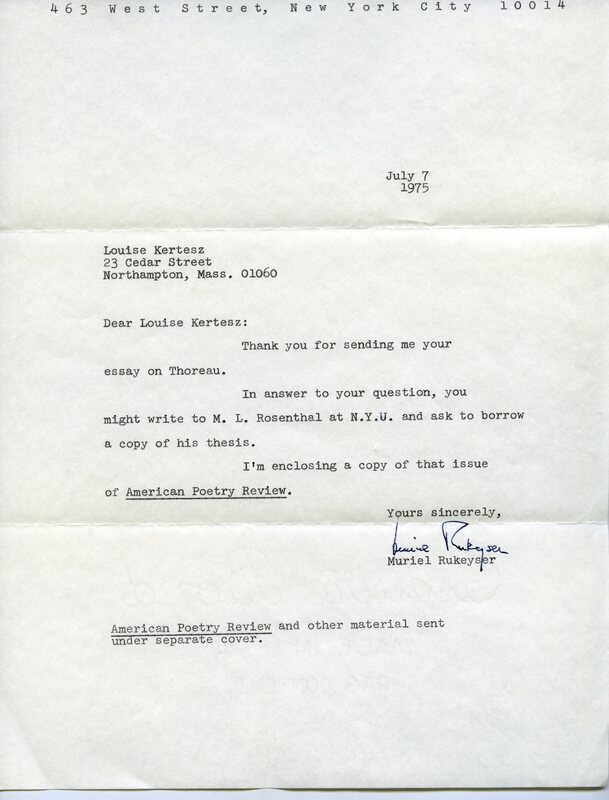
An original, typewritten letter, dated July 7th, 1975. The letter is from Muriel Rukeyser to Louise Kertesz. In the letter, Rukeyser thanks Louise for sending her essay on Thoreau. Rukeyser also provides an answer to Louise’s question [how to access a copy of M.L Rosenthal's 1949 thesis, "Chief Poets of the American Depression: Contributions of Kenneth Fearing, Horace Gregory, and Muriel Rukeyser to Contemporary American Poetry"] and suggests that she write to M.L. Rosenthal at N.Y.U. and ask to borrow a copy of his thesis. Rukeyser ends the letter by saying that she is enclosing a copy of the issue of American Poetry Review that Louise had requested.
Dated September 11th, 1976. A typewritten note From Muriel Rukeyser to Louise Kertesz. Muriel had received Louise’s questions on August 25th, and she praises “The depth of perception, the beauty, of your work - what you have written and your questions - lead me now to make a further commitment to your work.” There is “one condition, very important, that I must make: will you send me a confirming note that all passages in your manuscript concerning my son and his birth be sent to him, and none of those passages be published without his consent?” Muriel ends by saying, “Your book, as it is taking form, seems extraordinary to me. It is not a thesis.”
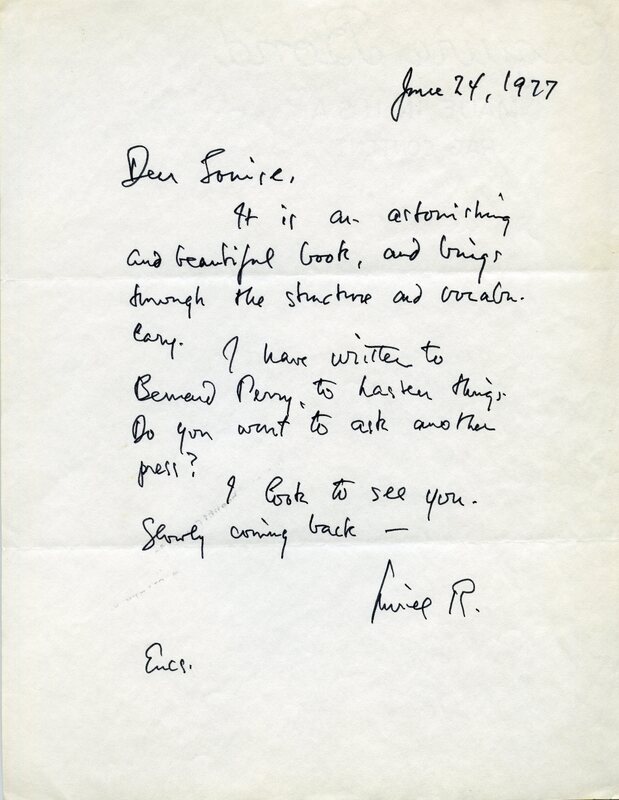
Dated June 24th, 1977. A photocopied handwritten note from Muriel Rukeyser to Louise Kertesz. Rukeyser states that Kertesz's manuscript “is an astonishing and beautiful book, and brings through the structure and vocabulary.”’ Rukeyser had written to Bernard Perry to “hasten things along” and asks if Louise wants her to write to another press. Rukeyser also looks forward to seeing Louise. Her final words, "Slowly coming back," refer to her recovery from her second stroke.
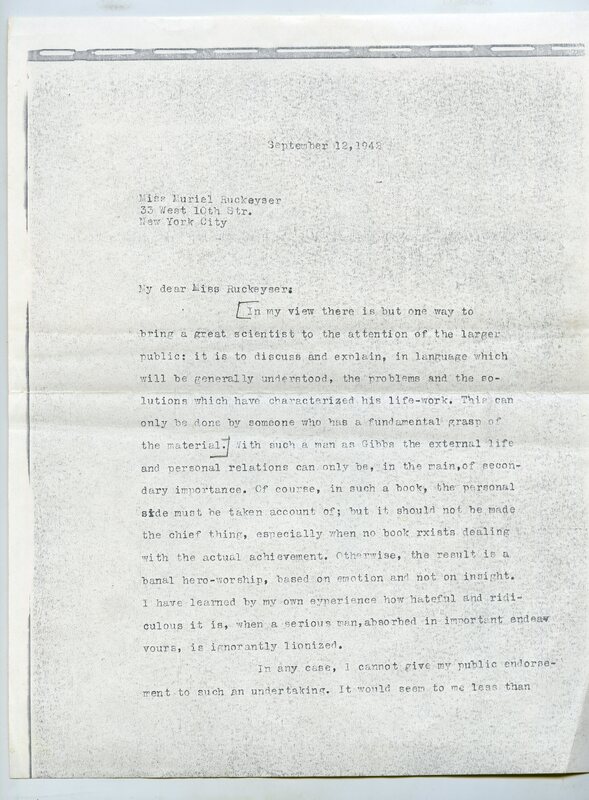
A photocopy of a typewritten two-page letter, dated September 12th, 1942. The letter is from Albert Einstein to Muriel Rukeyser. The background information on this letter is that Muriel Rukeyser had asked Albert Einstein to write a foreword to her biography of the theoretical scientist Willard Gibbs. Rukeyser asked Einstein to “lend his name to her effort to make Gibbs known to a time that needed the story of his achievement." Without reading Rukeyser’s book, Einstein refused, saying that “In my view, there is but one way to bring a great scientist to the attention of the larger public: it is to discuss and explain, in language which will be generally understood, the problems and solutions which have characterized his life-work. This can only be done by someone who has a fundamental grasp of the material.” Kertesz found this letter during her research in the Berg Collection of the New York Public Library. Page 2 of 2.
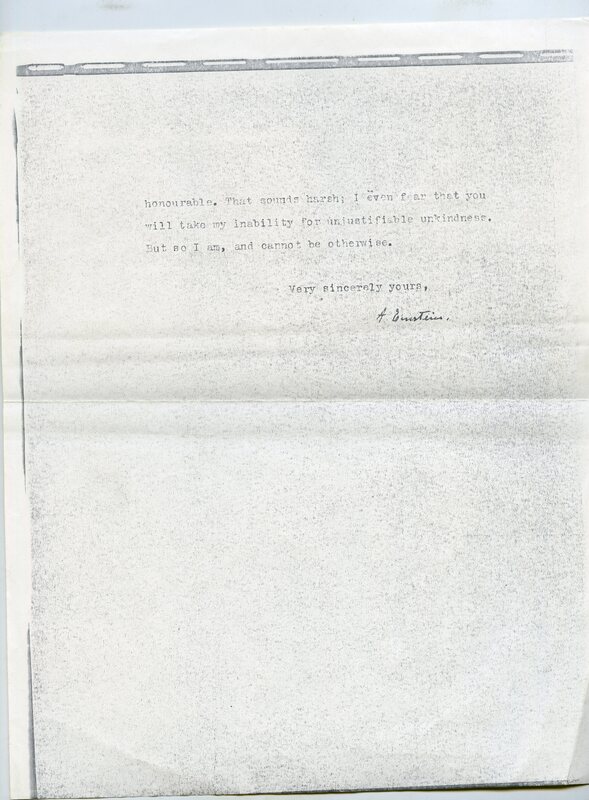
A photocopy of a typewritten two-page letter, dated September 12th, 1942. The letter is from Albert Einstein to Muriel Rukeyser. The background information on this letter is that Muriel Rukeyser had asked Albert Einstein to write a foreword to her biography of the theoretical scientist Willard Gibbs. Rukeyser asked Einstein to “lend his name to her effort to make Gibbs known to a time that needed the story of his achievement." Without reading Rukeyser’s book, Einstein refused, saying that “In my view, there is but one way to bring a great scientist to the attention of the larger public: it is to discuss and explain, in language which will be generally understood, the problems and solutions which have characterized his life-work. This can only be done by someone who has a fundamental grasp of the material.” Einstein acknowledges that "the personal side must be taken account of," but it can’t be the whole focus of the book, or the work becomes “banal hero-worship, based on emotion and not on insight” and that Einstein has learned “by my own experience how hateful and ridiculous it is, when a serious man, absorbed in important endeavors, is ignorantly lionized.” In the end, Einstein refuses Rukeyser’s request, writing that “I cannot give my public endorsement to such an undertaking. It would seem to me less than honourable. That sounds harsh: I even fear that you will take my inability for unjustifiable unkindness. But so I am, and cannot be otherwise.” Kertesz found this letter during her research in the Berg Collection of the New York Public Library. She bracketted the first part of the letter, and attached a sticky note to the back of the paper that says, “Einstein.” Page 1 of 2.
Photograph of Muriel Rukeyser with Sarah Lawrence President Charles R. DeCarlo on her left. “A day in Honor of Muriel Rukeyser," December 9, 1978, Sarah Lawrence College.
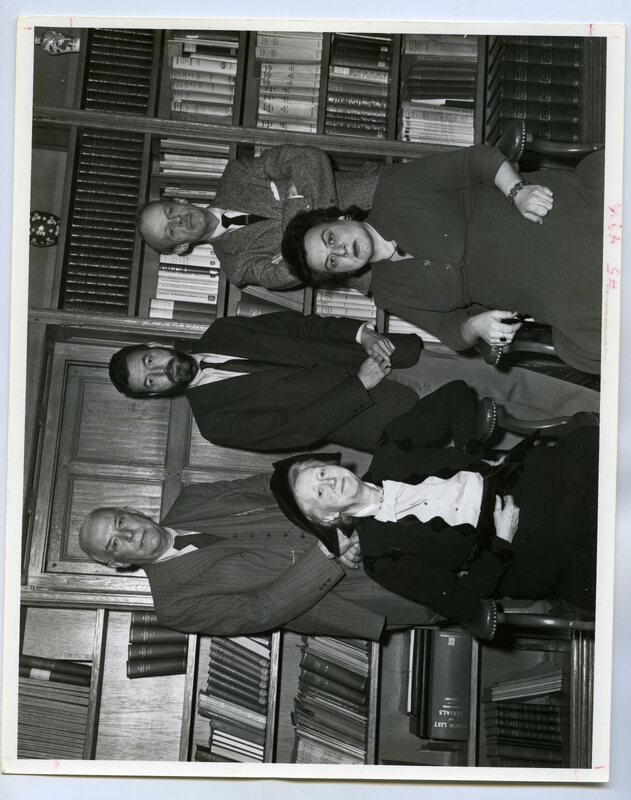
Dated 1954, a photograph of the Bollingen Poetry Prize Selection Committee. A group photograph (from the back row, left to right) Wallace Stevens, Randall Jarrell, Allen Tate. (Front row) Marianne Moore and Muriel Rukeyser.
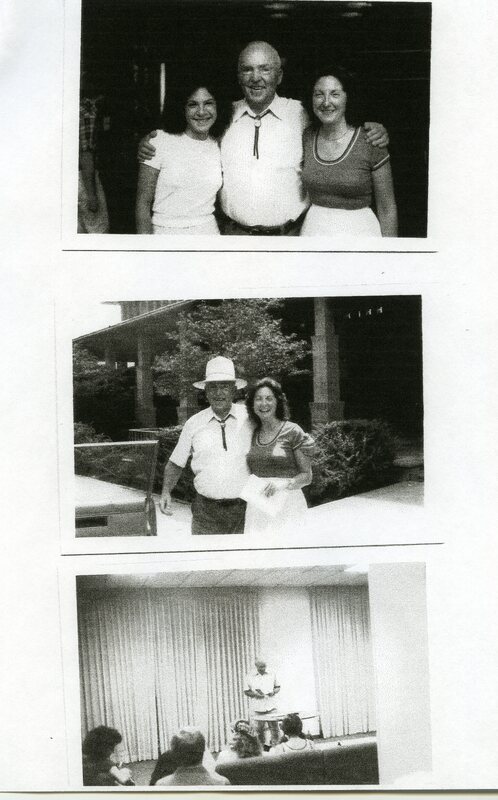
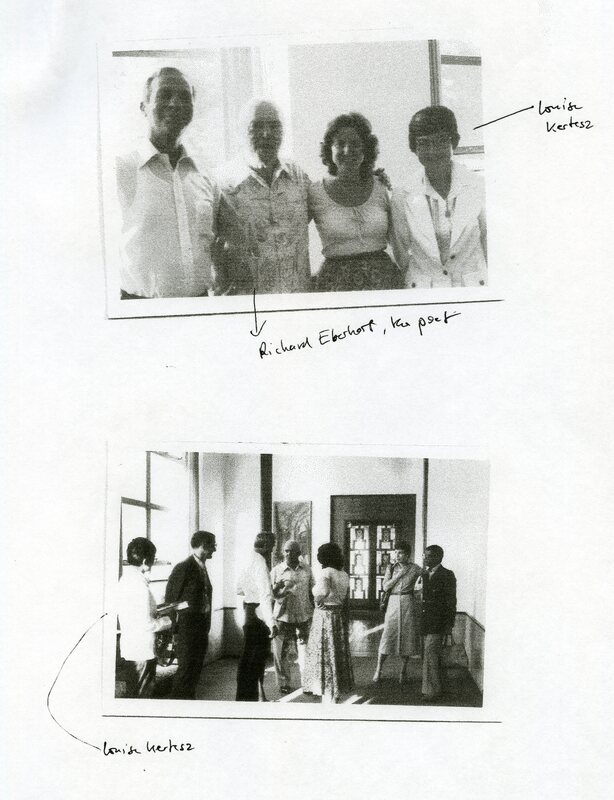
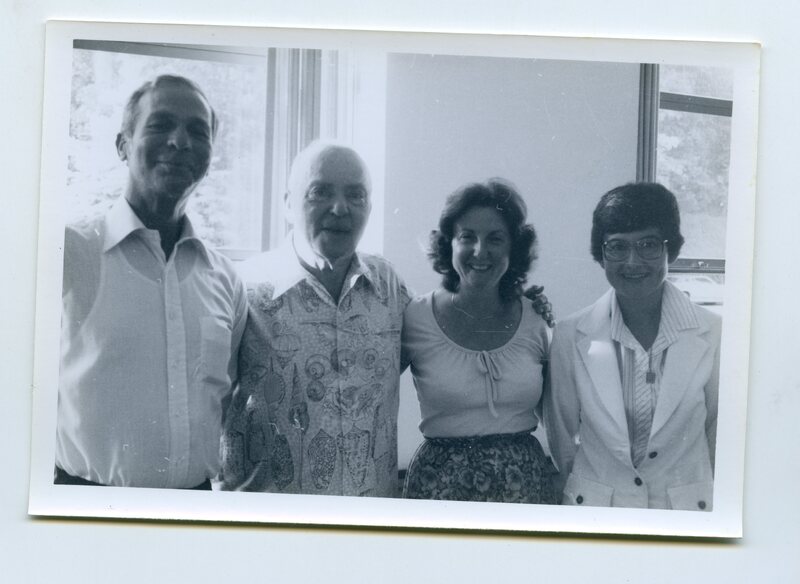
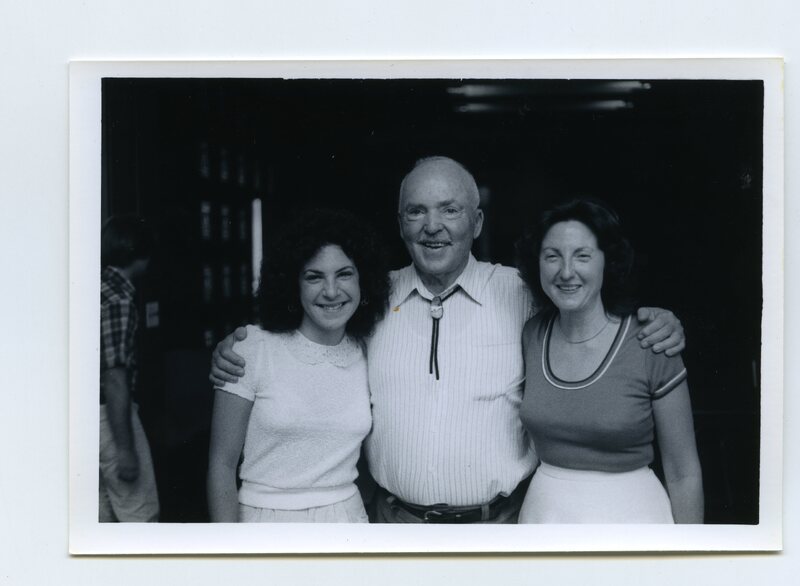
Louise Kertesz, far right, standing with poet Richard Eberhart and two other individuals, one man and one woman, at a poetry event, date and location still to be determined.
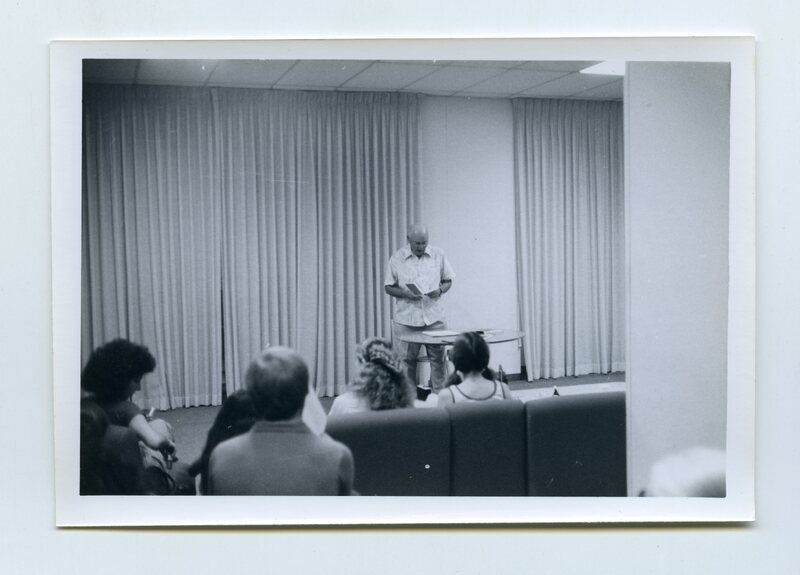
The poet Richard Eberhart stands behind a low table with an open book in front of a small audience of seated individuals, at a poetry event, date and location still to be determined.
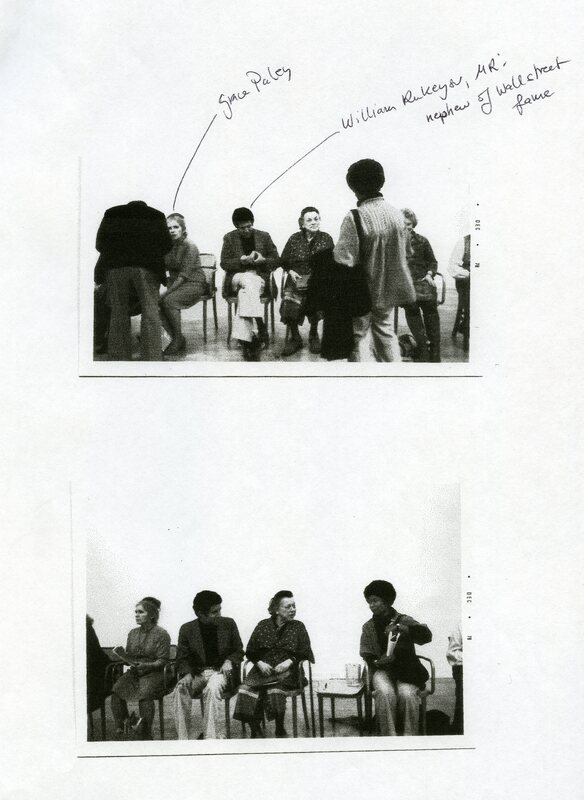
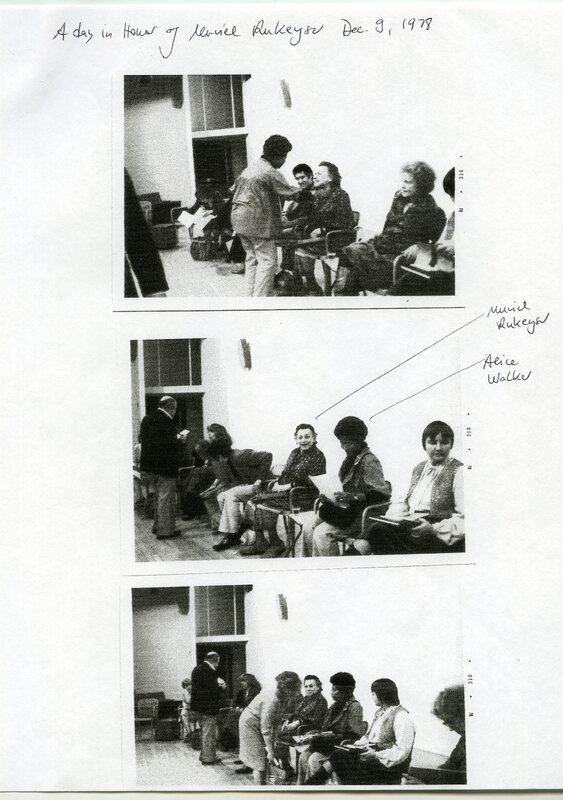
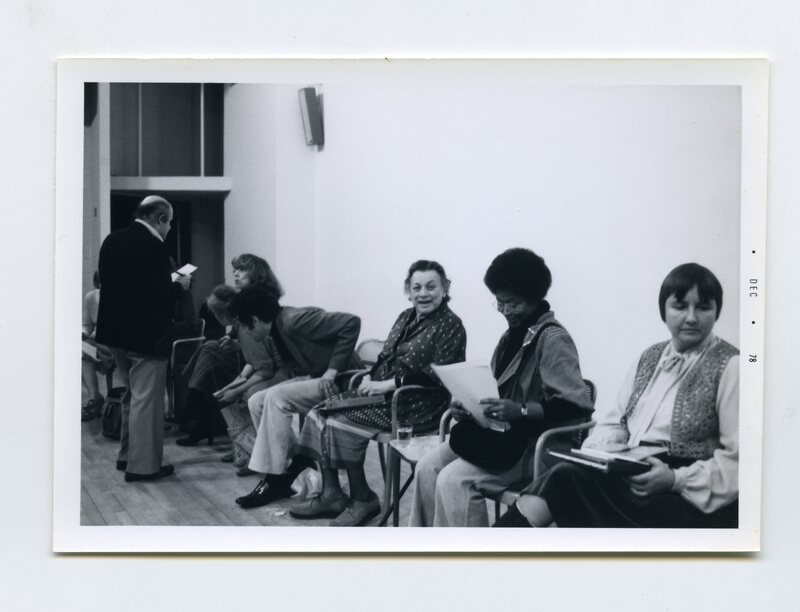
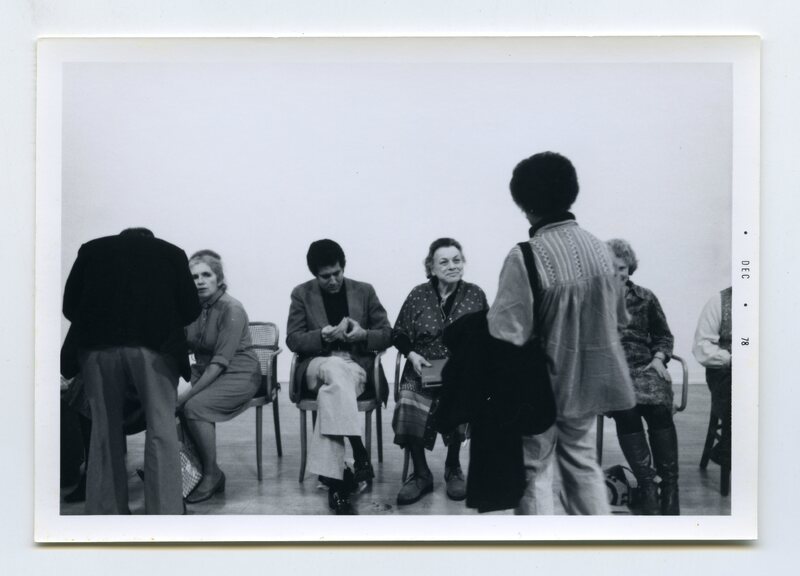
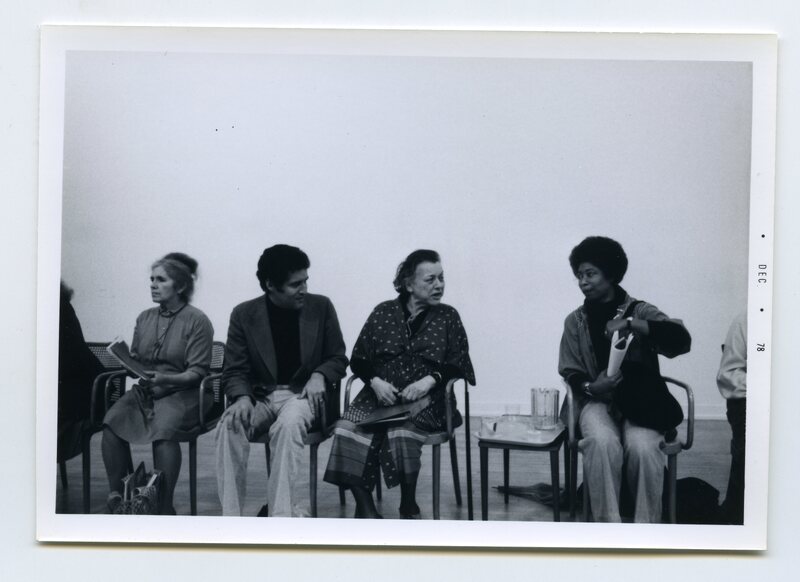
Muriel Rukeyser is present in the photograph, sitting with the writer Alice Walker to her right. Grace Paley appears to be the woman standing in front of Walker and involved in conversation with her. Alice Walker was a former student of Muriel Rukeyser at Sarah Lawrence College.
“A day in Honor of Muriel Rukeyser," December 9, 1978, Sarah Lawrence College. Muriel Rukeyser is present in the photograph, sitting with the writer Alice Walker to her right. Alice Walker was a former student of Muriel Rukeyser at Sarah Lawrence College.
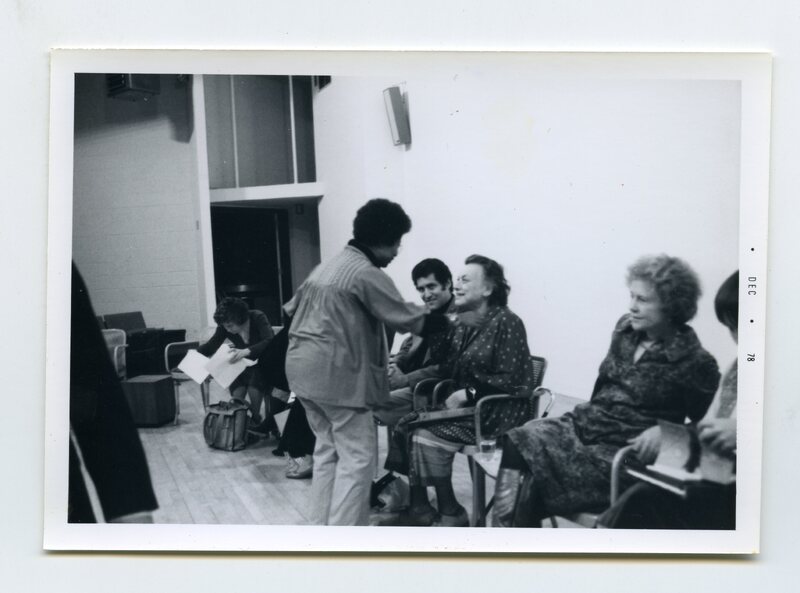
“A day in Honor of Muriel Rukeyser," December 9, 1978, Sarah Lawrence College. Muriel Rukeyser is present in the photograph, sitting with her nephew Louis Rukeyser to her left, and the writer Alice Walker standing and facing Rukeyser. Alice Walker was a former student of Muriel Rukeyser at Sarah Lawrence College.
"A day in Honor of Muriel Rukeyser," December 9, 1978, Sarah Lawrence College. Muriel Rukeyser is present in the photograph, sitting with her nephew Louis Rukeyser and the writer Grace Paley to her left and the writer Alice Walker standing to her right, facing her. Alice Walker was a former student of Muriel Rukeyser at Sarah Lawrence College.
“A day in Honor of Muriel Rukeyser," December 9, 1978, Sarah Lawrence College. Muriel Rukeyser is present in the photograph, sitting with her nephew Louis Rukeyser and the writer Grace Paley to her left and the writer Alice Walker to her right. Alice Walker was a former student of Muriel Rukeyser at Sarah Lawrence College.
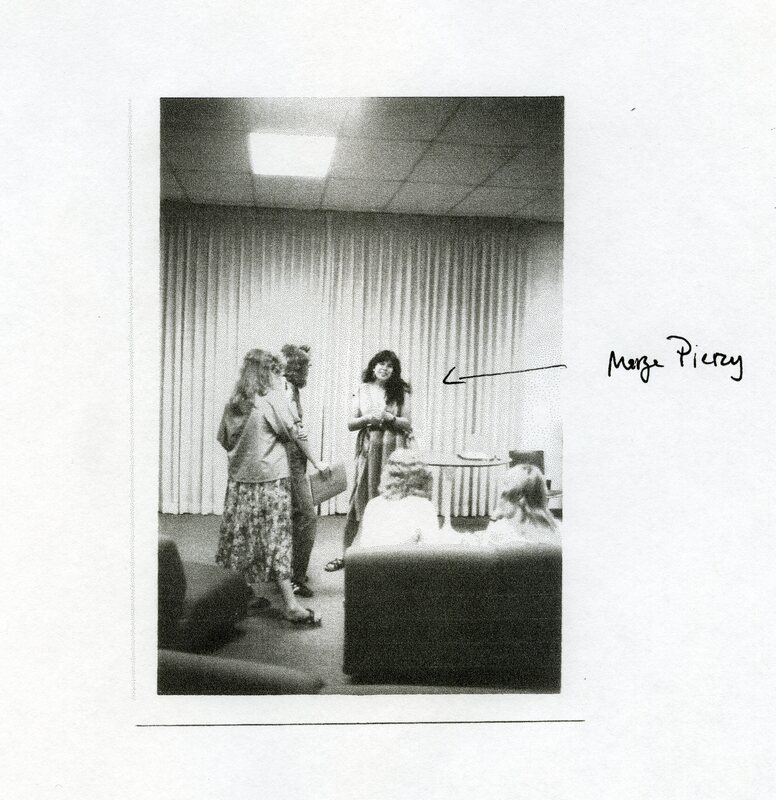
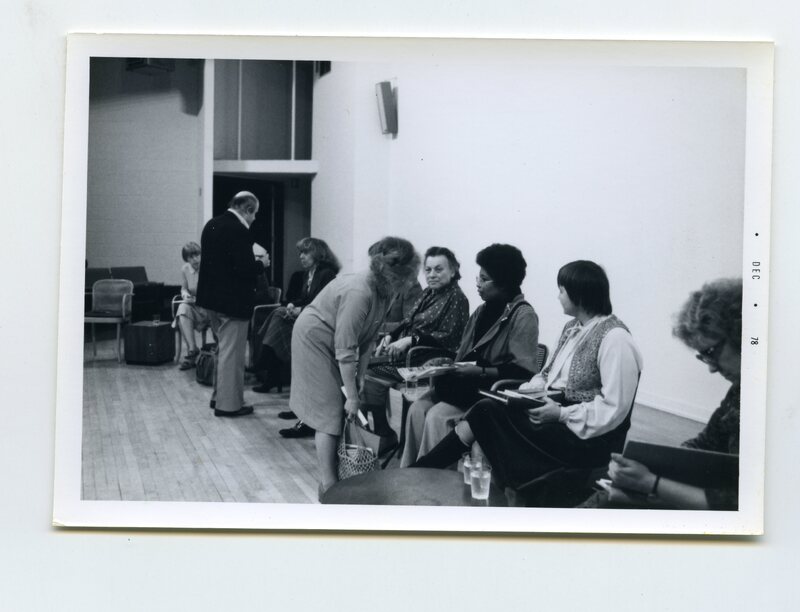
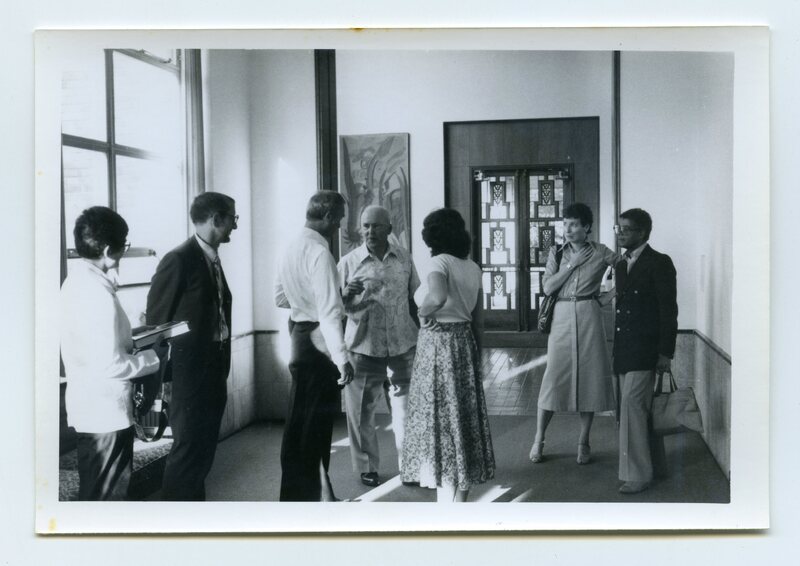
Black and white photograph of Louise Kertesz (pictured far left), her husband Chris Kertesz beside her, and four other individuals, among them Marge Piercy, in conversation with poet Richard Eberhart, at a poetry event, date and location still to be determined.
Kate Mehuron, professor of History and Philosophy and the Department of Women's and Gender Studies, and Dennis O'Grady, professor with the Departments of Communication, Media, and Theater Arts and Women's and Gender Studies, were both instrumental in the planning and implementation of the EMU LGBT Resource Center. Acting as a vital connection between faculty, students, and administration, Mehuron and O'Grady describe working with other faculty like Kathleen Russell to win support for the center. They also describe some of the pushback to the center amongst EMU faculty.
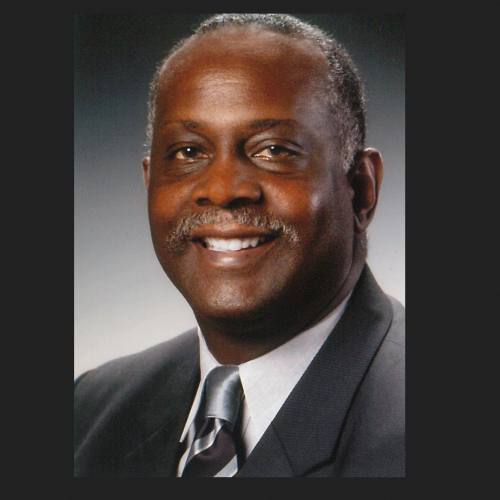
As a university administrator of over 40 years at EMU, Gregory Peoples devoted himself to bettering the college experiences of marginalized students,. In 1994, Peoples helped establish the LGBT Resource Center at EMU, and in this interview, he describes the challenges both to himself and from the university in forming this crucial campus support center.